

Asset Publisher

Geneva Telegram

75th anniversary of the 1951 Refugee Convention: Insights from the UNHCR Global Trends report

On 28 July 2026, the Geneva Refugee Convention turned 75. Its enduring relevance is particularly evident in light of the record numbers of people forcibly displaced worldwide.

Learn more
Geneva Telegram

The global fight against HIV/AIDS amid financial pressures and an uncertain future for UNAIDS

Although the global fight against HIV/AIDS has made remarkable epidemiological and medical progress, its political, financial, and institutional foundations are coming under increas...

Learn more
Einzeltitel

Advancing Protection under Article I(2) of the 1969 OAU Refugee Convention

Article I(2) of the 1969 OAU Refugee Convention is the ‘most influential conceptual standard of refugee status apart from the [1951] Convention definition itself’.

Learn more
Geneva Telegram

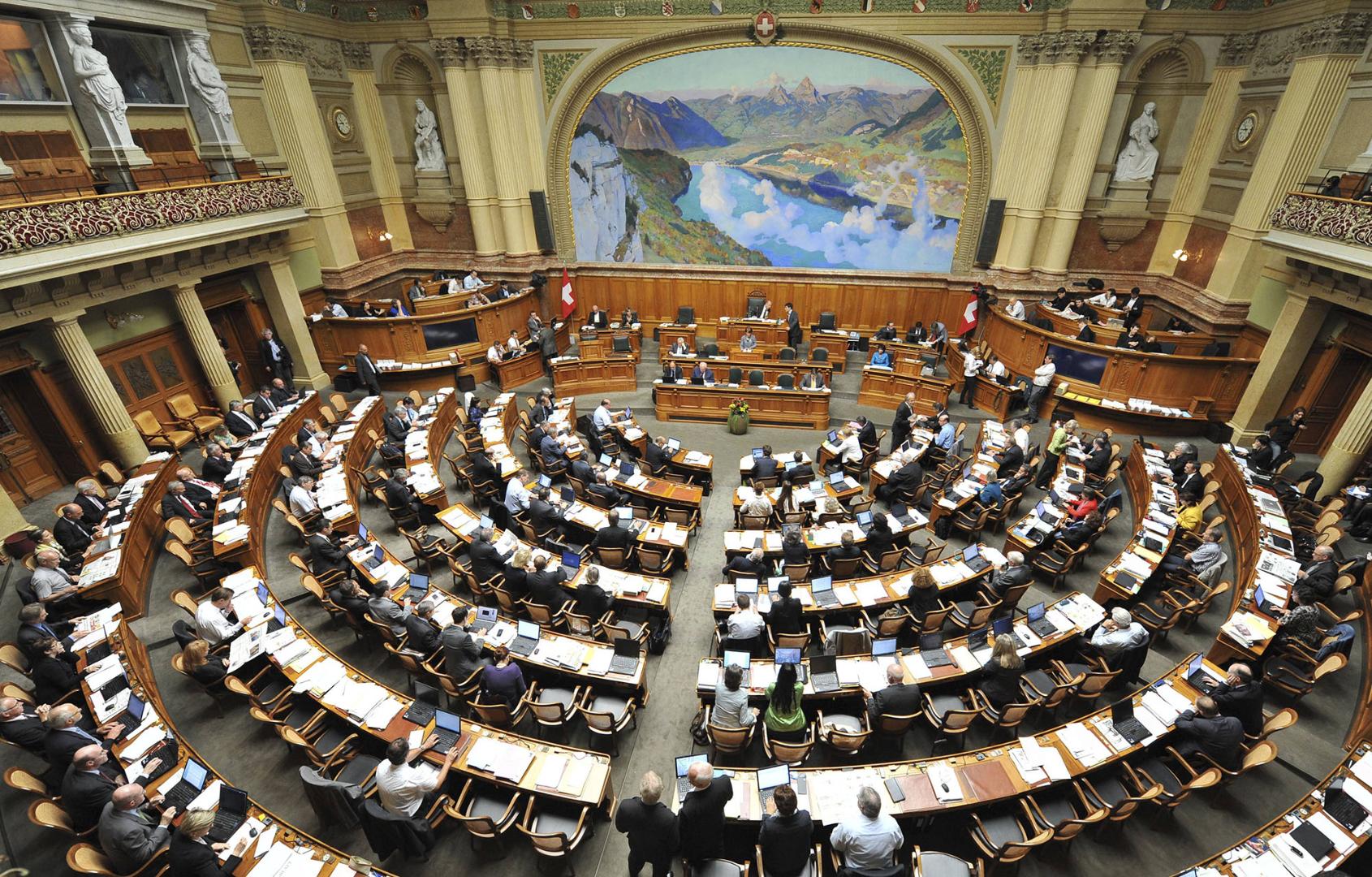
Analysis of the Swiss vote on the 10 Million Initiative on 14 June 2026

On Sunday, 14 June 2026, Swiss voters and cantons delivered a clear verdict on the Swiss People's Party's (SVP) initiative to cap Switzerland's resident population at 10 million.

Learn more
Geneva Telegram

Vote on the 10-million initiative on 14 June 2026

On 14 June, Switzerland will vote on the Swiss People’s Party’s (SVP) 10-million initiative. The SVP aims to strictly limit the population through this measure.

Learn more
Geneva Telegram

The 79th World Health Assembly 2026

Under the theme “Reshaping global health: a shared responsibility,” the 79th World Health Assembly (WHA) of the World Health Organization (WHO) convened in Geneva from 18 to 23 May ...

Learn more

Asset Publisher

Welcome

Freedom, justice and solidarity are the basic principles underlying the work of the Konrad-Adenauer-Stiftung (KAS). The KAS is a political foundation, closely associated with the Christian Democratic Union of Germany (CDU).
More about us

Asset Publisher

Media library

Neue Folge des Podcasts Multipod

Multipod: WHO macht Fortschritte bei internationalen Gesundheitsvorschriften

Die Covid-Pandemie hat auch auf internationaler Ebene Folgen. Erfahren Sie, wie die Weltgesundheitsorganisation (WHO) und ihre Mitgliedstaaten sich besser für die Zukunft wappnen.

Read now
Neue Folge des Podcasts Multipod

Multipod: Wie können Frauenrechte im Gesundheitssektor gestärkt werden?

Erfahren Sie mehr über die Herausforderungen von Frauen, Ihr Recht auf Gesundheit einzufordern.

Read now
Statement

Norbert Lammert on the 75th anniversary of the Universal Declaration of Human Rights

"Human rights are not laws of nature. [...], they must be protected & defended by people who take the claim to the inviolability of human dignity seriously".

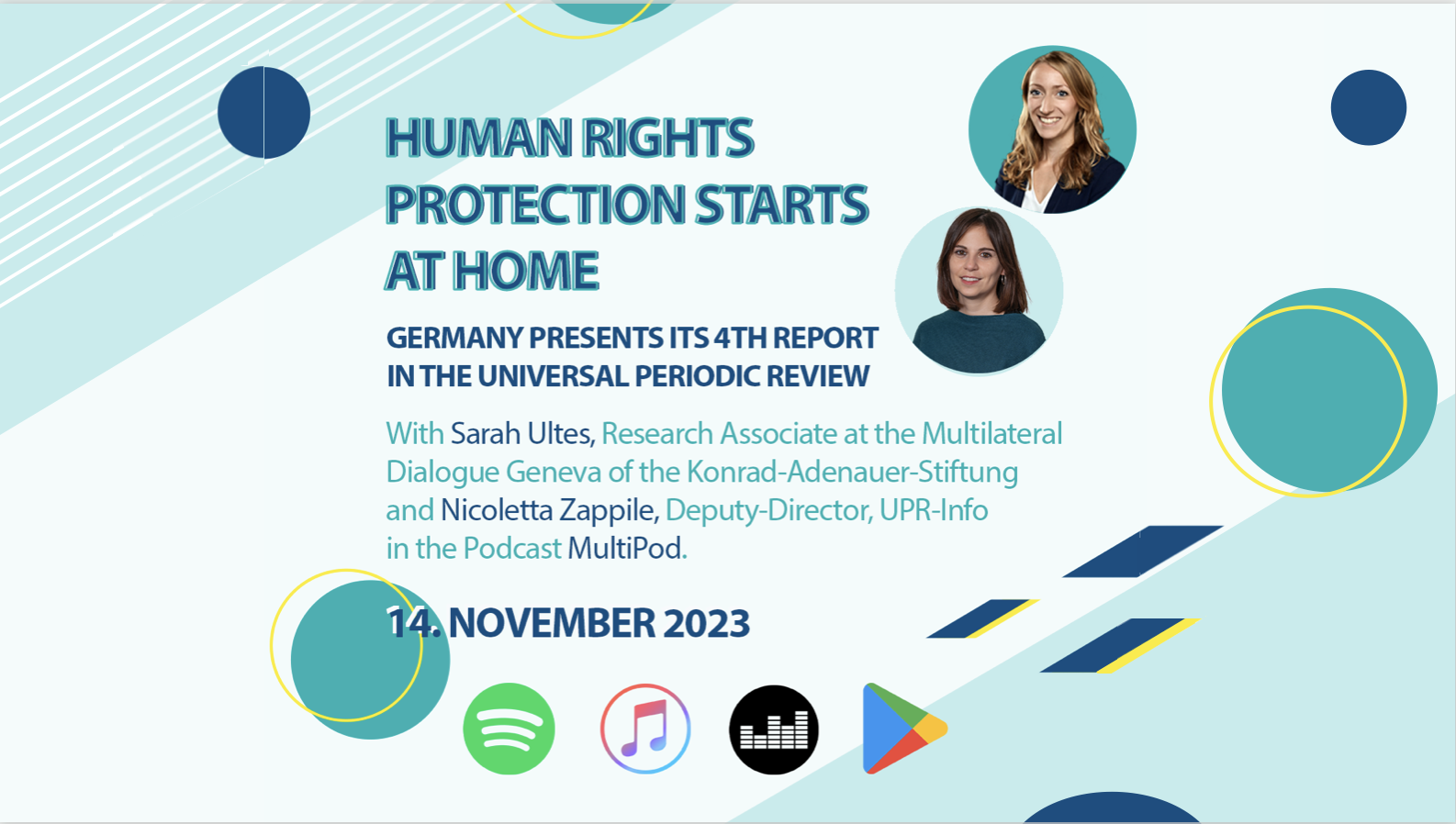
Multipod: Review of Germany in the UPR

Multipod: Human rights protection starts at home. Germany in the UPR

On 9th November 2023, the United Nation's Human Rights Council discussed the human rights situation in Germany

Read now
Genfreise

Geneva Security Debate zum Krieg in der Ukraine

Prof. Dr. Lammert, Botschafter Dr. Heusgen und Botschafter Greminger zu den Auswirkungen des Krieges in der Ukraine auf den Multilateralismus und die Weltordnung

Delegationsreise

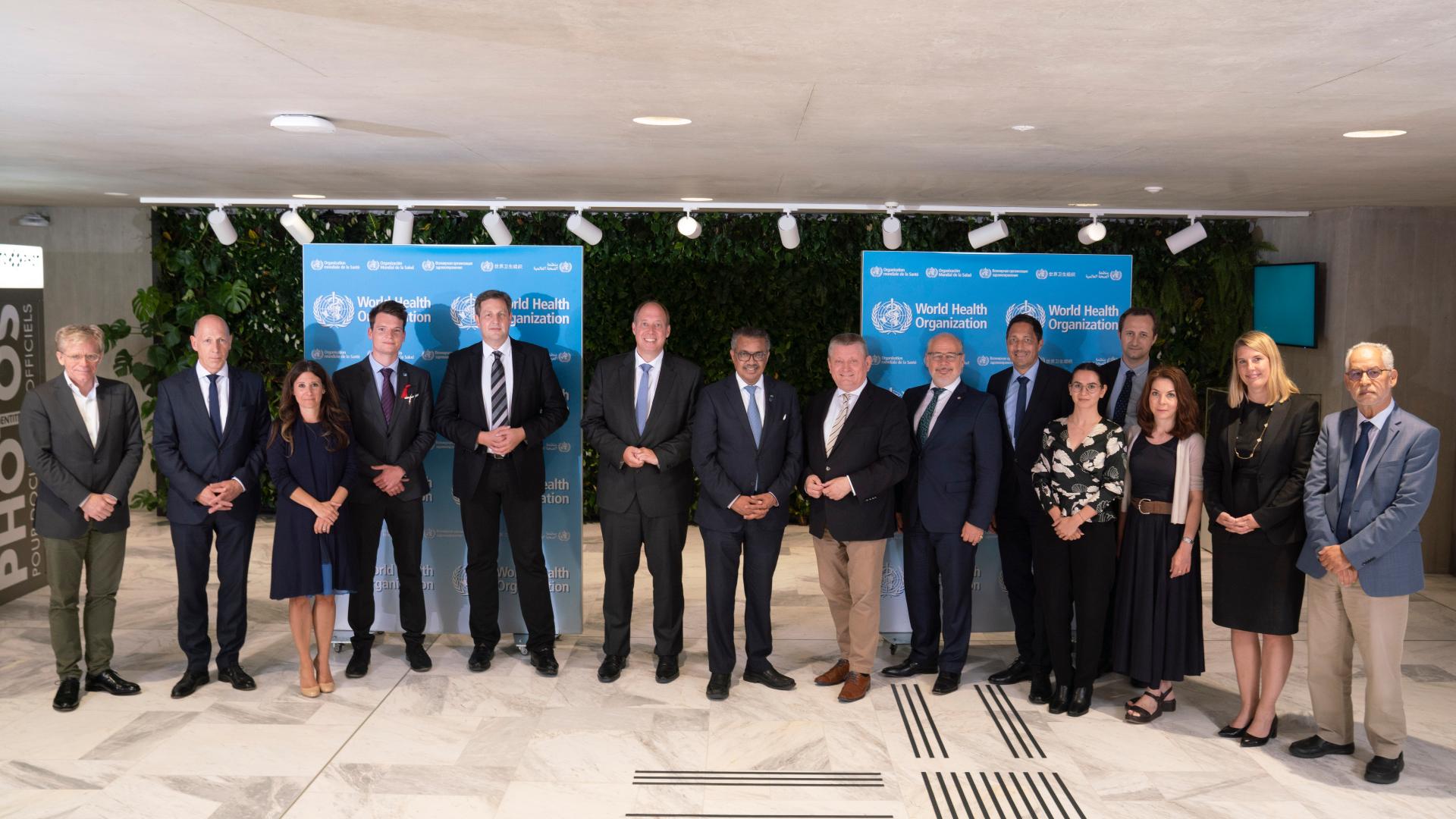
Dialogprogramm des Arbeitskreises Globale Gesundheit der Konrad-Adenauer-Stiftung in Genf

Erfahren Sie mehr über die Delegationsreise zu aktuellen Herausforderungen im Bereich Globale Gesundheit vom 7-9. Juni

Asset Publisher

Asset Publisher

Asset Publisher

Map of the Month

The KAS Map of the Month

Publications

Vote on the UN General Assembly resolution concerning the UN80 Initiative (workstream 2 on UN mandates)

Map of the Month 04/2026

On 31 March 2026, the UN General Assembly (UNGA) voted on a resolution in the context of the UN80 reform Initiative. Launched in March 2025, the initiative aims at improving the UN’s efficiency and impact, thereby reaffirming the value of multilateralism at a time when it is under enormous strain. The UN 80 Initiative consists of three workstreams. The first focuses on improving internal efficiency in the UN Secretariat which has resulted in deep budget cuts and a staff reduction of nearly 19 per cent over the past year. The second deals with the review of around 40,000 mandates that Member States have created since 1946 in search of duplication, overlap or redundancies. The third one discusses more than 80 proposals for structural reform of the UN architecture at large. The resolution that was adopted on 31 March is the main outcome document of workstream 2 on mandate review. It lays out principles for a more structured approach across the lifecycle of UN mandates, from their creation, over their implementation to their review. It further asks the Secretary General to establish digital tools that would assist Member States in doing so and creates a formal Ad Hoc Working Group on Mandate Implementation Review. A large majority of 168 states voted in favour, only 4 against (Belarus, Honduras, North Korea and Russia) with 21 abstaining after Russia had called for a vote.

Key results of the 61st UN Human Rights Council

Map of the Month 04/2026

During the 61st session of the UN Human Rights Council, which convened in Geneva from 23 February to 31 March 2026, a total of 38 texts were adopted, 28 of them (81%) by consensus. 25 resolutions were thematic in nature and 12 were country-specific. A key focus of the spring session was the ongoing conflict in the Middle East. On 28 February, at the request of Bahrain on behalf of the Gulf Cooperation Council (GCC) and Jordan, the Council held an urgent debate, during which it unanimously adopted a resolution calling on Iran, amongst other things, to “immediately and unconditionally cease all unprovoked attacks, threats and provocations” against Bahrain, Kuwait, Oman, Qatar, Saudi Arabia, the United Arab Emirates and Jordan. Iran, together with China and Cuba, also requested an urgent debate, which was held on 27 March and addressed the airstrike on the Shajareh Tayyebeh Girls’ School in Minab (Iran) as a "grave breach of international humanitarian law and international human rights.” Among the country-specific resolutions put to the vote were, among others, the mandate extensions for Ukraine, South Sudan and Belarus, which are illustrated in the maps of the month. A new initiative at the 61st session was a resolution adopted by consensus on the human rights of homeless people, calling on states to take all necessary measures to abolish laws criminalising homelessness and to implement and strengthen nationally appropriate social protection systems and measures for all. Numerous resolutions once again referred to the United Nations’ liquidity crisis. On the occasion of the 20th anniversary of the UN Human Rights Council, 81 states also delivered in a joint statement in which they praised the Council as a key pillar of the multilateral system and pledged to renew their commitment to preserve, strengthen and support the Council, among other things by renewing their determination to stand firmly for adequate and predictable funding for the entire human rights pillar, including the treaty bodies.         

E-Commerce draft decisions ahead of the 14th WTO Ministerial Conference

Map of the Month 03/2026

The 14th WTO Ministerial Conference (MC14) will be held 26–29 March in Yaoundé, Cameroon.​ In 2024, members agreed to extend the ‘practice of not imposing’ customs duties on electronic transmissions until MC14 or 31 March 2026 (whichever comes first), when it will expire.​ The so-called E-Commerce Moratorium has existed since 1998, but renewals have become increasingly contested.​ Given the importance of digital trade, most members want greater predictability in the digital economy.​ Based on draft Ministerial Declarations and submissions to the WTO General Council: 19 members support making the moratorium permanent; 139 support at least extending it until the next Ministerial Conference.

Contributions received for the United Nations Regular Budget in 2025 and 2026

Map of the Month 03/2026

The United Nations is primarily funded by its 193 member states through mandatory assessed contributions to the regular budget and the peacekeeping operations budget. This year’s regular budget of the UN amounts to 3,45 billion US-Dollar which is 7% less compared to the previous year. Only 55 States have respected the 30 days period specified in Financial Regulation 3.5 (by 8 February 2026) and paid their regular budget assessments in full and in time. This is 28% of the total UN membership and only 27% of the total assessments due.  As of 20 March, 93 States have paid their regular budget assessments in full. This represents 47% of the UN membership and 39% of the total regular budget. Due to the size of the US-economy, the United States are charged with the highest dues (22%), shortly followed by China with 20%. Japan ranks 3rd with 6,9%, followed by Germany with ca. 5,7%, UK and France with around 4%. By the end of January, UN Secretary General Guterres had already warned that the UN may risk financial collapse by July if the dues are not paid in time. Back in 2025, the UN regular budget amounted to 3,72 billion US-Dollar but only 49 Member States (25%) had paid their regular budget assessments in full and in time. As of 30 December 2025, only 151 Member States (78%) had paid their regular budget assessments in full although often very late leaving the UN no time to meaningfully implement it. Together with arrears, a record 1,5 billion US-Dollar were still outstanding at the end of the year - a record high. 

Asset Publisher

Geneva Telegram

75th anniversary of the 1951 Refugee Convention: Insights from the UNHCR Global Trends report

On 28 July 2026, the Geneva Refugee Convention turned 75. Its enduring relevance is particularly evident in light of the record numbers of people forcibly displaced worldwide.

View details

Asset Publisher