




Asset Publisher

Publications

Asset Publisher

IMAGO / ZUMA Press Wire

Return to stability and pragmatism

President Lee Jae-myung demonstrates diplomatic competency

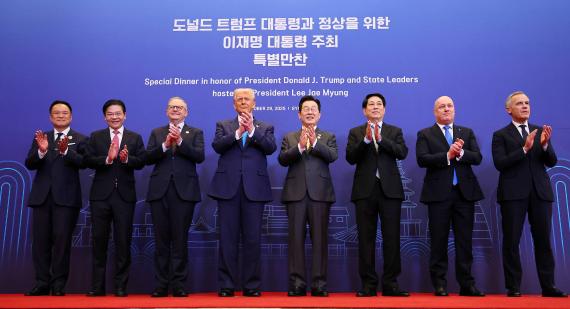
From 31 October to 1 November, South Korea hosted this year's Asia Pacific Economic Cooperation (APEC) summit in Gyeongju, the former capital of its Silla Dynasty. This was Korea's first international, multipolar stage under the new presidency of Lee Jae-myung and thus the first opportunity to polish up Korea's image after it had been severely damaged by former president Yoon Suk-yeol's martial law declaration at the end of last year and his protracted impeachment proceedings that lasted until April 2025. Uncertainty and concerns surrounded the preparations for the event in the country – not least because the real spotlight was on the bilateral meetings on the sidelines of APEC. But avoiding any major divergences with the US or with China, and between the US and China, is Lee Jae-myung's quiet success: a sign of a more stable, pragmatic Korea.

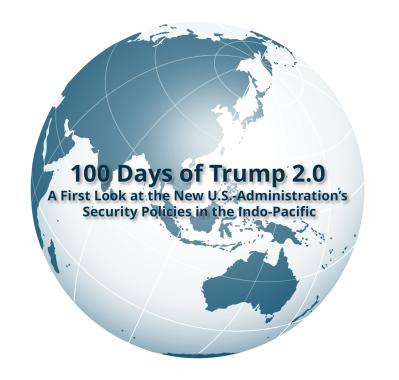
100 Days of Trump 2.0

A First Look at the New U.S.-Administration's Security Policies in the Indo-Pacific

On January 20, 2025, the new U.S. administration took office. Donald Trump’s second term as President has introduced a mix of new and old hopes and concerns, including particularly the realm of U.S. security policy in the Indo-Pacific. Three months into the administration, the KAS Korea Office presents an interview series with experts based in U.S. partner locations in the region to gather initial impressions of its security and defense policies, as well as any notable changes so far. The series includes perspectives from Australia, Japan, The Philippines, South Korea and Taiwan as well as one interview focused on maritime security in the Indo-Pacific.

IMAGO / Xinhua

Consensus amid Chaos

Korean Parliament passes pension reform

On 20 March 2025 the Korean National Assembly passed a pension reform. This historic decision, which was passed by both major parties despite fierce political debate, ushers in a new chapter for the pension system after 18 years. Despite ongoing challenges, the course for solutions in the face of serious demographic developments is set. Above all, it provides a striking contrast to the enormous polarization that otherwise characterizes Korean politics and has led to the current crisis.

Risk and Threat Perception

This project aims to identify and compare the current perceptions of risks and threats among Indo-Pacific countries, and to examine their influence on the respective regional policies and strategies. For each country, three dominant security concerns are presented, how they cause uncertainty, and how the situation and its perceptions have emerged and developed. The reports illustrate the current position and trajectory of these countries in the Indo-Pacific security environment.

IMAGO / NurPhoto

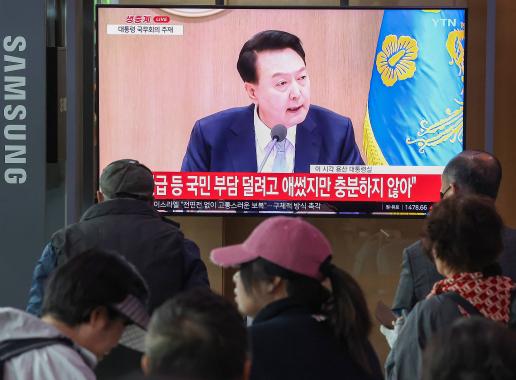
Surprise coup against Parliament

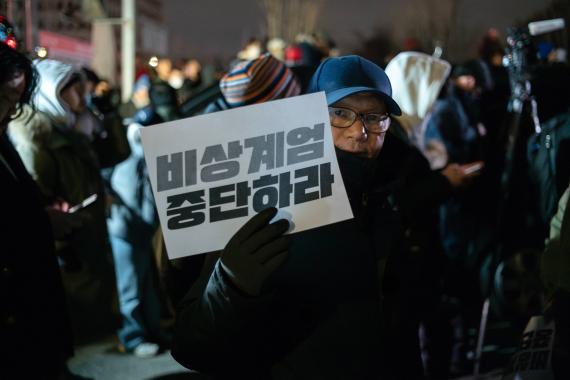
In conflict with opposition, South Korea’s President declared martial law

During the night of December 3-4, 2024, martial law prevailed in South Korea for the first time since the days before democracy in 1980/81. President Yoon Suk-yeol declared that the opposition's efforts to cut his budget and for further impeachment proceedings against members of his government were a threat to the country and spoke of infiltration by pro-North Korean forces. A few hours later, he was forced to reverse the decision by successful resistance from parliament and massive demonstrations, and now his government is in ruins. The next few days will probably only decide whether he leaves voluntarily or has to be forced.

IMAGO / Newscom / Yonhap News

House specialty: lame duck?

Results of South Korea’s general election

South Korea elected a new parliament on April 10th. The numbers remain largely unchanged: the governing party fails in its hopes for changing conditions, the opposition gains a ‘supermajority’ to accelerate its own legislation, albeit only with combined forces, but does not win a two-thirds majority either. In the government we expect another change of guards, while the president - three years before the end of his term in office - is further weakened and already fighting a lame duck image.

Mobility Transformation

This joint publication with the Korea Transport Institute (KOTI) provides an exemplary overview of visions and approaches in Germany and Korea for their respective Mobility Transformation.

IMAGO / Panthermedia

Korea's parties in turmoil

Generation change or carry on as before?

The next regular parliamentary election in South Korea is just under four months away. The conservative People Power Party (PPP) of ruling President Yoon Suk-yeol is hoping to win back the majority from the opposition Minju Party after several years of drought. However, unrest reigns on both sides: resignations, departures and rumours of mergers and new formations. A large proportion of the electorate is still undecided as to who they should vote for on 10 April. The race remains undecided.

Party Convention of the Korean Conservatives

Impressions, results and analysis

On 8 March 2023, the People Power Party (PPP), South Korea's ruling party, held its party congress directly outside Seoul. After years of pandemic, the Conservatives once again celebrated their president, who had won the election a year ago on 9 March 2022. This time they met to elect a new party leadership. As expected, MP Kim Gi Hyeon, the president's preferred candidate, won with a share of 52% of the vote. The new appointments to five offices in the highest party body also reflected the president’s strong political position. The demonstrative show of unity and confidence mirror the challenges in upcoming twelve months till the next parliamentary elections.

Rolle Koreas in der internationalen Gesellschaft

Digitale Bildung

Im Zuge der Pandemie habenen viele Länder auf der Welt den Aufbau einer digitalen Bildungsumgebung intensiviert. Prof. KIM Kyung-Hee, Altstipendiatin der KAS, schreibt zu aktuellen Entwicklungen und Perspektiven der digitalen Bildung in Korea.