






 KAS Shanghai/SUIBE
 KAS Shanghai/SUIBE
 KAS Shanghai/ SUIBE
 (c) Konrad-Adenauer-Stiftung Shanghai 2014
KAS Shanghai/SUIBE
KAS Shanghai/SUIBE
KAS Shanghai/ SUIBE
(c) Konrad-Adenauer-Stiftung Shanghai 2014
(c) Konrad-Adenauer-Stiftung Shanghai 2014
KAS Shanghai/SUIBE
KAS Shanghai/SUIBE
KAS Shanghai/ SUIBE
(c) Konrad-Adenauer-Stiftung Shanghai 2014
The order and efficiency of financial markets are closely linked to the sustainability of public finance. Many countries have derived sophisticated systems of transfers and compensatory payments to make up for internal inequity. The majority of states, however, still lacks the measures and mechanisms to sustain public finances in the long term. Structural imbalances and high public debt thus also pose a threat to global financial stability.
Professor LU Ming of Shanghai’s Jiaotong University, outlined the recent developments in China’s public finances and referred to the similarities with comparable symptoms in the Eurozone. In China, municipalities were increasingly taking out loans by buying local bond issues to use as make-up payments for old debt. This he called a risky development, since both China and the Eurozone were facing the threat of destabilizing its currency through “fiscal decentralization”.
Dr. Angelika Poth-Mögele of the Council of European Municipalities and Regions (CEMR), a representative of local European governments in Brussels, responded to the growing challenges in European public finance. She outlined the impact of the global financial crisis on the communal financial situation and introduced different measures that have been taken by the European members to tackle the growing problem of indebtedness. According to Poth-Mögele, adopted policies included reduction of public bureaucracy, merging of municipal districts, creating synergies and local tax adjustments.
Dr. ZHAO Min, Director of the Asia-Pacific Finance and Development Center in Shanghai, emphasized the differences between governmental and national debt: in China, she explained, indebtedness stayed within the limits of national borders, thus creating governmental debt. Increased supervision from the central government would ensure that loans would only flow into long-term investments. She further recommended expanding the cooperation of public and private interests in so-called Public-Private-Partnerships (PPP).
In the succeeding talks of the conference, the PPP proved to be a key instrument in future considerations to consolidate public finances. However, it became clear that governments were still in a phase of experimenting; the role of state-owned enterprises and common standards for PPPs are still to be determined.
Ekkehard Grunwald, board member of the German national association for local affairs of the Christian Democrats (CDU/CSU) (“Kommunalpolitische Vereinigung der CDU/CSU”), presented the financial and political situation of the German local municipalities (Kommunen). He stressed the discrepancies in financial soundness of structurally weak and structurally strong regions in Germany. Local municipalities would suffer from the limited access to credit since the financial crises hit banks in 2008. A growing share of financing needs would now be saturated by acquiring bond issues.
The second part of the conference put the Chinese financial markets into focus. China’s advancement to the world’s most important economic power needs to go hand in hand with global financial integration. This has its implications for the increasingly international Chinese financial sector. Though the RMB is slowly maturing towards an international currency and clearing-centers begin to operate worldwide, central issues in the domestic financial order remain unanswered.
Dr. Sandra Heep of the Mercator Institute for China Studies in Berlin (MERICS) argued that Chinese reforms so far had not aimed at the complete liberalization of the financial markets. Rather, they were designed to achieve a better management of the financial system. Further liberalization might add to the already high level of public debt; at the same time, a market-driven approach would decrease the influence of the usufructuaries in today’s allocation system.
Professor XU Mingqi, researcher at the Shanghai Academy of Social Sciences, gave a comprehensive introduction into the status quo and outlooks for the Shanghai Pilot Free Trade Zone. He proposed to view the FTZ as an experiment, aimed to pave the way for a next round of financial liberalization. The characteristics of a pilot zone made it easier for policy makers to adjust or abandon measures that developed unfavorably. However, he noted, the zone was not yet ready to serve as a hub for operations in regional and global markets and numbers for registered companies were still low.
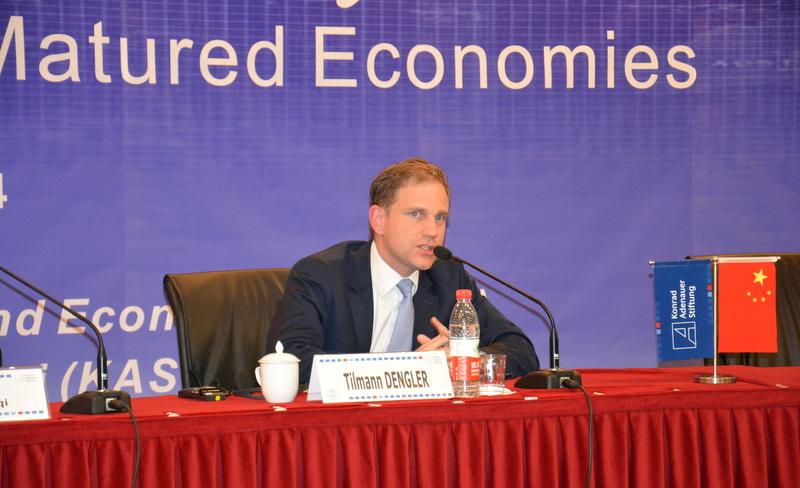
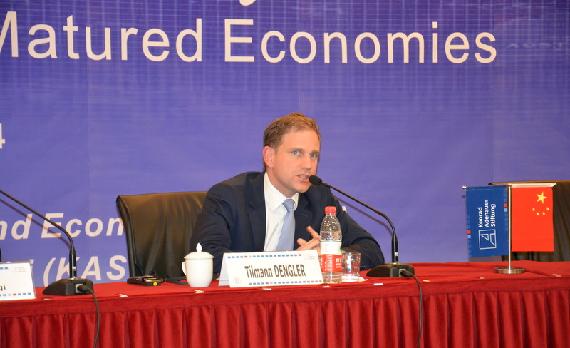
Tilman Dengler, Head of Global Network Banking China & Taiwan at Deutsche Bank, gave a comprehensive overview of the Chinese financial market from the viewpoint of a global leader in banking. The RMB, he said, had become one of the seven most important currencies and the newly formed cooperation of the Shanghai and Hong Kong stock exchanges could be read as a sign for ongoing reform and opening of the financial sector. The expected slowdown in economic growth would further push for financial reform, including liberalization of capital flows and further development of bond markets.
The concluding panel of the conference revealed that further liberalizing reforms were needed to promote transparency and efficiency in the various sectors of the financial system. A great part of local debt could be traced back to excessive infrastructure spending. Stressing the importance of a balanced budget could be another way to solve problems of indebtedness. The quick development of a bond market for these governments is expected. Again, transparency is key in this undertaking, to better assess the financial soundness of the municipalities.
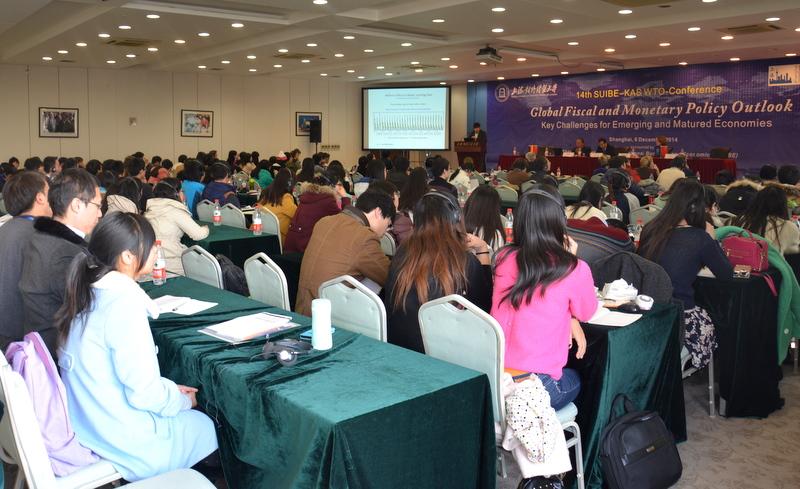
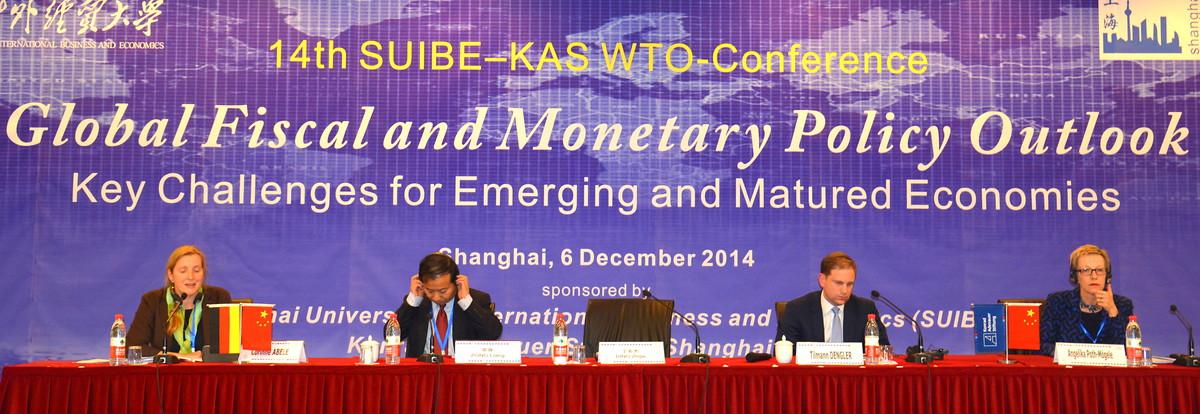
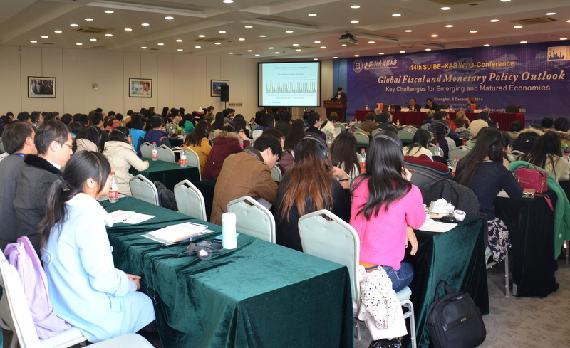
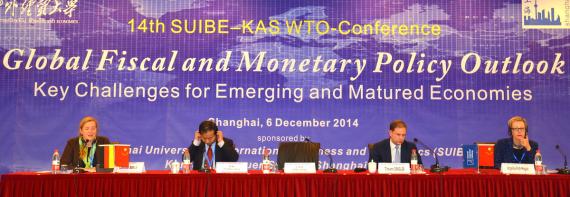
The conference was the 14th annual WTO-Conference of the KAS and their most important Chinese partner, the Shanghai University of International Business and Economics (SUIBE). Each year, trending economic and political issues are discussed in-depth and linked to their regional, national and global dimensions. The forum creates a platform for academics and practitioners from China, Germany and the world.