







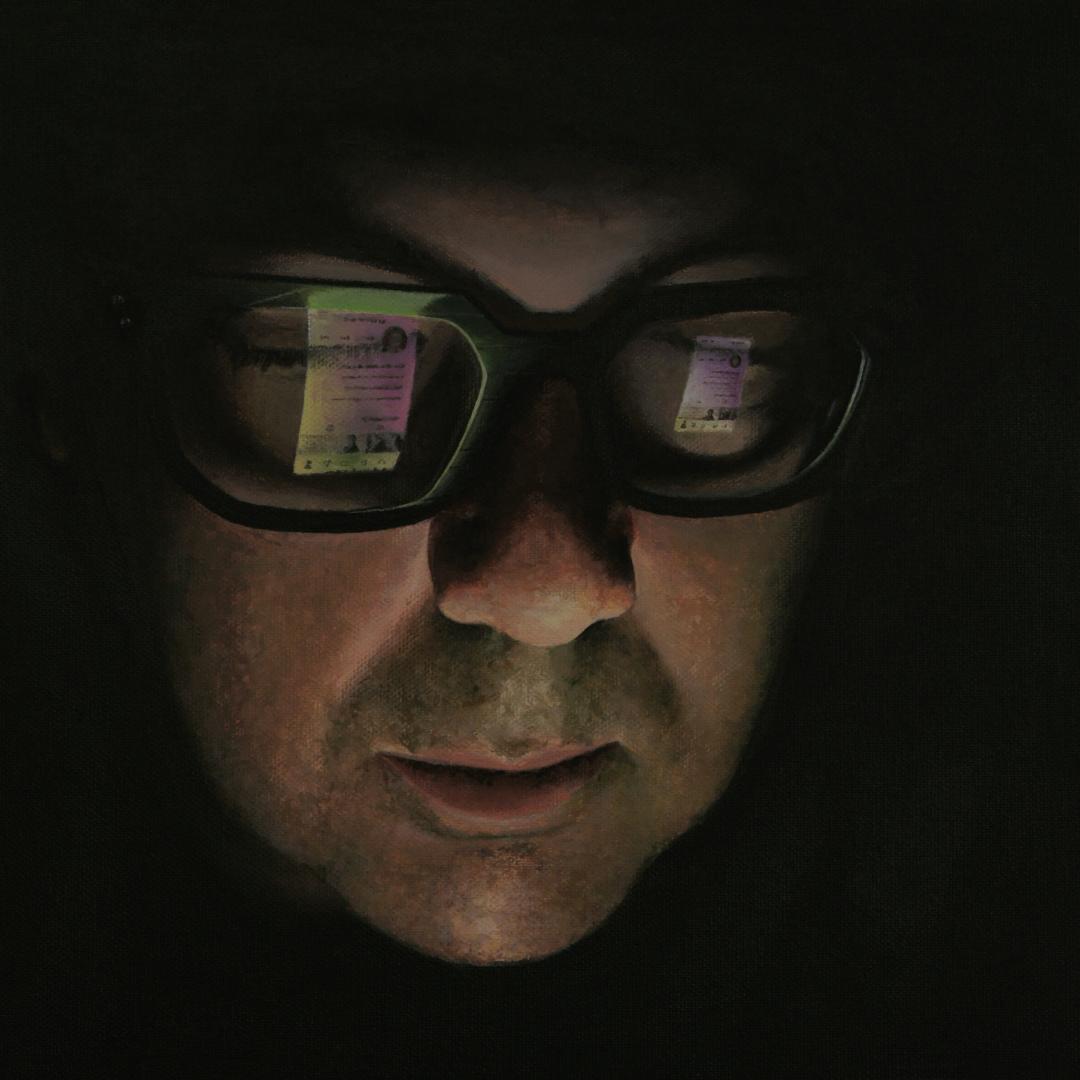
Peter Davis lives and works in the south of Manchester. He paints people — in acrylics, in portraits, and in what he calls “urban landscapes.” He meets his “models” on the street or they commission a portrait from him. Whether in his portraits or city scenes, his protagonists always carry a smartphone and direct their gaze toward it.
His small-format paintings, often just 35 by 45 cm, are hyperrealistic depictions of people and everyday life. He focuses on a central figure who interacts with the world exclusively through their smartphone. The viewer’s gaze slows down almost involuntarily. In the fast-paced visual formats that dominate our perception — selfies and other social-media genres — we rarely see both the person and their device; the viewer’s eye replaces the camera lens. Davis calls this “personal technology.” He captures this intimate moment of exchange. It is no coincidence that the series he has been working on for ten years is called Zeitgeist.
Peter Davis, whose works illustrate issue 592 of Die Politische Meinung titled “TikTok. Precarious Platform,” took the time to answer a few questions for our blog.
 Peter Davis
 Peter Davis
 Peter Davis
 Peter Davis
 Peter Davis
 Peter Davis
 Peter Davis
 Peter Davis
 Peter Davis
 Peter Davis
You have been working as a professional artist since 2015. Your main subject is people in everyday situations, always accompanied by their smartphones. You discovered this not-quite-symbiotic relationship long before COVID. Did the pandemic change your art, or do you think it changed people’s relationship with digital technologies?
Peter Davis: We are living in the Fourth Industrial Revolution, a time in which smartphones blur the boundaries between our physical and digital worlds and force us to redefine what it means to be human. People glued to their devices have become so familiar that we barely notice them anymore. It was different in the late 2010s: I remember standing on a train platform and realizing that everyone around me had their head down, absorbed in their screens. In that moment I sensed something that would become central to my work.
In 2015, I started a portrait series about our growing dependency on smartphones. These devices — which illuminate our lives both literally and metaphorically — are designed in every way to be irresistible. This technological dependency has crept in quietly. We now reconstruct much of our world within digital ecosystems. Henry Miller once wrote: “What the artist sees, he is obliged to communicate. Usually, he lets us see and feel what we normally ignore or have become immune to.” That aligns with my intention: to make visible what has become invisible through overfamiliarity.
The pandemic did not fundamentally change my artistic direction. But it accelerated the relationship between people and their digital lives. Smartphones became not just companions but essential lifelines — tools for communication, work, entertainment, and escapism. I remain fascinated by how rapidly technology has reshaped our behavior and emotions. Consider the IRL/URL paradigm, the interplay between our “in real life” selves and our digital identities. The stronger the dependency, the greater the ethical and existential questions regarding personal access to technology and its impact on quality of life.
Question:
Your images of people and their smartphones differ: portraits emphasize emotion against empty backgrounds; urban scenes focus more on situations. But in every case, the smartphone seems like a natural part of their clothing.
Answer:
Smart devices distract us, shorten our attention spans, and fragment our relationships — they estrange us not only from one another but also from our surroundings. That’s why I began exploring urban landscapes. The people in these scenes are friends, sometimes strangers I have observed, or individuals I have cast from the street. I sketch on location and take hundreds of photos. In the studio, I test different compositions, shifting elements, adding or removing details until the narrative feels right. Composition is crucial to storytelling.
My work is documentary in nature. Modern life and our reliance on smartphones form the connective tissue between my portraits and my urban landscapes.
In the portraits, I want my traditionally painted compositions to appear technically beautiful while still highlighting our dependency on digital technology. There is a deliberate contrast between the contemporary subject and my meticulous, traditional painting process. By placing a carefully rendered figure against a flat, reduced background, I hope to prompt viewers to reconsider what at first appears to be a banal moment: to make isolation, distance, or introspection visible.
The smartphone is a recurring motif because it has become an extension of the body. Excluding it would feel dishonest for the era we live in. By including it, I invite viewers to reflect on how seamlessly — and perhaps uncritically — we have allowed this technology to shape our behavior, posture, and presence in the world.
Question:
Your work suggests a fundamentally sympathetic view of people. You never show the classic scene of two people sitting together but ignoring each other while looking at their phones. You don’t depict that “dark side.” Instead, the smartphone acts as a companion.
Answer:
In my urban landscapes, I’m interested in the quiet tension between the built environment and the solitary figure immersed in their device. Before smartphones, people looked around, noticed others, took in their surroundings. Today, the default posture is a downward-turned head, lost in digital worlds.
I don’t show the “dark side” as interpersonal neglect, but I do depict isolation and estrangement — just in a more subtle way. Sometimes the smartphone in my paintings even acts as a protective shield between the individual and the surrounding city.
I want to document this behavioral shift so future generations can understand our era. As the Ukrainian-American painter Louis Lozowick (1892–1973) said: “The true artist will, in sum, objectify the dominant experience of our epoch in plastic terms that hold value beyond the present moment.” That resonates with me. It will be fascinating to see how my work is interpreted in 10 or 20 years. Will we still stare at our devices like zombies, or will technology be so deeply integrated into us that today’s reality will seem strangely old-fashioned?
Question:
You are very active on social media. For many people, the internet is a space to gain visibility, but it also exposes them to hostility. Is that a problem for you? How do you connect real life and social media as an artist?
Answer:
I’m very aware of how my work is consumed on social media. The digital reproduction and circulation of paintings have exploded. For artists, these platforms have become indispensable. Traditional galleries are no longer the primary meeting place for artists and collectors — people now find each other online; it’s not geographic proximity but algorithms that create connections.
Social media has also transformed our understanding of visual culture and how we engage with it. We are more visually literate than ever. Platforms like TikTok and Instagram encourage people to tell stories through images and short videos, often without realizing how creative they are.
The rise of digital media — and the anxiety it generates — has strengthened my resolve to work more with traditional materials again. Paint and canvas have their own physicality; the artist makes a gesture and leaves a trace. Digital tools cannot yet replicate that immediacy. Each brushstroke carries its own handwriting. When I work traditionally, I’m doing something profoundly human in a culture that is becoming ever more automated and screen-based.
 privat
Antonella Schuster was born in Augsburg and grew up in the Allgäu region. She studied Art History, Ancient History (Greek/Roman), Medieval History, Historical Auxiliary Sciences, and Bavarian Regional History at the University of Regensburg. She pursued her doctoral studies at Ludwig Maximilian University Munich under Prof. Dr. Ulrich Pfisterer, focusing on “New Allegories in the 14th Century.” From 2018 to 2022, she worked for the Bavarian Provenance Research Consortium, followed by a position in 2023 in the Director’s Office at the Central Institute for Art History in Munich.