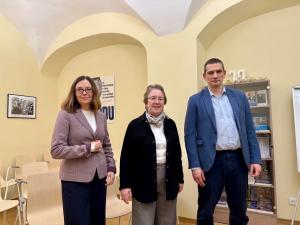
In 2018, the Belarus Office of the Konrad Adenauer Foundation initiated the creation of a dedicated Konrad Adenauer Room at the European Humanities University (EHU). The room symbolized a long-standing partnership that has resulted in conferences, workshops, seminars, joint publications, and the Sur-Place scholarship program for EHU students.
As the years passed, the space required an update. The room was renovated, enriched with new furniture, photographs, biographical materials, and a refreshed selection of books that highlight Konrad Adenauer’s legacy. The renewed space is intended to support study, discussion, and inspiration for future work.
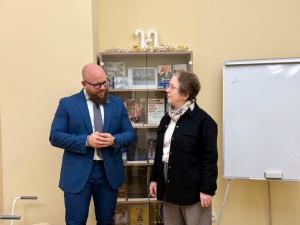
The re-opening brought together the university’s academic community, Sur-Place scholarship holders, and partners of KAS Belarus. The ceremony opened with welcoming remarks from Dr. Vilius Šadauskas, Rector of EHU, who emphasized the importance of the room for the university. Following him, Gabriele Baumann, Director of the KAS Belarus Office, spoke about Konrad Adenauer’s role in building a new democratic Germany, a united Europe, and a stable transatlantic security architecture.
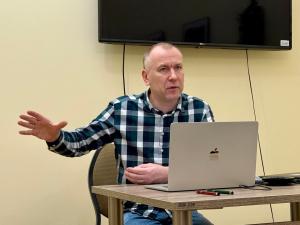
Afterwards, Andrey Dynko, journalist and former editor of the magazine “Nasha Historyja,” delivered a reflection on Adenauer’s political biography and the idea of the “power of the defeated.” The event concluded with an informal networking reception, where students, faculty members, and partners continued the conversation and exchanged perspectives on Adenauer’s enduring relevance for today’s Europe.
Lecture by Andrei Dynko
Key theses
- War has once again become a direct reality for Europe; there is no guarantee it will stop on its own or remain limited.
- The tragedies of the 20th century are not confined to the past: patterns of aggression and political collusion are repeating.
- The current threat targets not only Eastern Europe but Europe as a whole as a community of values and security.
- A widespread sense of helplessness is one of the most dangerous effects of prolonged crises.
- Politics after dictatorship requires realism, responsibility, and long-term strategic thinking.
- Konrad Adenauer’s biography demonstrates how personal hardship can shape political resilience and leadership.
- Democracy does not emerge automatically; it requires patience, sustained effort, and action under imperfect conditions.
- Politics is the art of the possible; without realism, it risks becoming ineffective moral rhetoric.
- National and societal reconstruction is possible only through inclusion and overcoming deep internal divisions.
- Europe once again needs responsible leadership capable of defending democratic values, rights, and freedoms.
- The key lesson of Adenauer’s generation is patience, hard work, and time as the foundations of lasting change.