




Asset-Herausgeber

Publikationen

Asset-Herausgeber

A Guide to Your Rights: Fundamental Rights and Freedoms in Sierra Leone - Krio Version

This booklet, presented in Krio, the common language spoken by 97% of Sierra Leoneans, is a practical guide to understanding and exercising human rights. Although the Constitution guarantees these rights, many citizens face challenges in enforcing them, often due to limited awareness or lack of accessible information. Developed by the Centre for Human Rights and the Konrad Adenauer Stiftung’s Rule of Law Programme for Sub-Saharan Africa, the booklet seeks to bridge this gap by clearly explaining the origins, meaning, and significance of human rights. By making these rights more understandable and actionable, the initiative aims to strengthen the rule of law and promote dignity and freedom throughout the region.

A Guide to Your Rights: Fundamental Rights and Freedoms in Sierra Leone

This booklet is a practical guide to understanding and claiming human rights in Sierra Leone. While the Constitution guarantees these rights, many citizens struggle to enforce them due to limited awareness or access to information. Developed by the Centre for Human Rights and the Konrad Adenauer Stiftung’s Rule of Law Program for Sub-Saharan Africa, the booklet aims to bridge this gap by explaining the meaning, origin, and importance of human rights in a clear and accessible way. By making rights more understandable and actionable, the initiative contributes to strengthening the rule of law and promoting dignity and freedom across the region.

Strathmore Law Journal, Volume 8(1), November 2024

Beyond Formal Law: The Role of Ethics, Beliefs, and Values in Amplifying Action against Plastic Pollution in Africa

This special edition of the Strathmore Law Journal features papers from the conference “Beyond Formal Law: The Role of Ethics, Beliefs, and Values in Amplifying Action against Plastic Pollution in Africa,” held in November 2023 and co-organized by Strathmore University, UNEP, and the Konrad Adenauer Stiftung Rule of Law Program for Sub-Saharan Africa. Rooted in earlier discussions during the 4th International Parliamentarians Conference on Freedom of Religion or Belief, the conference explored how informal norms such as ethics, beliefs, and cultural values can complement formal legal frameworks in addressing environmental challenges. The event brought together diverse stakeholders from across Africa and beyond, and its findings were shared at the Intergovernmental Negotiating Committee on plastic pollution. This journal issue reflects the depth of those discussions, emphasizing a multidisciplinary and values-driven approach to environmental governance and calling for greater integration of informal norms in promoting sustainable and effective action against plastic pollution.

Judicial Financial Independence in Africa

A Study of Eleven Sub-Saharan Countries

This book, published by the Konrad Adenauer Foundation’s Rule of Law Programme for Sub-Saharan Africa, explores the vital yet often underexamined issue of judicial financial independence as a cornerstone of judicial autonomy and the rule of law. Drawing on comparative analysis across eleven African countries, it examines the legal frameworks, budgetary structures, and institutional challenges that shape the judiciary's capacity to operate free from political and financial interference. Against the backdrop of colonial legacies and contemporary governance challenges, the book highlights how executive control over judicial finances continues to undermine the separation of powers and the effective delivery of justice. It offers concrete recommendations to enhance financial independence, bridging the gap between legal commitments and practical implementation. Intended as a resource for policymakers, legal professionals, and advocates, this publication underscores the imperative of protecting judicial autonomy as a foundation for democracy, good governance, and human rights in Sub-Saharan Africa.

Stellenbosch Handbooks in African Constitutional Law

Corruption and Constitutionalism in Africa

This fourth volume in the Stellenbosch Handbooks in African Constitutional Law series, like its predecessors, emerges from the Stellenbosch Annual Seminar on Constitutionalism in Africa (SASCA). Consistent with SASCA’s mission, the volume centres on a topic of pressing constitutional importance: the pervasive challenge of corruption across Africa. Corruption, deeply embedded in the continent’s social, economic, and political spheres, is a core obstacle to constitutionalism and democratic governance. Although its detrimental impact has long been evident, serious attention to the issue has only been mobilized in recent years. Most anti-corruption efforts have been symbolic rather than substantive. The African Union’s 2018 declaration of the 'African Anti-Corruption Year' along with the annual designation of 11 July as ‘Africa Anti-Corruption Day’ reflects a growing recognition by African governments of the urgent need for action. The key objective of this volume is to draw attention to the problem of corruption and the need for remedial action. It seeks to foreground corruption as a critical threat to constitutional governance. In doing so, it contributes to ongoing efforts on accountability, and the promotion of meaningful reform. This volume serves as both a timely call to action and a foundational text for scholars, practitioners, and policymakers seeking to confront corruption in Africa. By placing corruption squarely on the constitutional agenda, it advances the broader struggle for governance rooted in integrity, accountability, and the rule of law.

IMAGO / Xinhua

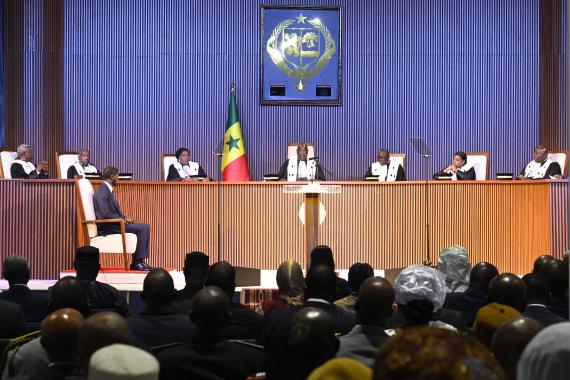
Wie der Verfassungsrat die Demokratie im Senegal rettete

Ein wegweisendes Urteil für Demokratie und Rechtsstaat in Westafrika

Die Demokratie im Senegal wurde in den letzten Jahren vermehrt durch Machtspiele gegen die Opposition, gewaltsame Demonstrationen und die strafrechtliche Verfolgung zahlreicher Oppositionspolitiker überschattet. Jüngst hat der senegalesische Verfassungsrat in einem wegweisenden Urteil die geplante Verschiebung der Präsidentschaftswahlen auf Dezember 2024 für verfassungswidrig erklärt. Damit hat er nicht nur den Senegal aus einer tiefen politischen Krise geholt, sondern im letzten Moment den Weg für eine verfassungsgemäße und demokratische Machtübergabe geebnet. Diese Machtübergabe fand nun am 2. April 2024 an den neu gewählten Präsidenten Bassirou Diomaye Faye statt.

A Guide to Your Rights

Fundamental Rights and Freedoms in Ghana

The booklet introduces the reader to human rights, the history of the constitution of Ghana, the structure of the court system in Ghana and a simplified version of Chapter 5 of the Constitution-fundamental human rights and freedoms.

KAS African Law Study Library

KAS African Law Study Library Volume 2 of 2023

KAS African Law Study Library is a journal which publishes articles written by young scholars from the African continent. The journal deals with practical aspects important for the development of the Rule of Law in an African context. The articles are the result of seminars and conferences organized by the Konrad-Adenauer-Stiftung’s Rule of Law Program for Sub-Saharan Africa in collaboration with Prof. Dr. Hartmut Hamann and African partner universities. KAS African Law Study Library thus creates a discussion forum for all lawyers interested in Africa and the diverse facets of Rule of Law in interaction with different historical, cultural, economic and political backgrounds. The journal addresses readers from all continents. Starting from Africa, it also wants to give thought-provoking impulse outside of Africa. KAS African Law Study Library is published quarterly and welcomes contributions in English and French. KAS African Law Study Library is available open access at www.nomos-elibrary.de See: https://www.nomos-elibrary.de/10.5771/2363-6262-2023-2/kas-african-law-study-library-volume-10-2023-issue-2

KAS African Law Study Library

KAS African Law Study Library Volume 3 of 2023

KAS African Law Study Library is a journal which publishes articles written by young scholars from the African continent. The journal deals with practical aspects important for the development of the Rule of Law in an African context. The articles are the result of seminars and conferences organized by the Konrad-Adenauer-Stiftung’s Rule of Law Program for Sub-Saharan Africa in collaboration with Prof. Dr. Hartmut Hamann and African partner universities. KAS African Law Study Library thus creates a discussion forum for all lawyers interested in Africa and the diverse facets of Rule of Law in interaction with different historical, cultural, economic and political backgrounds. The journal addresses readers from all continents. Starting from Africa, it also wants to give thought-provoking impulse outside of Africa. KAS African Law Study Library is published quarterly and welcomes contributions in English and French. KAS African Law Study Library is available open access at www.nomos-elibrary.de See: https://www.nomos-elibrary.de/10.5771/2363-6262-2023-3/kas-african-law-study-library-volume-10-2023-issue-3

Palastrevolution in Gabun

Ein Militärputsch als Garant für Demokratie und Rechtsstaat?

Das frankophone West- und Zentralafrika kommt nicht zur Ruhe. Nach fünf Militärputschen in den letzten drei Jahren (Mali, Tschad, Guinea, Burkina Faso, Niger) hat auch im bisher weitgehend stabilen Gabun das Militär Ende August 2023 die Macht übernommen. Reiht sich dieser Staatsstreich in Gabun in die jüngsten antidemokratischen Entwicklungen in Subsahara-Afrika ein oder lässt sich dieser Putsch in einem anderen Licht betrachten?