How do you think the role of Ukrainian media – both those based in Ukraine and perhaps foreign ones – has changed since the beginning of the Russo-Ukrainian war and the full-scale Russian invasion of Ukraine?
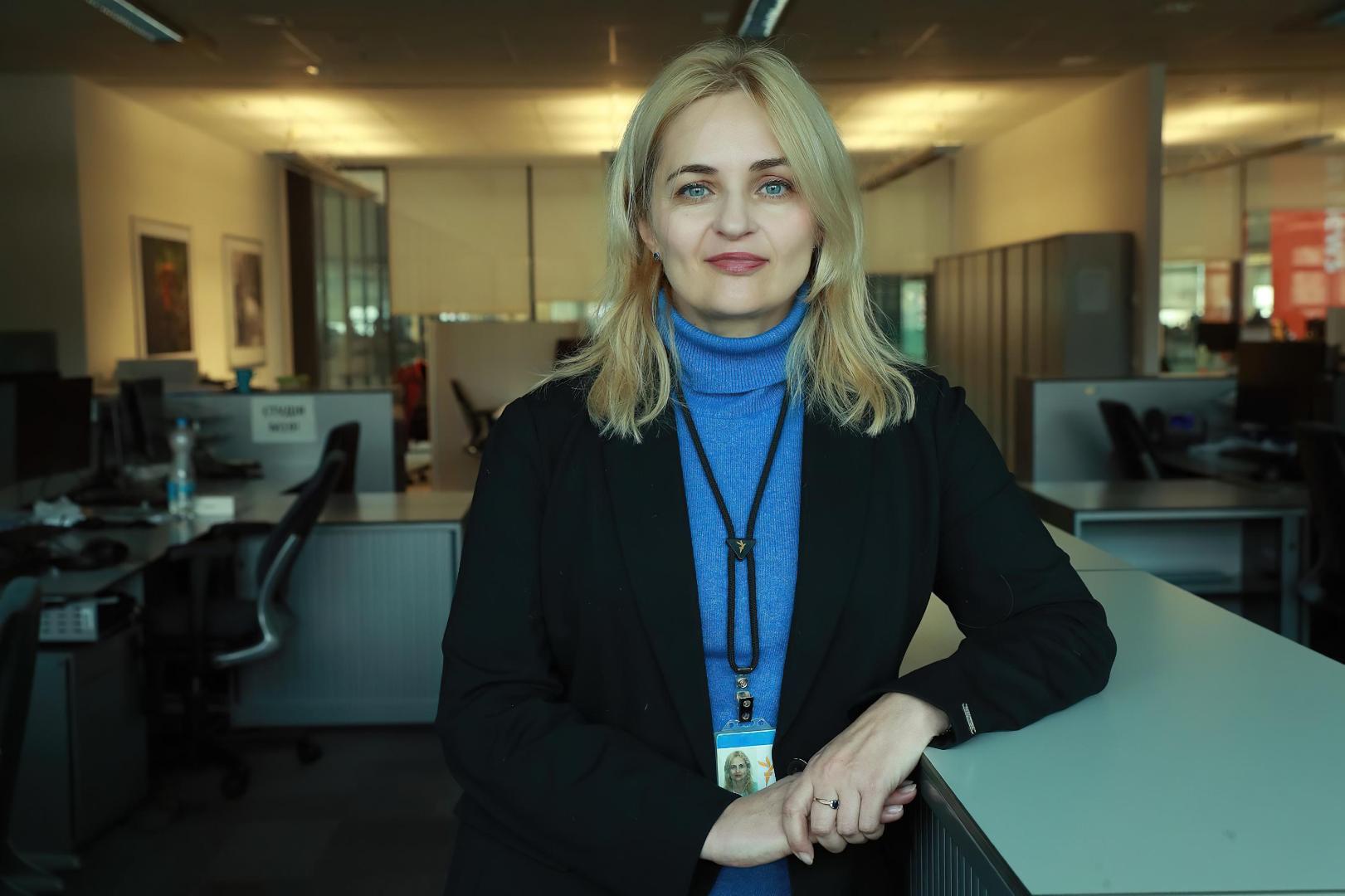
Maryana Drach: Our job is not only to document events but also to provide people with practical advice on how to survive in wartime conditions. An RFE/RL photojournalist was one of the first to document the aftermath of massacre in Bucha three years ago. His photos were used for Ukrainian postage stamps dedicated to the liberation of the Kyiv region, which Russia called a "staging.
Ukrainian journalists on the ground have become key to spreading the truth. An example is Mstyslav Chernov's film "20 Days in Mariupol," which won an Oscar and showed the world how important reliable information is during wartime.
I recall when we received a message on Instagram from a woman from Izyum in the Kharkiv region, who spent more than six months under occupation. She listened to our "Donbas.Realities" project on her mobile phone – it was her only source of information. According to her, this information not only debunked Russian fakes but also helped her understand the real situation around her. This demonstrates how important Ukrainian media have become today.
Does RFE/RL identify specific areas where Russia's information attacks are particularly strong, or is it comprehensive?
Maryana Drach: Russian propaganda actively attacks all key events of the war. We conduct our own investigations – for example, Dmytro Dzhulai identified the likely Russian military personnel involved in the killings in Bucha, including the murder of civilians. Another striking example is the shelling of the "Okhmatdyt" children's hospital in July 2024. Russia immediately claimed it was a Ukrainian missile.
The themes of "American biolabs" and the "illegitimacy of President Zelensky" are also constantly repeated. Russian narratives cover everything from events on the front lines to politics in Ukraine.
RFE/RL always adheres to journalistic standards. We do not engage in propaganda but present information in a balanced way, analyzing how Russia distorts facts. We recently created the "Cargo-200" database, where we collected information about more than a thousand Crimeans who died in the Russian army. This is another example of our work against disinformation.
Do you consider those brought to Crimea by the occupying authorities after 2014 to be residents of Crimea? What is their legal impact on the situation from the point of view of international law?
Maryana Drach: We prepared this databaset for the audience of "Crimea.Realities" – our project aimed at informing residents of occupied Crimea. We clearly explain what information we have and what we do not. Anyone can search for the deceased by first and last name, or, if you know the region where the Crimean was born, or if you know their status – whether they were mobilized, a contract soldier, or recruited. We cannot say about the citizenship of each of the fallen soldier, but we assume that most of them were also Ukrainian citizens waging war against their own country. According to human rights groups, this is already an issue. This is a violation of international humanitarian law — in particular, the Geneva Convention, which prohibits an occupying power from forcibly conscripting the population of occupied territories into military service. This is an example of how we try to find out the truth about what is happening in the war.
We know that similar work is being done by other journalists – including the BBC, as well as other RFE/RL services that document war losses, and our database is the most comprehensive source on the situation in Crimea.
What is RFE/RL doing to ensure that truthful information spreads virally on social media?
Maryana Drach: We have long been actively working on social media, constantly adapting content to the needs of the audience. Today, the main news platform for Ukrainians, including the occupied territories, is Telegram. There, we quickly disseminate information. On TikTok, we focus on short explanatory videos.
YouTube has become the main video platform of our editorial office, where we regularly publish viral videos about events in the regions – Sumy, Kryvyi Rih, Zaporizhzhia. Since the beginning of the full-scale war, our social media audience has grown many times over, and now our indicators are very strong even in a competitive environment that is actively attacked by Russian propaganda.
Since the beginning of the full-scale invasion, our YouTube channels have gained over one and a half billion views. Video views on Facebook and Instagram have nearly reached 2 billion. And the Radio Svoboda website has received over half a billion page views.
What are the main security threats for your journalists on the ground?
Maryana Drach: Since the beginning of the full-scale invasion, we have lost two colleagues. One of them died from a Russian missile in her own home in Kyiv, the other – our former freelancer Victoria Roshchyna – died in Russian captivity at the age of 27.
Our journalists work daily on the front line, often coming under fire. We provide them with special training, but the risk remains high. For many of our colleagues, this work is a true calling.
For example, journalist Yevhenia Rusetska, after being shelled in 2023, saved wounded soldiers. A year later, she became a mother and has already returned to work on the front lines. I can also mention Maryan Kushnir, a front-line correspondent whose testimonies about the war are deeply moving.
For them, this is not just a profession – it is a great responsibility, constant fatigue, pain, and, at the same time, a sense of duty to convey the truth to the world.
How do you assess the current state of press freedom in Ukraine, in particular, the ability of RFE/RL to openly cover internal criticism, for example, corruption scandals?
Maryana Drach: The problem of corruption in Ukraine is still relevant. Since 2014, our investigative journalism project "Schemes" has been exposing corruption crimes, and after the full-scale invasion, it also investigates Russian war crimes. We cover procurement for the army, the wealth of officials, and cases of Russian citizenship among representatives of the judicial system.
Our investigations have had real consequences – for example, the dismissal of Deputy Prosecutor General Verbytskyi. However, journalists face pressure and risks. A striking example is the case of journalist Natalia Sedletska, who won a case at the ECHR after persecution by the previous government.
A separate challenge for freedom of speech was the high-profile case of the Bihus.Info editorial office, when the special services illegally spied on journalists. This caused a sharp reaction from human rights community
But the biggest violations of press freedom are in the occupied territories. There, journalists are tortured and illegally imprisoned. Our authors Stanislav Aseyev, Mykola Semena, and Vladyslav Yesypenko became victims of such persecution.
Aseyev, after being released from captivity, became a well-known publicist, joined the ranks of the Armed Forces of Ukraine, and continues to expose problems as an astute observer. These cases clearly show how risky and necessary the work of journalists is in wartime.
How does the reduction in funding from the American government affect the work of RFE/RL? Will the editorial office be able to continue to function fully, or is additional support needed now?
Maryana Drach: As of now, RFE/RL has not received funding for April. We have filed a lawsuit against the U.S. Agency for Global Media (USAGM), as we consider this decision illegal and contrary to the U.S. Constitution – because Congress has already approved funding until September 2025.
Due to lack of funds, some employees in Prague have been placed on partially paid leave, and in Kyiv and Lviv – on downtime (according to Ukrainian law). We were also forced to suspend cooperation with many freelancers.
The situation is difficult and critical. Russian propagandists are already publicly rejoicing about this. But we continue to work carrying our mission to provide uncensored news.
If funding is radically reduced, is the Ukrainian editorial office of RFE/RL ready for restructuring or finding new sources of support? Could this mean the end of a certain era? What are the plans for such a scenario?
Maryana Drach: The Czech Republic, where the headquarters of RFE/RL is located, initiated a discussion of our situation at the EU level – and more than 10 countries have already supported this initiative. We are open to dialogue and ready to answer all questions.
The future is unpredictable, but it is important to realize what role we already play. According to a Gallup poll, every fourth Ukrainian gets news from RFE/RL. In Crimea, it's every fifth adult. Focus groups in Donbas also show high trust in our work.
Our goal is to preserve the main thing: informing people. Even with reduced resources, we continue to work, setting priorities even more clearly. This is not the end of an era – it is a challenge that we respond to with daily work.
Do you think interest in Ukrainian voices is still being maintained now – both in journalism and in the media space in general?
Maryana Drach: Yes, interest has increased. RFE/RL is part of an international network with 23 countries. Our materials, including investigations about Bucha, are translated and distributed in other countries – from Russia to Romania and Hungary.
We cooperate with other editorial offices daily. For example, when Ukraine mentioned the growing influence of China in the Black Sea, we immediately involved the Georgian service and did an analysis. Such joint projects – like the investigation into the GRU mercenaries ("Redut") – became possible thanks to our international structure.
At the same time, strong independent Ukrainian media with English-language content have also emerged – Kyiv Independent, "Ukrainska Pravda," The New Voice of Ukraine. They convey the Ukrainian view of the war and European topics at a high level. This voice was previously lacking – now it sounds loudly.