




Asset Publisher

Publications

Asset Publisher

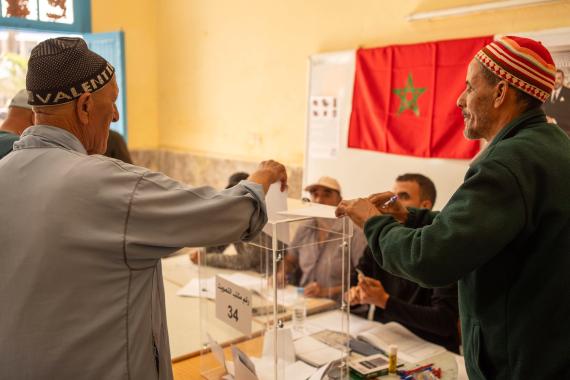
IMAGO / ZUMA Press

Parliamentary elections in Morocco

PAM well ahead of RNI and Istiqlal

On 23 September 2026, Morocco held elections to the House of Representatives, thereby laying the party-political foundations for the next government. There were 395 seats up for election; approximately 15.8 million people were registered to vote, of whom 38 per cent turned out. For the first time, the PAM emerged as the strongest force from the election, whilst its previous coalition partners, the RNI and Istiqlal, came off second best. However, the political significance of the election extends beyond the distribution of seats. The central question is whether the accelerated economic and infrastructural development of recent years is also being reflected in the everyday lives of those sections of the population who have so far benefited from it only to a limited extent. Expectations are therefore high for the new government.

OFFRE D'EMPLOI: Gestionnaire des sous-projets

Nous recrutons un.e gestionnaire des sous-projet dans le cadre du projet "Innov4Impact, Accélérer la transition digitale des OSC marocaines", co-financé par l'Union Européenne et le Konrad Adenauer Stiftung, est mis en œuvre depuis janvier 2026 pour une durée de quatre ans.

IMAGO / Anadolu Agency

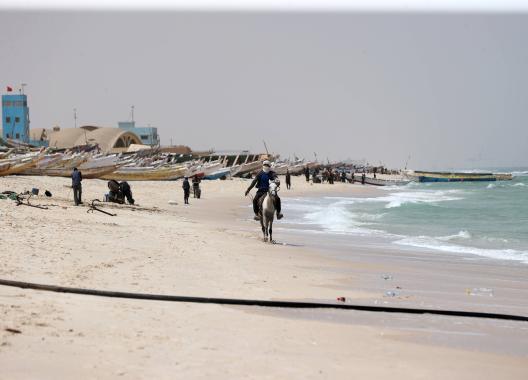
Mauritania between national dialogue and geopolitical power politics

Stability cannot be taken for granted

Political developments in Mauritania are often underestimated in Europe. Yet today, the country is one of the democratic West’s last reliable partners in a region increasingly turning away from Europe. While Mali, Burkina Faso, and Niger are under military rule – with a high influence of Russia in recent years – Nouakchott is prioritizing political stability, international cooperation, and cautious reforms. However, challenges might rise faster than the state’s capacity to act. The “national dialogue” could therefore prove to be a crucial test for the country’s future stability.

Taking the long view - Morocco’s maritime dimension

Policy Brief 10

Evaporation in Morocco: How to End the Bleeding?

Research Paper

Kenza Sifi is a postgraduate student at the College of Europe, specialising in international rela-tions with a focus on European security and water governance. She is a business partner at TS DIGITEAU, a Morocco-based company operating in the shade ball sector. Her research sits at the intersection of policy, management and governance.

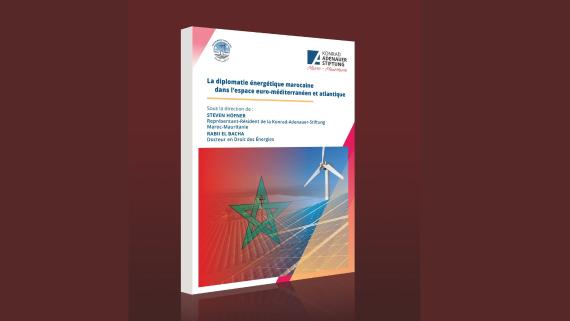
La diplomatie énergétique marocaine dans l’espace euro-méditerranéen et atlantique

Cet ouvrage, premier en son genre, propose une lecture croisée de la diplomatie énergétique marocaine, à la fois juridique, géopolitique et technico-industrielle. Il met en perspective le rôle des grandes infrastructures d’interconnexion, l’essor de nouvelles filières notamment de l’hydrogène vert et des énergies marines ainsi que les mutations rapides des cadres normatifs, sous l’impulsion notamment des politiques européennes.

Morocco's Energy Wager: What European Partners Should Expect by 2030

Policy Brief 09

German Political Foundations in Morocco: A Strategic Partnership in Support of Dialogue and Cooperative Solutions

On the sidelines of the 80th Session of the United Nations General Assembly held in New York on 26 September, the Minister of Foreign Affairs, African Cooperation and Moroccan Expatriates, Mr. Nasser Bourita, held talks with his German counterpart, Mr. Johann Wadephul. On this occasion, the two ministers signed an amendment to the technical and economic cooperation agreement governing the activities of the German political foundations in Morocco.

Morocco's religious diplomacy at a crossroads

Policy brief 08

Les Politiques publiques et le droit face aux opportunités et enjeux de la digitalisation au Maroc

La transformation numérique s’impose aujourd’hui comme un levier stratégique majeur de modernisation de l’action publique, tant à l’échelle internationale qu’au Maroc. En favorisant l’efficacité administrative, la transparence, l’accès aux services et la participation citoyenne, la digitalisation contribue à renforcer la gouvernance, la démocratie et la performance des institutions publiques. Au Maroc, ce processus, soutenu au plus haut niveau de l’État, s’inscrit dans des politiques publiques visant à moderniser l’administration et à lutter contre les dysfonctionnements structurels, tout en faisant face à des défis juridiques, organisationnels et sociaux, notamment en matière de protection des données, d’inégalités d’accès et d’adaptation du cadre juridique. Ainsi, la transition vers l’État digital soulève des enjeux transversaux articulant politiques publiques, innovation technologique et régulation juridique, appelant à une approche globale, inclusive et durable.

Showing 1 to 10 of 198 entries.