








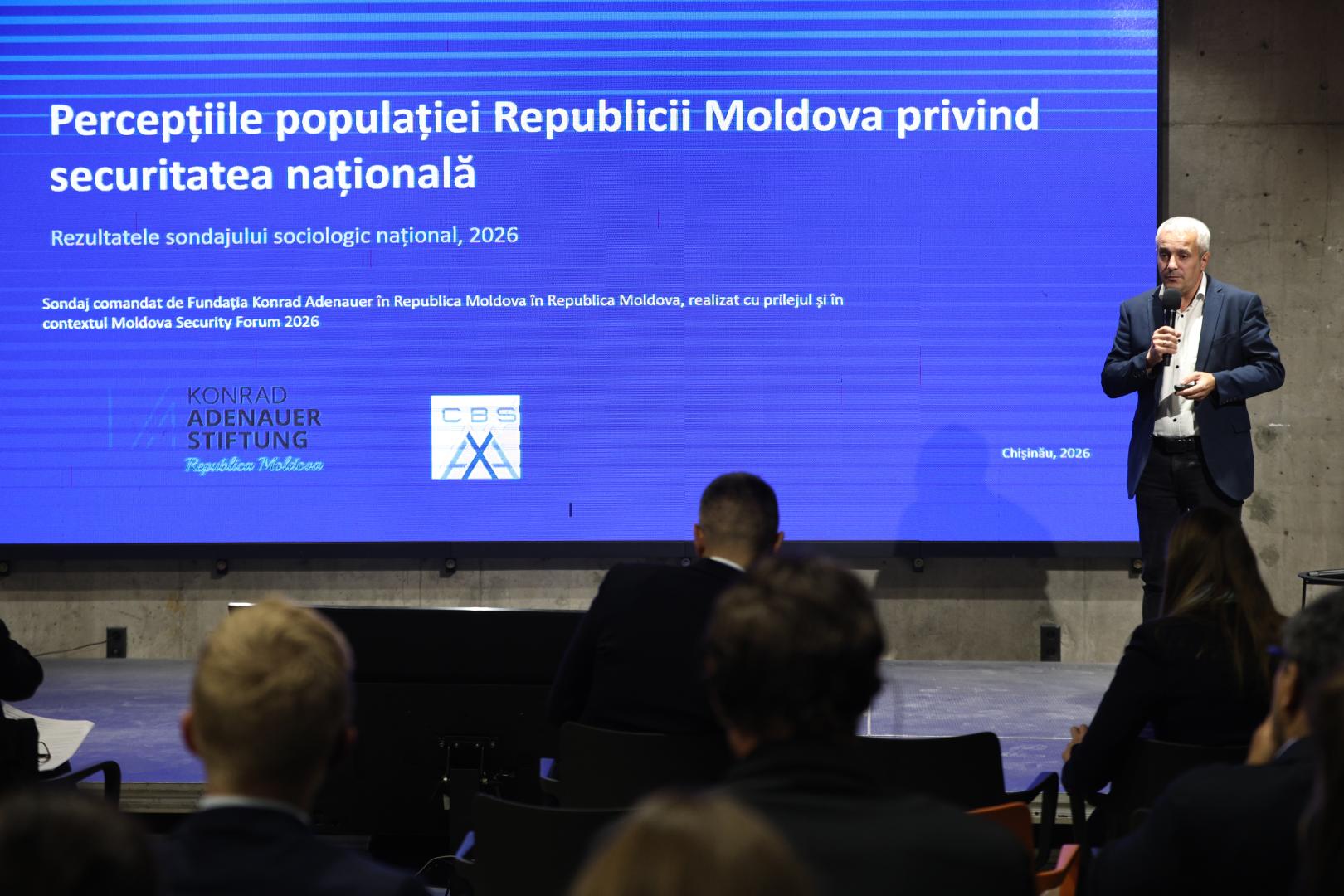

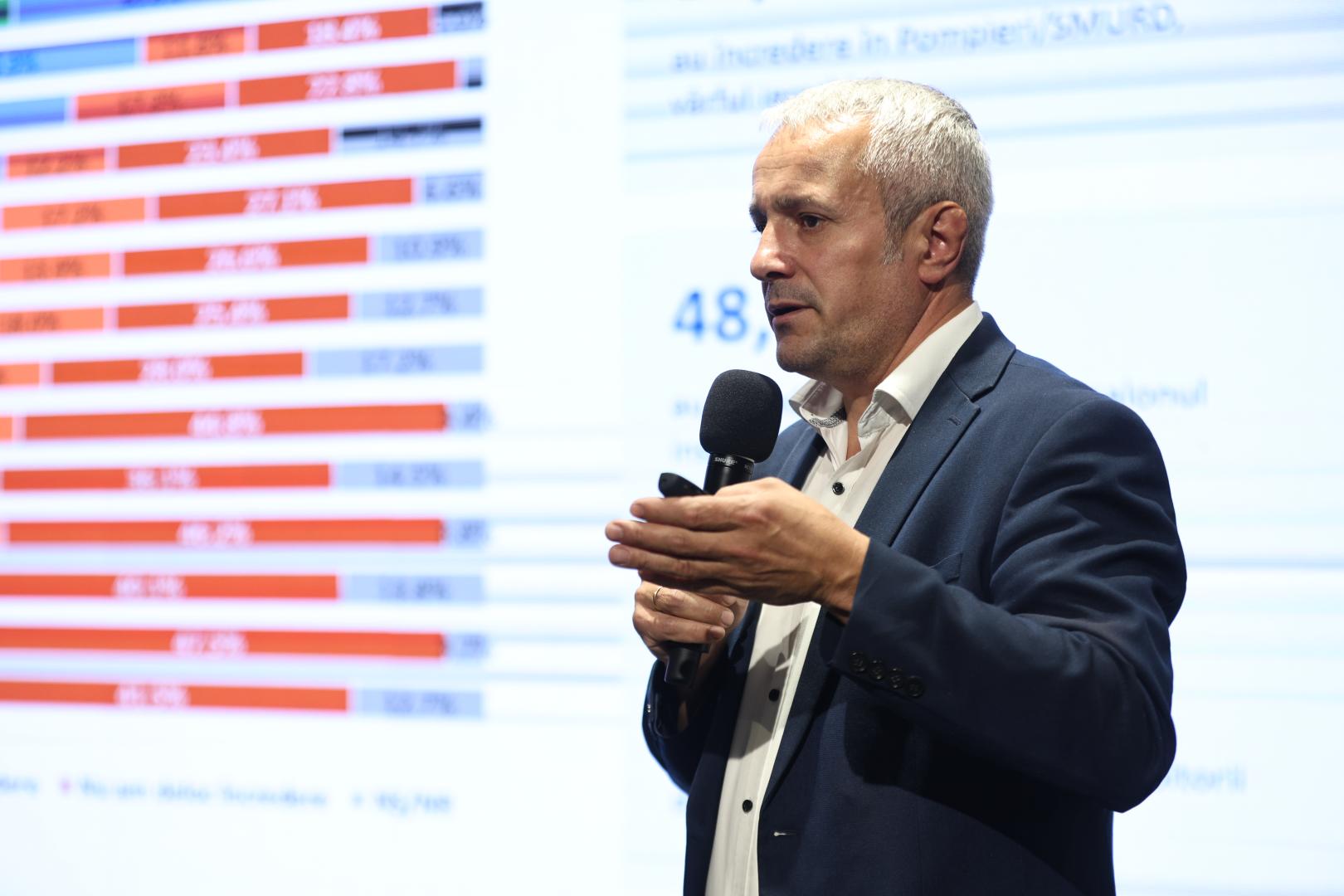
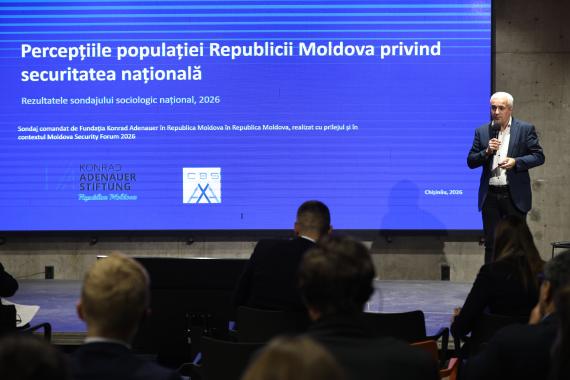

In the context of Moldova Security Forum 2026, the Konrad-Adenauer-Stiftung Office in the Republic of Moldova presented a study on public perceptions of security and defence.
On 7 October 2026, the Konrad-Adenauer-Stiftung Office in the Republic of Moldova presented the findings of the sociological study “Public Perceptions of Security in the Republic of Moldova”, conducted by CBS AXA. The event took place in the context of Moldova Security Forum 2026 and brought together experts in sociological research, security and international cooperation.
Through this study, the Konrad-Adenauer-Stiftung Office in the Republic of Moldova aims to contribute to a better understanding of citizens’ concerns and expectations in the field of security. The findings provide a basis for informed public dialogue, more effective strategic communication and policies that strengthen the democratic resilience of the Republic of Moldova.
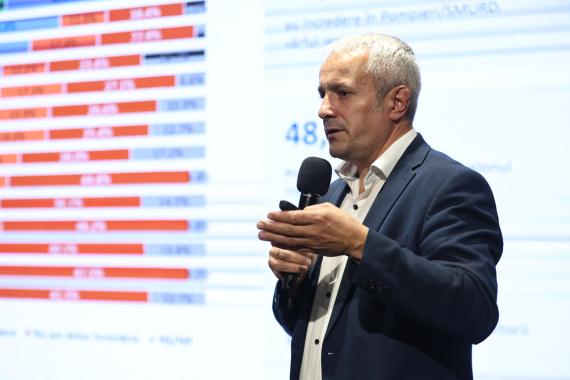
The presentation featured Vasile Cantarji, Deputy Director of CBS AXA, Sanda Sandu, Security Expert and Project Manager at the Konrad-Adenauer-Stiftung Office in the Republic of Moldova, Marina Stănescu, Political Officer at the NATO Liaison Office in the Republic of Moldova and Arcadie Barbăroșie, Executive Director of the Institute for Public Policy. The experts addressed the public’s main concerns, attitudes and expectations in the current regional security environment.
Cooperation with international partners remains relevant for the population: 6 out of 10 Moldovans believe that the Republic of Moldova still needs external support to strengthen its security and defence. Nearly 2 out of 3 respondents consider cooperation with the European Union and Romania important for the country’s development.
According to the poll, more than 80% of respondents believe that the Republic of Moldova is not prepared to face external aggression.
“Moldovans’ attitudes can be explained by the consequences of the war at our border and by the new tools used in military confrontations, which require adaptation in our country as well, including through strengthening the defence and security sector,” said Sanda Sandu.
At the same time, the risks to the country’s security most frequently identified by respondents are corruption, poverty and the war in Ukraine. This points to an understanding of security that goes beyond the military dimension alone.
“The Republic of Moldova’s security does not begin with weapons or with the choice of an alliance. It begins with people’s trust, with access to accurate information and with the sense that they are not left alone in the face of risks. The study shows that one third of the population faces significant socio-economic and information vulnerabilities. This is precisely where indecision and false narratives most easily find fertile ground. Therefore, the results should not be read as a score for or against a geopolitical option. They are a map of the areas where the state needs to communicate more honestly, closer to people, and build societal resilience before a crisis, not during one,” said Vasile Cantarji.
The findings also reveal the need for more accessible public communication on crises and emergencies. More than half of respondents, 56.5%, say they are informed only to a small extent or not at all about the measures they should take in such situations. At the same time, 6 out of 10 people reported encountering disinformation at least weekly, while social media is perceived as the space most affected by manipulation, especially external manipulation.
“We were interested in learning what citizens think about security and defence, key areas for the Republic of Moldova, especially in the current regional context. Understanding public perceptions is important to ensure that decisions and public communication respond to people’s real concerns,” said Arcadie Barbăroșie.
The discussions underscored the need for a comprehensive approach to security that includes not only the military dimension, but also good governance, anti-corruption efforts, economic and energy resilience, media literacy and public communication based on verifiable information.
The poll was conducted between 25 August and 9 September 2026 on a nationally representative stratified probability sample of 2,009 respondents aged 18 and above. The margin of error is ±2.2%.