




Asset Publisher

Publications

Asset Publisher

AI Safety Institutes in the Global South

Exploring AISIs in the Global South

The rapid expansion of AI systems across multiple domains, especially the proliferation of generative AI tools and large language models (LLMs), has brought questions of safety to the forefront, exacting immediate attention from all stakeholders alike. As countries in the Global South take steps to form their AISIs, this report offers insights from the direction and experiences of existing AISIs, for upcoming Global South AISIs. This report includes a comparative mapping that provides insights into some of the structural and functional aspects of the existing and upcoming AISIs. The jurisdictions included in the mapping have been identified to ensure regional representation and the inclusion of major jurisdictions from each region of the world.

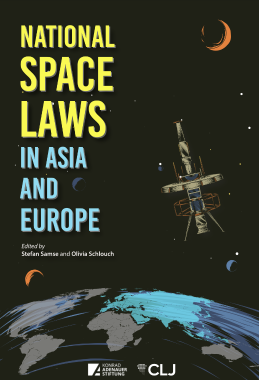
National Space Laws in Asia and Europe

The book is a comparative compilation of ten national space laws from Asia and Europe.

The book analyzes how five Asian and five European countries designed their national space legal frameworks, how they balance international obligations with domestic priorities, and how their laws reflect broader strategic, economic, and institutional choices.

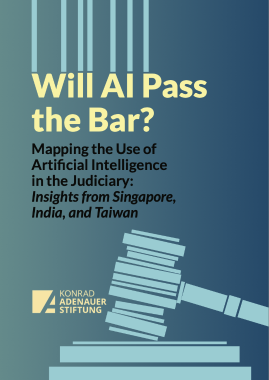
Will AI Pass the Bar? Mapping the Use of AI in the Judiciary in Singapore, India, and Taiwan

The comparative report maps the use of Artificial Intelligence (AI) in the Judiciary with insights from three jurisdictions; Singapore, India, and Taiwan.

The report highlights approaches to AI in the judiciary across Asia, profiling Singapore’s governance-first and human-centric strategy, India’s use of AI to reduce backlogs and bridge linguistic divides, and Taiwan’s careful balance between innovation, constitutional safeguards, and public trust. It is authored by Nydia Remolina, Jameela Sahiba, and Kuan-wei Chen, edited by Stefan Samse and Archana Atmakuri with an introduction by Mark Findlay, and designed by Justice Adda.

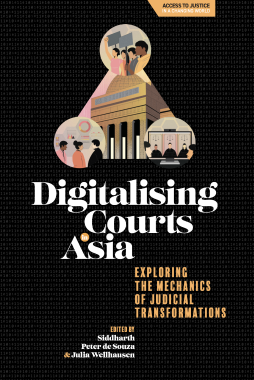
Digitalising courts in Asia

Courts are unique locations to witness digital transformations. Not only are they institutions upon which digitalisation is having increasing effects such as in terms of court management and adjudicatory processes, they are also institutions that are actively shaping discourses on what digitalisation means for the delivery of justice. With the advent of digitalisation in different aspects of the working of the court such as document discovery, legal research, evidence gathering and processing, workflow management, predictive sentencing, and virtual hearings, the approach taken by courts as institutions that must ensure access to justice in digital and networked spaces remains vital toa study of justice delivery.

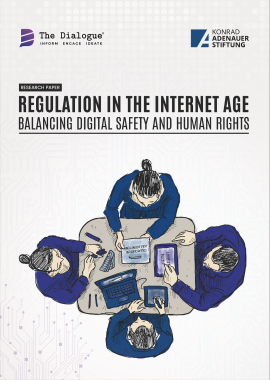
Regulation in the Internet Age - Balancing digital safety and human rights

Regulation in the Internet Age - Balancing digital safety and human rights

This report, titled "Regulation in the Internet Age: Balancing Digital Safety and Human Rights," is the result of a collaborative effort between Konrad-Adenauer-Stiftung's Rule of Law Programme Asia and The Dialogue. This report explores the evolving legal and regulatory frameworks surrounding online safety in India and their implications for users' digital human rights, with a special focus on freedom of expression, privacy and consent and safety. It delves into case studies and presents key recommendations aimed at safeguarding online spaces while upholding fundamental human rights.

Exploring Public Digital Transformation - Case studies from Singapore, India and Taiwan

Exploring Public Digital Transformation - Case studies from Singapore, India and Taiwan

The Konrad-Adenauer-Stiftung Rule of Law Program Asia (KAS RLPA) is proud to present this original study on digitalization, which meticulously examines the digital strategies and best practices of Singapore, India, and Taiwan’s administration and judicial system. Well-known as front-runners of digital governance and innovation, this study is an opportunity to learn from their success stories and understand how these administrations managed to leverage technology to enhance efficiency and citizen engagement.

Publication - Social Media Platforms Regulation and the Rule of Law

Key Trends in Sri Lanka, India and Bangladesh

This report examines the critical intersection of social media platforms regulation and the rule of law in the context of three South Asian countries: India, Sri Lanka, and Bangladesh. It highlights how social media platforms impact national security and human rights, including free speech and privacy, and identifies challenges such as Internet shutdowns and content control. Through comprehensive analysis and comparative examination, the report offers insights into legislative frameworks, enforcement mechanisms, and the evolving landscapes of these countries. The report underscores the importance of promoting accountability, transparency, and inclusivity in regulating cyberspace and social media platforms.

Publication - Mass Data Sharing in Smart Cities

The Rule of Law Programme Asia released a report on Mass Data Sharing in Smart Cities, in collaboration with the SMU’s Center for AI and Data Governance (CAIDG).

The report delves into the challenges and dynamics of data sharing between private companies and public institutions in Smart Cities, but also the opportunities of creating a new citizen-centric governance model. By involving and empowering "smart" citizens, this report introduces an innovative approach fostering greater trust and accountability in data governance.

Launch of Afghanistan evacuations report

The Rule of Law Asia Programme recently published its joint report with Leitner Centre for International School and Justice on evacuations in Afghanistan

The Rule of Law Asia Programme, Konrad Adenauer Stiftung had recently published its joint report with Leitner Centre for International School and Justice, Fordham School of Law titled “The world simply gave up": International law and the role of non-state entities in humanitarian evacuations in Afghanistan. The report report engages international law to document the experiences and examine the role of these non-State entities (NSEs) in the humanitarian evacuations from Afghanistan, as well as post-conflict obligations on the part of withdrawing States. It also seeks to shed light on the lived realities of evacuation processes; and the gaps that have been exposed by these experiences in terms of applicable laws, policies, and practices.

IMAGO / NurPhoto

What next for Sri Lanka?

In 2023, the country’s struggle for political and economic stability is far from over

The situation in Sri Lanka continues to remain volatile and precarious with Sri Lankans still facing economic hardships in 2023. In November 2022, the Institute of South Asian Studies, National University of Singapore, together with its partner, Rule of Law Programme Asia, Konrad-Adenauer-Stiftung, Singapore, hosted a closed-door hybrid workshop, under Chatham House rules, with four sessions to bring together distinguished speakers from Sri Lanka, Singapore and outside the region. While the main takeaways of the workshop have recently been published in a Special Report that examines the constitutional, legal and political dimensions of the ongoing crisis, this country report assesses the latest developments on the economic, political and social fronts in Sri Lanka from a current yet broader perspective.