







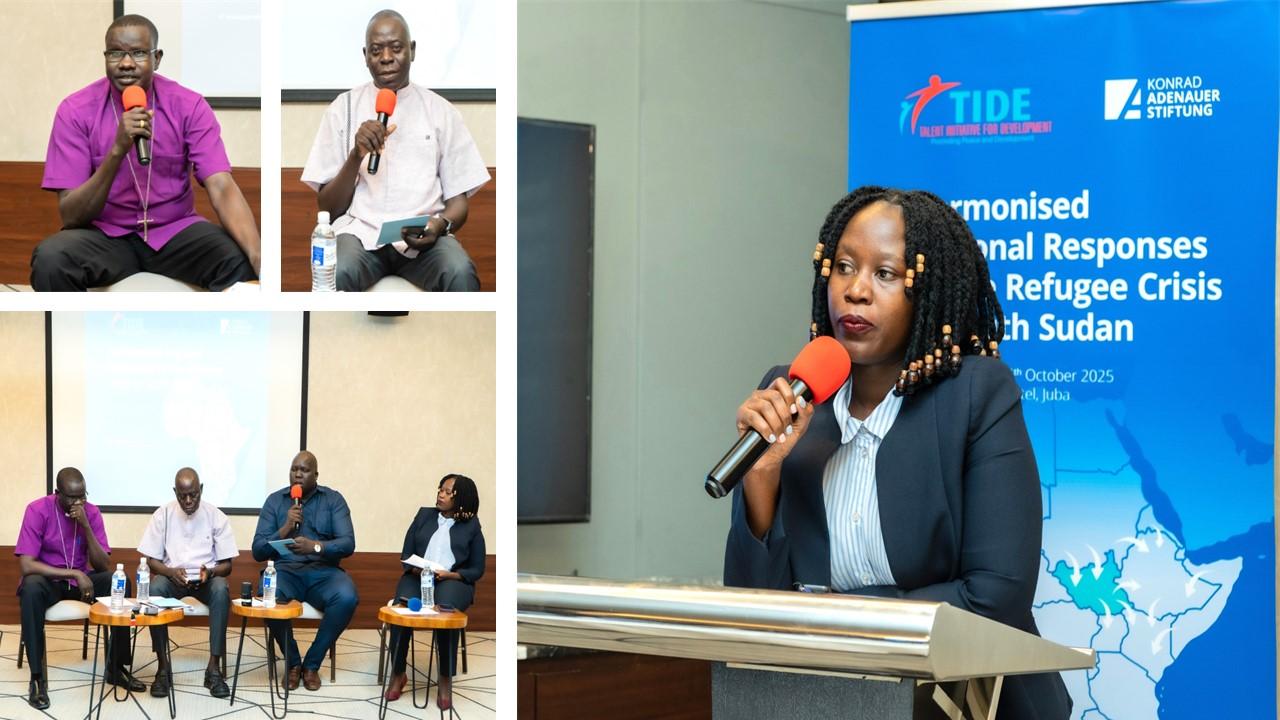

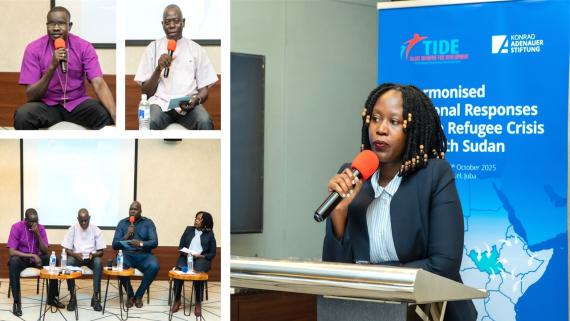
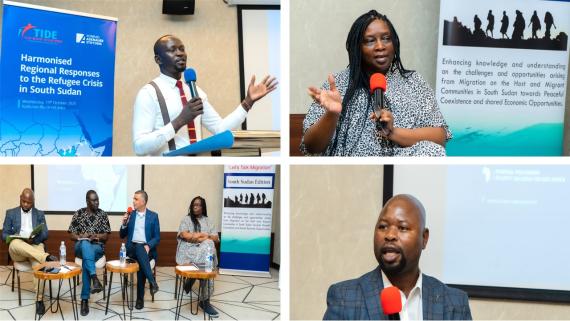
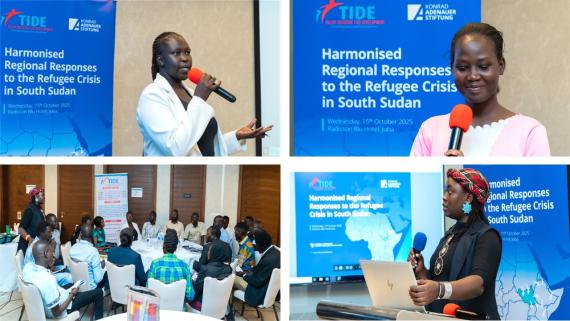
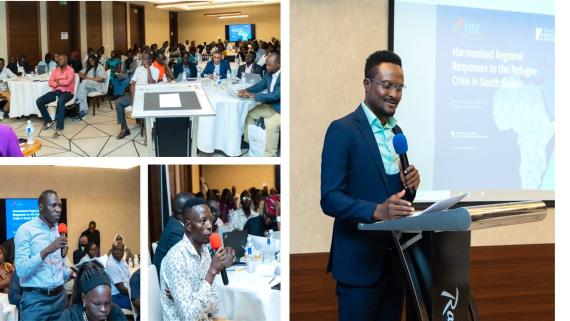
The event, introduced and moderated by Susan Natumanya, Programme Manager, KAS RP SIPODI EA, was officially opened by Edgar Mwine, Programme Manager, KAS RP SIPODI EA, who welcomed the participants and highlighted that the dialogue was timely but also appropriately hosted in South Sudan, given the country’s centrality to mixed migration flows in the region, as a source, transit and destination of refugees, but also, with millions of internally displaced persons. In his opening remarks, Robert Guya Antipas, Ag Executive Director, TIDE, noted the growing negative trends arising from untracked migrations especially trafficking in humans, inadequate response by government and humanitarian agencies, and public health risks.
The first panel which assessed the drivers of mixed migration patterns was moderated by Anisha Alinda, Project Manager KAS Uganda and South Sudan, and comprised of Bishop Dr Zechariah Manyok Biar, Diocesan Bishop of Wanglei, Alaak Daniel Atem, Programme Assistant Migration Management, IOM and Dr Christopher Oringa Lecturer, Institute of Peace and Conflict Studies, University of Juba. Panellists noted that the fluid movement of refugees, returnees and internally displaced persons has been occasioned by reduced humanitarian supplies, (especially food and medical items), land and ethnic conflicts, and flooding in seven of South Sudan’s ten states.
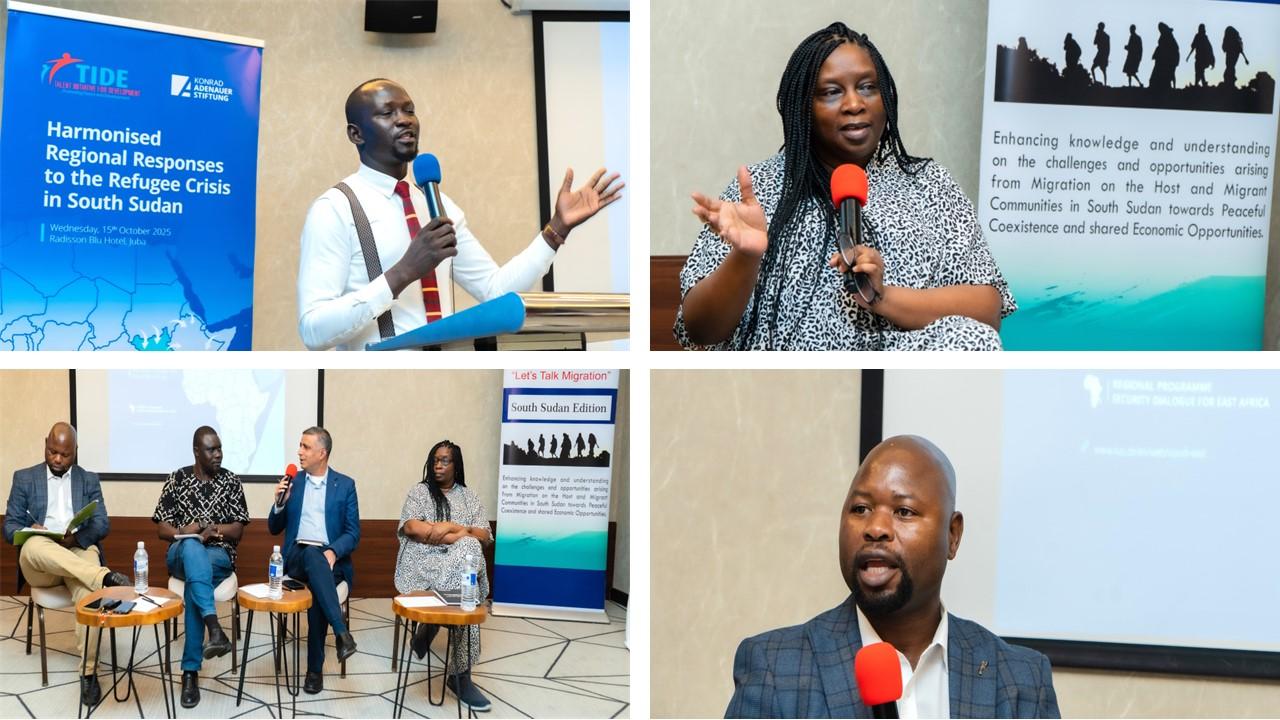
The second panel evaluated the consequences of unmanaged migration for social cohesion, regional stability and public health. The panel was moderated by Daniel Mwaka Lagony, Executive Director Youth Empowerment Organisation and comprised of Asar Mohamed, Chief of Mission, IOM, Gloria Nyaki, Protection Assistant, UNHCR Boboya James Edimond, Executive Director, Institute for Social Policy and Research and Hope T. Chichaya, Peacebuilding and reconciliation Advisor, Finn Church aid. This panel discussed challenges South Sudan faces in Migration data capture, management, analysis and dissemination. In turn, these challenges affect planning for displaced persons, causes mistrust between the different agencies and fragments humanitarian efforts.
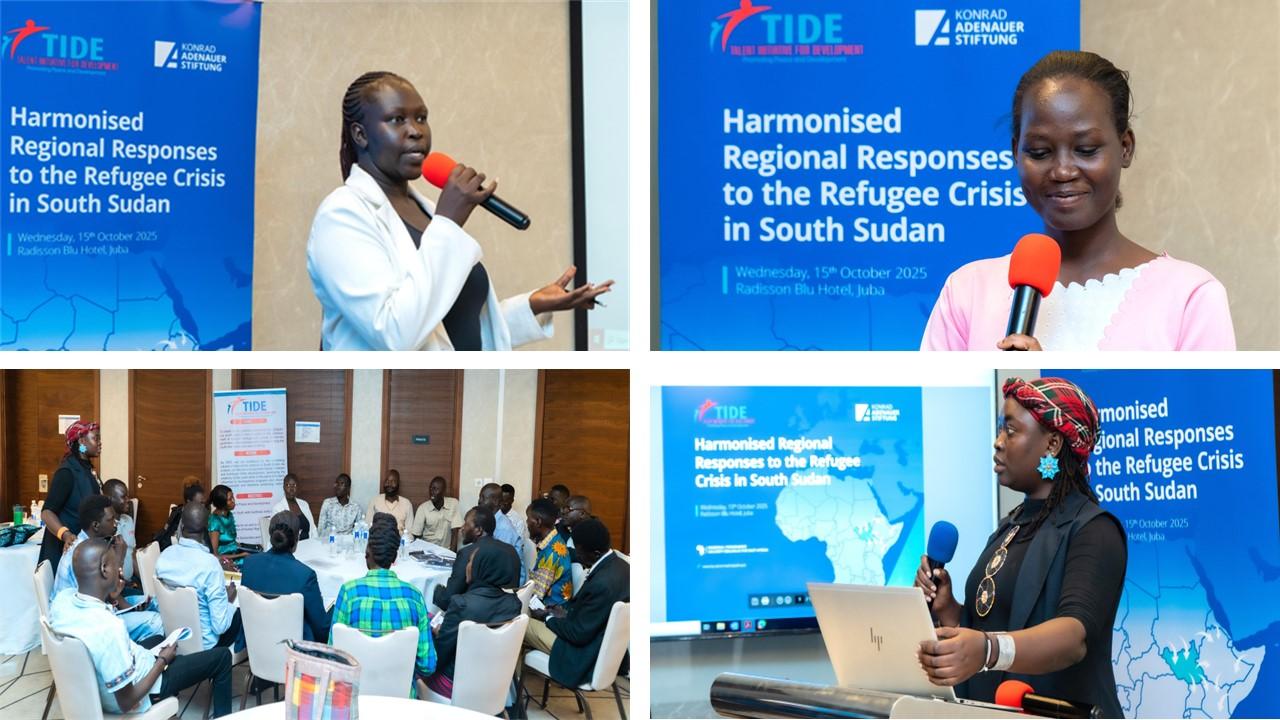
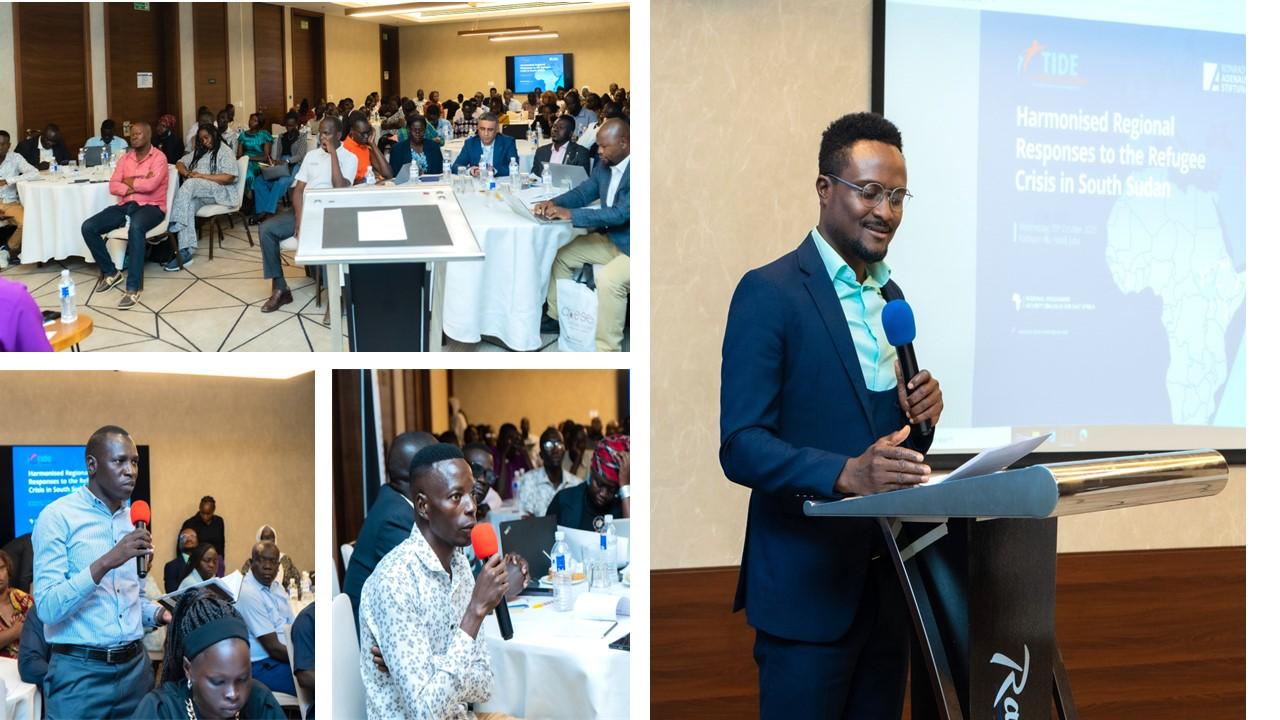
The dialogue then constituted itself into a workshop, with participants discussing in several break-away groups, policy interventions that could be adopted internally, but also regionally to respond to the challenges arising from the mixed movement patterns of refugees and internally displaced persons. In a session, moderated by Florence Agiba, Executive Director, Markaz Al Salam, the proposed policy interventions were presented and discussed. Some of the policy proposals raised were, harmonising data collection, management and sharing between agencies and countries in the region, setting up and supporting local community mechanisms for conflict resolution, and greater consideration of the host communities in refugee planning and management.
Koffi Oda, Project Manager RP SIPODI EA, in his closing remarks thanked all the participants for their keen and candid contributions and called for a harmonised regional response to the South Sudanese refugee crisis, rooted in solidarity, shared responsibility, and cross-border policy coherence. He urged a shift from short-term humanitarian aid to sustainable, people-centred development and stronger collaboration among governments, civil society, and international partners to turn dialogue into action for lasting regional stability.
About this series
The Konrad-Adenauer-Stiftung, its educational institutions, centres and foreign offices, offer several thousand events on various subjects each year. We provide up to date and exclusive reports on selected conferences, events and symposia at www.kas.de. In addition to a summary of the contents, you can also find additional material such as pictures, speeches, videos or audio clips.