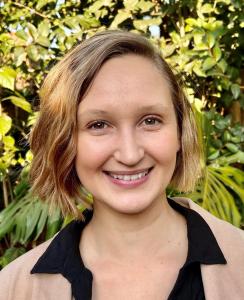
Cynthia Gichiri, Africa Uncensored, Kenya
Documentary – “The Seed Syndicate: The Battle to Control What Kenyan Farmers Can Plant”
The Jury said:
Seed Syndicate, a meticulous year-long investigation by Africa Uncensored and her author Cynthia Gichiri, is a great piece of investigative journalism. The report uncovers how one heavily manicured law systematically marginalizes and criminalizes smallholder farmers. The story also discloses malpractices by plant breeders who ‘rebrand’ naturally occurring crops for profit and has already sparked a national dialogue on food rights and a more inclusive and protective legislation.
It’s a shining example for courageous, accountability-driven journalism - a masterclass not only in its depth of research and fearless confrontation of the powerful corporate and political forces shaping Kenya’s agricultural landscape. It’s also outstanding in its sophisticated technical execution, including:
- extensive fieldwork, and travelling and countless interviews
- cinematic excellence and a visual language that skillfully shifts between macro shots and wide shots, utilizing graphics and info-boxes to make complex legal data accessible.
- and a consequent human-centric focus: By centering the perspective of those most affected, the report remains anchored to its core theme: Seed is our livelihood.
In an era of information - and misinformation - overload and minimal attention spans Seed Syndicate serves as a vital reminder of the role of the press. By illuminating the systematic exploitation of rural communities and the ‘seed captivity’ caused by the criminalization of indigenous seed sharing, Cynthia and her team have provided a voice to the marginalized against powerful corporate actors. This is a courageous piece of journalism that doesn't shy away from naming influential forces ... one hopes that this kind of journalism will continue to exist for a long time.
Watch her Documentary here.
https://www.youtube.com/watch?v=TTt0TNBdT6s
Jack McBrams, Platform for Investigative Journalism, Malawi
Article - “THE ELEPHANT INVASION: How a historic elephant translocation unleashed death, hunger, and heartbreak among Kasungu villagers”
The jury said:
“Real conservation should mean coexistence — not conquest.”
The writings of Jack McBrams exemplify the most authentic traditions of long-form investigative print journalism. This 2,000-plus-word piece weaves together survivor testimony, most hauntingly that of Kannock Phiri, whose wife and infant child were killed by elephants and several other harrowing experiences, alongside internal documents, on-the-ground reporting, and institutional responses, to construct a narrative that is both rigorously evidenced and deeply human.
Through intimate, character-driven storytelling, the journalist centres ordinary lives, farmers, parents, children, allowing readers to witness how global conservation decisions unfold in kitchens, maize fields, and village paths. The careful use of scene-setting that literally transports one to the villages in Kusugu, restrained language, and verified detail transforms statistics into lived reality, without sensationalism or the exploitation of grief.
McBrams masterfully juxtaposes celebratory international imagery with the quiet devastation experienced by affected communities, exposing power imbalances, interrogating accountability, and restoring dignity to voices too often excluded from policy and donor narratives. This work stands as print journalism at its most authentic form: patient, courageous, ethically grounded, and unwavering in its commitment to truth in service of the public good.
Read their piece here.
https://www.pijmalawi.org/show-story/the-elephant-invasion-how-a-historic-elephant-tr
Hauwa Shaffii Nuhu, Hum Angle Media, Nigeria
Article – “A Robbery Incident Killed His Wife and Unravelled His Whole Life”
The Jury said:
There are some stories, even great stories, that one reads and immediately forgets. And then there are the stories that stay with you, that you think about days, weeks or even months later. Hauwa Shaffii Nuhu's fascinating and heartbreaking profile of Modu Baraka - a trader in north-eastern Nigeria whose life was unraveled by a robbery - is in the latter category.
It is not just the rigour of the reporting which sets this piece apart. It is also the quality of the writing, which is of the highest order; and the editorial judgment required to recognise how one man's story, skillfully told, could tell readers more about state failure than a dozen think tank reports.
This year, the quality and the quantity of award entries was outstanding. Despite the crowded field, Hauwa Shaffii Nuhu's stood out – making her a worth recipient of the 2026 KAS Local Journalism Award.
Read their piece here.
https://interactive3.humanglemedia.com/a-robbery-incident-killed-his-wife-and-unravelled-his-whole-life
Many exceptional submissions
This year’s competition brought in many exceptional submissions – a testament to the calibre of journalism across the continent. While we can only have 3 winners, the jury identified the following 2 submissions for recommendations:
Abdullahi Jimoh, The Xylom, Nigeria
Radio production – “Paraquat, A Banned Toxic Chemical, Is Leaking Into The Global Food Supply Chain”
The jury said:
“This deep investigation into the use of a banned toxic herbicide shows, how - despite treaties like the Stockholm Convention - international supply chains ensure these chemicals are still used in countries with weak enforcement, like Nigeria. The fallout is poisoned farmers and groundwater, harm to ecosystems and long-term loss of productivity, and ultimately, the toxic chemical finds its way into our global food supply."
Read their piece here.
https://www.thexylom.com/post/paraquat-banned-toxic-chemical-stockholm-convention-cocoa-corn-us-malaysia
Diafarou Hawa, Mali
Radio production – “Suicide, une tragédie aux causes multiples : cas du District de Bamako”
The jury said:
"Diafarou Hawa offers us a global investigation on the phenomenon of suicide in Mali. Well narrated, it unveils taboos on hidden human failures while touching the important issue of mental health in Africa."
Listen to their piece here.
https://www.dropbox.com/scl/fi/ih159n9l1anfp8as81vcf/Documentaire-sur-le-ph-nom-ne-du-suicide-Bamako-Mali.mov?rlkey=yhk0snxmylww0muy6t53ufdwb&st=t7m06hgn&dl=0
The jury members:
- Prof. Nancy Booker
Dean of the Graduate School of Media and Communications at the Aga Khan University, Nairobi, Kenya
- Ms. Mamadiarra Diop
Founder of BMC Médias Consulting, Bamako, Mali
- Ms. Sandra Niemann
Editor, Science Programmes, Multimedia, Rundfunk Berlin-Brandenburg (RBB), Berlin, Germany
- Mr. Claus Stäcker
Director of Programs for Africa, Deutsche Welle, Bonn, Germany
- Mr. Simon Allison
Co-Founder of The Continent and executive board member of the International Press Institute, Johannesburg, South Africa