



Asset Publisher

Country Reports

Short political reports of the KAS offices abroad

Publications

IMAGO / SNA

Between nuclear threats and diplomatic initiatives: The Zapad 2025 military exercise in Belarus

Even after the military exercises, the country remains a Russian staging area

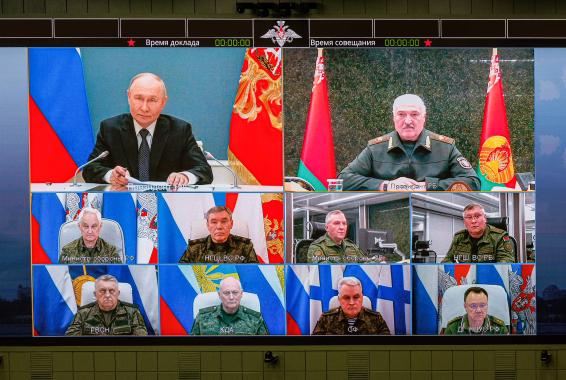
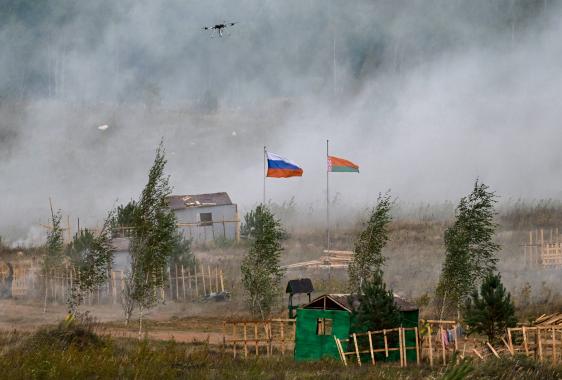
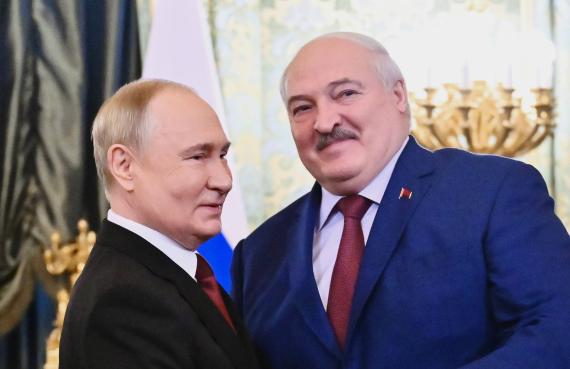
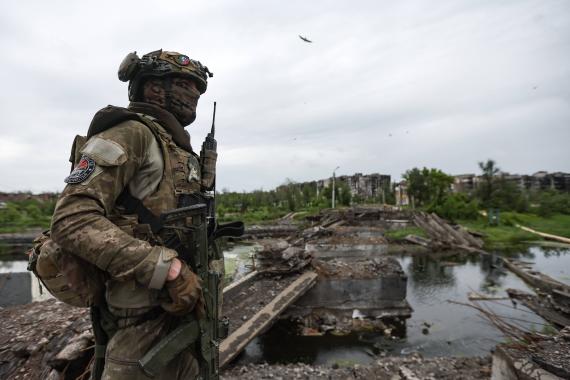
The active phase of the Russian-Belarusian military exercise Zapad 2025, held from September 12 to 16, 2025, ended—just as expected—without major incidents. However, in recent weeks, the threat to countries bordering Belarus has reached a new level. On September 10, at least 19 Russian drones, mostly flying over Belarus, penetrated deep into NATO member Poland. According to security experts, Russia likely intended to test NATO’s defensive response. In reaction, NATO announced Operation "Eastern Sentry" to strengthen defense along its eastern flank. Although only 8,000 troops (including just 2,000 Russian soldiers) were deployed in Belarus this time, with an estimated 30,000 more stationed in Russia, the exercise brought back grim memories of Zapad 2021, after which Russia launched its invasion of Ukraine from Belarusian territory. Back then, however, 200,000 troops participated in the drills. This year’s joint exercises were meant to demonstrate just how closely Belarus and Russia now cooperate militarily. It was also a show of force aimed at the West, with Russian leader Putin maintaining a firm grip on his junior partner, Lukashenko.

IMAGO / SNA

Formally still independent, but hardly sovereign

Belarus in Russia's wake

Russia is now driving the process towards a union state with Belarus, which has long been simmering on a low flame, at all levels and at high speed. Most recently, the pompous forum ‘Great Heritage - Common Future’ took place at the end of April in Volgograd, Russia, on the margins of the commemoration of the 80th anniversary of the victory of the Red Army in Stalingrad. What independent observers describe as Moscow's ‘victory hysteria’ surrounding the military parade on 9 May, is equally evident in official Belarusian rhetoric. The Russian narrative about the interpretation of the history of World War II is also actively employed in Belarus to justify aggression against Ukraine and to shape its stance toward Europe. Lukashenko has maintained his grip on power by making extensive concessions to the Kremlin, effectively trading Belarusian sovereignty for political survival. In terms of security policy, the ‘Agreement on Security Guarantees in the Union State’, ratified in Moscow at the beginning of the year, represents a further stage of escalation. Among other things, it enables military bases for Russian nuclear missiles, which can reach Vilnius in two minutes. Russia needs the regime in the neighboring country as a critical military ally, relying on its territory for missile deployment and as a strategic staging ground for troops near the borders of Lithuania, Poland, and Ukraine. The upcoming Zapad 2025 military exercises, scheduled for September, evoke troubling memories of the large-scale Russian invasion of Ukraine in February 2022, which followed similar “training maneuvers.”

IMAGO / ITAR-TASS

“Election” in Belarus

Ruler Lukashenko Grants Himself Another Five Years

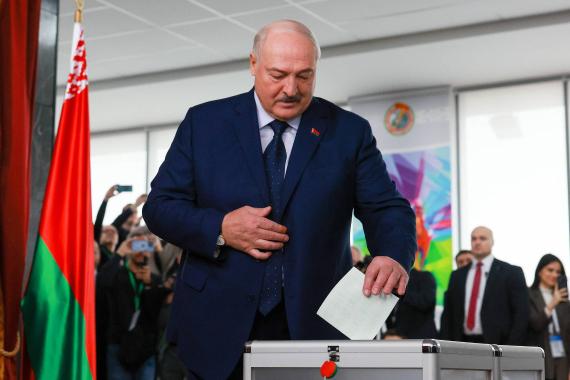
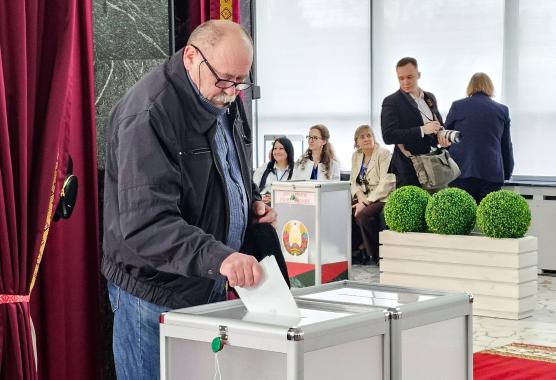
The result of the “presidential election” in Belarus on January 26th, with 86.82 percent for the 70-year-old Lukashenko, who has been in power for 30 years, and 8.83 percent for the four “alternative” candidates, is completely fictitious. Experts assume that Lukashenko might realistically achieve 40-50 percent of the vote due to the country's hopeless situation in Russia's stranglehold and the lack of alternatives. However, this cannot be verified. OSCE observers were not allowed to attend the “election,” and candidates from opposition parties or independent civilian election observers were not even given a chance to stand. The “election” should actually have taken place in July but was brought forward to January 26th during a visit by Lukashenko to Russia in October last year. The active phase of the election campaign thus fell in the coldest month of the year, with many public holidays, which reduced the likelihood of street protests. The slowdown in economic growth by mid-2025 would also have had a more significant impact on the population's prosperity. In the event of peace negotiations in Ukraine after Donald Trump’s inauguration, Lukashenko wanted to legitimize himself early on with a renewed mandate as the real incumbent to participate in these negotiations. Since the protests against the election fraud in 2020 were brutally suppressed, Belarus has been on the path to becoming a totalitarian state, with close ties to Russia and isolated from the West by extensive sanctions.

IMAGO / SNA

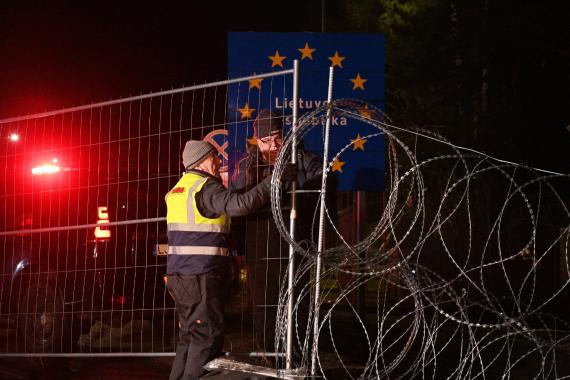
New Iron Curtain rising on the EU border with Belarus

"New EU-sanctions package against Belarus might backfire"

After introducing the latest EU sanctions package against the Republic of Belarus, the Baltic States Latvia, Estonia, and Lithuania imposed an entrance ban for almost all passenger cars with Belarusian license plates. Belarusian cars currently present in these countries were given limited time to either leave or reregister locally. Aimed at closing loopholes in the sanctions which were introduced to punish the regimes in Minsk and Moscow for their aggressive behaviour and to strengthen border security at NATO’s eastern flank, the passenger car ban sparked strong negative reactions, also from the democratic community of Belarus. They warn that shutting the EU’s door for regular citizens, most of whom voted for Sviatlana Tsikhanouskaya in 2020, will only further alienate the Belarusian population from the West. As trade with the Lukashenka regime continues, his propaganda machine will know how to use the “travel ban” to strengthen the pro-Russian narrative claiming that “nobody in the West wants you Belarusians”.

Generiert mit Adobes Firefly KI in Photoshop

Political system in Belarus

One nation – two new representative bodies?

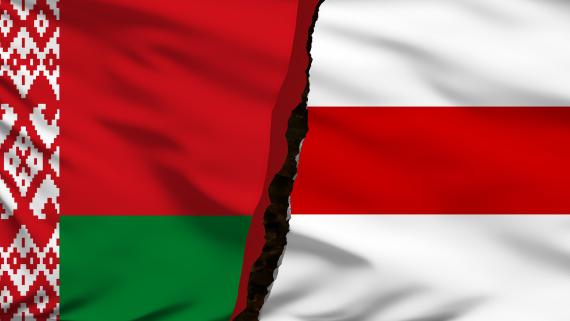
In spring 2024, Belarusians had the “pleasure” of renewing two political bodies, both of which claim to represent the people, albeit in diametrically opposed ways: The All-Belarusian People's Assembly, appointed by Lukashenka, is intended to be the new super-authority to ensure his personal rule and the continuation of the authoritarian system, while at the same time fulfilling a demand by Vladimir Putin for internal reforms in Belarus. Staffed by 1,200 loyalists, it is also an artificial image of an “ideal society” in the eyes of the ruler, which excludes political opponents, i.e. most of the electorate, from participation. The democratic forces in exile, on the other hand, held what was probably the first Belarusian democratic election since 1994 with the elections to the Coordination Council. Technically successful, they hardly managed to arouse greater interest among the population, as the mandate, function, and potential for action of the “proto parliament” remains unclear. This report analyses how both work, how they came about and how they fit into the current political situation in and around Belarus.

IMAGO / ITAR-TASS

Elections as a “special operation”

With Lukashenka’s “single voting day” only a coup by the democratic forces is surprising

On February 25, 2024, the “single voting day” for the national parliament and local councils took place in Belarus. This was likely the least free election in the history of the nation. Politically sterile, with no opposition on the ballot or in the election commissions, Lukashenka is ushering in a process that the democratic opposition calls a “special operation.” Strictly guarded by a massive contingent of his repressive apparatus, the system is now to be restructured in the spring with a new super-committee in order to secure his authoritarian rule and personal power. From his point of view, the people are above all a threat following the peaceful pro-democratic mass protests of 2020. An action led by democratic forces produced a surprise on the eve of “Election Day.”

IMAGO / ITAR-TASS

The Human Rights Situation in Belarus on the Eve of the “Single Voting Day”

The repressive system in Belarus today is no less brutal than in Putin's Russia

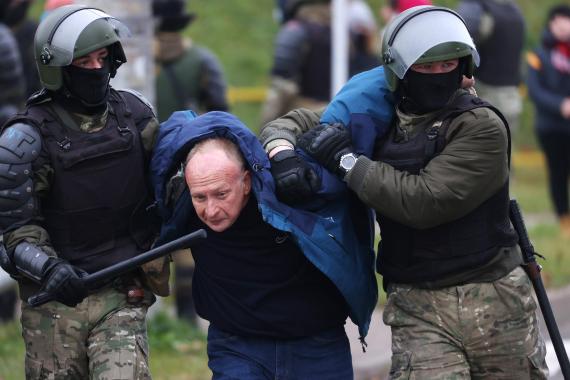
Just days after the breaking news of Alexei Navalny's death made global headlines, Belarusian independent media reported another tragedy that is similar in character but will likely cause much less attention. The political prisoner Ihar Lednik died in a hospital in Minsk after he had been incarcerated despite a known heart condition. He had been accused of “slandering Lukashenka” in a publication that demanded the dissolution of the Union State with Russia. This underlines yet again that the repressive system in today’s Belarus is not less brutal than in Putin’s Russia. Since 2020, at least five political prisoners have died in Belarus, four of them within the last nine months. Since last spring, at least six political prisoners, among them the most prominent leaders of the 2020 democratic protest, have “disappeared”. Former inmates and relatives describe the conditions in the penal colonies as “creeping death” and the UN sees signs of “crimes against humanity”. Since the repressions aim to secure Lukashenka’s rule beyond “elections”, this report is to give an overview of the human rights situation in Belarus on the eve of the “single voting day” on February 25, 2024.

IMAGO / ITAR-TASS

The Wagner Group in Belarus

Possible scenarios based on their previous activities worldwide

The alarming reports about the relocation of the private military company (PMU) Wagner to Belarus after the aborted "March on Moscow" raise a number of questions with regard to national and regional security: Will the Wagner Group act as a political actor in Belarus? Which "instruments" from previous missions in other parts of the world could it bring to bear? And what danger is there for Ukraine and NATO countries if Lukashenka openly fantasises about "excursions" to Poland by his new guests?

IMAGO / ITAR-TASS

New friends in the "eastern vector"

Upheaval in the foreign policy of Belarus

For decades, the foreign policy of the Republic of Belarus resembled a pendulum game between East and West. But following the crackdown on the peaceful protests in 2020, the "Ryanair incident" and the artificial migration crisis, the regime isolated itself from the West. Lukashenka's complicity in Russia's war of aggression also severed traditionally important ties with Ukraine. In the shadow of Moscow's crushing dominance, Minsk has recently made efforts to deepen its relations with countries of Central Asia, China and Iran. It remains to be seen how Lukashenka's "mediation" in the Wagner uprising will affect his foreign policy leeway.

Konrad-Adenauer-Stiftung e. V.

Menschen mit Behinderungen und das Bildungssystem in Belarus

Inklusion weltweit – aktueller Stand aus Belarus

Trotz einer äußerlich relativ guten Situation in dem im Titel angesprochenen Bereich in Belarus – vor allem auf der Ebene der Gesetzgebung – scheint die reale Lage bei einer genaueren Betrachtung von dem schönen Bild, das der Staat vor allem auf der internationalen Bühne darzustellen versucht, weit entfernt zu sein. Der vorliegende Überblick gründet sich auf Berichte belarussischer Menschenrechtler und Empfehlungen des UN-Ausschusses für die Rechte des Kindes vom Februar 2020. Die Lage wird sich seitdem kaum zum Besseren verändert haben, da das in Belarus herrschende Regime seit August 2020 um sein Überleben kämpft und kaum Mittel für signifikante Verbesserungen in diesem arbeits- und ressourcenintensiven Bereich hat. Außerdem wurden seit August 2020 so gut wie alle NGOs, die sich in diesem Bereich betätigen und sich um einen Dialog mit dem Staat zugunsten der Menschen mit Behinderungen bemüht haben, auf Initiative des Regimes zerschlagen.

Asset Publisher

About this series

The Konrad-Adenauer-Stiftung is a political foundation. Our offices abroad are in charge of over 200 projects in more than 120 countries. The country reports offer current analyses, exclusive evaluations, background information and forecasts - provided by our international staff.

Order details

Editor

Konrad-Adenauer-Stiftung e.V.