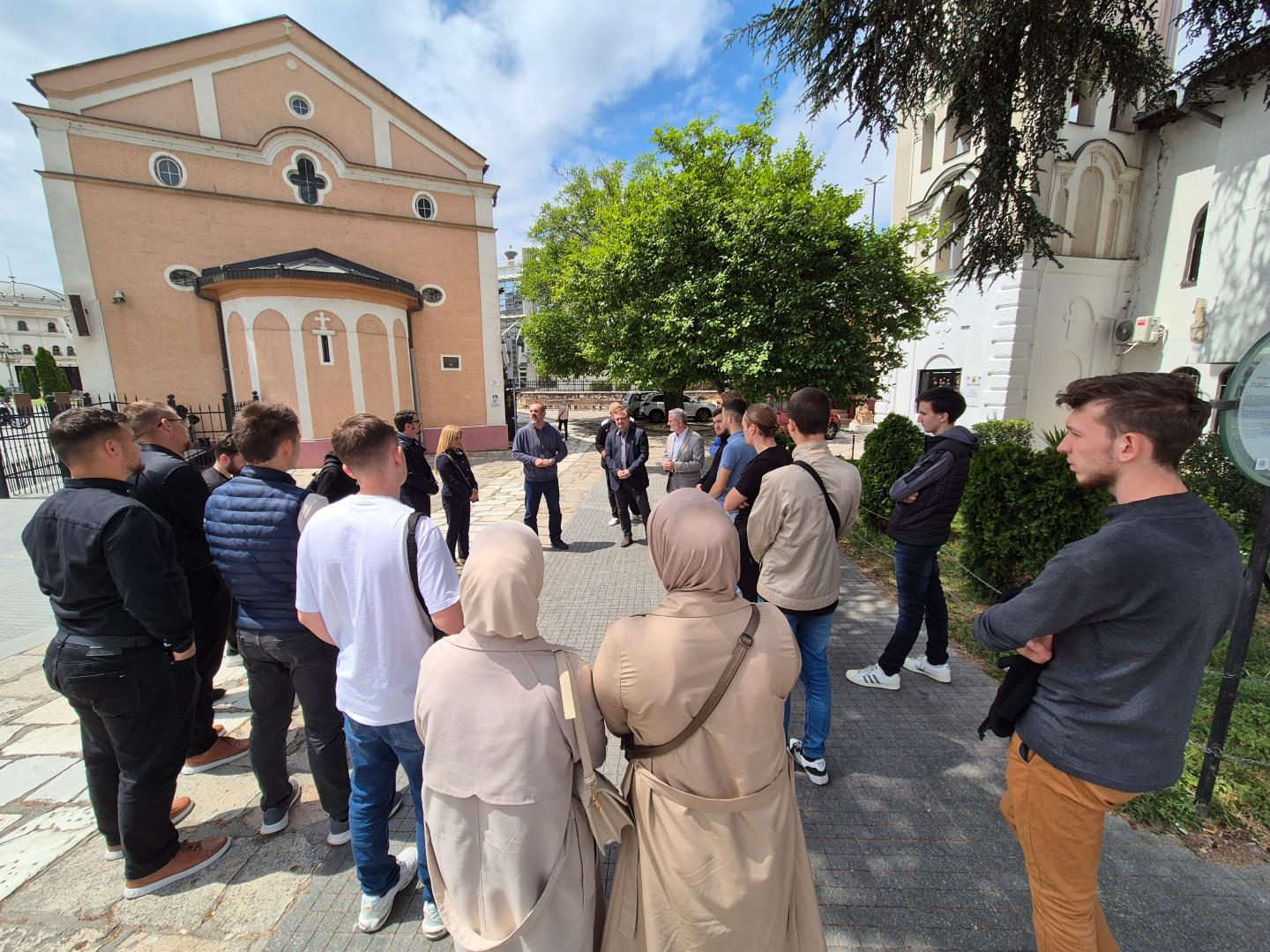
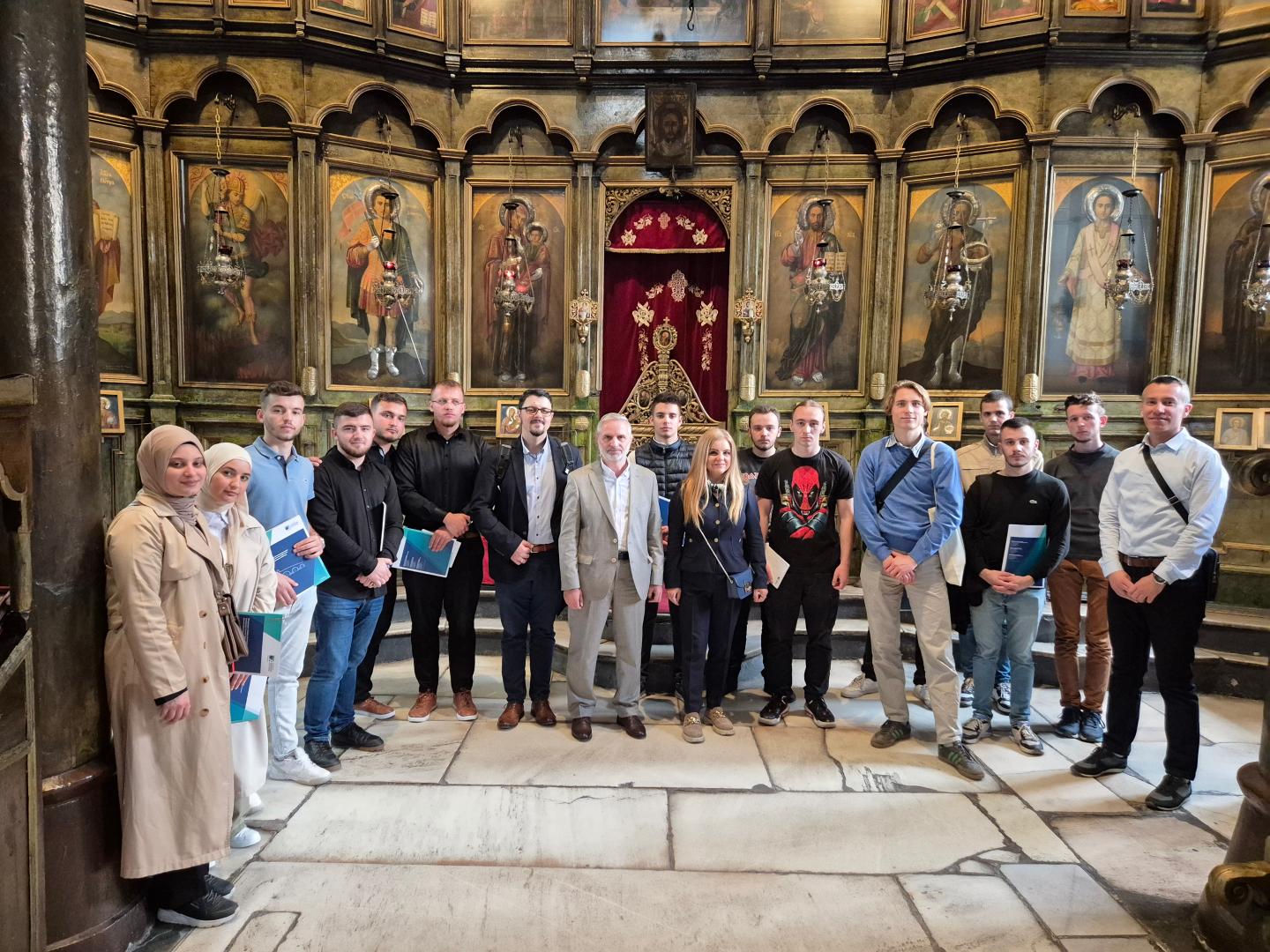
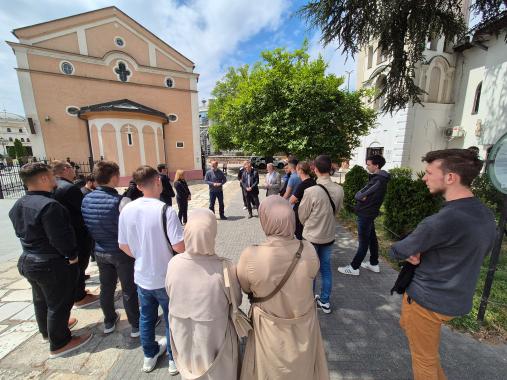
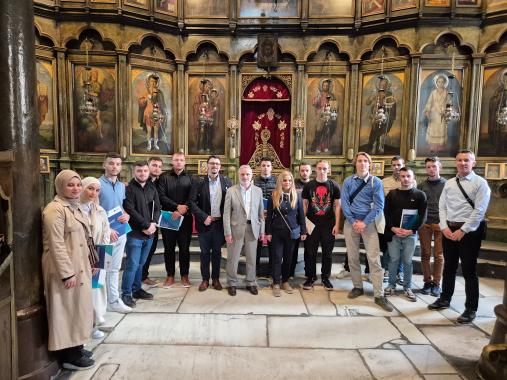
The participants gathered at the Church of St. Demetrius, one of the most significant Orthodox churches in Skopje. The event started with opening remarks given by Daniel Braun, Official representative of Konrad Adenauer Foundation, who emphasized the importance of interethnic and interreligious communication in a multiethnic country like North Macedonia.
Later professor Aneta Javkovska from the Faculty of Orthodox Theology, provided historical context on the Church of St. Demetrius and how its history can serve as a basis for fostering mutual cohabitation nowadays. Professor Jovkovska referenced the Parable of the Good Samaritan to highlight how compassion across divides can foster interreligious and interethnic understanding. The story served as a reminder that true progress in mutual communication comes when we, like the Samaritan, show empathy and solidarity beyond our differences.
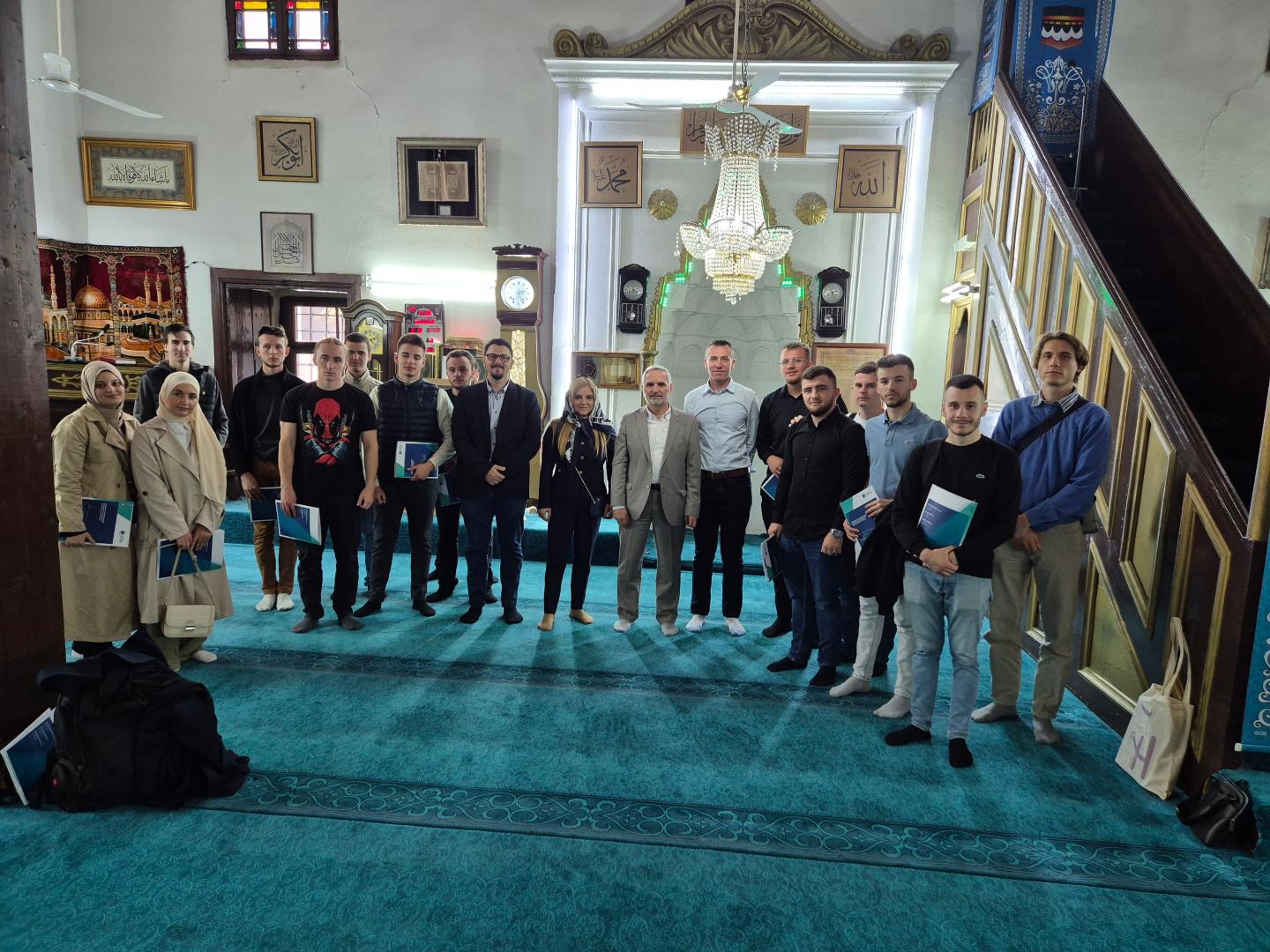
The study visit continued through the streets of Skopje’s Old Town, which are rich with traces from the Ottoman Empire, and reached the Mosque of Murat Pasha, located in the heart of the Old Bazaar. Inside the mosque, Professor Naser Ramadani from the Faculty of Islamic Science has provided insights into its historical and architectural significance. He highlighted the mosque's role as a symbol of the city’s cultural and religious diversity, situated in a space where different faiths have coexisted for centuries. This setting provided a valuable context for discussing how such shared spaces can promote interreligious dialogue and understanding.
After the insightful visit to the Church of St. Demetrius and the Mosque of Murat Pasha, the study visits concluded at a restaurant overlooking the Vardar River and Skopje’s main square, where the interethnic and interreligious exchange continued over a luncheon discussion in an informal setting. We as KAS Office in North Macedonia are pleased to see that yet another edition of the Interreligious Classroom project has come to a successful conclusion.