




Asset-Herausgeber

Publikationen

Asset-Herausgeber

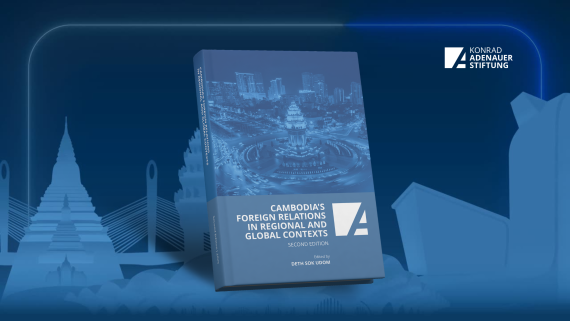
Cambodia's Foreign Relations in Regional and Global Contexts

Second Edition

In December 2017, Konrad-Adenauer-Stiftung (KAS) Cambodia published the first edition of Cambodia’s Foreign Relations—a collection of twenty articles exploring the Kingdom’s diverse and evolving external engagements. That inaugural edition provided a comprehensive overview of Cambodia’s diplomatic relations with its neighbors; its interactions within maritime Southeast Asia; its partnerships with regional and global powers; and its participation in international organizations, economic cooperation, and security affairs. Now, seven years later, we at KAS Cambodia believe it is high time to revisit and update this important work, which has since become a key reference for students and scholars of international relations, as well as for the diplomatic community. The past decade has witnessed profound changes in the regional and global order. Strategic rivalries have intensified, new economic partnerships have emerged, and pressing transnational challenges—from climate change and the COVID-19 pandemic to digital transformation—have reshaped the landscape of international cooperation.

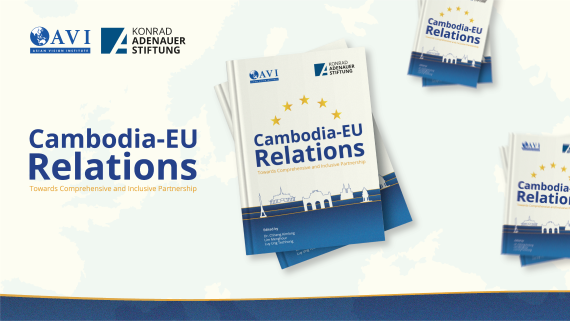
Cambodia-EU Relations: Towards Comprehensive and Inclusive Partnership

"Cambodia-EU Relations: Towards Comprehensive and Inclusive Partnership" is a joint publication by Konrad-Adenauer-Stiftung Cambodia and the Asian Vision Institute. The publication is the result of genuine collaboration, shared vision, and countless conversations between individuals and institutions committed to deepening the understanding of Cambodia–EU relations. It reflects not only the evolution of policies and partnerships but also the spirit of cooperation that has long connected our two regions.

Cambodia’s Economic Transformation: Pathways to Diversification, Competitiveness, and Resilience

Policy Brief | Issue 3

Welcome to the third issue of the annual policy brief of the Konrad-Adenauer-Stiftung Cambodia and the Institute for International Studies and Public Policy of the Royal University of Phnom Penh. This edition, “Cambodia’s Economic Transformation: Pathways to Diversification, Competitiveness, and Resilience”, boldly examines strategic areas for broadening Cambodia’s economic base and strengthening economic resilience by leveraging technology, education, and investment.

Law and Innovation

Law & Innovation is a compilation of scholarly articles produced under Konrad-Adenauer-Stiftung (KAS) Cambodia’s Law & Innovation initiative. The publication gathers diverse perspectives from legal scholars and practitioners examining the intersection of law, technology, and innovation. Each article explores pressing issues such as digital governance, artificial intelligence, and data protection, emphasizing how law can both enable and regulate technological progress. Together, these contributions aim to inspire dialogue and guide Cambodia’s legal development toward a modern, innovation-driven society.  

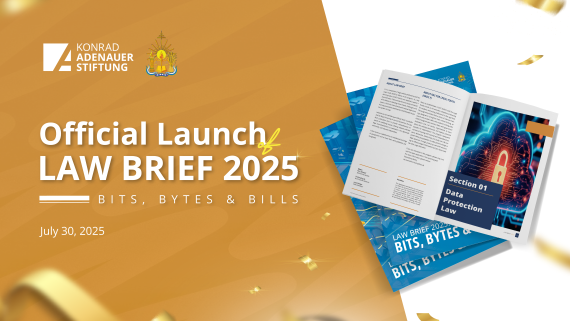
Law Brief 2025: Bits, Bytes & Bills

Bits, Bytes & Bills

Law Brief is a compilation of legal articles produced by KAS For Legal Youth (KASFLY) fellows in the program. As a key learning output, KASFLY fellows are required to author a law brief article. These articles focus on issues of interest of the fellows on debating recent trends, challenges, and issues in "Digital Law" theme that may provoke key development and threaten the justice system at large.

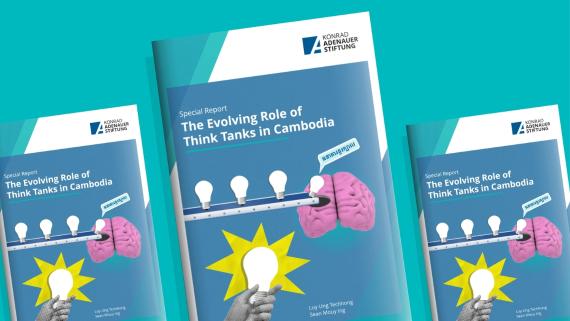
The Evolving Role of Think Tanks in Cambodia

What exactly is a think tank, what do these organisations actually do, and how do they operate in Cambodia’s current climate? This special report offers a long-overdue, full-spectrum look at the country’s think-tank landscape, domestic and foreign alike, by explaining their roles, the constraints they face, and why their work matters for evidence-based policymaking. On Friday, 30 May 2025, KAS Cambodia convened the dialogue “The Role of Think Tanks in Cambodia: Challenges and Opportunities,” bringing together local institutes, government officials, and international experts. Insights from that discussion, combined with the authors’ independent research and literature review, form the backbone of this report. Why do Cambodian think tanks matter and how have they grown from fragile saplings into a thriving ecosystem of ideas? The report revisits Sangkum planning offices of the 1960s, the void left by the Khmer Rouge, and how CDRI and CICP moved after 1993 to fill data gaps. By the 2010s a second wave of institutes, university centres and policy units had mushroomed with economic integration. Today the landscape spans autonomous NGOs, quasi independent hubs, government link and foreign foundations, all registered with state ministries and balancing autonomy with alignment. Alongside policy papers they host dialogues, train skilled analysts and translate research for local audiences. International grants keep the lights on, domestic funds stay scarce, brain drain siphons talent and bilingual outreach strains budgets even as ministries call for data driven policy. Yet unlike peers in larger economies they rarely command endowments or subscription income, and that financial fragility shapes the substance and speed of their work. The study urges institutes to link research to national priorities, widen funding, embed peer review and publish in Khmer and English, working with rather than against the growing cadre of government researchers. Cambodia’s policy future will be sturdier once a financially resilient, methodologically rigorous and locally rooted think tank community turns evidence into long term insight.

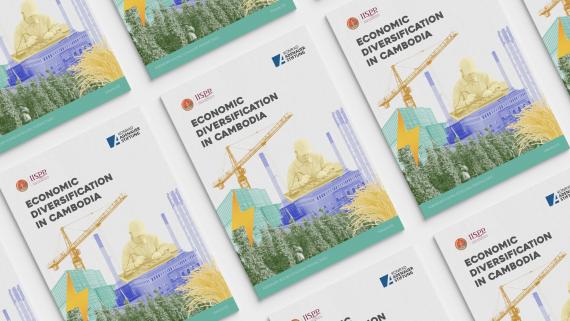
Economic Diversification in Cambodia

Adenauer Young Scholars' Perspectives

As Cambodia looks beyond its traditional industries to build a broader, more resilient economy under the Pentagonal Strategy Phase I, our fellows from Adenauer Young Scholars have mapped out where and how the next wave of growth might emerge. Their findings, captured in fourteen commentaries in Adenauer Young Scholars’ Perspectives on Economic Diversification in Cambodia, highlight practical ideas on new sectors, skills, and policies that can drive this transition. If you want a concise, up-to-date take on Cambodia’s diversification journey, this collection is an inviting place to begin.

Geostrategic Competition in an Age of Uncertainty: Predict the Unpredictable

Diplomatic Briefing Issue 07/2024

The seventh issue of Diplomatic Briefing, we have gathered scholars across Cambodia and the region to provide their insights on evolving and complex political and security issues across the world.

Driving Digital Transformation in Cambodia: Issues, Challenges and Recommendations

Policy Brief | Issue 2

Welcome to the second issue of the annual policy brief of the Konrad-Adenauer-Stiftung Cambodia and the Institute for International Studies and Public Policy of the Royal University of Phnom Penh. This edition, “Driving Digital Transformation in Cambodia: Issues, Challenges, and Recommendations,” boldly examines the complexity of various issues concerning Cambodia’s digitalization progress.

Law Talk Conference 2024 - Report

Since its inception in 2006, Law Talk Conference has been hosting various discussions on legal development in Cambodia on many topics such as labor law, consumer protection, cybersecurity, personal data protection, and more. This is an exclusive conference which brings stakeholders together to discuss how to make the law better for Cambodia. Every year, we welcome over 50 guests from government bodies, international organizations, legal practitioners, businesses, and academics to discuss emerging legal issues. Over the years, Law Talk has been instrumental in shaping legal frameworks and influencing national policies. A noteworthy achievement was in 2022 when recommendations from Law Talk’s publication on Consumer Protection were adopted into a Sub-Decree 0.113 on “cooling off” period by the Ministry of Commerce, underscoring the conference's impact on legal reform. This year, the 23rd Law Talk was held under the theme of “The Intersection of Law and Artificial Intelligence” with the support from National University of Management and the German Federal Bar Association.