








The conference was opened by Dr James Kember, the Chair of NZIIA, who set the scene by quoting the Roman Emperor Hadrian: ‘Peace through strength. Failing that, peace through threat. In the Opening Session, the Ukrainian Ambassador to New Zealand, HE Vasyl Myroshnychenko, reminded the audience that Ukraine had given up its nuclear arsenal in the 1990s, and called for a strong and united response by like-minded countries to Russia’s aggression.
The AsiaNZ Foundation presented the results of its survey on New Zealanders’ perceptions of Asia & Asian peoples, showing that Aotearoa’s literacy of Asia had increased. Further, there were various keynote speakers and high-profile experts from New Zealand, Australia, the USA, Mexico, India, and the Pacific Region, who spoke to New Zealand’s foreign policy reset, the changing international order, climate change, trade and economics, and Trump 2.0.
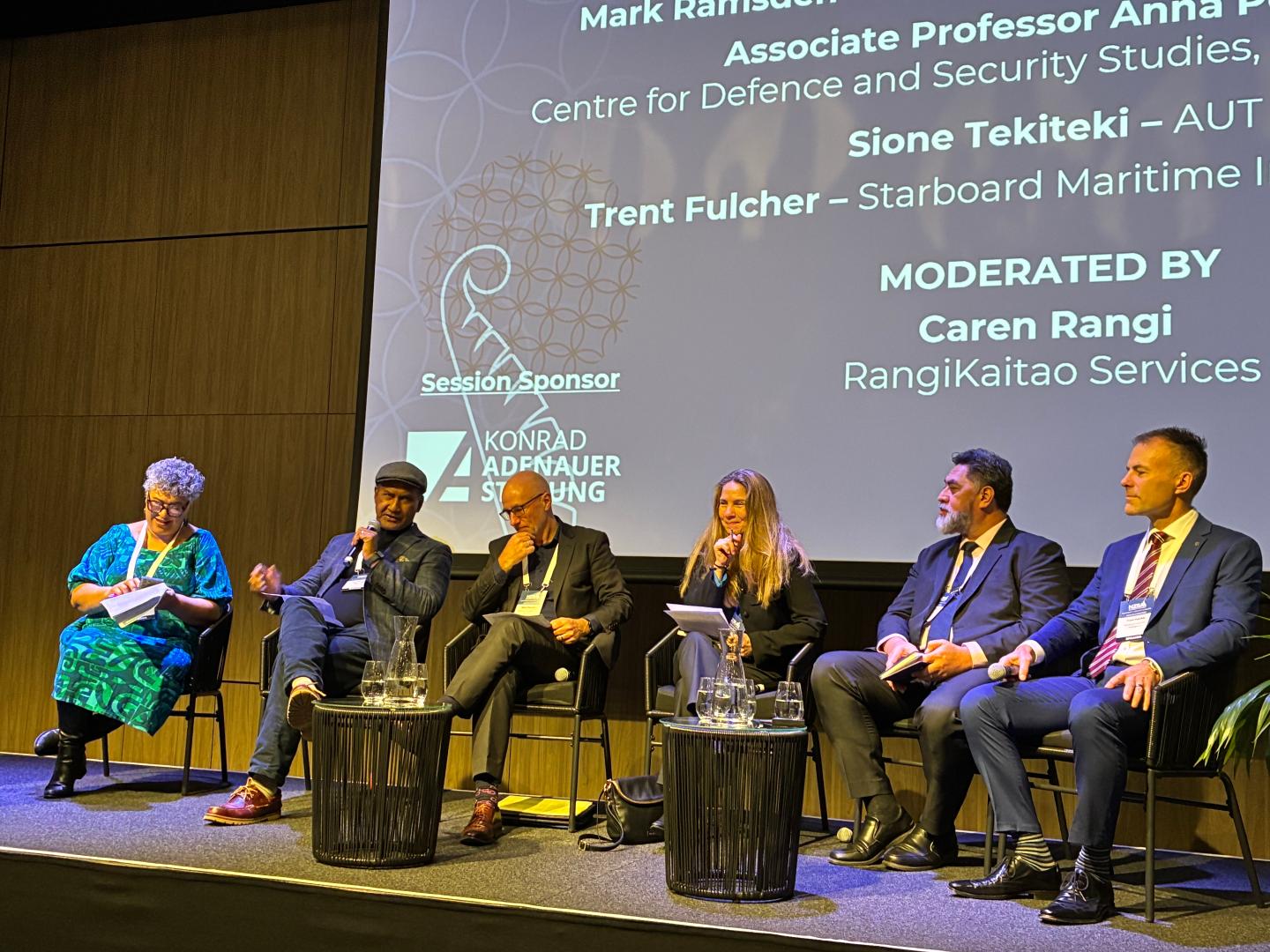
The KAS-sponsored Panel on security in the Pacific region evolved around the various dimensions of security (including human, economic, climate, and financial), the rising geopolitical competition in the region, and related matters. More precisely, the MFAT representative inter alia outlined New Zealand’s engagement with the Pacific (e.g., PNG-Bougainville independence negotiations scheduled to be held in New Zealand next week) and beyond (e.g., PM Luxon’s attendance at the upcoming NATO Summit). Anna Powles from Massey University inter alia highlighted the dual challenge of external geopolitical pressure and internal friction. Sione Tekiteki from the Auckland University of Technology (previously a long-term employee of the PIF Secretariat) inter alia emphasized the need to consider the Pacific perspective at the domestic level (including small populations and their limited capacities) and expressed his concern that bilateral agreements might affect the conclusion of regional treaties. Steven Ratuva from the University of Canterbury inter alia addressed the insecurity caused by climate change, noting it had become a political issue leveraged by great powers. The CEO of Starboard Maritime Intelligence demonstrated his company’s surveillance of illegal maritime activities (eg, fishing) in the Pacific region and around the world.
The conference concluded with a keynote address by the Minister for Foreign Affairs, the Rt Hon Winston Peters, who outlined New Zealand’s foreign policy reset. Foreign and trade policy, he said, may seem abstract but affects New Zealanders in their everyday life. In his view, it is incumbent on New Zealand to chart its own course, noting that the current challenges also provide enormous opportunities.