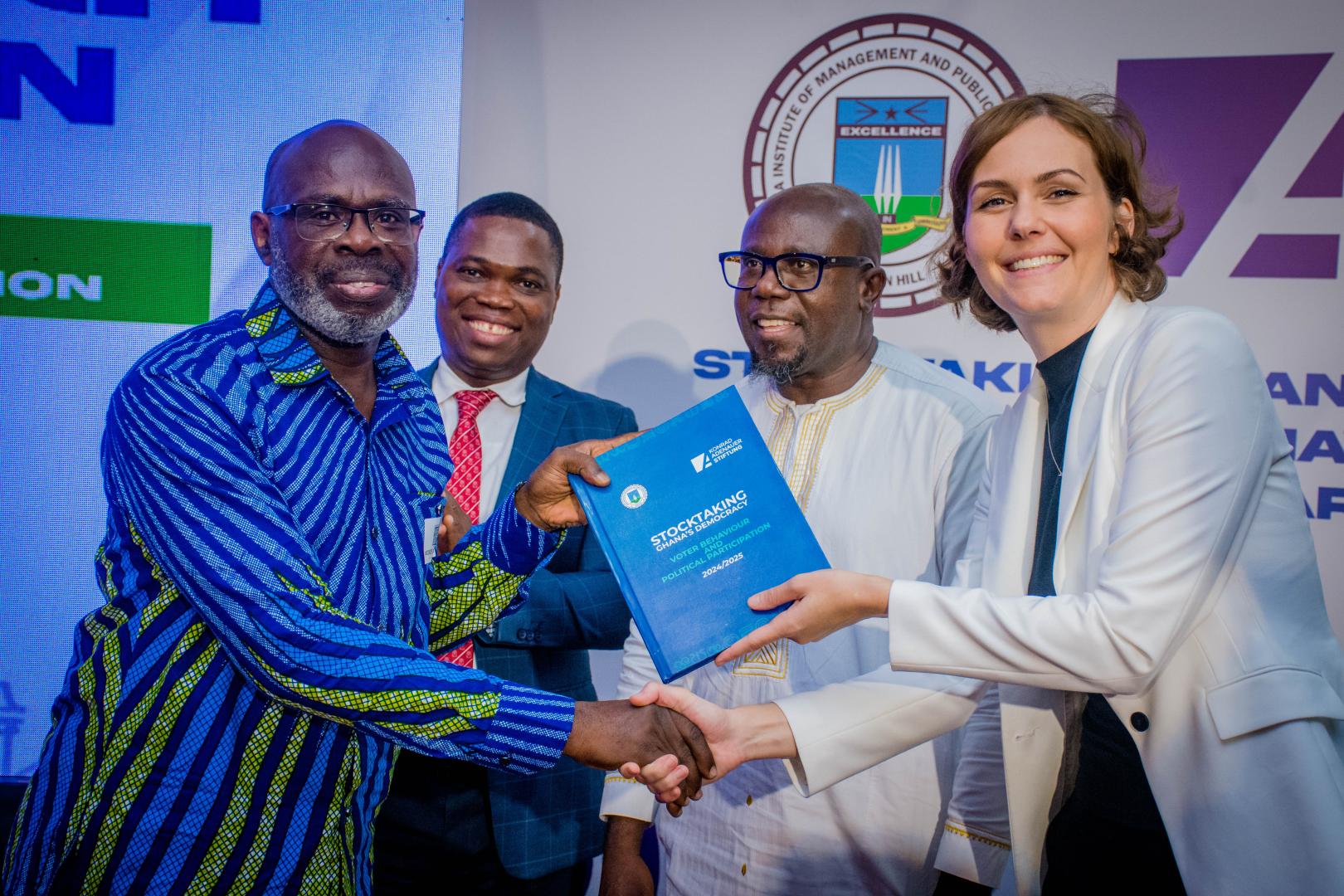
Methodology
For the survey, 16,988 respondents were representatively selected from all 276 constituencies in all 16 regions of the country. The sample was distributed proportionally to the voter population of each region according to the 2023 Ghana Electoral Commission figures. The respondents comprise 8,244 men and 8,744 women.
Important findings
- The study provides insights into the causes of the comparatively low voter turnout as well as socio-economic, demographic, and political factors influencing voting decisions.
- Around 50.5% of respondents felt a strong connection to a particular political party and stated that this had an impact on their voting decision.
- At the same time, 81.6% of voters said they voted for the National Democratic Congress (NDC) mainly due to the disappointing government performance of the New Patriotic Party (NPP) between 2020-2024 under President Nana Akufo-Addo.
- The main reasons for the voting decision also include economic aberrations, the high cost of living, the introduction of the e-levy, and corruption.
- Regarding the influence of demographic factors on voting behavior, it is evident that party loyalty is less strong among young people than among older generations, and they are more willing to vote for other parties or candidates that do not represent either the NPP or the NDC.
- The publication also highlights the influence of religion on voting behavior, investigates which media voters prefer for political information, assesses whether misinformation and disinformation during the elections were seen as problematic, and evaluates the overall level of trust respondents have in the electoral process and democracy in Ghana.
- Finally, the study also provides a forecast of possible political developments in the future by analysing, for example, which presidential candidate respondents prefer for the upcoming elections or how likely they think it is that they will vote in 2028.
Significance of the study
This work serves as a valuable source of information for policymakers, academics, journalists, and the interested public. It presents a historical inventory of democracy in Ghana, provides fact-based analyses of political participation, and contributes to the promotion of a well-founded democratic discourse. The study is also the prelude to a series of publications of the same name entitled ‘Stocktaking Ghana's Democracy’: further papers, publications, and studies dealing with various aspects of Ghanaian politics and democracy will be published under this title in the future.
We thank GIMPA for the scientific management of the study and all partners who contribute to strengthening democracy in Ghana and beyond.
- Authors: Prof. Samuel Bonsu, Dr. Joseph Darmoe, Mrs. Anna Lena Sabroso-Wasserfall