






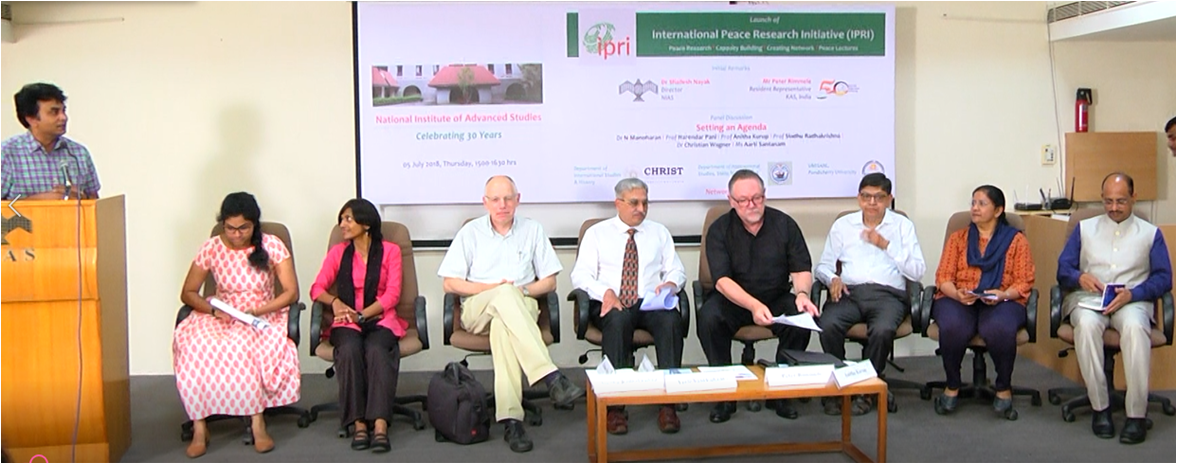

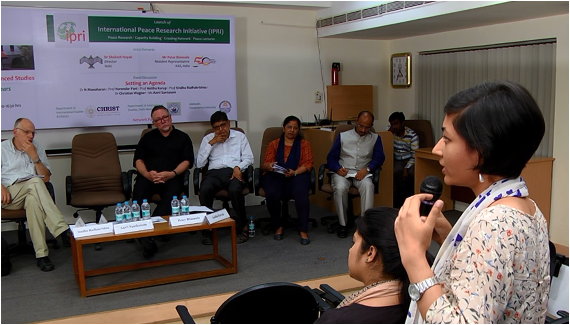
In his introductory remarks, Prof. Suba B. Chandran, Dean of the School of Conflict and Security Studies at NIAS, emphasized that the initiative seeks a multidisciplinary approach and addresses peace issues from different perspectives. The aim of the initiative is to develop policy recommendations for a sustainable peace and to bring civil society together with the government. Dr. Shailesh Nayak, Director of NIAS, emphasized in his welcome address that the technical aspects of promoting peace should also be paid attention to in the consideration of sustainable peace solutions. Mr. Peter Rimmele, Resident Representative of the India office of KAS, pointed to the German-French relations and how successful, despite centuries of enmity, relations had developed since the end of the Second World War. How a sustainable peace could be achieved has been impressively demonstrated by European countries in recent decades, said Mr. Rimmele.
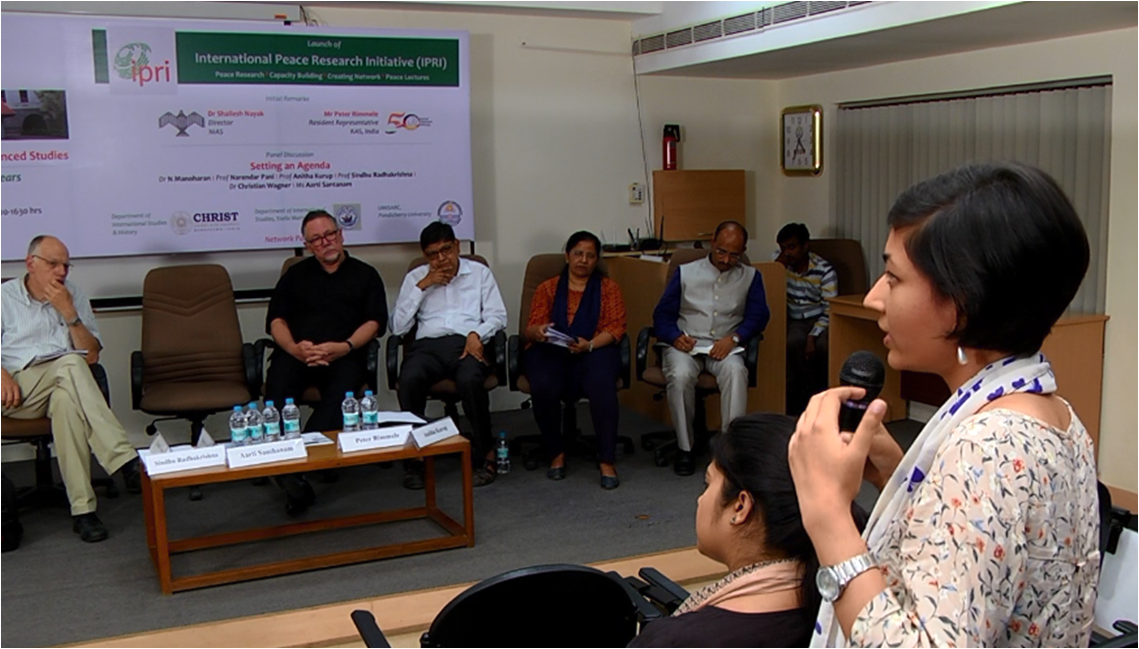
In the following discussion, Dr. Christian Wagner, Senior Fellow of German Institute for International and Security Affairs, Dr. N. Manoharan, Associate Professor at Christ University, and Prof. Narya Pani, Professor Anitha Kurup, Prof. Sindhu Radhakrishna, all from NIAS, and Ms. Divya Bharathi, Stella Maris College, debated about current developments in peace and their expectations of the newly launched initiative. At the outset, the experts stated that the world is less peaceful than in the last decade. Due to growing uncertainty and unpredictability on a global scale, increasing inequality at the local and global level and the impact of climate change, the potential for conflict is rising rather than diminishing. It is therefore important to prevent conflicts in advance. Especially education plays an important role, said one of the experts. Learning from successes in conflict mediation and reconciliation of societies, but also strengthening of weak state structures, especially the judiciary, in order to ensure justice, and human rights training for security forces are important steps towards a sustainable peace. In addition, it is important to convey tolerance already at a local level and in school in order to prevent conflicts.
With the International Peace Research Initiative (IPRI), KAS and NIAS aim to provide a platform for research on peace, development of policy recommendations, networking and capacity building for peace and conflict researchers. Besides the NIAS-KAS lectures on peace, the initiative will also give inputs to the highlights of NIAS-KAS cooperation which would manifest itself by way of an annual study on worldwide armed conflicts and peace processes. KAS and NIAS are thus continuing the study on armed conflict in South Asia after a hiatus of a few years.