




The year 2015 was a challenging one for student bodies in South Africa. It began in March with students from the University of Cape Town (UCT) protesting against a statue of former imperialist and Apartheid race theorist Cecil John Rhodes on the university campus. In modern South Africa this symbol of Apartheid segregation was proclaimed no longer tolerable by the #RhodesMustFall movement. After the statue was removed from the UCT campus on April 9th protests spread to other universities, demanding the “decolonization” of the South African educational system. A second major wave of protests began with University of Witwatersrand students demonstrating against a more than 10 percent fees hike for 2016 which soon spread nationwide demanding the abolition of student fees. And again, they took to the streets with cardboard signs like in 1960s Europe, demanding “feesmustfall”, singing, dancing, and toyi-toying - a uniquely South African sort of protest dance. On the eve of the first free elections in 1994 the African National Congress (ANC) had promised free education for all citizens. In reality there might be free schooling, but sadly it has become a synonym for poor quality. Private schooling ensures a higher standard which is a requirement to even qualify for higher education. Universities remain a very elitist domain. Only a few students from weak socio-economic backgrounds can enter university and often their families struggle to keep their children in school. In 2015 students stepped out to the streets and demanded change.
DIGITAL UPRISING
The difference between the 1960s protest and today’s movement lies in the form of the messages. Protest signs use social media symbols like the twitter hashtag to formulate brief and basic demands of the movement. In 2015 it seems all remnants of inequality had to fall in South Africa. The suffix “mustfall” developed into the universal mantra of resistance for the South African protest movements initiated by the “born free” generation. #Rhodesmustfall, #FeesMustFall, #ParliamentMustFall. Nowadays, political activism means mass protest organized online.
The born free generation grew up after the first free elections in South Africa in 1994 and after the end of the illegitimate Apartheid state. Now they are young adults and are they are transferring the traditionally vibrant South African protest culture to the digital world by using twitter to express demands on educational policy and equality. Within only one year, the number of active internet users climbed 24% to approximately 25 million users. The popularity of social media apps has risen at a similar pace. South Africa indeed boasts a very active Twitter scene - 13% of the population are active twitterers and with a total user figure of 6,6 million the continent’s southernmost country holds peak position in Africa. In contrast, this microblogging service has established itself in Germany more as a channel for professional statements, persons of public interest, journalists and media workers - only 7% of Germans use the service.
'#BORNFREE PAY LATER'? “BORN FREE” AND THE 68-GENERATION
The born free generation lives in a very different world to their parents, whose everyday lives were dominated by racism, discrimination and segregation. The extent of the difference in their respective circumstances is comparable to the post-war generation in mid-20th century Germany. “68s” was the tag adopted for a whole generation born after the Second World War that reached adulthood in the 60s, also twenty years after a major rupture in their national history. Closely linked to the left wing European civil rights movement, this generation developed a very active protest culture. Squatting, sit-ins, street demonstrations, conflicts with the police and acts of vandalism were part of the movement that was predominantly sustained by the students of that time. The origin of the conflict lay rooted in deeper tensions between the generations. Young people criticized their parent’s passiveness towards their German past and called for the reappraisal of atrocities and crimes under the Nazi regime. In their search for a common set of societal values that had been lost during the war era, the 68 generation sparked a process of vast cultural and social transformation.
A GLIMPSE INTO HIDDEN LIVES
We may find such a tension between generations now in South Africa. The young generation has not experienced Apartheid but was born into a society with deep divisions. Now they are starting to protest for their constitutional rights and also against their parents’ powerlessness against the remaining inequalities in the political system. In the South African weekly newspaper Mail & Guardian, commentator Sisonke Msimang called the big media attention students managed to create with #feesmustfall “a glimpse into hidden lives of South African society”. Through protest people try to draw attention to slow-burn conflicts, problems of marginalized groups of society and unsolved social issues. This is a very important process for the negotiation and modernization of social norms and it is equally important for the discourse about experiences of daily discrimination and inequality. Social media provides a space for personal stories and the means to share and preserve experiences within groups of similar interests and problems. Maybe, Msimang argues, the #feesmustfall movement is starting a process of reappraisal somewhere between the physical and the virtual world. Maybe this is the start of a more active dialogue about the problems and challenges of everyday life in South Africa between the different groups of society.
ACTIVISM AND THE HYPERMEMETICAL LOGIC OF THE SOCIAL WEB
Nowadays, big social movements online require digital branding in order to be successful, that is, some sort of shibboleth that sums up the mission in a symbol or a catchy statement. Immediate recognition and a characteristic, memorable quality are key features to stay visible and relevant in the massive data stream of the digital public sphere. Part of the success of #FeesMustFall is due to the use of the twitter hashtag as a means of protest. The system is a highly coordinated form of digital tagging that collects personal stories, discussions, comments and other things related to a certain topic and files all the information into an online archive. This is why an initiative is more successful the more consistently its hashtag or symbol is used. With this strategy, the #feesmustfall initiators harnessed the functional logic of social media in order to spread their reach and impact beyond cardboard signs on campus.
VIRALS VS MEMES
Online news diffusion can be differentiated into viral and memetic lineages. A viral piece of content is characterized by a massive increase in visibility in a short period because people in social networks share and reshare it. It will always be a single photo or video with exact copies being shared and shared again. There are many examples of viral commercials and other forms of advertisement. An internationally known example is the Superbowl commercial by German automotive brand Volkswagen, in which a boy dressed as Darth Vader brings the car to life using “the force”. At some point, viral content like this reaches a state of saturation after which its distribution stops and media attention falls. Viral pieces of content can be strategically planned and are popular tools as a controlled form of publicity, marketing and campaigning. In contrast, memetic content conveys more of an idea or feeling and reproduces itself by imitation and repackaging. Memes can have distinctively longer life cycles than virals and can become part of a social movement. In Germany, the hashtag meme #Aufschrei (outcry) archives daily cases of sexism against women and has become a popular online discussion forum on the subject.
BRIEF INTRODUCTION TO MEMETICS
There is a feature of the suffix “MustFall” that carries a very high social web value – its potential for associative variation and creative remixing. This is what allowed the fragment to become the sub-headline of international student protests aimed at overcoming racism in academia on campuses from Cape Town to Oxford and Berkeley. Academic research analyzing the phenomenon is a discipline called Memetics. Memes are cultural replicants, meaning cultural information like manners, ideas, catchphrases and complexes of meaning spread via imitation. The concept is linked to the evolutionary concept of genes, in which biological information spreads via contest, variation and extinction. The concept of memetics was introduced by evolution theorist Richard Dawkins in 1976 and was readopted with the rise of digital studies. Apparently, the spread of digital content follows the same dynamics as age-old myths and folk songs. Any social media user would recognize a meme. Most online memes have the structure of an image macro, a picture with superimposed writing in bold white font. Classic examples are LOLcats - anyone who doesn’t know grumpy cat most likely hasn’t been online in the past three years. There are also video and multimedia memes like snippets of movies turned into gif graphics or music clips that get mimicked by fans, like the “Happy” song by Pharell Williams. Pure text memes are the oldest memetic form because they require very little data capacity to be shared. Interestingly, with the spread of twitter as a mainstream platform, they are experiencing a revival due to the increased use of hashtags on social media since 2010, making the hashtag meme one of the memetic trends of the decade.
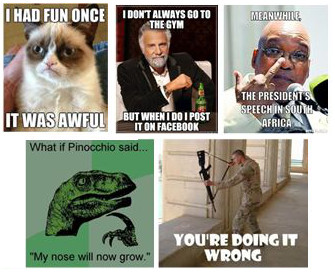
From this originally very playful cultural technique more serious variants have developed addressing and processing social issues. For example, every major world event is accompanied by a flood of memes. There is also now a tendency for mainstream media to regularly report about memetic trends online. Limor Shifman from the Hebrew University of Jerusalem is known as the expert on the construction of public discourse via memes. In her 2013 book Memes in Digital Culture, she describes how subversive messages can be coded into memes as pieces of pop culture. This is a useful tool for critical thinkers in oppressive media regimes like China and North Korea since symbols and intertextual references used in protest memes evolve at a speed that censorship officials can’t keep up with. For Shifman, the meme is the core of the shared culture of participation of the Web 2.0 age and a cultural custom across all media. The conditions of the social media communication environment developed this content form.
WHAT MAKES #FEESMUSTFALL A MEME
There are some basic features that constitute successful memes. There has to be a clear, immediately understandable message that is emotionally appealing to the receiver. The range of emotions is wide and varies from amusement to astonishment, revulsion or consternation and consensus or dissent with one’s personal political opinion. #FeesMustFall concisely sums up the message; it is also a clear and provocative demand that triggers spontaneous approval or refusal. Emotionalizing, exaggeration, polarisation and strong opinions are tendencies of online communication generally and are not limited to twitter and Facebook.
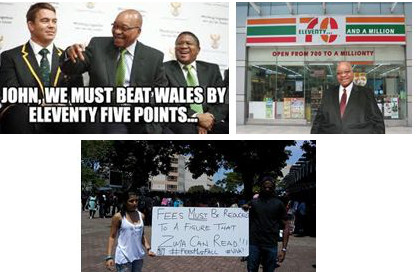
Memes are never isolated, otherwise they would be virals. Instead, they arise as groups of variants of one original meme and often get combined with one another; pop culture influences, topics of daily news and politics are interlaced. The better you can combine the original meme, the longer it will stay up-to-date because it can be transferred to different contexts. The word fragment of “must fall” can be combined in many ways. #RhodesMustFall and #FeesMustFall are variants linked to student life but there are also others. With the firing of the South African finance minister in late 2015, #ZumaMustFall gained a following as well as #ParliamentMustFall. There are several other memes lampooning lapses and scandals involving South Africa’s President Jacob Zuma. In October 2015, he struggled with his well-known weakness to read out big figures in English while giving an announcement about decreased party membership of the ruling ANC. As a reaction, “netizens” developed a number of funny meme versions mocking him. The left picture has a reference to the recent Rugby World Cup, the picture on the right is an example of a fusion of memes with reference to the student protests.
Furthermore, all socio-critical memes bear the tendency of producing antagonists, meaning subversive counter memes. In that way, all variants of the original meme represent a different opinion or identity within the memetic discourse. The Minister of Higher Education Blade Nzimade unwarily produced a counter meme by joking with a colleague about “studentsmusfall” in front of recording microphones. Students reacted indignantly to this statement and perceived it as a threat. This is an example of how politicians can fuel the escalation of debates by adopting the informal style of user-generated online language of the memesphere.
Other recent events can be found mirrored by the #FeesMustFall meme. There is an ongoing drought in South Africa which was turned into #RainMustFall. This slightly foolish version is a classic example of memes being hybrids between a recent news event and LOL content. The national month of diabetes awaren
The online campaign of the #FeesMustFall movement is very up-to-date and shows the innovative potential of the South African web community. It is now up to the “born free” generation to influence the future of their nation not only technologically but also politically. It is a country with a heavy burden of history, but perhaps social media is becoming the meeting space for discussion within the society, its indirectness and function as the barometer of public opinion can soften old frames and narratives and eventually create a common digital language for the nation.