




Asset Publisher

Geneva Telegram

Publications

U.S. Mission / Eric Bridiers / flickr / CC BY-ND 2.0

PABS Annex to the WHO Pandemic Agreement: The Sixth Meeting of the Intergovernmental Working Group in March 2026

Geneva Telegram

Article 19 of the Constitution of the World Health Organization (WHO) enables the World Health Assembly, by a two-thirds majority, to adopt international conventions or agreements on any matter within WHO’s competence. It was on this basis that the WHO Pandemic Agreement was adopted in May 2025. Its ratification process, however, cannot begin until the PABS Annex provided for in Article 12 has been adopted. To that end, the World Health Assembly established an Intergovernmental Working Group (IGWG), tasked with drafting the Annex and submitting it to the Seventy-ninth World Health Assembly for consideration in May 2026. From 23 to 28 March 2026, the IGWG convened in Geneva for its sixth formal meeting. Yet no agreement was reached. Instead, WHO Member States decided to resume the sixth meeting from 27 April to 1 May 2026 and to hold informal consultations in the interim. The next phase of deliberations will focus in particular on concrete rules for benefit-sharing, contractual mechanisms, and the institutional governance of the PABS System.

KAS Genf

Unpacking the Outcomes of the WTO 14th Ministerial Conference

Geneva Telegram

The 14th Ministerial Conference (MC14) of the World Trade Organization (WTO) was held between the 26 and the 30 of March 2026 in Yaoundé, Cameroon. The topmost decision-making body of the WTO met, as scheduled on a bi-annual basis, and this time brought together nearly 2,000 trade officials and more than 90 ministers responsible for trade from WTO members, to discuss the challenges and opportunities facing the multilateral trading system and to take action on the future work of the WTO. The Conference was chaired by Luc Magloire Mbarga Atangana, Cameroon's Minister of Trade. MC14’s agenda was quite packed, and included topics such as the extension of the E-Commerce moratorium, agricultural subsidies and the WTO reforms.  

U.S. Mission / Eric Bridiers / flickr / CC BY-ND 2.0

PABS Annex to WHO Pandemic Agreement: Fifth Meeting of Intergovernmental Working Group in February 2026

Geneva Telegram

The "Geneva Telegram" deals with events in Geneva's multilateral organizations on a current topic. Our latest report analyzes the fifth session of the Intergovernmental Working Group (IGWG) of WHO Member States who convened from 9 - 14 February in Geneva to advance negotiations on the PABS Annex to the WHO Pandemic Agreement. Pursuant to Article 12 of the Pandemic Agreement, the PABS Annex is intended to further elaborate a multilateral and legally grounded system that enables the rapid, safe and traceable sharing of pathogen materials and related sequence information, while inseparably linking such access to fair and reliable benefit-sharing. Whether such a system can prove both politically sustainable and operationally viable will depend above all on a precise definition of its scope, an enforceable contractual and institutional design, and its coherence with existing international frameworks.

U.S. Mission / Eric Bridiers / flickr / CC BY-ND 2.0

PABS Annex to WHO Pandemic Agreement: Resumed 4th Meeting of the Intergovernmental Working Group

Geneva Telegram

The "Geneva Telegram" deals with events in Geneva's multilateral organizations on a current topic. Our latest report analyzes the resumed 4th meeting of the Intergovernmental Working Group (IGWG) for the Pathogen Access and Benefit Sharing Annex of the Pandemic Agreement. Following the formal suspension of the fourth round of negotiations in December 2025, WHO Member States resumed deliberations on the PABS Annex under heightened time constraints from 20 to 22 January 2026. The Annex is intended to establish a safe, transparent and accountable system for the sharing of pathogens with pandemic potential and their genetic sequence information, alongside the fair and equitable sharing of benefits arising from their use. The objective remains to consolidate the PABS Annex to enable the WHO Pandemic Agreement, adopted by the Seventy-eighth World Health Assembly in May 2025, to be opened for signature once the Annex is completed. Subject to finalization, the PABS Annex text will be submitted to the Seventy-ninth World Health Assembly (WHA79) in May 2026 for consideration.

U.S. Mission / Eric Bridiers / flickr / CC BY-ND 2.0

3. and 4.meeting of the Intergovernmental Working Group on the PABS Annex of the Pandemic Agreement

Geneva Telegram

The "Geneva Telegram" deals with events in Geneva's multilateral organizations on a current topic. Our latest report analyzes the negotiations of the Intergovernmental Working Group (IGWG) for the Pathogen Access and Benefit Sharing Annex of the Pandemic Agreement. In November and December 2025, the Intergovernmental Working Group of WHO Member States reconvened to negotiate the PABS Annex of the Pandemic Agreement. In view of growing geopolitical tensions that repeatedly put multilateral processes to the test, this renewed affirmation of shared responsibility is a welcome signal. At the same time, these sessions once again revealed considerable divergences on central issues. As the operational core of the Agreement, the PABS Annex is designed to link the rapid and safe exchange of pathogen samples and sequence information with reliable access to pandemic-related products and equitable benefit-sharing, thereby enabling predictable research, production and allocation. For Germany and the EU, more than health policy is at stake: a practicable PABS stabilises data exchange, protects open science, creates investment incentives in laboratories and surveillance and reduces crisis costs. The task now is to design a ratifiable Annex that provides normative and legal certainty and is effectively deployable in an emergency.

U.S. Mission / Eric Bridiers / flickr / CC BY-ND 2.0

Antworten und Klarstellungen zu den Desinformationen rund um das Pandemieabkommen

Genfer Depesche

Für globale Gesundheitsexperten ist eine zukünftige Pandemie nicht eine Frage des Ob, sondern des Wann. Während aktuell die internationale Staatengemeinschaft die Details eines Annex des bereits im Mai 2025 verabschiedeten Pandemieabkommens aushandelt, nehmen nicht nur die Desinformationen zur WHO und zum Pandemieabkommen im Netz zu. Die aktuelle Genfer Depesche bietet Antworten und Klarstellungen zu den Desinformationen rund um das Pandemieabkommen.

UNHCR, 2024, Nicolò Filippo Rosso

Key insights from UNHCR’s new global trends report 2025

The "Geneva Telegram" explores events in Geneva-based multilateral organizations on a current topic. This time, the focus is on the new global trends report of the UNHCR.

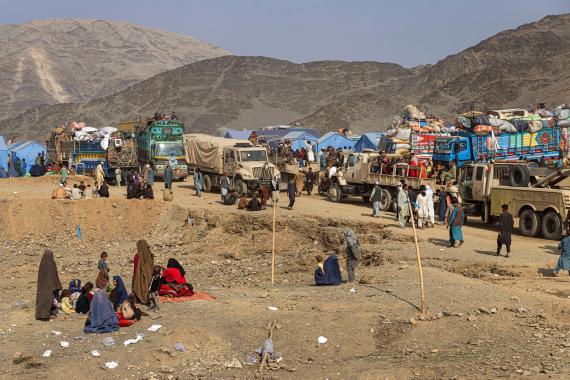
On 12 June 2025, the UN High Commissioner for Refugees (UNHCR) presented its new global trends report which focuses primarily on developments in 2024, in which 123.3 million people were displaced, 7 million people or 6% more than in the previous year. This is the 13th consecutive increase. The largest displacement crisis worldwide is currently Sudan, with 14.3 million people displaced. Despite the increasing needs, the UNHCR is facing a massive funding crisis, partly due to the financial uncertainty caused by the US foreign aid freeze, and is being forced to cut operations and staff by around 30%. UN High Commissioner Grandi therefore spoke of a ‘crisis of responsibility’ which is likely to fuel only further instability.

U.S. Mission / Eric Bridiers / flickr / CC BY-ND 2.0

The Pandemic Agreement

Opening a Window to Global Cooperation

The "Geneva Telegram" deals with events in Geneva's multilateral organizations on a current topic, this time the successful conclusion of negotiations on the WHO pandemic agreement. Our latest report analyzes the background to the agreement, its key contents and Germany's role in the negotiations.

U.S. Mission / Eric Bridiers / flickr / CC BY-ND 2.0

Geneva Telegram on the 13th meeting of the INB - A crucial moment for the pandemic response

The "Geneva Telegram" deals with events in Geneva's multilateral organizations on a current topic, this time the 13th meeting of the Intergovernmental Negotiating Body on the Pandemic Agreement (INB13), which met in Geneva from 17-21 February 2025.

With only five official negotiation days left before the World Health Assembly (WHA) in May—where the agreement is set to be adopted—delegations are under immense time pressure. While some progress has been made, key contentious issues remain unresolved. These include the distribution of resources and technologies during a pandemic, access to pathogens (Pathogen Access and Benefit Sharing, PABS), technology transfer, and the definition and financing of prevention measures. Despite geopolitical tensions, there is cautious optimism that an agreement can be reached. The withdrawal of the United States from the negotiations initially created uncertainty but has also reinforced the determination of the international community to push forward and conclude the agreement successfully.

UN Photo/Jean-Marc Ferré

What a second Trump Administration will mean for multilateralism, in particular International Geneva

The "Geneva Telegram" deals with events in Geneva's multilateral organizations on a current topic, this time the possible impact of a second Trump Administration on International Geneva.

Asset Publisher

About this series

The ‘Geneva Telegram’ analyses and documents the processes in Geneva's multilateral organisations on current topics. The reports on multilateral issues draw on the expertise of the KAS Geneva team and external authors. The Geneva Telegram is supplemented by the Maps of the Month, which summarise the voting results of UN member states on selected topics.

Andrea Ellen Ostheimer
Andrea Ostheimer
Director KAS Genf Office
andrea.ostheimer@kas.de +41 79 318 9841