Swedish-German Talk on Defence: Approaches and Insights from Stockholm and Berlin
The Jarl Hjalmarson Foundation and the Konrad-Adenauer-Stiftung Nordic Countries are pleased to present the Swedish-German Talk on Defence: May 26, 2026, Stockholm
In an increasingly uncertain geopolitical environment, robust Swedish-German defence cooperation is crucial to effectively responding to a growing roster of shared security interests and challenges. These include, but are not limited to, supporting Ukraine against Russia’s war of aggression, facing Russian hybrid operations and grey-zone tactics, responding to growing tensions in the Arctic and finding common and unified strategies to deal with great power rivalries. As NATO and EU member states, Sweden and Germany have made substantial progress in deepening their bilateral defence cooperation, yet potential for further collaboration remains. Against this backdrop, the Jarl Hjalmarson Foundation and the Konrad-Adenauer-Stiftung Nordic Countries are pleased to present the Swedish-German Talk on Defence, the first of two seminars exploring the defence and economic ties between the two countries. The seminar will discuss shared defence-related challenges and ways of responding to them, highlighting differences and commonalities between German and Swedish approaches, exploring opportunities for even closer collaboration and the further exchange of knowledge, experiences and best practices. The speakers will be: Pål Jonson, Swedish Minister of Defence, Carl Bildt, Former Prime Minister of Sweden, Prof. Dr. Carlo Masala, Professor of International Politics at the Bundeswehr University of Munich, Ludger Siemes, German Ambassador to Sweden.
When Security Comes Home: The Impact on Local Communities in the High North
Panel Discussion
This public panel discussion will critically examine the risks posed by an increasingly militarised national security approach to local communities in the High North and will explore strategies for mitigating negative repercussions.
A Konrad Adenauer Roundtable: The Thought of Europe
The Konrad Adenauer at 150 Roundtable Series
Countering Hybrid Threats in the Nordic Baltic Region
A current state of affairs
In recent months, European countries, particularly in the Nordic-Baltic region, have faced a surge in hybrid attacks, including cyber-attacks on public institutions and drone incursions near critical infrastructure.
"Nordic Security in a Changing European Context"
KAS Nordic Countries Autumn Conference
As Europe faces a rapidly evolving security environment – one that is shaped by renewed geopolitical tensions, hybrid threats, energy insecurity, and the ongoing repercussions of Russia’s war in Ukraine, among others – there is an urgent need to strengthen collective responses and strategic resilience. In this context, the Nordic countries play a pivotal role in safeguarding Europe’s Northern boundaries, including by contributing to NATO’s deterrence in the North and by occupying a crucial role in the broader European defence architecture. This first Konrad-Adenauer-Stiftung Nordic Countries´ Autumn Conference aims to inspire dialogue, foster new partnerships, and explore ways to strengthen European security. We will convene politicians, leading experts, policymakers and security analysts to examine Europe’s most pressing security challenges. With a focus on the Nordic region, the conference will discuss how to improve regional cooperation, strengthen strategic foresight, and find effective ways to enhance security. The conference will also dive deeper into how Germany can contribute to shaping and supporting a comprehensive security strategy that integrates both Nordic and broader European perspectives.
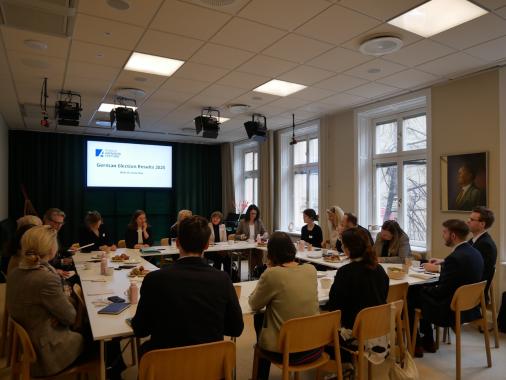
Evaluating the German Elections Results
How did Germany vote 2025? – A KAS Nordics Roundtable
The coalition of Social Democrats (SPD), Free Democrats (FDP) and Greens ruling Germany since 2021 collapsed in November 2024. With the election results now in, it is time to consider the possible coalition constellations, tease apart the key themes driving voters, and to analyse possible shifts in voting behaviour. Germany is the EU´s largest economy and most influential member state. For the Nordic countries, it is a key partner in trade and security politics. Thus, the outcomes matter not only for the German population and the country´s economy but also for the future of the European Union, Ukraine, and Northern Europe. To evaluate and discuss the outcome and its consequences for Northern Europe and the EU, the Konrad-Adenauer-Stiftung-Nordic countries invites you to a roundtable discussion.