Saudi Arabia is currently experiencing a wide-reaching societal transformation. In the once ultra-conservative kingdom, women are now permitted to drive, while world-famous singers like David Guetta and Jennifer Lopez grace the country’s stages in front of packed audiences. Before the announcement of Vision 2030 nearly ten years ago, everything was different: only men were allowed to apply for a driver’s licence, cinemas and concerts were forbidden, and the morality police employed excessive measures to enforce adherence to the religious leadership’s strict interpretation of Wahhabi Islam on the country’s streets.
Nowadays, the rethinking of societal rules and norms even touches Saudi Arabia’s official history. Traditionally, the story of the Saudi state began in 1744, when the Emir Mohammad bin Saud – current King Salman bin Abdulaziz Al Saud’s great-great-great-great grandfather – concluded a pact with the father of Wahhabism, the preacher Mohammad bin Abd al-Wahhab. Since 2022, however, the kingdom’s new Founding Day holiday rewinds this story back by 17 years. Instead of 1744, Founding Day commemorates 1727, the year in which Emir Mohammad climbed the throne of Diriyah, a town located on the western edge of contemporary Riyadh.
This revision of Saudi Arabia‘s official national history supports the re-structuring of the kingdom’s elite political consensus, which Crown Prince Mohamad bin Salman, called MbS, has championed since his father became king in 2015. MbS aims to limit the power of the Wahhabi clerical class, the ruling Al Saud family’s long-time governing partner. Beyond de-emphasising the importance of 1744, other examples highlight how purposefully the Crown Prince has sought to diminish the religious establishment’s status. In 2016, the state relieved the morality police of their enforcement authority, while in 2019, the prominent cleric Ayed al-Qarni delivered a public apology for the mistakes of the strict, ultra-conservative years of the Islamic Sahwa [period of awakening] from 1979 to 2015. Moreover, al-Qarni declared his enthusiastic support for the new „moderate Islam“ of the Crown Prince.1
Nevertheless, examples of continuity persist amidst the removal of central characteristics of the Sahwa period and the re-education of its most prominent supporters. This contrast is especially apparent in the historical domain. Despite the recent introduction of an amended founding myth for the state, important places in the kingdom remain true to the traditional narrative.
Based on two cases that highlight this simultaneity between continuity and change – the National Museum and the Diriyah History Museum in Riyadh – this policy report explains how, why, and under which circumstances the Saudi national historical narrative is transforming under Vision 2030. This piece argues that the new Saudi Arabia places less emphasis on a singular, all-encompassing origin narrative for the nation, but rather focuses on creating space for a multitude of histories narrated from below to coexist. The state thus changes not only the definition of what counts as Saudi history, but additionally widens the circle of those who are authorised to tell it. Departing from the status quo ante, this diversity brings with it a multitude of narratives that confer legitimacy upon the ruling Al Saud family. Simultaneously, ordinary Saudi citizens’ newfound status as narrators of the country’s past ensures that the biographies of their grandfathers and great-grandfathers contribute to cementing the nation’s status as a deeply rooted civilisation in the Arab world.
From the Covenant of Medina to the Alliance of Diriyah
An excursion from the Olaya neighbourhood, where matcha- and mocha-drinking men and women impart an impressive image of Saudi Arabia’s social transformation, to the National Museum in nearby al-Murabba transports visitors back into the time before Vision 2030. Opened in 1999, the National Museum takes visitors on a journey through the history of the Arabian Peninsula, starting in the era before Islam and ending with the founding of the Kingdom of Saudi Arabia in 1932. Throughout the exhibits, one motif recurs: the role of the pure, unadulterated Islam as the foundation stone for establishing political unity in Arabia.
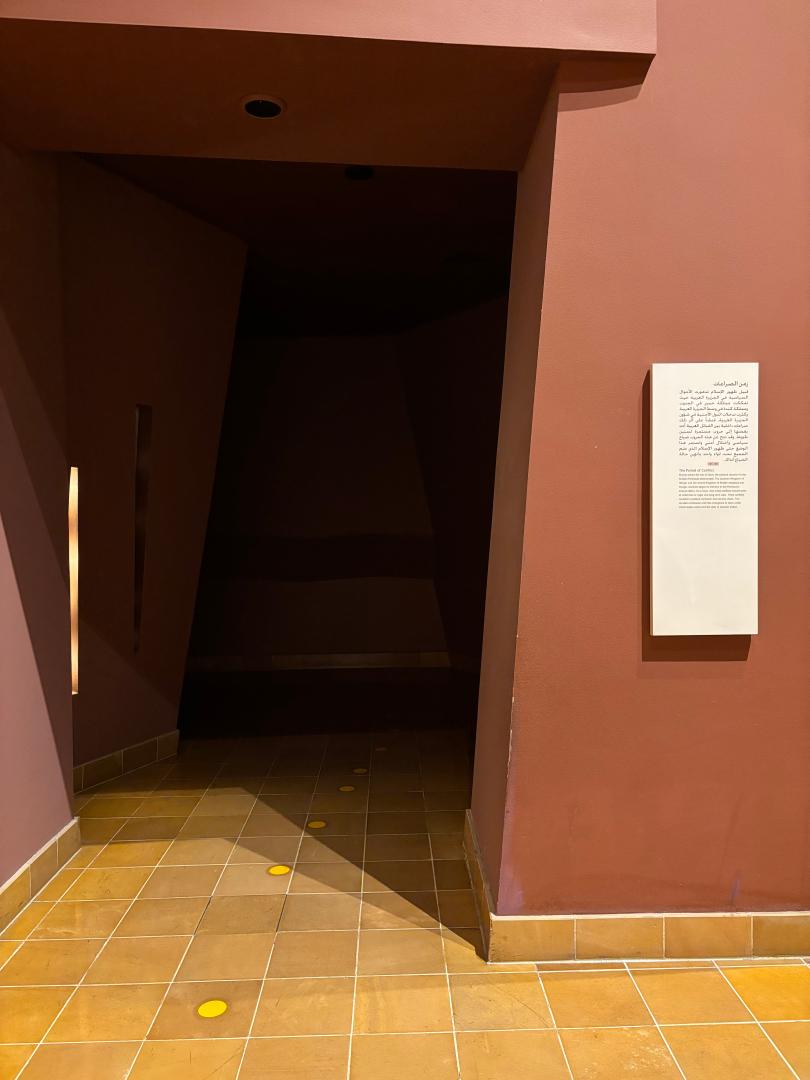


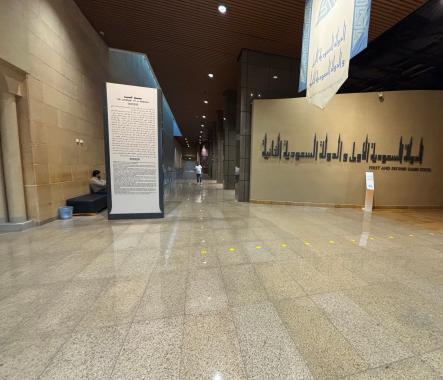
On the ground floor, the exhibit describes “The Era of Conflict“ (see Figure 1). When the Kingdoms of Himyar and Kindah fell apart, the tribes of the Arabian Peninsula began fighting one another, a dynamic fuelled by the intervention of foreign powers. After an escalator ride to the first floor lifts visitors out of this period of strife, they discover how security and order were re-established in Arabia. Shortly after the seventh century commenced, the Prophet Mohammad’s message inspired a return from polytheism to monotheism, from political division to unity. The inhabitants of the Arabian Peninsula “entered the religion of God with excitement, which led to a change in their lifestyle – the plurality of tribes gave way to the oneness of Islamic society, the worship of idols and false Gods…to the worship of Allah, the one indivisible God.”2
The prominently displayed plaque explaining the Covenant of Medina exemplifies this transformation. After he fled Mecca, the Prophet drafted the pact as a communal code by which the inhabitants of his adopted hometown would live (see Figure 2). The Covenant distinguishes itself through introducing the idea of a religiously inspired Umma that places the duties and responsibilities of Muslim believers towards one another over ties based on tribal affiliation.
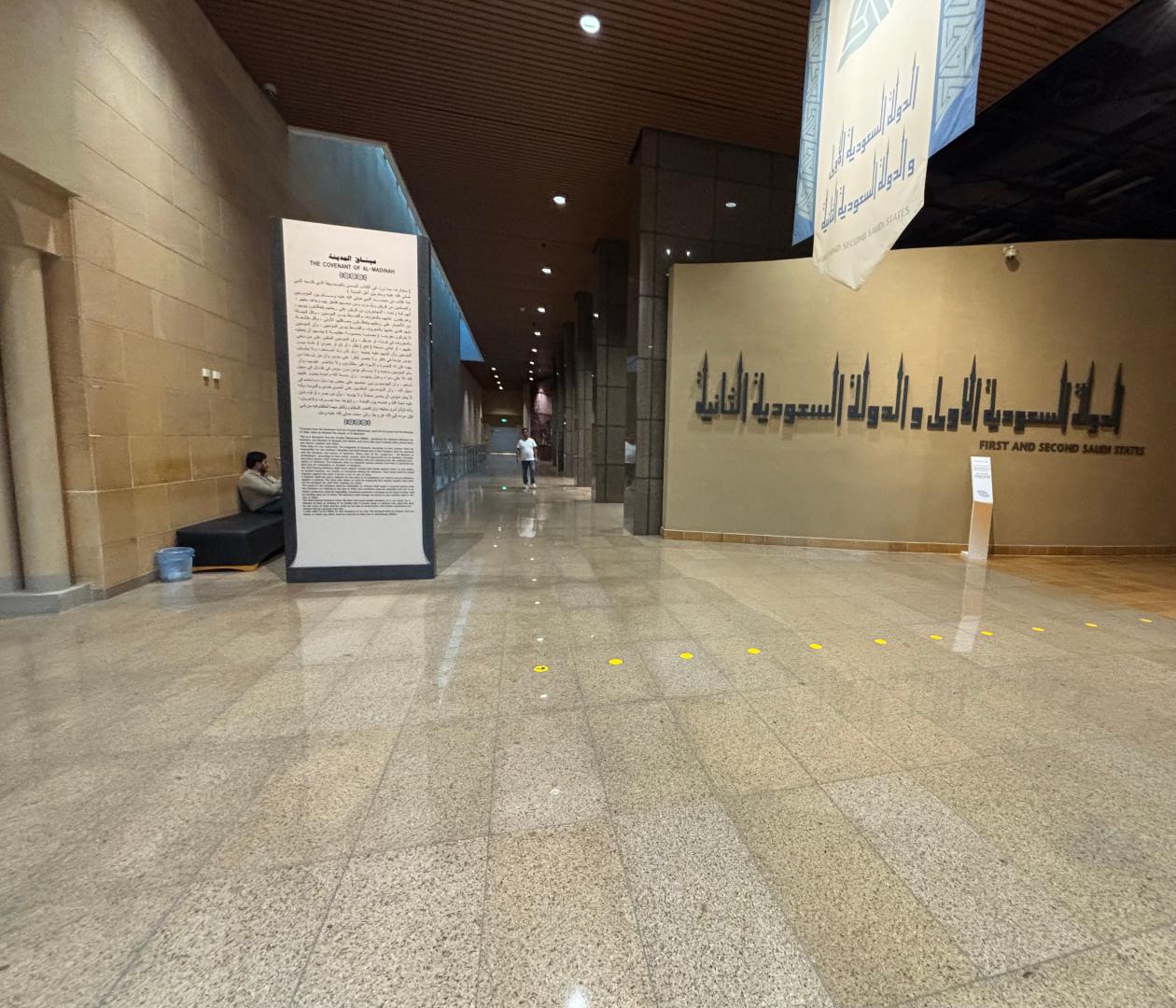
The motif of religion as a binding force once again manifests in the exhibit’s description of the 1744 Alliance of Diriyah. When the Emir – also called Imam – Mohammad bin Saud ascended the throne in 1727, Diriyah was “but one of many towns in Najd that competed with one another for power.”3 A three-meter tall, backlit plaque located in a dedicated room explains the establishment of the pact that allowed Diriyah to become the most powerful city in Najd and the Arabian Peninsula:
“The Emir Mohammad bin Saud said to the Shaikh Mohammad bin Abd al-Wahhab, ‘I proclaim to you glad tidings of a land that is better than your land, and I give you strength and protection.’
The Shaikh then said to him, ‘And I promise you the strength and empowerment contained in the words there is no God but Allah. He who remains true to these words, practices them, and allows them to triumph, will rule with them over the lands and the people.’… After that, he told him of that which the inhabitants of Najd were doing at that time, about their transgression in associating partners with the almighty God, about religious innovation, discord, injustice, and oppression.
When the Emir Mohammad realised the meaning of the unity of God and learned of its religious and worldly advantages, he said to the Shaikh, ‘O Shaikh, truly this is the religion of God and his Messenger, therein lies no doubt. I promise to support you and that which you command.’… After that, Mohammad extended his hand towards the Shaikh and swore his faithfulness to him in the religion of God and his Messenger, in Jihad in the cause of God, in upholding Islamic law, and in enjoining good and forbidding evil” (see Figure 3).
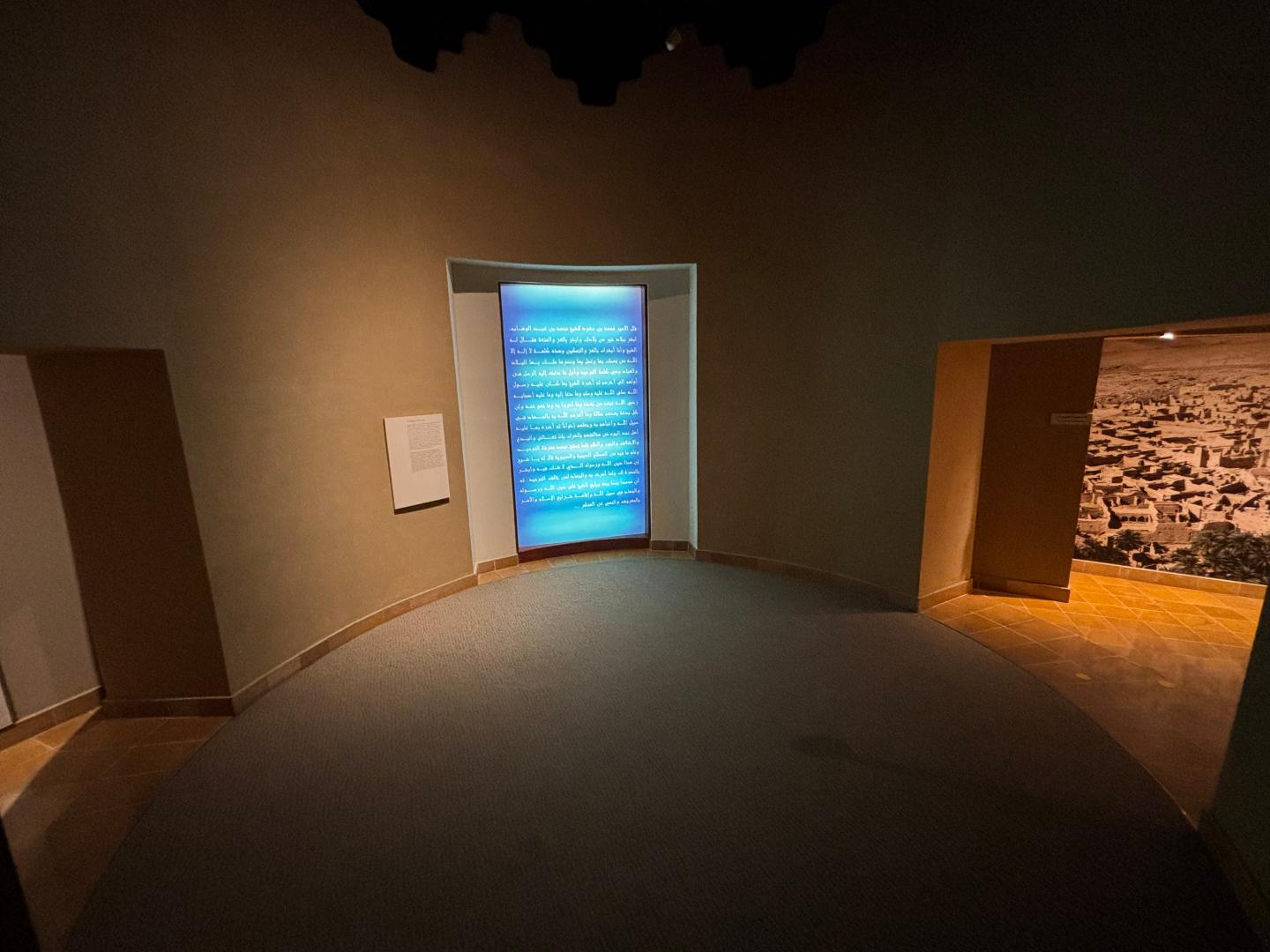
The text combines the portrayal of this encounter by the historians Ibn Bishr and Ibn Ghannam, two contemporaries of Imam Mohammad bin Saud and Shaikh Mohammad bin Abd al-Wahhab who count today as the most significant chroniclers of the First and Second Saudi States.4 According to the museum’s reproduction of the texts of Ibn Bishr and Ibn Ghannam, Ibn Saud and Ibn Abd al-Wahhab were not just partners at eye level. To the contrary, the exhibit highlights the power of the Shaikh, to whom the Emir swears faithfulness and whose message he follows.
Beyond the Alliance of Diriyah, the remainder of the exhibit highlights the centrality of the Wahhabi movement to the Saudi state’s traditional understanding of itself and the expansion of its power. The “soldiers of the unity of God,“ reports one plaque, “set forth from Diriyah, carrying the message of reform to all corners of the Arabian Peninsula.”5 Just as the original message of Islam re-established security and order in Arabia, modern Saudi Arabia’s eighteenth-century predecessor succeeded in “eradicating those who found themselves outside the bounds of obedience towards the ruler and the law, who once dominated the desert.”6
The National Museum underscores the persuasiveness of the Saudi state’s traditional founding myth as a means of legitimating a political order that primarily employed Wahhabi-Salafi narratives to justify its right to exist. Mohammad bin Abd al-Wahhab’s call for a return to the original Islam lends persuasive power to the territorial expansion of the Al Saud family’s influence, in addition to enabling the establishment of a direct parallel between the Islamic state of the Prophet Mohammad and its implied Saudi successor. This underscores that the story told by the National Museum is an all-encompassing legitimating narrative. It explains not only that the Al Saud family expanded its power across the Arabian Peninsula, but also how and why. In this way, the traditional narrative not only recounts the history of the rulers of the land, but also gives a multitude of Saudi citizens – especially Sunni men – the opportunity to integrate themselves into the fabric of the nation through their own faithfulness to the Shaikh’s message, just as Mohammad bin Saud and the original “soldiers of the unity of God” once did.
Al Saud Exclusivity in a Shaikh-less Diriyah
The National Museum’s focus on the traditional founding myth and Shaikh Mohammad bin Abd al-Wahhab’s message contradicts MbS’s attempts to mold a new national identity that exists outside of the influence of Wahhabism. Accordingly, the adherence of the “official museum of the kingdom” to the Shaikh-centric story of the state’s establishment appears to constitute an important missed opportunity to reign in the disseminative power of this comprehensive and convincing narrative.7 This impression solidifies itself at other sites of official history-telling whose divergent portrayal of Wahhabism’s role in the Saudi state’s establishment successfully removes Ibn Abd al-Wahhab from the picture. In doing so, however, these locations also highlight the difficulty of developing an alternative story of the nation’s birth whose ability to inspire popular identification is similarly powerful.
A case in point in this regard is Diriyah, the birthplace of the First Saudi State. The former fortress town at the edge of Saudi Arabia’s contemporary capital hosts a far-reaching, billion-dollar project that aims to convert the area into Riyadh’s cultural and touristic centre. The main components of this initiative are the at-Turaif and al-Bujairi neighbourhoods located on opposite banks of the Wadi Hanifah.
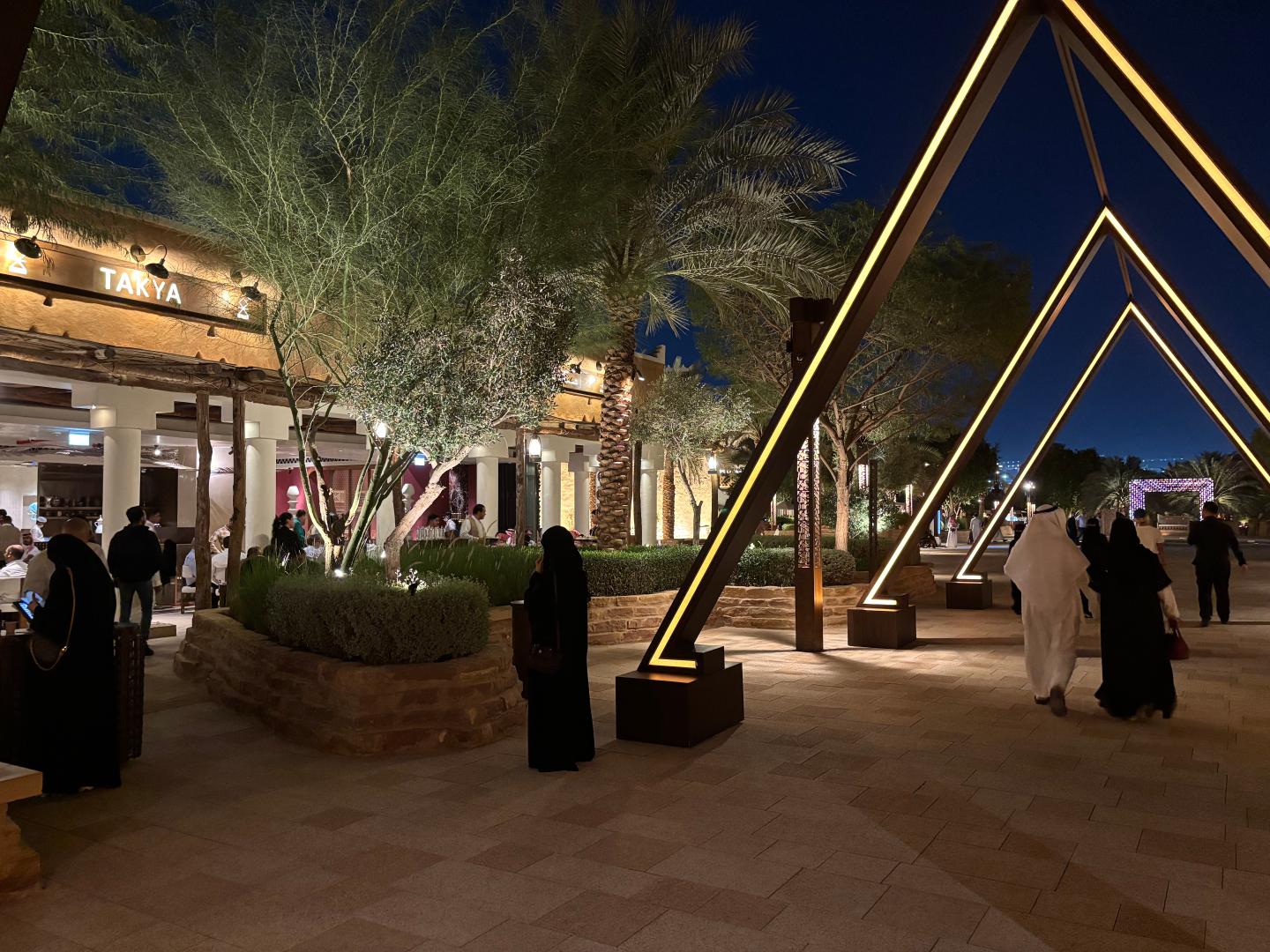
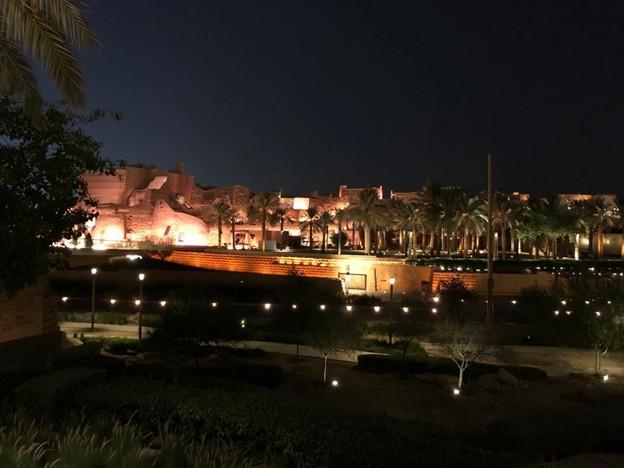
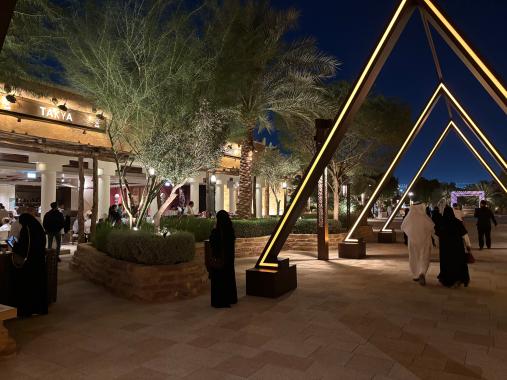
The Diriyah Gate Development Authority follows two divergent approaches as it renovates these two parts of the town. On the one hand, the carefully restored ruins of the former palaces of the Al Saud family in at-Turaif have since 2022 served as open-air museums and monuments to the First Saudi State. On the other hand, the giga-project decouples al-Bujairi from its historical significance as the place of residence of Mohammad bin Abd al-Wahhab and his followers. Instead, the new Bujairi Terrace boasts a series of luxury restaurants in which renowned chefs commit culinary bid‘ah by serving novel interpretations of traditional dishes from Saudi Arabia and around the world (see Figure 4). The only place commemorating the fundamentalist Shaikh amidst these innovations is the Mohammad bin Abd al-Wahhab Mosque located near a side entrance to the premises, away from the tourist flows.
Just behind the entrance to the UNESCO World Heritage Site at-Turaif, the Diriyah History Museum offers visitors an introduction to the First Saudi State. Contrary to the National Museum, however, the Shaikh’s fingerprints are nowhere to be found here. Instead, the exhibit tells the story of the First Saudi State along the lines of the genealogy of its rulers.
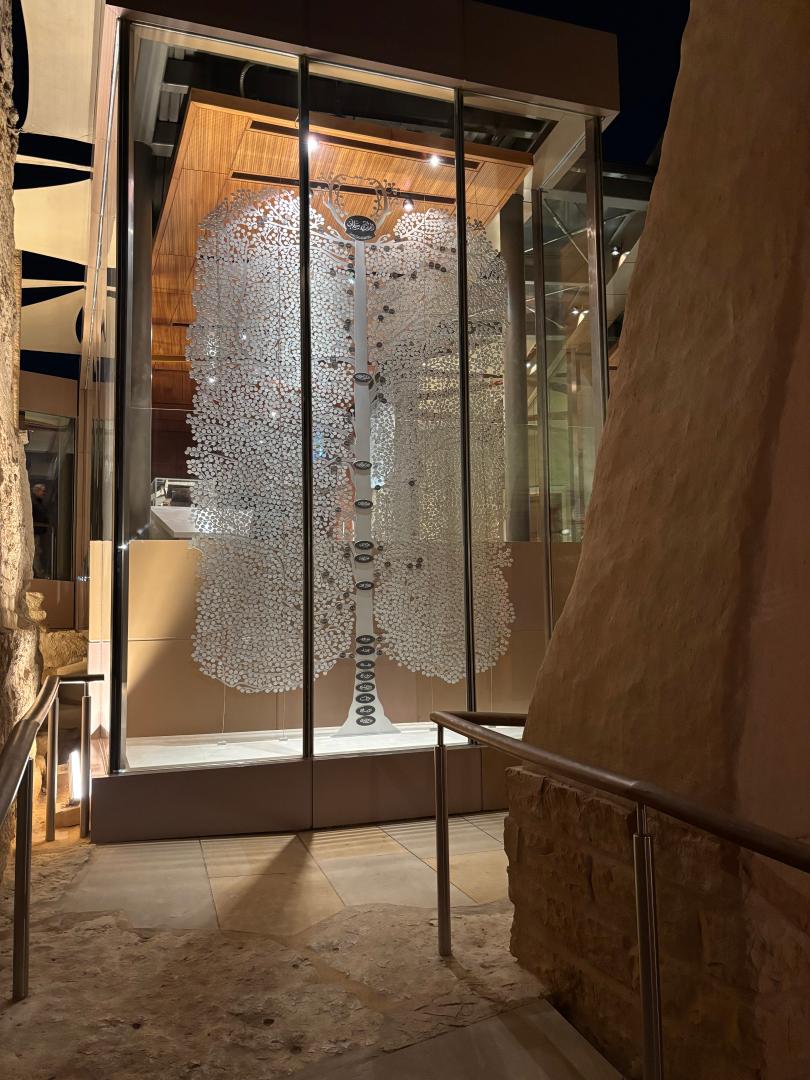
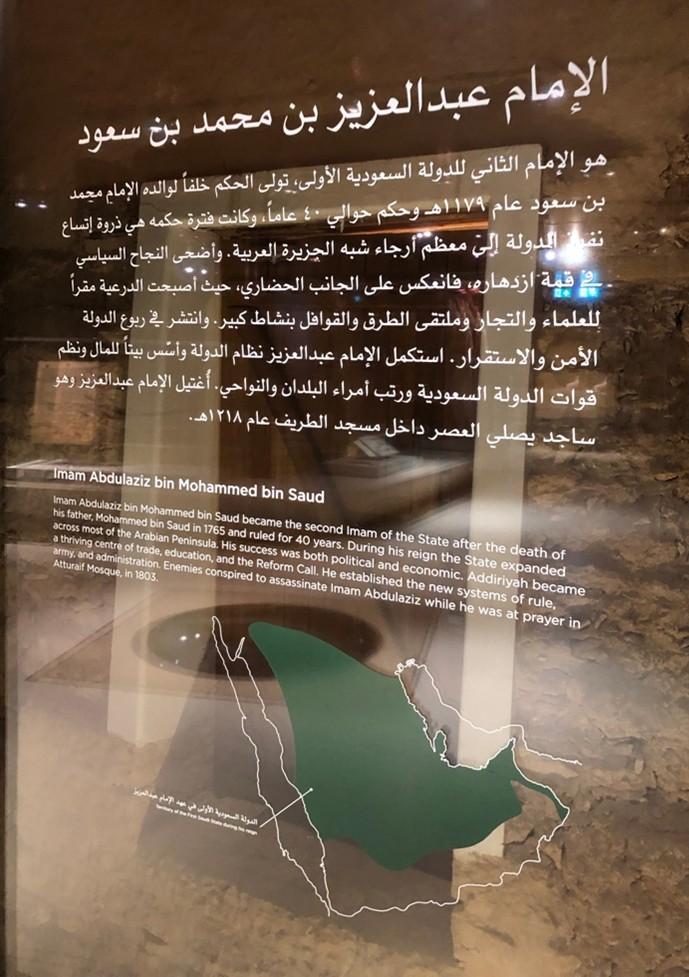
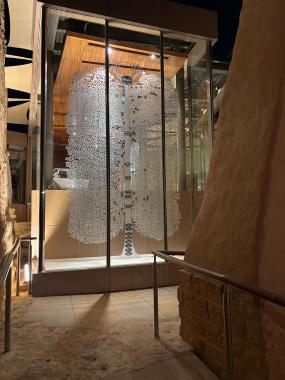
In this respect, the prominently placed Al Saud family tree at the museum’s entrance sets the tone (see Figure 5, left). The foot of its trunk bears the name Mani’ al-Muraidi, who moved from the Arabian Peninsula’s east coast to Najd on the invitation of his relative, the local ruler Ibn Diri’. Mani’ al-Muraidi settled in Najd and acquired land that he later named ‘Diriyah’ in honour of his tribal relative. From its very beginning, then, the exhibit highlights that Al Saud’s status as one of Najd’s ruling families originated not in 1744 or 1727, but began a full three centuries earlier.
The exhibit on the family tree’s other side follows a similar pattern, telling the story of the First Saudi State based on the biographies of its rulers: first Mohammad bin Saud, then Abdulaziz bin Mohammad bin Saud, then Saud bin Abdulaziz, and finally Abdullah bin Saud. The museum matter-of-factly summarises the four Imams’ reigns, describing the territorial conquests or losses that took place under the rule of each. Unlike the National Museum, these descriptions depart decidedly from supernatural explanations, emphasising instead the profane work of state-building on Earth. Imam Abdulaziz bin Mohammad’s reign, for instance, represented “the peak of the expansion of the state’s influence to cover most of the Arabian Peninsula.” Paving the way for this success, “Imam Abdulaziz completed the development of the state apparatus, established a treasury, organised the Saudi state’s armed forces, and ensured an ordered administration of the princes of the towns and the districts” (see Figure 5, right).
At the museum’s exit, the visitor once again confronts the Al Saud family tree as it blossoms into a thick canopy. Its leaves are graced with the names of the contemporary princes and princesses of the different branches of the Saudi royal family. The Diriyah Museum thus transmits one message in particular: the heritage of Saudi Arabia is the genealogy of the Al Saud family. The story of the state’s founding can be told through the accomplishments of the Imams, whose successors are the kingdom’s current rulers.
This message renders concrete the difference between the traditional founding myth and this new version. The story told by the Diriyah Museum leaves no doubt that Saudi Arabia is the land of Al Saud. In doing so, it not only erases Shaikh Mohammad bin Abd al-Wahhab from the story of the state’s birth, but also the young state’s citizens themselves. Between the leaves of the ruling family tree and the achievements of the most famous sons of the house of Saud, no room exists in this new narrative for the “soldiers of the unity of God” to serve as religious points of identification for the breadth of Saudi society.
Granted, by 2015, many Saudis certainly did not feel represented by the original founding narrative – after all, the ultra-conservative interpretation of Sunni Islam that it engendered created too few opportunities for the kingdom’s predominantly young population to express itself. Nevertheless, the traditional story of the nation’s birth portrayed the state as the land of an idea with which the people could choose to identify or not. The Diriyah Museum does not offer such a choice. Quite the opposite, it replaces the grand, unifying concept of old with a narrative built on blood-based exclusivity.
The Saudi Nation writes its own History
In the era of Vision 2030 and its goal of fostering the development of an ambitious nation, it is paradoxical that the founding story recited at the mythical place of its birth offers answers to the Saudi Arabian who and how that centre exclusively on the ancestors of the kingdom’s contemporary rulers. Unlike the National Museum, moreover, the question of the national why remains unanswered in Diriyah.
The new Saudi nationalism thus delivers a puzzling performance on the stages of at-Turaif and al-Murabba. On the one hand, the National Museum demonstrates that government funds continue to support the traditional founding myth’s proliferation at sites of official historical transmission. On the other hand, at-Turaif exemplifies that attempts to replace this narrative fail to articulate a new story of the Saudi nation that reaches a similar standard of comprehensiveness and inclusion. Why does the Saudi state allow for these opportunities to fuel its new nationalism with an integrating impulse from above to go unused?
The answer lies in the fact that it is erroneous to view these places of public historical narration as distinct. Certainly, thinking these two museums together produces a picture full of confusion and contradictions, but this is exactly the point. The Saudi Arabia of Vision 2030 values the provision of a multitude of choices, from entertainment offers and career options to historical narratives. For the kingdom and its citizens, this diversity of options opens up a broad palette of possible answers to the question of what it means to be Saudi, some of which would have been unthinkable during the peak of the traditional founding story’s dominance and the national self-understanding it helped produce.
At the same time, this new direction does not entail the forced re-education of adherents of the narratives and more conservative lifestyles of old. The kingdom’s transformation is not a Chinese Cultural Revolution: Although the Diriyah Museum reveals the state’s desire to advance a narrative without Ibn Abd al-Wahhab at new sites where official history is told, it simultaneously does not view as necessary the alteration, muting, or destruction of the old story in places where it already exists. The Saudi political scientist Eyad Alrefai interprets this phenomenon as follows:
“The state opened up the field for historical and cultural interpretations, rather than forcing a new narrative on Saudi citizens. If you ask an average Saudi citizen in the street how they think about the historical narrative of Saudi Arabia, they would be more aligned with the traditional one, because the state does not impose a different one on them.”8
In today’s Saudi Arabia, the traditional founding myth is one of many national narratives that lend the Saudi nation historical depth. Furthermore, the religious-historical motifs of the old story of the Saudi state’s establishment continue to confer legitimacy upon the ruling Al Saud family – nowadays like before, the king, after all, is the Custodian of the Two Holy Mosques.
Diriyah too constitutes one of these important narratives among many. Of course, the emphasis on the accomplishments of the Imams and the exclusive association of their achievements with the history of the state send a clear signal concerning who holds the right to lead the Saudi nation in the present, and why. At the same time, however, the absence of a claim to historical comprehensiveness or totality at the Diriyah Museum signals to society that they themselves should take up the mantle of filling this gap – once again, the state has “opened up the field for historical and cultural interpretations.”Beyond Diriyah, other initiatives of the state deliver a similar impulse to clear the way for a multitude of interpretations. These include official efforts to emphasise or rediscover the unique cultural characteristics of different regions of the kingdom, along with the pre-Islamic heritage sites that dot the country.9 Saudis have internalised this direction from above to articulate anew the nation’s history from below and are implementing it with enthusiasm. The spread of lively debates on social media is evidence of this. In these contexts, topics are broached for which the traditional historical narrative left no room during its Sahwa-period peak, such as the origins of Arabs, their tribes’ pre-Islamic history, and the foregrounding of the birth of a long litany of civilizations on Saudi territory, such as the Nabataeans and the Kingdoms of Kindah, Thamud, and ‘Aad.10
The opening of this interpretative space also leaves room to recognise the biographies of ancestors of today’s Saudi nation, irrespective of how they positioned themselves relative to the “soldiers of the unity of God” of the First, Second, or Third Saudi States. One of these figures is Sultan bin Bjad al-Otaybi, who as co-leader of the militia Ikhwan man Ata’ Allah [Brotherhood of those who obey God] played a key role in the Al Saud victory over the Hashemites in the Hejaz, bringing the province under the control of King Abdulaziz in 1926. Sultan bin Bjad and other Ikhwan later rebelled against Al Saud rule, however.11 This short-lived revolt ended with his defeat and arrest in 1929, after which he spent the last five years of his life in a Riyadh prison. Nevertheless, the Saudi Twitterverse today portrays bin Bjad’s biography in a largely positive light. In recent years, posts shared on the occasion of Saudi National Day – which celebrates the 1932 establishment of the unified Kingdom of Saudi Arabia from the dual Kingdom of Hejaz and Najd – have even portrayed bin Bjad as the commander of the military forces that took over the Hejaz.12 The themes of unity and rich heritage associated, respectively, with National Day and Founding Day also pervade contributions elsewhere on X, such as posts highlighting the origins of tribes like Qahtan and Otaiba, along with their accomplishments in service of the Saudi political project.13
From the Diriyah Museum and national holidays to discussions on X, a key characteristic unites this diverse discourse: like the Al Saud family tree, these genealogically oriented narratives of ordinary citizens locate their ancestors upon the territory of today’s kingdom, highlighting their longstanding ties to this land. In doing so, these stories incorporate themselves into a national narrative that unambiguously communicates that the Saudi nation writes its own (hi)story on its land, and has done so since time immemorial.
Narrating the Past: An expression of the new Saudi nationalism
This policy report reveals that the traditional founding myth of the Saudi state exists today alongside a series of historical narratives which together transmit the message that the Saudi nation is deeply rooted on the Arabian Peninsula. The contemporary form of this civilization is the outcome of the achievements of its current citizens’ ancestors.
The present argument thus differs from other analyses focusing on recent changes to the way in which Saudi Arabia’s history is told.14 These articles correctly identify Diriyah and Founding Day as instances of departure from the traditional founding myth, which centres the pact between Mohammad bin Saud and Mohammad bin Abd al-Wahhab. However, they over-interpret the implications of the large-scale erasure of Ibn Abd al-Wahhab from al-Bujairi, at-Turaif, and the narrative around Founding Day. For instance, Alamer claims that the new Founding Day “creates a new myth that leaves no room for Muhammed ibn Abdul-Wahhab and his movement,” leaving the Saudi state to govern with “no partner” at its side.15
This policy report confirms that Diriyah and Founding Day indeed tell a new story of the nation’s birth. Nevertheless, this contribution also demonstrates that the state simultaneously calls upon its people to partake in the narration of the nation’s history from below. Furthermore, it allows for the traditional founding narrative to continue to exist in the kingdom’s official museum. Through permitting the propagation of these multiple myths and stories, the Saudi state ensures that it does not stand alone, but instead elicits widespread participation and support for its transformative national project.
In truth, the new politics of history in Saudi Arabia grants the ruling family many (new) partners. In a domain in which a select group of grand chroniclers like Ibn Bishr and Ibn Ghannam once dominated the narrative space, the opening of the field now allows hundreds of hobby historians to write the history of the nation themselves. This creative license elicits not only pride in being Saudi, but also a feeling of responsibility for the achievement of the ambitious goals of the present articulated in Vision 2030. This enablement of personal responsibility in the historical space also manifests in other policy fields of the Vision, such as the encouragement of young Saudis to contribute to fuelling private-sector-led growth – away from the oil industry and government jobs – through letting loose their entrepreneurial spirit.
Beyond the borders of the kingdom, historical narratives from the grassroots level bolster the assertion of a distinct Saudi identity vis-à-vis competing national collectives and projects in the Middle East. In the past, Arabian history was not written in Riyadh, but in Cairo, Damascus, and Beirut. Najd lay on the periphery of the Arab Nahda, or renaissance, of the nineteenth century, despite the fact that successive Saudi states offered examples of the type of homegrown resistance against Ottoman imperial rule for which enlightenment thinkers in Arab capitals advocated. Today, however, the pendulum of political might swings decidedly in the direction of the Arabian Peninsula. In an Egyptian and Levantine epoch of economic and political dependence16, the kingdom is in ascendance. Along the way, it is reaffirming the saying that history is written by the winners.
In an era in which the Gulf increasingly converts its economic dominance into political and cultural capital, it makes sense that the largest nation on the Arabian Peninsula has also begun to assert itself in the domain of history. The kingdom thus delivers a conscious riposte to the condescending view that other Arab countries have espoused towards the Gulf states in the past, a phenomenon that Bsheer terms “secondary orientalism.”17 However, the Saudi system of opening the field of historical interpretation does not need to exist in conflict or competition with Levantine or North African models of national identity formation. The house of Saud appears to have succeeded in bringing the goals of history-writing from above and below into stronger harmony with one another, finding an equilibrium that the experience of neighbouring nations confirms is not easy to strike. For instance, the Hashemite Kingdom of Jordan‘s official history, focusing as it does on the Hashemite-led Great Arab Revolt against the Ottoman Empire, foregrounds historical moments that differ from those emphasised by local tribes whose power peaked in the era before the state’s establishment.18 Saudi Arabia’s neighbours can thus look to the kingdom’s contemporary politics of history as a model for how to create the conditions necessary to capitalise on this domain’s potential to serve as the fountainhead of a national “we.” This cohesiveness can in turn be employed in the service of the ambitious present-day agendas of state and citizenry alike.
Endnotes:
1. Arab News: Saudi cleric apologizes for ‘intolerant’ views of Sahwa movement, 07.05.2019, in: https://www.arabnews.com/node/1493956/amp [03.11.2025].
2. Gallery “Jahilliyah Pre Islam Period” n.d.: زمن الصراعات [The Era of Conflict], Saudi National Museum [16.02.2025].
3. Gallery “First and Second Saudi States” n. D.: قيام الدولة السعودية الأولى [The Founding of the First Saudi State], Saudi National Museum [05.11.2025].
4. Bin Bishr, Othman 1910: عنوان المجد في تاريخ نجد [The Glorious History of Najd], Beirut, pp. 15-16; Bin Ghannam, Hussein 1994: تاريخ نجد [The History of Najd], Beirut, p. 87.
5. Gallery “First and Second Saudi States” n. D.: الدرعية، عاصمة الدولة السعودية الأولى [Diriyah, Capital of the First Saudi State], Saudi National Museum [05.11.2025].
6. Ibid.
7. Ministry of Media of the Kingdom of Saudi Arabia 2025: The Saudi National Museum, Saudipedia, in: https://saudipedia.com/en/article/492/culture/museums/the-saudi-national-museum [11.10.2025].
8. Eyad Alrefai 2025: Interview with the author, 27.08.2025.
9. Reuters 2021: Archaeologists in Saudi Arabia excavate forgotten kingdoms, 02.11.2021, in: https://www.reuters.com/world/middle-east/archaeologists-saudi-arabia-excavate-forgotten-kingdoms-2021-11-02/ [11.10.2025]; Digital Government Authority 2025: Our Culture, Our Identity, GOV.SA, in: https://my.gov.sa/en/content/culture#section-2 [11.10.2025].
10. See for example Waleed al-Amoudi [@WaleedAlshmmari] 2025: كلمة حق وليست مجاملة... [A word of truth, no exaggeration…], X, 05.03.2025, in: https://x.com/waleedalshmmari/status/1897171173277905288?s=48 [11.10.2025].
11. The reasons for the break between the Ikhwan and King Abdulaziz lie in the contradiction between the desire of the Ikhwan to continue raiding, conquering, and holding uncompromisingly on to the Wahhabi doctrine, on the one hand, and the monarch’s intent to take practical steps towards building a state, on the other. Saudi Ikhwan raids in the neighbouring British protectorates of Transjordan, Iraq, and Kuwait underscore the diplomatic combustibility of these opposing agendas. For more information, please consult Zeidan, Adam 2020: Ikhwān, Britannica Online, 10.06.2020, in: https://www.britannica.com/topic/Ikhwan [31.10.2025].
12. See for example Dr Mansour Al-Dajani [@mns800] 2021: اليوم_الوطني_السعودي...#ذكرى [The celebration of #Saudi_National_Day…], X, 23.09.2021, in: https://x.com/mns800/status/1440998946860634113?s=46 [31.10.2025]; Fahad al-Dughaylbi [@aldughalbi] 2019: صورة نادرة للملك عبدالعزيز [A rare photo of King Abdulaziz], X, 24.09.2019, in: https://x.com/aldughalbi/status/1176357921036427264?s=12 [31.10.2025].
13. See for example نفحات [@history_439] 2023: الدهينة من أشهر فرسان الجزيرة العربية...#مقعد [Migad #al-Duhaina is one of the most famous knights of the Arabian Peninsula…], 12.08.2023, in: https://x.com/history_439/status/1690451549435174912?s=12 [01.11.2025]; البيان في تاريخ قحطان [@albyan_qh] 2025: آل محمد ياهل التوحيد [The House of Mohammad, of family of oneness…], 30.10.2025, in: https://x.com/albyan_qh/status/1983882969929376028?s=12 [01.11.2025]; البيان في تاريخ قحطان [@albyan_qh] 2025: نبذة مختصرة عن قبيلة آل مسعود [A short overview about the Al Masoud tribe…], 02.10.2025, in: https://x.com/albyan_qh/status/1983882969929376028?s=12 [01.11.2025].
14. Alamer, Sultan 2022: The Saudi “Founding Day” and the Death of Wahhabism, Arab Gulf States Institute, 23.02.2022, in: https://agsi.org/analysis/the-saudi-founding-day-and-the-death-of-wahhabism/ [11.10.2025]; Ibish, Hussein 2022: Saudi Ruler Rewrites History to Shrink Islamic Past, Bloomberg, 02.03.2022, in: https://www.bloomberg.com/opinion/articles/2022-03-02/saudi-crown-prince-mbs-is-rewriting-history-to-shrink-islamic-past [11.10.2025]; The Arab Weekly 2022: Diriyah, birthplace of Saudi state, rises to encapsulate ‘new nationalism’, 17.06.2022, in: https://thearabweekly.com/diriyah-birthplace-saudi-state-rises-encapsulate-new-nationalism#:~:text=Defining%20a%20dynasty-,While%20the%20country%20that%20bears%20the%20Al%2DSaud%20name%20is,t%20easily%20co%2Dexist.%E2%80%9D [11.10.2025].
15. Alamer 2022, N. 14.
16. Reeves, Nicolas 2024: Pounds, Petrodollars, and Planned Paradises: The evolving role of Gulf capital in Egyptian megaprojects, KAS Regional Programme Gulf States Policy Report No. 75, in: https://www.kas.de/en/web/rpg/detail/-/content/pounds-petrodollars-and-planned-paradises [11.10.2025]; Reeves, Nicolas 2023: Binding the Ties that Bind: Commercial Banks and Political-Economic Links between Saudi Arabia and Jordan, KAS Regional Programme Gulf States Policy Report No. 73, in: https://www.kas.de/en/web/rpg/detail/-/content/binding-the-ties-that-bind [11.10.2025].
17. Bsheer, Rosie 2020: Archive Wars: The Politics of History in Saudi Arabia, Stanford, S. 8.
18. Reeves, Nicolas 2021: Erasing History: Rival tribal narratives, official regime discourse, and the exclusionary debate over indigeneity in Petra, Jordan, ESIA Dean’s Scholars Journal, 28.09.2021, in: https://blogs.gwu.edu/esiadeansscholarsjournal/2022/08/01/erasing-history-rival-tribal-narratives-official-regime-discourse-and-the-exclusionary-debate-over-indigeneity-in-petra-jordan/ [22.02.2026]; Shryock, Andrew 1997: Nationalism and the Genealogical Imagination: Oral History and Textual Authority in Tribal Jordan, Berkeley.