








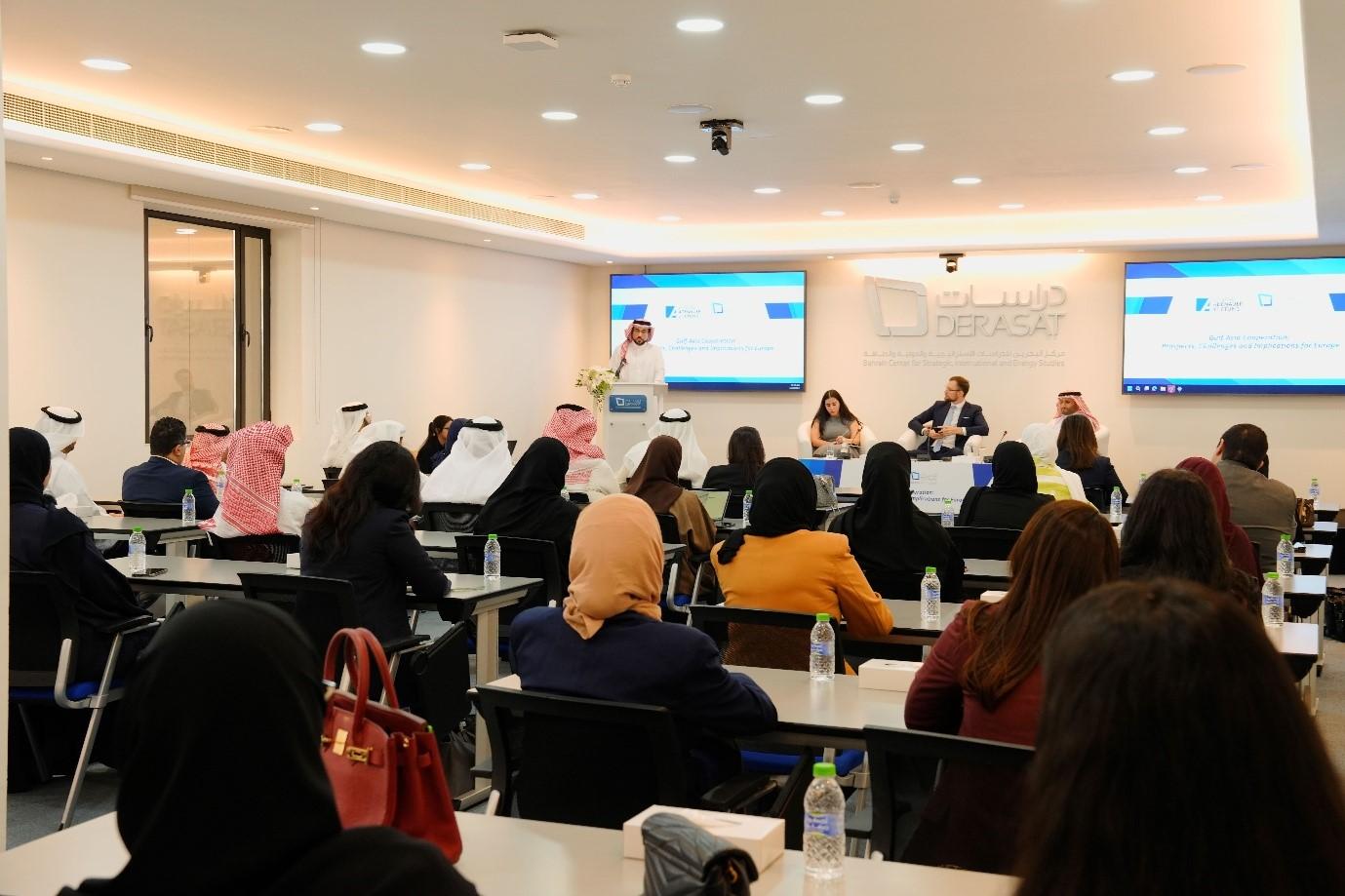
The Regional Programme Gulf states in cooperation with the The Bahrain Center for Strategic, International and Energy Studies (Derasat), convened a panel discussion titled “Gulf-Asia Cooperation: Prospects, Challenges and Implications for Europe” at Derasat’s headquarters in Awali in Bahrain. The panel discussion brought together distinguished experts and scholars to discuss the evolving dynamics between the Gulf Cooperation Council (GCC) and Asian countries, and to assess their wider significance for Europe.
In his opening remarks, Dr. Hamad Ebrahim Al-Abdulla, Executive Director of Derasat, underscored the importance of fostering dialogue on Gulf-Asia relations. He highlighted Derasat’s role in providing a neutral platform for research and exchange, and emphasised the necessity of joint efforts to address global challenges such as energy security, economic diversification, and sustainable development.
Philipp Dienstbier, Director of the Regional Programme Gulf States of KAS, reaffirmed the Foundation’s longstanding commitment to supporting dialogue and mutual understanding between the Gulf and its partners. He noted that Gulf-Asia cooperation is not only reshaping regional dynamics but also carries significant implications for Europe at a time of shifting trade patterns, technological transformation, and geopolitical realignment.
The panel discussion featured contributions from Dr Shigeto Kondo, Senior Researcher at the JIME Center of the Institute of Energy Economics, Japan; Dr Omar Ahmad Al-Ubaydli, Director of the Studies and Research Directorate at Derasat; and Mr Philipp Dienstbier. The session was moderated by Ms. Marah Jamous, Project Manager at the Regional Programme Gulf States at KAS.
Discussions highlighted the expanding economic, political, and cultural linkages between the Gulf and Asia, with particular attention to the strategic opportunities these relationships present for Europe. Participants emphasised that deeper cooperation among the three regions could contribute to addressing shared challenges and advancing collective prosperity.
The panel discussion concluded with a call to further strengthen collaborative frameworks and to institutionalise dialogue among stakeholders in the Arabian Gulf, Asia, and Europe. Both Derasat and KAS reiterated their commitment to facilitating such exchanges and to providing policy-relevant insights that promote regional and interregional understanding.