





Asset Publisher
IMAGO / ABACAPRESS
Country reports
Senate elections in France
by
Anja Czymmeck, Max Willem Fricke, Nele Katharina Wissmann
The Senate as an anchor of stability during a turbulent presidential election campaign
The whole of Europe is eagerly awaiting the 2027 presidential election in France. Yet it is often forgotten that during late summer 2026, on 27 September 2026, another important election will shape the political Rentrée: the partial renewal of the Senate.
The upper house of the French Parliament comprises 348 senators, who are elected for six-year terms, with half the seats being up for election every three years. The last Senate elections on 24 September 2023 confirmed the existing centre-right majority. The Senate is not elected directly, but by an electoral college (Grands Électeurs), which is predominantly made up of local councillors and members of parliament at national and regional level; the election takes place at the level of the départements (which represent the constituencies for the Senate elections) and the minimum age for standing for election is 24.
The electoral system varies depending on the size of the constituencies: in départements with up to three seats to be filled – which constitute the majority – a two-round first-past-the-post system applies, while in larger départements with four or more seats, elections are held under a proportional representation system. This system gives smaller and rural local authorities, in particular, disproportionate influence.
Against this institutional backdrop, there are strong indications that the Senate will continue to be characterised by a stable centre-right majority even after the elections. Nevertheless, a few months before the presidential election, politically symbolic shifts could occur – particularly through the possible formation of a separate parliamentary group by the Rassemblement National (RN). At present, the party holds only three seats in the Senate; however, given its strengthened local roots, it could reach the threshold of ten seats required to form a parliamentary group.
July 16, 2026
Order details
Asset Publisher
Please note that the full-length Country Report is only available in German.
Asset Publisher
comment-portlet
Asset Publisher
Media library
Rule of Law Rules Podcast
#11: Hannah Lim on Legal Technology in South East Asia
As Head of Rule of Law and Emerging Markets at LexisNexis in Singapore, Hannah identifies areas where LexisNexis can, leveraging on technology, support the rule of law.
Read now

Rule of Law Rules Podcast
#6: Lee San Natalie Pang on the General Data Protection Regulation & its influence in Southeast Asia
For the last episode of our first series “Data Protection” we go to Asia and take a closer look at the Southeast with Dr Lee San Natalie Pang, our expert on Data Protection.
Read now

Rule of Law Rules Podcast
#5: Ridwan Oloyede about the GDPR and its influence in African legal framework
Ridwan Oloyede is co-founder of a Nigerian start-up, that helps businesses to achieve operational excellence through the reliable and efficient application of technology.
Read now
Rule of Law Rules Podcast
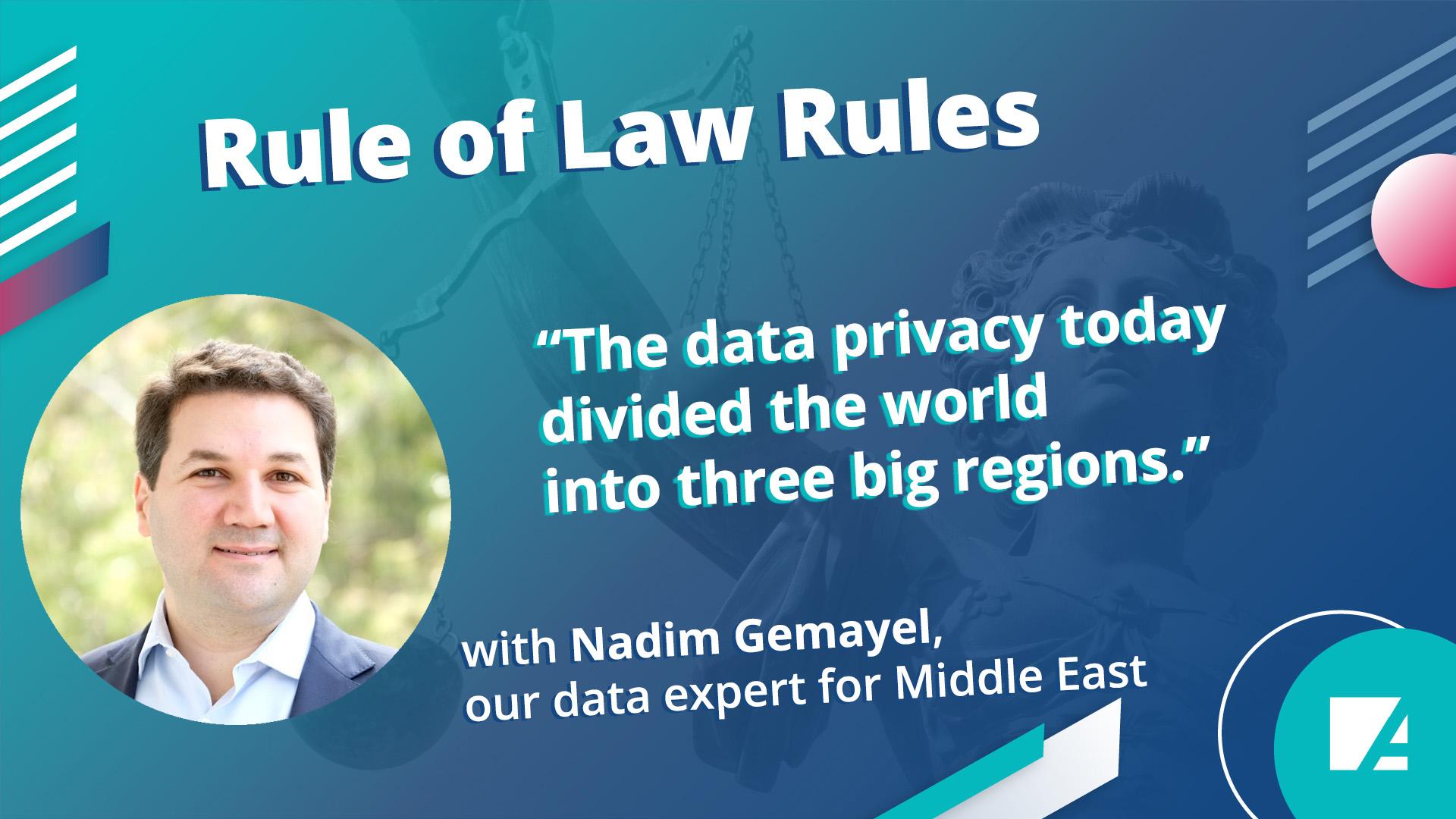
#4: Nadim Gemayel on the General Data Protection Regulation and its influence in Middle East
Nadim Gemayel is a politician and lawyer based in Lebanon and Qatar. He was a member of the Lebanese Parliament between 2009 and 2020.
Read now

Rule of Law Rules Podcast
#3: Eduardo Magrani on Data Protection in Latin America
We speak with Eduardo Magrani about the General Data Protection Regulation and its influence in Brazilian and Latin American legal framework.
Read now

Rule of Law Rules Podcast
#2: Ioana Stupariu on the GDPR's influence in South East Europe
Ioana Stupariu works with tech and healthcare start-ups and companies across Central and Eastern Europe. And she researches on Data protection & Privacy.
Read now

Rule of Law Rules Podcast