On 17 May 2026, the World Health Organization (WHO) declared the Ebola outbreak in the Democratic Republic of the Congo (DRC) and Uganda an international public health emergency. According to the WHO, as of 16 May 2026, eight laboratory-confirmed cases, 246 suspected cases, and 80 probable deaths had been reported in Ituri province in the DRC, as well as two confirmed cases in Kampala, Uganda. The WHO justified its decision by citing the risk of further international spread, significant uncertainty about the true scale of the outbreak, and the need for coordinated international measures.[1] Health emergencies not only create medical and organisational pressure to act, but also generate an information vacuum. Especially in the first days of an outbreak, much remains unclear: How did the outbreak occur? How many people are affected? Which regions are impacted? What measures are necessary? What risks exist for other countries? This uncertainty provides a favourable moment for disinformation. This is true for Ebola, and equally so in the DRC and Uganda.
Ebola Disinformation After the WHO Declaration: A Persistent Threat
Immediately after the WHO declaration, the first targeted false reports about Ebola and the outbreak began to become visible. In local communities in the DRC, dangerous narratives and misinformation were already widespread and continue to circulate. For example, Ange Adihe Kasongo, journalist and founder of Balobaki Check, a Congolese fact-checking organisation, reports conversations with local miners in which Ebola is described as a “mysterious disease brought by a ghost coffin” or as an “occult sacrifice brought about by a mine manager through injections in order to appease the earth.”[2] Such messages initially spread orally and through direct exchanges in WhatsApp communities, as Kasongo notes: “We know that the spread of misinformation in rural areas originates in conversations within the community before it spreads to social media.”[3]
In the first week of the Ebola emergency, social media analyses therefore show a mixed picture: on 17 May, social media users, “health influencers,” anti-vaccination activists, AI-powered conspiracy channels, and providers of dubious dietary supplements and “medicines” from the United States were already deliberately posting misinformation and drawing on three well-known conspiracy narratives:
- Ebola was artificially created in a laboratory.
- The Ebola outbreak is a planned conspiracy (linked to earlier hantavirus incidents on a cruise ship and, in an unspecified context, to the FIFA World Cup in the United States, Mexico, and Canada).
- There is a simple cure for Ebola that is being concealed by health authorities.
Notably, all the identified accounts appear to originate from the United States and primarily target a domestic American audience. However, none of the posts achieved a significant number of views, clicks, reposts, or likes.[4] This is initially a positive sign. More concerning, however, is the growing tendency for reporting by major international media outlets such as Deutsche Welle, the BBC, The Times, or the Associated Press to be flooded with disinformation comments and annotations. So far, dissemination is mainly occurring through individuals and within comment sections. This is particularly visible where major media outlets report on the outbreak and dense comment threads form beneath posts. In videos and posts by international media, such as Deutsche Welle or The Times, this dynamic is already becoming highly apparent:
Comments by anonymous users here draw on the full spectrum of well-known narratives of Ebola and disease-related disinformation. Unlike original posts and content, these narratives are not a marginal phenomenon in the comment sections—for example on Deutsche Welle’s Facebook or YouTube pages—but are highly prevalent.[5] Common messages include claims that Ebola is a bioweapon, that Bill Gates is responsible for the outbreak, that the West is conducting medical experiments in Africa, or that vaccines are more dangerous than the virus. These narratives are consistent with the large volume of Ebola disinformation that has circulated in the past.
For Russia, which since the 1980s has used intelligence services and international broadcasters to deliberately spread narratives about the alleged artificial origin of HIV/AIDS, and later Ebola and COVID‑19 as United States (U.S.) (today: Ukrainian) bioweapons, the current Ebola context requires a cautious assessment. Based on the current situation, no dominant Russian escalation narrative is (yet) identifiable. Instead, Russian foreign media outlets such as Sputnik Africa currently display a positive framing of Russia, for example through reports about dispatched aid.[6]
In a podcast for Sputnik Africa, however, the topic of alleged U.S. biolaboratories in Africa and the risk to “public health sovereignty” is discussed, with the segment being subtly integrated into Ebola-related reporting.[7]
Disguised channels, such as the outlet “African Initiative,” which is attributed to the Russian intelligence service GRU, repeat reports of Russian aid efforts, but at the same time, on 20 May 2026, cautiously attempted to establish the narrative of an alleged Russian vaccine against this specific Ebola variant.[8]
Overall, it appears that the Russian propaganda apparatus has not yet significantly shifted its focus to the Ebola outbreak, but is instead attempting to instrumentalise the hantavirus outbreak on a cruise ship in Europe. In this context, disinformation channels linked to “Operation Matryoshka” have circulated claims of a widespread hantavirus outbreak in France. In doing so, fabricated front pages of Western media outlets carrying such reports are being distributed via social media.[9] Other narratives either claim that the hantavirus originated in Ukraine or draw a connection to COVID‑19 vaccinations.[10] However, this current Russian restraint could change at any time if the outbreak becomes more heavily politicised or if additional entry points for anti-Western interpretations emerge.
In the online space of the DRC and Uganda, a mixed picture is emerging. A sample analysis of around 30,000 posts on the platform “X” relating to the Ebola outbreak—conducted by Murmur Intelligence South Africa for the author of this study—showed that both health authorities and local as well as national legacy media dominated the discourse in May, both quantitatively and qualitatively, with factual information, warnings, and recommendations for action forming the core content.
In the English-language discourse, local and international health authorities and organisations currently appear to retain interpretive authority and informational dominance over the Ebola outbreak. As a result, conspiracy and disinformation narratives have not yet spread widely from comment sections to influencers, content creators, or local media.
However, as the Ebola crisis progresses, orally transmitted misinformation about Ebola from local and oral communities is increasingly spreading to social media. On 25 May 2026, for example, at the Congolese Fact-Check-Portal Balobaki reported on viral TikTok videos in French that describe Ebola as a “political fabrication,” allegedly commissioned by Félix Tshisekedi, President of the DRC, who is said to have tasked a virologist with its creation.[11]
And the narrative of the “simple cure” that is allegedly being concealed is also already being spread, for example by an influencer in the local language Lingala.[12] As the state of emergency continues, the daily increase in identified infections and the difficult supply situation in the affected regions raise concerns that the wave of illnesses will be accompanied by a steadily growing wave of dis- and misinformation. Attacks on emergency aid facilities, vaccine refusal, political tensions, and other forms of physical consequences therefore constitute a very real risk.
Historical Tradition of Ebola and Disease-Related Disinformation
Previously, between 2023 and autumn 2025, African fact-checking organisations in Central and West Africa observed a massive wave of Ebola- and disease-related disinformation. Among others, individual influencers with audiences of several hundred thousand followers were actively involved in spreading politically motivated false information about Ebola.[13]
Ebola disinformation is therefore not a new phenomenon. During the Ebola outbreaks in the DRC in 2014 and 2018/19, it was a serious problem. Dis- and misinformation circulating both online and offline led to a significant loss of trust in science, medical personnel, and aid workers on the ground, politicised public health measures, and complicated the response to the outbreaks. Due to armed conflict, political divisions and tensions, as well as distrust toward foreign and international assistance, the local population was particularly vulnerable to false information.[14] The narratives and messages at the time included, for example, claims spread by Russian Online Actors that foreign aid workers (especially from the United States) were themselves spreading the disease and interfering politically in the country’s internal affairs.
However, Ebola disinformation—and the narratives seen today as in the past—go back much further. As early as the early 1990s, repeatedly circulated and newly revived narratives were already portraying Ebola as an artificially manufactured Western bioweapon.[15] These narratives built on even earlier disinformation operations by the Soviet intelligence service, the KGB, which in the 1980s conducted a global campaign claiming that HIV/AIDS was a U.S. bioweapon developed in a laboratory.[16] As detailed studies showed more than ten years ago, this narrative of an artificial origin and the deliberate, planned spread of epidemics has been formative for health disinformation over the past 40 years. The diseases themselves have shifted—from HIV/AIDS to Ebola, Lyme disease, measles, typhus, COVID‑19, hantavirus, and back again to Ebola. However, the underlying pattern and narratives—as well as many of the Multipliers and Spreaders—have remained the same: an artificial origin from biolaboratories as bioweapons, targeted dissemination, Africa and Africans portrayed as testing grounds and experimental subjects, supposed simple treatments, the alleged danger of vaccines and protective measures, and much more.[17] Even older precedents can be found in scapegoating narratives such as the medieval claim that Jews had poisoned wells and thereby caused the plague.
 © Graphic created with AI Copilot / Konrad-Adenauer-Stiftung
The Playbook: Recurring Narratives and their Dissemination
Health disinformation follows a recurring playbook: the disease changes, but the underlying pattern remains the same. Ebola, COVID‑19, hantavirus, Lyme disease, or AIDS are framed in different contexts using similar narratives. Current Ebola disinformation therefore does not stand in isolation, but is part of a long tradition of disinformation surrounding highly infectious and dangerous diseases.
-
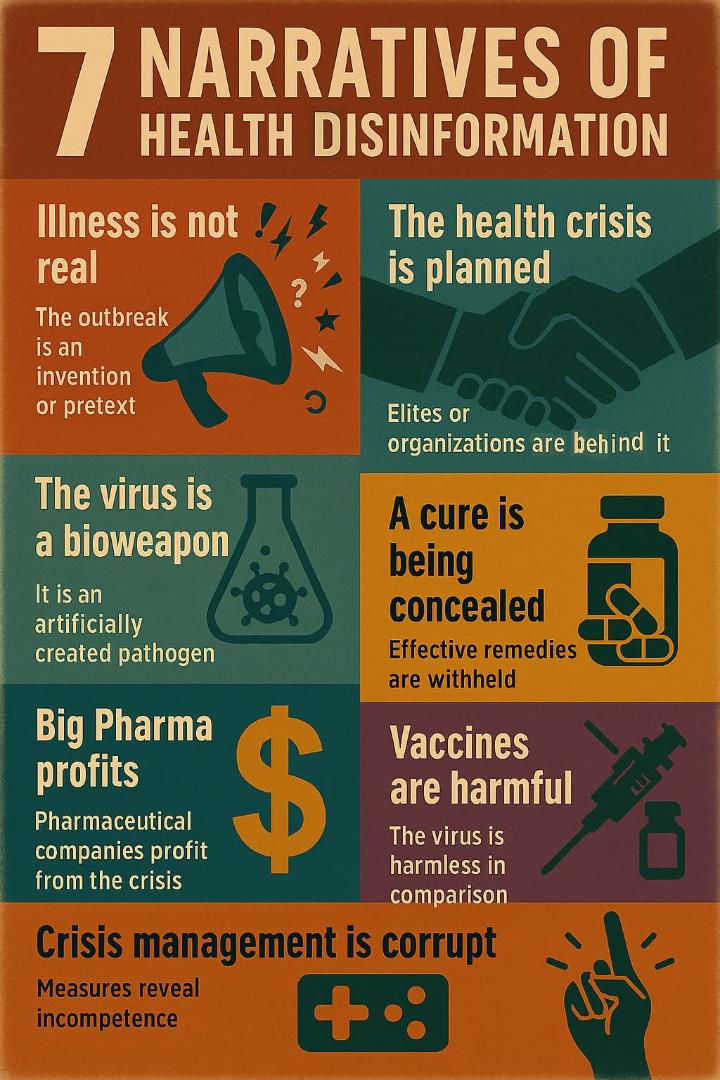
A first narrative claims: the disease is not real. In this variant, the outbreak is portrayed as an invention, media hysteria, or a pretext. The claim does not need to be consistent; it is sufficient to cast doubt on whether authorities, international organisations, or the media are reporting honestly about the situation.
- A second narrative claims that the outbreak and the health crisis are planned. Here, the outbreak is not presented as a medical event, but as a deliberately engineered crisis. Such claims often refer to alleged simulation exercises, global elites, or international organisations. Crisis management is not interpreted as a response to risk, but as supposed evidence that the outbreak had been prepared in advance.
- A third narrative presents the virus in question as an artificially produced bioweapon from a laboratory. This narrative is particularly compelling because it combines medical uncertainty with geopolitical distrust. It can be directed against Western states, international organisations, laboratories, the military, or pharmaceutical companies. In the case of Ebola, this theme has a long history: even earlier outbreaks were accompanied by claims that the virus had been artificially created or deliberately spread.
- A fourth narrative claims that a simple cure exists which is allegedly being concealed. In this version, unapproved medications, dietary supplements, or supposed natural remedies are promoted as solutions. The narrative combines distrust of medicine and authorities with direct monetisation. Those who generate fear around a disease can simultaneously sell products, consulting services, donation campaigns, or exclusive content.
- A fifth narrative asserts that “Big Pharma” profits from the crisis and/or deliberately caused it. Medical research, vaccines, medicines, and international aid measures are not presented as necessary responses to an outbreak, but as a business model.
- This can be linked to a sixth narrative: it is not the virus, but vaccines, medicines, and public health authorities that constitute the real danger.
- A seventh narrative interprets crisis management itself as evidence of corruption and instability. Delays, contradictory early information, logistical challenges, or border measures are not understood as typical features of complex health crises. Instead, they are framed as supposed proof of cover‑ups, incompetence, or deliberate manipulation.
Such narratives are disseminated by a range of actors. These include anonymous or hard-to-identify users on social media, health-related influencers, organised anti-vaccination groups, as well as operators of often AI‑supported conspiracy platforms. Commercial actors who promote dubious dietary supplements or unapproved therapies also contribute to their spread. Motivations vary: some actors pursue political objectives, others economic interests, and many combine both.
Why Health Topics Are Particularly Vulnerable to Disinformation
Public communication about highly infectious and deadly diseases, as well as epidemics and pandemics, is particularly susceptible to disinformation. This is because these topics are emotionally charged, closely connected to everyday life, and associated with fear, while at the same time being highly complex in their details and difficult for most people to fully verify. As a result, they are especially prone to resonance. Diseases can affect anyone, and no one wants to fall ill. At the same time, viruses, transmission pathways, mutations, laboratory findings, or epidemiological models are not directly visible or tangible for most people. They remain abstract and technical, and are usually accessible only through experts, authorities, or the media. This combination of personal relevance and limited comprehensibility creates uncertainty.
Disinformation exploits precisely this uncertainty: it offers simple explanations, clear culprits, and seemingly immediate courses of action. This can have a psychologically relieving effect, even if the explanation is false. Anyone claiming that a virus is fabricated, planned, or spread by a specific group transforms a complex health risk into a political narrative with perpetrators and victims.
In addition, for many purveyors of health disinformation there is a financial incentive. An analysis by the Global Disinformation Index, for example, shows that a single content creator spreading health disinformation in the German-speaking information space can earn up to Euro 15,000 per month.[18] Sources of revenue include programmatic advertising, subscriptions, donations, merchandise, affiliate marketing, shares in advertising revenue, and promotion on other monetised channels. Telegram channels, for example, make particularly frequent use of affiliate marketing—an online marketing model in which products or services of a company are promoted in return for a commission—and promotional activities, while websites tend to rely heavily on programmatic advertising. Many of the examples mentioned above of disinformation surrounding the current Ebola outbreak display exactly these characteristics, such as the sale of supposed remedies or conspicuous advertising placements.
Health disinformation is therefore not only a problem of false claims, but always also a business model—on a global scale. Fear generates attention. Attention generates reach. Reach can be converted into advertising revenue, donations, subscriptions, product sales, or commissions. Particularly lucrative are pieces of content that provoke outrage, reinforce existing distrust, and repeatedly draw users back—for example through familiar narratives such as the artificial origin of diseases. This helps explain why, on the very first day of the WHO declaration, dubious health influencers already made the Ebola outbreak their topic.
Political actors also exploit this resonance: domestic disinformation undermines trust in governments, aid organisations, authorities, science, and the media; others link diseases to anti-colonial narratives and agendas. Foreign information manipulation, on the other hand, deliberately uses health disinformation to amplify crises, promote social division, and foster distrust and disorientation. The core objectives of state-driven disinformation are confusion, loss of trust, and the weakening of functional institutions.
It is also striking that disinformation itself is often described using medical terminology. Content “goes viral,” societies are “infected,” and people are supposed to become more resilient through “information inoculation.” These terms are vivid and can help explain dynamics. However, they also carry a risk: if disinformation is described like a natural pathogen, political intent, financial interests, and concrete responsibilities may be obscured.
 Graphic created with AI Copilot / Konrad-Adenauer-Stiftung
Countermeasures: faster, coordinated, local, community-driven and tech-supported
Health disinformation in general, and current Ebola disinformation in particular, shows recurring patterns. Actors, narratives, and dissemination mechanisms are similar across different outbreaks and crises. Nevertheless, key institutions often only react once disinformation is already visibly spreading or has real, physical consequences. This creates a time window in which malicious actors can fill the information vacuum. It is precisely this window that must be closed. To achieve this, key actors such as the WHO, as well as national and local health authorities, require the following:
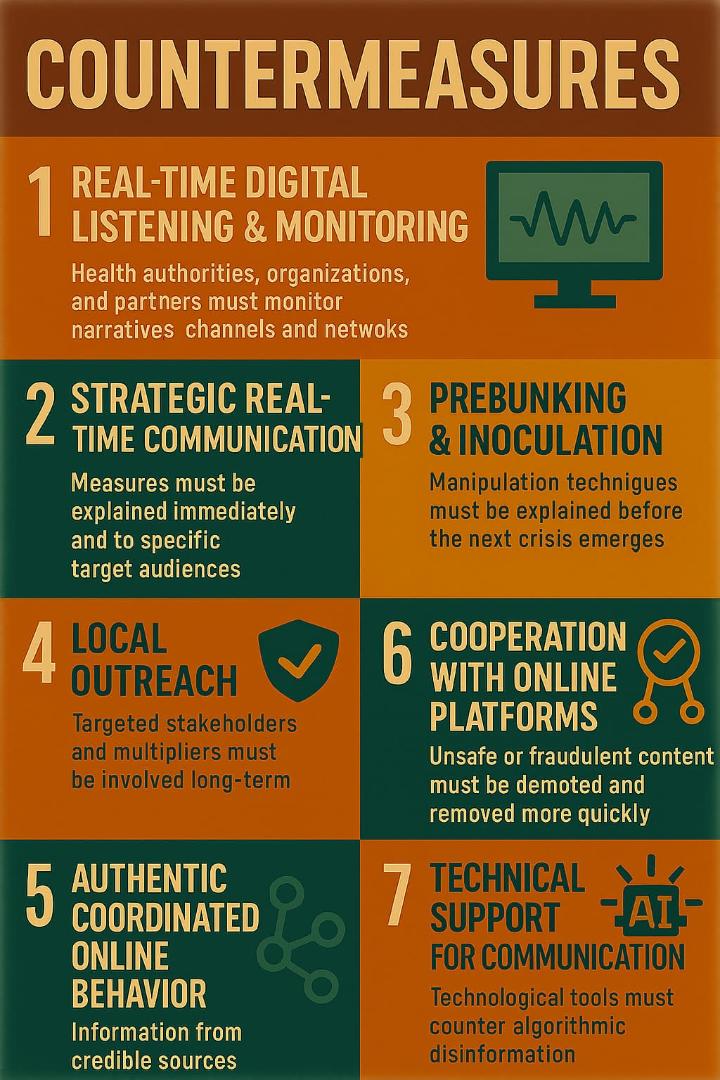
- First, real-time digital listening and monitoring: Health authorities, international organisations, and partners must use software-supported monitoring to observe digital information spaces in order to identify narratives, communication channels, networks, and key amplifiers at an early stage. Monitoring must reveal which narratives are circulating, which target groups are being addressed, which actors are spreading them, and when a narrative moves from comment sections into broader public discourse. As is currently evident in the DRC, depending on the region this must also include monitoring not only in local languages but particularly in cooperation with local communities. Where communities are primarily oral, methods must be developed (e.g. via telephone, radio, or direct conversations) to obtain a reliable situational picture.
- Second, strategic communication in real time: Official measures, such as the declaration of an international public health emergency, must not be communicated in isolation. They must be accompanied by active communication. Effective crisis communication explains what is known, what remains unclear, what is currently being assessed, and what a measure does not imply. This communication must be tailored to target audiences in terms of format, content, and channels of distribution. The goal is to avoid information vacuums and interpretive gaps, and to establish informational dominance. As with monitoring, both proactive and reactive strategic communication must take into account local languages, traditions, and the importance of trusted local actors as Multipliers.[19]
- Third, Prebunking and Inoculation should be used on a sustained basis: Disinformation actors do not spread their narratives only during an acute outbreak. Over time, they build distrust, establish narratives and enemy images, and train their audiences to distrust official sources. Credible communication must therefore also operate continuously. It can explain typical manipulation techniques before the next crisis occurs: false experts, allegedly suppressed remedies, bioweapons claims, fabricated simulation exercises, documents taken out of context, and manipulated graphics.
- Fourth, outreach to local and target group-specific stakeholders and multipliers is necessary: In the current Ebola context, the WHO explicitly recommends large-scale and sustained engagement with communities, local, religious, and traditional leaders, as well as healers. These actors should play a central role in case identification, contact tracing, and risk communication.
- Fifth, cooperation with—and pressure on—online platforms is required: Clearly false, health-threatening, or fraudulent content and channels that distribute such material professionally and for financial gain must be labeled, downranked, or removed more quickly. This applies in particular to content promoting alleged cures, discouraging people from seeking medical treatment, or deliberately spreading fear of doctors and public health authorities. Platforms should not only moderate content but also review the monetisation of problematic actors.
- Sixth, authorities and credible actors should strengthen coordinated, authentic online behaviour: Various tools are available for this purpose, including “nutrition labels,” corrections, community notes, reposting and linking to reliable information, coordinated supporter behaviour, and more. It is insufficient to place information on official websites; it must be brought into the same digital spaces in which disinformation is spreading.
- Seventh, strategic communication requires technical support: Attackers use AI-supported, fully automated disinformation tools, algorithmic amplification, emotionalization, hashtag hijacking, multi- and cross-channel communication, coordinated inauthentic behaviour, and spillover between platforms. Countermeasures must not only understand these mechanisms but also respond to them technologically. This can include, for example, software for coordinating supporter behaviour on social media (“elves”), AI-supported communication, or software-based counterspeech programs. In addition, AI-powered solutions can support the monitoring and translation of local discourse and communication, the tailoring and translation of messages, communication and interventions into local languages, and the targeted dissemination to trusted local actors
About the Author:
Dr. Christopher Nehring is a Security researcher, analyst, trainer, and consultant. He is an expert in disinformation, cyber influence operations and cybersecurity, AI and deepfakes, OSINT, and intelligence services. He regularly writes on security topics for leading German media outlets (e.g. Deutsche Welle, Tagesspiegel, NZZ, Spiegel Online, Die Welt). Most recently, he worked as Intelligence Director at the Cyberintelligence Institute in Frankfurt am Main, focusing on intelligence services, hybrid threats, and disinformation/information manipulation. Through the Konrad Adenauer Foundation’s Media Programme Southeast Europe, he received a fellowship as a visiting lecturer on disinformation, intelligence services, and media at the Faculty of Journalism and Mass Communication at Sofia University. Further information can be found on his LinkedIn profile: https://www.linkedin.com/in/christopher-n-423b06257
[2] https://balobakicheck.com/ebola-in-drc-the-virus-in-the-mirror-of-myths-and-misinformation/.
[3] Ange Adihe Kasongo in conversation with the Authors, 25.5.2026.
[4] Detailed: https://www.celinegounder.com/p/ebola-disinformation-playbook.
[5] https://www.facebook.com/dw.africa/videos/africa-cdc-has-confirmed-an-ebola-outbreak-in-eastern-dr-congo-amid-fears-the-vi/987496340651161/; aditionally on Youtube: https://www.youtube.com/watch?v=7rXSi0DSGYQ.
[6] https://t.me/s/sputnik_africa?q=Ebola.
[9] https://www.newsguardrealitycheck.com/p/hantavirus-is-overrunning-france.
[10] https://www.tagesschau.de/faktenfinder/hantavirus-falschinformation-100.html.
[15] See in detail: https://www.bundesarchiv.de/assets/bundesarchiv/de/Publikationen/BFi_33_Selvage_Nehring_AIDS_Auflage-02.pdf
[16] ibid.
[17] See also: https://disinfo.africa/how-social-media-conspiracies-sabotaged-vaccine-campaigns-in-africa-f5b4f05f7632.
[18] https://www.disinformationindex.org/research/2026-04-17-monetisation-german-online-ecosystem/
[19] Detailed explanation by Ange Adihe Kasongo, journalist and founder of Balobaki Check from the Democratic Republic of Congo.