Historical Walking Tour: Station 5
Memories of Konrad Adenauer at Villa La Collina
His tall figure without pathos, his arms hanging casually at the sides of his gaunt body, his bony hands pressed together expectantly, So I had [...] close enough to his hard head. The light of the morning sun fell on his open face with the deeply buried furrows and on the eyes that looked inquiringly at what was happening around him.




Table of Contents
Encounters with the painter Graham Sutherland
The painter Oskar Kokoschka portrays Adenauer
In the "Villa la Collina" there are still some original objects from the Adenauer era, such as the armchair and the white chest of drawers in the entrance hall. Original paintings by the well-known painters Graham Sutherland and Oskar Kokoschka, to whom Adenauer had "stood as a model" in Cadenabbia at the time, can also be seen in the villa.
Encounters with the painter Graham Sutherland
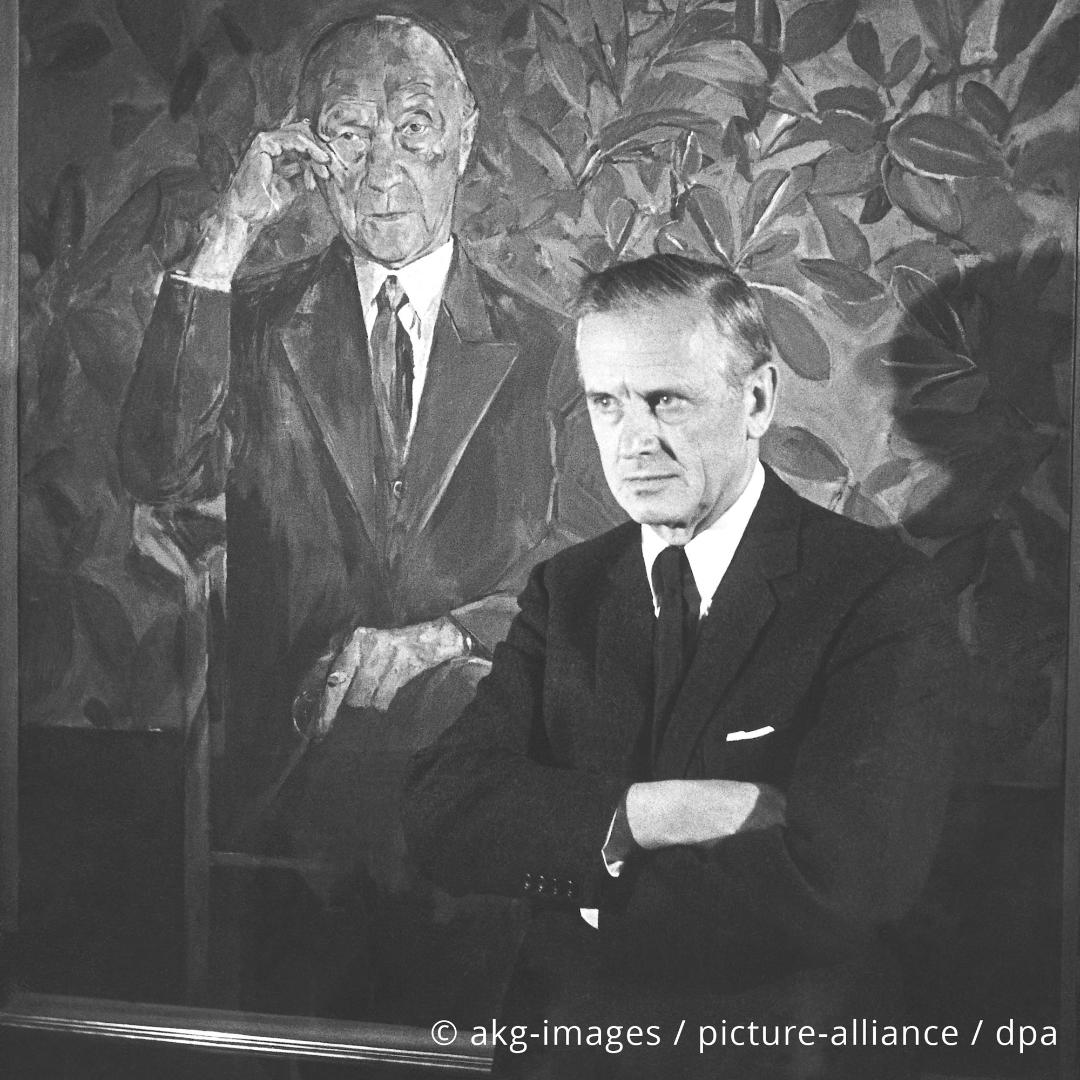
The British painter Graham Sutherland visited Adenauer for the first time in Cadenabbia in the autumn of 1963, a few weeks before he left office as Chancellor, to draw Adenauer. The photographer accompanying him, Felix H. Man, describes the situation during the portrait sessions as follows: "Adenauer was an excellent model who maintained his position easily, without visible effort, and gladly for half an hour to three-quarters of an hour, despite a lively conversation, in which the chancellor loved to explain his political convictions to an Englishman." As Man indicated, these statements were rather critical, but this is not surprising, after all, Adenauer never forgave the British for removing him from office after his reinstatement as Lord Mayor of Cologne in 1945 – as the National Socialists had done before him in 1933. Moreover, at the time of Sutherland's visit in 1963, Adenauer was a close ally of French President Charles de Gaulle, who had just vetoed Britain's admission to the European Economic Community (EEC) earlier this year. But Sutherland seems to have taken these small provocations in a sporting way. In any case, Adenauer was very satisfied with the main result, a portrait completed in 1965. He acquired the painting for 110,000 DM, it hung in the Adenauer House in Rhöndorf long after his death, and later hung under the CDU chancellors Helmut Kohl and Angela Merkel in the Federal Chancellery in Bonn and Berlin, respectively. Since 2023, it has found a new location in the European office of the Konrad Adenauer Foundation in Brussels.
The painter Oskar Kokoschka portrays Adenauer
In April 1966, the Austrian painter and representative of Viennese Modernism, Oskar Kokoschka, travelled to Cadenabbia for three weeks to paint a portrait of Adenauer. His fee was 200,000 DM. It was provided by an illustrated newspaper and donated to the charity campaign "Children in Need". Here, too, the two famous personalities took a liking to each other during the portrait sessions and lively discussions ensued. Kokoschka describes the beginning of the portrait work as follows: "In any case, I had a comfortable armchair placed on the podium so that it would not overexert itself. To stand for me for two or three hours a day—he was already over ninety years old—that, I thought, would be too much for him. He reprimanded me with a smile: After all, I wouldn't be sitting while painting, and we both belonged to a generation that doesn't age. So it was also right for me to paint him upright, how he had greeted us in the park and how his appearance had immediately impressed itself on me as a spiritual image."
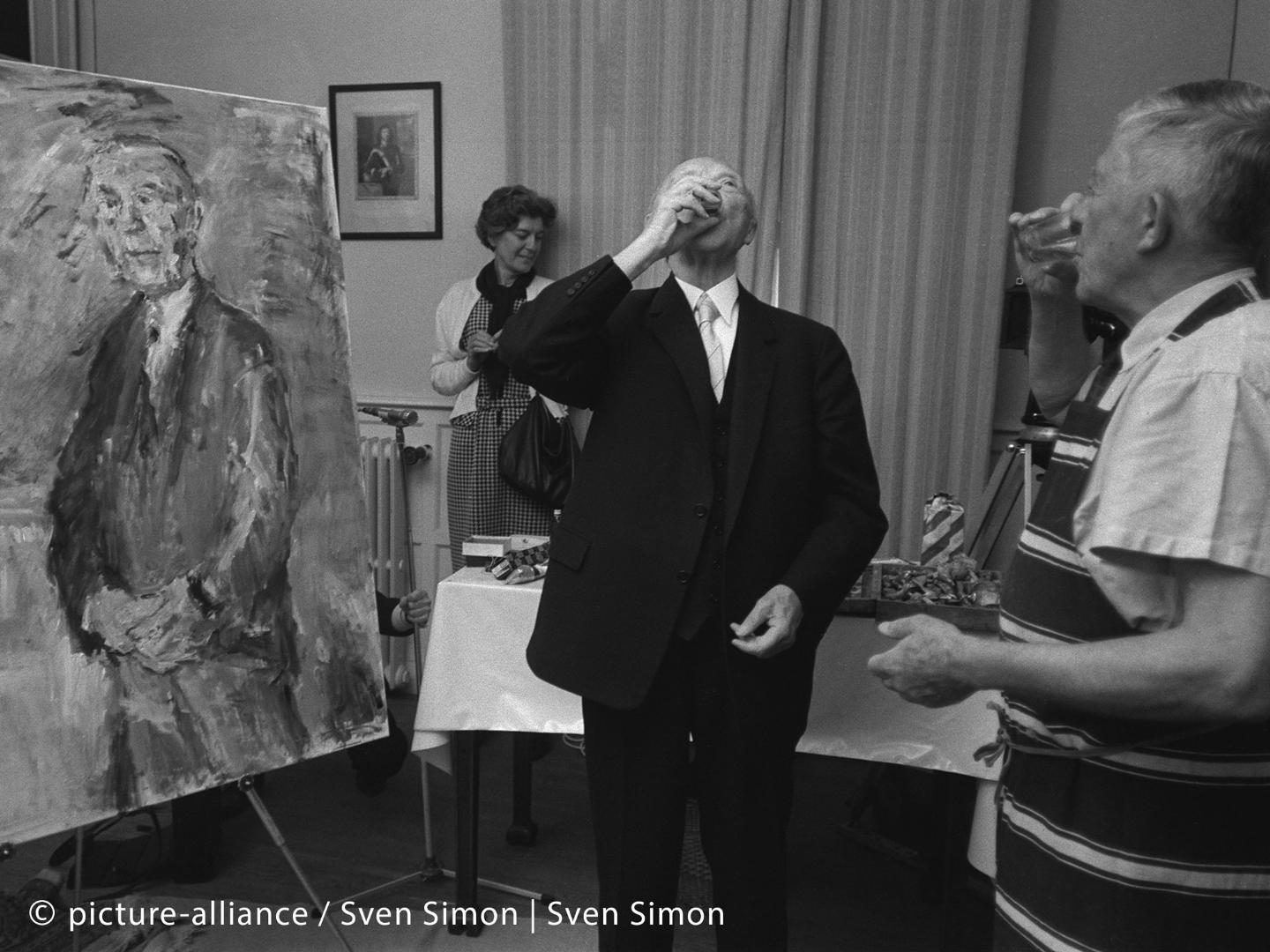
The illustrated magazine, as the commissioner, donated the portrait to the German Bundestag, where it hung in various offices, including that of the then President of the Bundestag, Prof. Dr. Rita Süssmuth. In February 2006, the President of the Bundestag, Prof. Dr. Norbert Lammert, presented Kokoschka's painting on loan to the Federal Chancellery. Until the end of her term in office in autumn 2021, it hung in the office of Chancellor Dr. Angela Merkel. A smaller portrait sketch made by Kokoschka now hangs in the entrance hall of the "Villa La Collina". It is a chalk lithograph that also dates back to his stay in Cadenabbia in 1966 and of which he made 95 copies.