Historical Walking Tour: Station 6
Germany and Italy
Cadenabbia is more than a charming holiday home on Lake Como that keeps the memory of the first chancellor of the Federal Republic alive. It is a place of legacy, a place of reflection on the international living conditions of our state: the strength of the Atlantic community and the political union of Europe.




Table of Contents
Transatlantic Security Partnership

Adenauer not only valued Italy as a holiday destination and because of its great cultural heritage, but also recognised and respected it as an important European partner. This was especially true of the central role that Italy has played as a comrade-in-arms in the European integration process from the very beginning.
European integration process
The idea of Europe played a central role in Adenauer's thinking. Instead of persisting in nationalism and demarcation, the European peoples should remember their common cultural and spiritual heritage and follow the common path of cooperation in the future. An important step in this regard was the founding of the European Coal and Steel Community (ECSC) in 1950, initiated by the French Foreign Minister Robert Schuman and Adenauer, which was joined by Italy, the Netherlands, Belgium and Luxembourg in addition to the Federal Republic of Germany and France. In 1957, the founding of the European Economic Community (EEC – predecessor of the European Community/EC and the European Union/EU) and the European Atomic Energy Community (EURATOM) were decided – after their place of signing, one also speaks of the "Treaties of Rome". This points to the central role that Italy, as a founding member of both the ECSC and the EEC, played in the process of European integration.
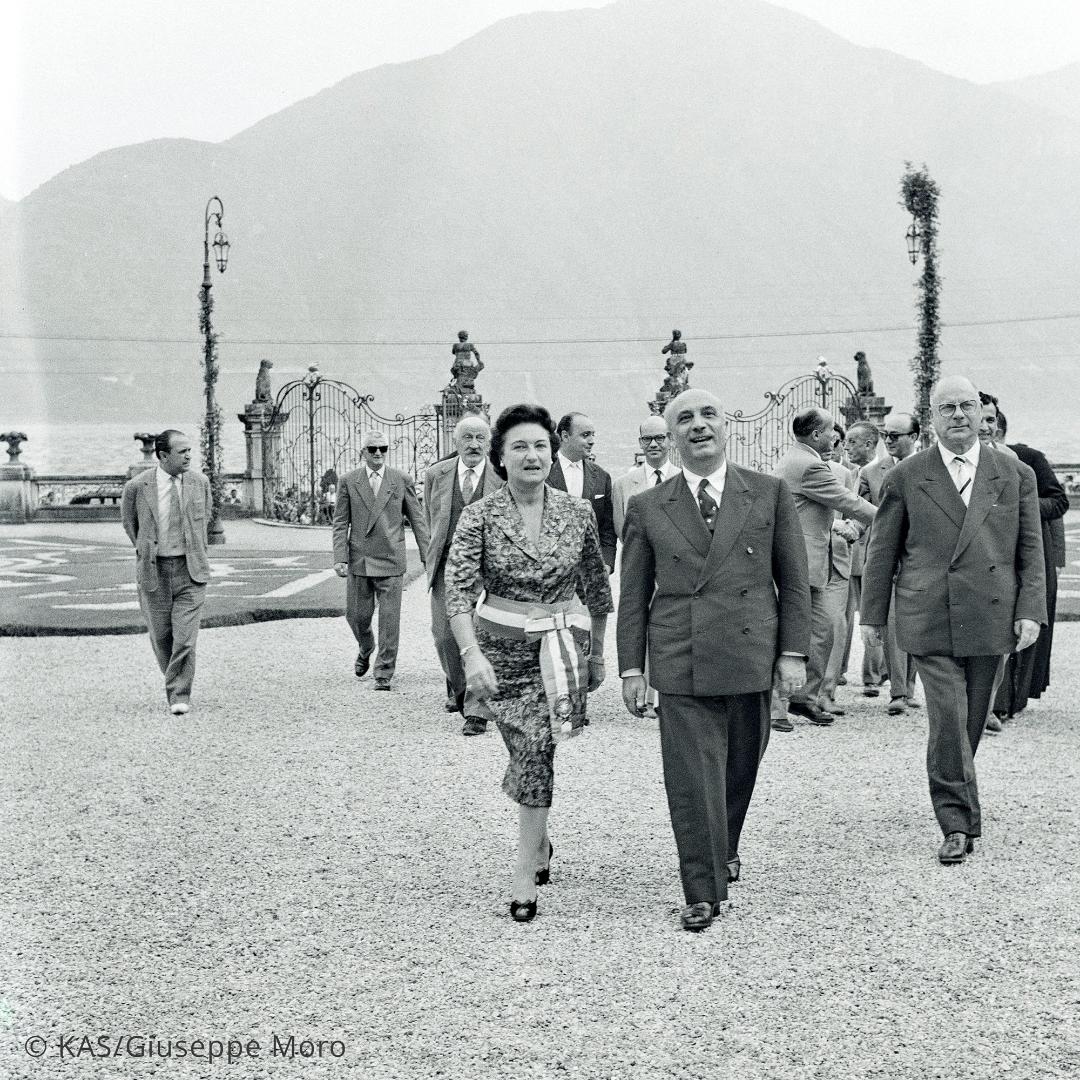
The dominant political force at that time was the Democrazia Cristiana, the partner party of the CDU. European and bilateral relations were correspondingly close. Two outstanding Italian politicians were particularly frequent guests in Cadenabbia, namely Amintore Fanfani (Prime Minister 1958/59 and 1960-1963) and Antonio Segni (Prime Minister 1955-1957 and 1959/60, Minister of Foreign Affairs 1960-1962, President 1962-1964).
Transatlantic Security Partnership
The United States of America also played a key role in Adenauer's concept of attachment to the West. As the military protecting power of the Federal Republic of Germany and Western Europe as a whole within the framework of NATO, they were de facto also a European power – and transatlantic relations were thus the central pillar on which his foreign policy concept was based, along with European integration. Although Adenauer began to have doubts about the reliability of the American promise of security from the end of the 1950s, contacts with the US governments remained close, because the later years of the Adenauer era were turbulent in terms of foreign policy with a new crisis over Berlin from 1958 onwards and finally the construction of the Wall in 1961 as well as a general escalation of the Cold War up to the Cuban Missile Crisis in the autumn of 1962, which endangered humanity. So it is not surprising that American representatives from politics, journalism and the military also found their way to Cadenabbia from time to time in those years, including the general and commander-in-chief of NATO forces in Europe, as well as Lauris Norstad, Secretary of State (from 1961) Dean Rusk, the renowned journalist of the New York Times Cyrus Sulzberger and John F. Kennedy’s National Security Advisor McGeorge Bundy.

There are voices that suspect that it was not only the good air that prompted Adenauer and his entourage to move the holiday resort to Cadenabbia. The Bürgenstock in Switzerland, his preferred holiday home so far, is said to have been populated by "bugs" - and in this case he did not mean the animals.