Historical Walking Tour: Station 4
Cadenabbia as substitute chancellor's office
These days in Cadenabbia have not exactly been embellished for me by the remarks, especially in the German press, about who now wants to become Chancellor.




Table of Contents
Preparation for the meeting with Charles de Gaulle
Reflecting on the "Presidential Crisis"
Controversy over the ratification of the Élysèe Treaty
The last Cadenabbia stay in the office of the Federal Chancellor
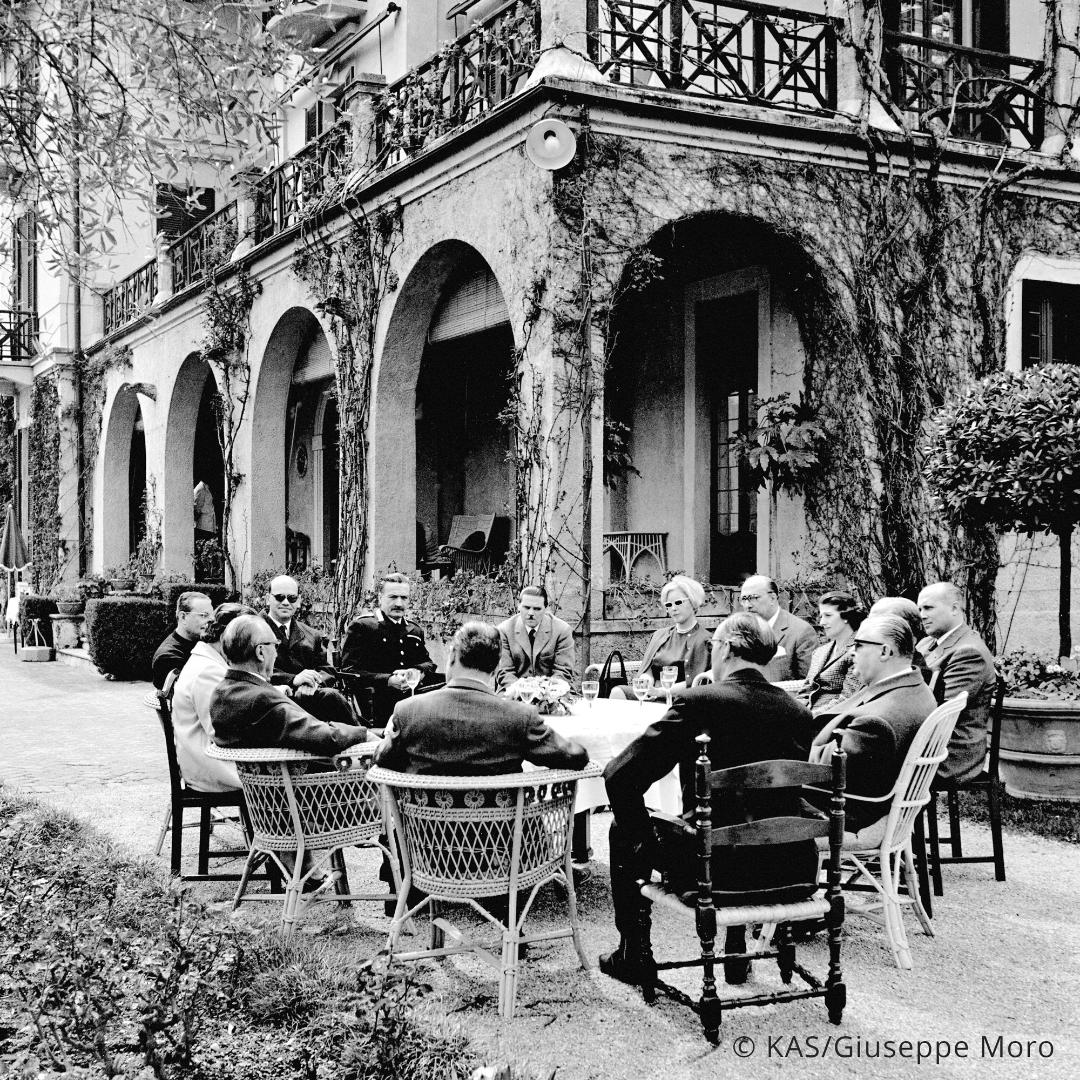
Despite all the holiday feelings that the pictures from Cadenabbia suggest, it must not be forgotten that the "Villa La Collina" was not a normal holiday home, but the temporary residence of the head of government of a state that was at the centre of the Cold War in Europe at the time and whose importance grew steadily through Adenauer's political actions. During Adenauer's stays, the residence on Lake Como thus served as a substitute chancellor's office, so to speak. This involved extensive preparations in the run-up to the visits. Employees of the Federal Chancellery traveled to Cadenabbia, examined the condition of the villa and commissioned necessary repairs. In cooperation with the Italian authorities, telephone and telex devices were connected so that the connection with Bonn was always available. Officers of the Federal Criminal Police Office inspected the security of the site and consulted with the local police forces. If strictly confidential information had to be communicated or exchanged during Adenauer's stay on Lake Como, couriers drove to Bonn or Cadenabbia.
In this sense, the former Prime Minister of Rhineland-Palatinate and Thuringia and Honorary Chairman of the Konrad Adenauer Foundation, Bernhard Vogel, warned against underestimating the importance of Cadenabbia at that time as a place of action for German and European politics: "It is easy to overlook the fact that decisive milestones of the late Adenauer era were conceived or set in Cadenabbia, that the Cadenabbia stays belong to those very years when Adenauer was regarded as the grand old man of the West."
Preparation for the meeting with Charles de Gaulle
In the summer of 1958, for example, Adenauer was preparing for his first personal meeting with the new French President Charles de Gaulle on Lake Como. At that time, it was not yet foreseeable that this would one day grow into a close friendship between two peoples as well as between two statesmen – on the contrary. As the “liberator of France” from German occupation, the general, who had been swept back into power by the chaotic domestic political situation following the Algerian war, was not previously known as a supporter of close bilateral relations between Bonn and Paris. In 1954, his supporters had also brought down Adenauer's pet project of a European Defence Community in the French National Assembly. Some German experts even feared the establishment of a military dictatorship west of the Rhine. In Cadenabbia, Adenauer consulted with Federal Foreign Minister Heinrich von Brentano and the German Ambassador to France, Manfred Klaiber, among others. On September 13, the chancellor set off from Lake Como. After a short stopover in Baden-Baden, he met de Gaulle on 14 September 1958 in his hometown of Colombey-les-Deux-Églises. This personal meeting has gone down in history as the "Miracle of Colombey" and paved the way for the special German-French rapprochement that was to culminate in the signing of the Treaty on Franco-German Cooperation (Élysée Treaty) in January 1963.
Reflecting on the "Presidential Crisis"
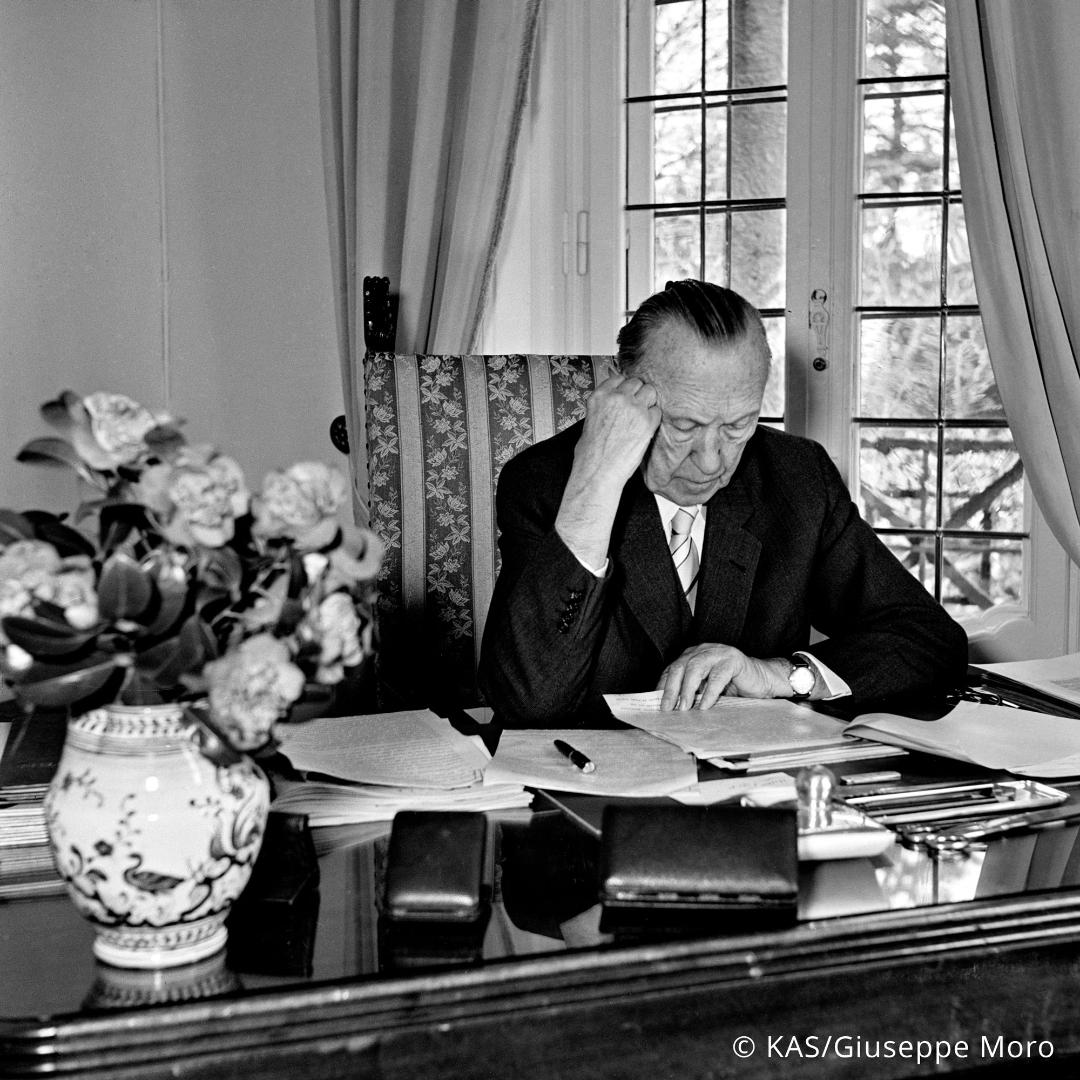
In the spring of the following year, Adenauer brooded over a domestic political "crisis" that he himself had conjured up during his stay on Lake Como: the so-called "presidential crisis". With the approaching end of the term of office of the popular Federal President Theodor Heuss, Adenauer had considered moving to the office of head of state himself, and also publicly announced this intention on April 7, 1959, before he left for Cadenabbia the following day, as he writes in his "Memoirs": "On the evening of April 8, 1959, I left for a four-week vacation in Cadenabbia, without having talked to anyone else about this whole matter first."
While calmly reflecting on Lake Como, however, he increasingly had doubts about his own intentions, as the powers of a Federal President were small compared to his own as Chancellor. In addition, it became apparent that Federal Minister of Economics Ludwig Erhard would succeed him in the office of head of government at this time, for which Adenauer simply denied him the qualification. Important representatives of the party, parliamentary group and government met in Cadenabbia in the spring of 1959, including Robert Pferdmenges, a member of the Bundestag and close confidant of the Chancellor, State Secretary Hans Globke and the CDU/CSU parliamentary group chairman Heinrich Krone. Adenauer writes further in his "Memoirs": "On May 2, Dr. Krone [...] and State Secretary Globke. Krone told me that in his opinion the majority of the parliamentary group was in favor of Erhard's candidacy for the office of Federal Chancellor. I expressed very emphatically to Krone my strong reservations about Erhard's candidacy for chancellor." […] On May 4, 1959, I returned from Cadenabbia to Bonn." The discussions leading up to Adenauer's final rejection of the office of Federal President dragged on for some time, but the conceptional basis for his decision to reject Erhard as his successor in the Chancellery had already matured in Cadenabbia.

Controversy over the ratification of the Élysèe Treaty
Meetings with federal ministers and the head of the CDU/CSU parliamentary group in the Bundestag were part of everyday life in Cadenabbia. What was unusual, however, was the holding of a coalition meeting at the holiday resort on 4 April 1963. The background to this was the dispute over the bilateral treaty on the foundations of German-French cooperation (Élysée Treaty), signed on 22 January 1963, which is rightly regarded as a milestone in reconciliation between the two countries, but was nevertheless controversial at the time because a dispute was raging within the Union parties about a closer alignment with either the USA or France ("Atlantic-Gaullist controversy"). Against this background, a group of around 14 people from both parliamentary groups met at Lake Como, including CDU Federal Foreign Minister Gerhard Schröder, Development Minister Walter Scheel (FDP), Minister for All-German Affairs Ernst Lemmer, Union foreign policy experts Ernst Majonica and Johann Baptist Gradl, FDP parliamentary group chairman Erich Mende and Parliamentary Secretary of the CDU/CSU parliamentary group Will Rasner.
At a preliminary meeting, Majonica had made it clear to the Chancellor that the ratification of the Élysée Treaty in the Bundestag was in danger of failing. This would not only have failed Adenauer's pet project in the last few meters, but it would also have meant an affront to France and de Gaulle to reject the treaty, which had already been ceremoniously signed, and would have questioned the reconciliation process that had begun with the former war opponent in general. Against this background, Adenauer agreed in Cadenabbia to the proposal to unilaterally preface the treaty with a preamble in which the importance of the transatlantic partnership was to be emphasised. And so it happened. De Gaulle reacted disappointed, but the treaty was saved – and is now considered one of the greatest achievements of the Adenauer era.
The last Cadenabbia stay in the office of the Federal Chancellor
One of Adenauer's special stays on Lake Como was in the late summer of 1963 – his last as Chancellor and a few weeks before his announced retirement. During this stay, he attended a particularly large number of press appointments, namely with Bavarian Television, photo reporters from the FAZ, British television, Axel Springer, photo reporters from Neue Illustrierte, Stern, Die Welt, the Stuttgarter Zeitung, photo reporters from Spiegel and Revue, the newsreel and an interview with the ZDF. In his "Memoirs" under the date of September 14, 1963, the Adenauer confidant and former CDU/CSU parliamentary group chairman Heinrich Krone noted: "In Cadenabbia together with Erhard and Schröder and Brentano. It was a beautiful autumn day. We sat in the garden. There was a hint of melancholy over that day, the eve of the day on which the chancellor was elected with a majority of one vote 14 years ago.”
Among the many high-profile visitors was the well-known painter Graham Sutherland, who had come to portray Adenauer. Also present was the photographer Giuseppe Moro, who otherwise had film stars such as Anita Ekberg in front of the camera and now – during Adenauer's Cadenabbia stays – advanced to the position of "chancellor photographer", and to whom we owe a special insight into the holiday stays of the "old man" through his photos. The Konrad Adenauer Foundation recently published an illustrated book with his photographs. The onward journey after the Cadenabbia stay was also special. Adenauer travelled on to Rome, where he was received by the new Pope Paul VI for an audience on 17 September 1963.