





Asset Publisher

Publications

Asset Publisher

IMAGO / Bashir Daher

New Yemen, new Gulf

The war in Yemen and the rift between Riyadh and Abu Dhabi

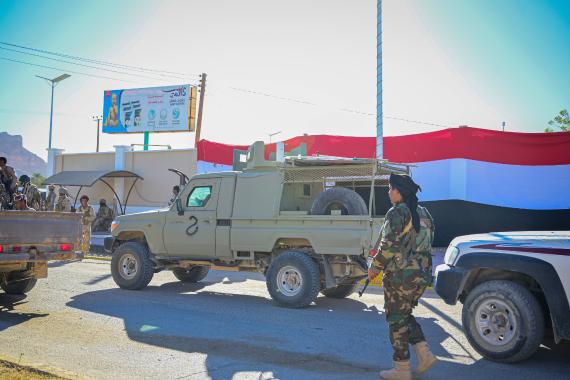
In the wake of the dramatic events in the Yemeni civil war at the turn of the year, the cards have been reshuffled between the regional powers Saudi Arabia and the United Arab Emirates (UAE). The military offensive by Emirati-backed separatists and the counterattack by the Yemeni government allied with Saudi Arabia are more than just another chapter in the war – they have caused tensions between the two Gulf monarchies to boil over. Not only has the long-simmering animosity between Riyadh and Abu Dhabi fully come to surface, but the conflict also makes another round of confrontations in the Gulf more likely. Moreover, it raises fundamental questions about stability in the Middle East, for which the Gulf states were in fact considered guarantors. In the Gulf, a new phase of politics could be dawning, with two opposing poles of the Gulf Cooperation Council (GCC) pursuing conflicting regional visions with the help of different coalition partners. Likewise, the breakdown of the former Saudi-UAE alliance is not without consequences for Europe's foreign policy in the Middle East, which so far relied on both protagonists as anchors of stability.

Drivers of Grassroots Social and Political Transformation: Enhancing Saudi-German underground art spheres

Enhancing Saudi-German underground art spheres

Underground cultures in art, politics, and philosophy play a pivotal role in shaping societal debates. Germany and Saudi Arabia both host vibrant underground communities comprised mainly of youth from diverse backgrounds. These communities have witnessed and accompanied entire social and political transformations in the past and can thus be considered drivers of grassroots societal progress and creative problem-solving through artistic collaborations. Given these similarities between the Saudi and German underground scenes, this policy report analyses opportunities and obstacles for closer cooperation between representatives of the countries’ respective underground scenes.

APAimages, Imago

The First Year of Trump’s Second Term from the Gulf Perspective

Honeymoon and Black Eyes

After a promising start to US-Gulf relations under President Trump, security setbacks soon followed. Military escalations and diverging strategic priorities raise questions about the resilience of personal networks. What consequences will this have for the region’s stability?

IMAGO / ZUMA Press Wire

The UAE – (not) just another BRICS member?

Admission to BRICS strengthens the Emirates’ economic and foreign policy ambitions

Although the UAE seem like an unusual member of BRICS, the Emirates have embraced their admission to join the group in 2024. Being a BRICS-member furthers Abu Dhabi’s agenda to become an economic hub and is part and parcel of its diversified foreign relations. For Europe this should be a wake-up call.

DAFG

German Arab Gulf Dialogue on Security and Cooperation in Berlin

Dialogue even in times of crisis

Amid the conflict between Israel and Iran, leading representatives from the Gulf states and Germany gathered for the 7th German-Arab Gulf Dialogue organised by the KAS and DAFG. Although the conference focused on overcoming current challenges in the Middle East and Europe, it also highlighted opportunities and potential for closer cooperation: Especially in times of crisis, stronger cooperation between Germany and the Gulf states is necessary.

IMAGO / ZUMA Press Wire

US-Iran Talks at a Crossroads

Tehran’s Red Lines, Trumpian Maximum Pressure, and Regime Survival

Negotiations between the Islamic Republic of Iran and the United States have reached a turning point. While Washington's position is continuously evolving, the regime in Teheran is hardly willing to make meaningful concessions. Shortly before the next round of talks, a resolution remains elusive.

IMAGO / ZUMA Press Wire

Chequebooks and Flattery

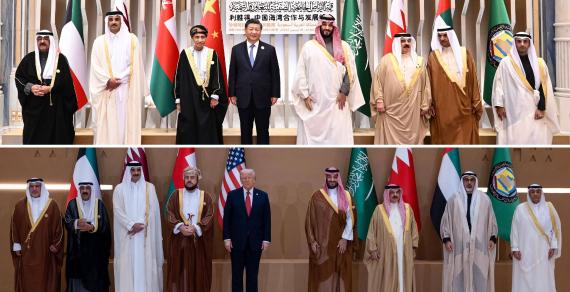
Lessons for Europe from Trump’s Gulf Visit

President Trump's visit to the Gulf States illustrated how close his personal ties are to its rulers. Beyond trillion-dollar deals, the trip showcased how the Gulf is leveraging its privileged access to advance its interest in Washington – something that Europe might have to take note of.

IMAGO / Depositphotos

Gulf-Asia Cooperation

Prospects, Challenges, and Implications for Europe

This publication explores the deepening ties between the Gulf Cooperation Council (GCC) and key Asian powers—China, India, Japan, and South Korea—and their implications for Europe. While energy remains central, cooperation is expanding into technology, infrastructure, and diplomacy. As Asia becomes the Gulf’s primary partner, Europe risks being sidelined unless it engages more strategically. This publication calls for greater EU-GCC-Asia trilateral cooperation to address shared challenges and seize emerging opportunities.

Forging Stronger Ties between Germany and Qatar

Insights from Norbert Lammert’s and Gerhard Wahlers’ visit to Qatar underscores shared priorities in diplomacy, development, and culture.

iStock.com/EyeEm Mobile GmbH

A View from South Asia Countries of Origin: Changing Contexts, Perceptions, & Policies

Special Issue on Vision 2030 and the Socio-Economic Reform Process: The Future of Labour and Migration in Saudi Arabia

With 75 percent of its workforce comprising foreign labour, Saudi Arabia faces increasing competition for its essential migrant workforce as other countries offer better conditions. Saudi Arabia must reform restrictive policies including the kafala system, improve recruitment practices, and lower remittance costs to maintain its labour advantage. This policy report examines how current migration systems impact South Asian workers and offers practical solutions to balance national economic interests with worker protections in an increasingly competitive global labour market.