

Bangladesh After the 2026 Election: What Comes Next?
ISAS-KAS PANEL DISCUSSION
Bangladesh’s parliamentary election of 12 February 2026 marks a major moment in the country’s post-uprising transition. Held alongside a referendum on constitutional reform, the vote took place in a context shaped by institutional strain, shifting alliances and competing visions of governance and national identity. Yet it also represents a renewed turn to electoral politics and an opportunity to rebuild stability after nearly two years of uncertainty following the collapse of Sheikh Hasina’s government and the interim administration led by Muhammad Yunus. This panel brings together scholars and practitioners to reflect on whether this moment can lay the groundwork for a more stable, inclusive and forward-looking political order in Bangladesh after the 2026 vote.
KASYP 16.3 Module: Local Governance and Development – Mongolia
Exploring decentralisation, citizen engagement, and effective local governance in democratic societies
Through expert lectures, comparative discussions, and interactive simulations, participants will examine key concepts of decentralisation, fiscal governance, and citizen engagement. The programme also includes sessions on the structure and competences of local governments, financial arrangements at the local level, and the challenges of implementing effective local governance systems in different political contexts. The participants will also present and discuss governance experiences from their respective countries, allowing for peer learning and comparative insights across Asia and Europe. Practical exercises, including a policy simulation addressing urban governance challenges, will encourage participants to apply theoretical knowledge to real-world governance scenarios. The module further features learning visits and dialogues with Mongolian political actors and institutions, including meetings with representatives of political parties, local government authorities, and members of parliament. These exchanges aim to provide participants with firsthand insights into Mongolia’s governance system and ongoing decentralisation reforms. By combining academic input, practical policy exercises, and institutional exchanges, the module seeks to deepen participants’ understanding of how effective local governance can contribute to democratic resilience, responsive policymaking, and sustainable development.
Women Parliamentarians and Security: Identifying Threats Through a Gender Lens
Asian Women Parliamentarian Caucus E Meets
The Konrad-Adenauer-Stiftung (KAS) Regional Programme Political Dialogue Asia announces the next session of the Asian Women Parliamentarian Caucus (AWPC) e-Meets, to be held on 25 February 2026
KASYP 17.1 Political Parties in Democratic Societies, 22- 27 February Cebu, Philippines
KASYP Batch 17 officially began their two-year journey toward responsible political leadership.
An intensive week of discussions, new perspectives, and honest exchanges lies behind the participants of KASYP Batch 17. The programme offered opportunities for personal and professional development while fostering connections among young politicians from across Asia. The first day laid a strong foundation for the week with inputs on different political systems and party structures. Country presentations, in which participants introduced their own countries, created space for comparison, reflection, and lively exchanges among the young politicians. Practical workshops on storytelling, feedback, leadership, and negotiation encouraged participants to step out of their comfort zones and work on their practical skills. Whether pitching political ideas, practicing giving and receiving feedback, or engaging in a multi-stakeholder negotiation simulation, the group worked constructively, strengthening their skills and confidence. A highlight of the week was the visit to Cebu City, including meetings at the Governor’s Office, the Vice Mayor’s Office, and the Office of the Ombudsman of the Visayas. After introductions to the work of each office, participants had the opportunity to ask questions and engage in discussion. These visits provided valuable insights into daily political practice, as well as perspectives on local governance and anti-corruption efforts in the Philippines. Beyond the formal sessions, participants also continued their exchanges outside the programme. A networking dinner with KASYP alumni from the Philippines provided additional opportunities to learn from the experiences and perspectives of former participants. The module concluded with the presentation of certificates, marking the successful completion of the first step in the two-year KASYP journey. With this strong start, Batch 17 now continues its path within the programme, building on the experiences and insights gained in Cebu. We look forward to following their progress in the upcoming modules.
KASYP 17.1, Module 01: Political Parties in Democratic Societies
KASYP 17.1 Cebu, Philippines | 22–28 February 2026
The module offers a comprehensive introduction to the ideational, institutional, and organisational foundations of political parties in Asia, with expert-led sessions on political ideologies, party systems, intra-party democracy, and party mobilisation. Through comparative formats such as discussions and country presentations, participants examine how political parties operate across different democratic contexts in the region. Beyond theoretical inputs, the programme places strong emphasis on practical political skills. Participants take part in hands-on workshops on pitching, framing, storytelling, public speaking, and party platform development, enabling them to translate political ideas into clear and compelling public narratives. The module also integrates direct engagement with democratic institutions, including visits to the Cebu Provincial Capitol, discussions with elected officials and oversight bodies, and exchanges with Philippines KASYP alumni, offering participants insights into democratic practice at the local and sub-national levels. As the inaugural module of the KASYP journey with participants from Thailand, Sri Lanka, Kazakhstan, Pakistan, Maldives, Indonesia, South Korea, Malaysia, Nepal, Bhutan, Timor Leste, Cambodia, India, Mongolia, Singapore and Taiwan, this programme lays the foundation for a cohort-based learning experience that combines political knowledge, practical skills, and democratic leadership development across Asia.
Agentische KI in einer entstehenden neuen Weltordnung: Was steht für Mittelmächte und kleine Staaten auf dem Spiel?
Seminar zu agentischer KI
Dieses Seminar untersucht, wie agentische KI eine entstehende Weltordnung prägt und was für Mittelmächte und kleine Staaten auf dem Spiel steht, die sich zwischen technologischem Wettbewerb, staatlicher Steuerungs- und Regulierungskapazität sowie strategischer Autonomie bewegen. Anstatt die Verbreitung von KI als eine einfache Trennung zwischen Produzenten und Anwendern zu begreifen, richtet die Diskussion den Fokus auf Handlungsfähigkeit, institutionelle Entscheidungsprozesse und Governance-Strategien in einem multipolaren Umfeld.
Security, Sovereignty, and Partnership in the Indo-Pacific
Indo-Pacific Security Seminar
The Indo-Pacific has become one of the central arenas of strategic competition in the second quarter of the 21st century. As shifting power balances, maritime tensions, and new economic alignments reshape the regional order, Europe faces both the challenge and the opportunity of defining a meaningful role in the Indo-Pacific. The region is home to key trade routes, emerging economies, and strategic partners whose security and prosperity are closely linked to those of Europe and thus dependent on a rules-based international order. This seminar brings together policymakers, scholars, and practitioners from Europe and across the Indo-Pacific to examine how security, trade, and connectivity are evolving amid intensifying geopolitical competition. Anchored in the principles of sovereignty, openness, and rules-based cooperation, the seminar seeks to identify practical pathways for deeper EU–Indo-Pacific engagement. By convening diverse regional voices in Singapore, the Konrad-Adenauer-Stiftung aims to support nuanced political dialogue and strengthen strategic partnerships at a time when developments in the Indo-Pacific will shape not only Asia’s destiny, but also the future of Europe as well.
KASYP Celebrates 15 Years!
15 Years of KASYP and 5 Years of ADLA: Charting the Next Chapter of Democratic Leadership in Asia
KASYP celebrated its 15th anniversary with a regional alumni gathering in Singapore from 20–22 October 2025, highlighting 15 years of empowering nearly 300 young political leaders across Asia. The event also marked ADLA’s 5th anniversary, reaffirming its role as KASYP’s alumni network and charting the path forward for stronger regional cooperation.
KASYP Marks 15 Years of Shaping Young Political Leaders in Asia
Celebrating together 15 Years of KASYP and its alumni organization ADLA
The Konrad Adenauer School for Young Politicians (KASYP), a flagship initiative of the Konrad-Adenauer-Stiftung’s Regional Programme Political Dialogue Asia, will celebrate its 15th anniversary with a major alumni gathering in Singapore. Since its launch in 2010, KASYP has trained nearly 300 emerging political leaders from across Asia, equipping them with the skills, values, and networks needed to strengthen political parties and advance democratic governance in the region. This three-day event will feature engaging networking sessions where KASYP alumni can reconnect, exchange ideas, and explore new opportunities for collaboration. It will also provide a platform for the existing alumni organization — ADLA (Asian Democratic Leaders Alliance) — to hold its elections for new Country Representatives and Executive Board members. The election of the new Executive Board will ensure that ADLA continues to represent the collective voice of KASYP alumni, strengthen regional cooperation, and nurture the next generation of democratic leaders across Asia. Beyond formal sessions, the event aims to foster meaningful dialogue, celebrate shared achievements, and inspire alumni to contribute actively to the future of the KASYP network.
AI and Civic Machines
Governance, Security, and Society
How can we harness AI agents not as disruptors, but as partners shaping the future of work?
KASYP 14 Module 4: Political Parties in Germany and Europe
KASYP will host Batch 14 Module 04: Political Parties in Germany and Europe from 4–10 October 2025 in Frankfurt, Erfurt, and Berlin, Germany.
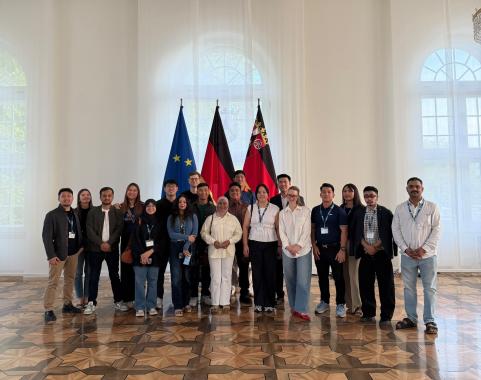
KASYP Batch 14 will have their final Module 04: Political Parties in Germany and Europe from 4–10 October 2025 in Frankfurt, Erfurt, and Berlin, Germany. This marks a milestone for Batch 14, who will officially graduate from the programme. The one-week programme immerses participants in Germany’s political landscape through visits to historical and political institutions, including the Point Alpha Memorial, Wartburg Castle, the Thüringer Landtag, Erfurt City Hall, and the Bundestag in Berlin. They will engage in discussions with policymakers and leaders as well as Members of Parliament. A highlight of the module is the “Day of KAS” at the Konrad-Adenauer-Haus in Berlin, where participants take part in workshops and exchanges with experts. With its mix of study visits, networking opportunities, and practical insights, this graduation module underscores KASYP’s commitment to empowering young political leaders in Asia by exposing them to European political systems, strengthening their comparative understanding of democracy and party politics, and preparing them to contribute effectively to their countries’ democratic development.
From Russia’s War on Ukraine to the Indo-Pacific:
A Stronger Europe for a Brave New World
The Russian war of aggression against Ukraine has shaken the foundations of European security, compelling the North Atlantic Treaty Organisation (NATO) allies in Europe to rethink long-standing security assumptions and their responsibility in defending sovereignty, democracy, and the rules-based international order. As Europe confronts the new geopolitical realities, defence budgets across NATO member states have risen to levels unprecedented since the end of the Cold War, with Germany’s historic Zeitenwende (turning point) marking a decisive break from an era of a pacifist security policy orientation. The substantial increase in defence expenditure across European countries and their moves towards forging a more cohesive security and unified foreign policy posture signal the emergence of a stronger Europe, not only as a cornerstone of Euro-Atlantic defence, but also as a contributor to security and regional stability in the Indo-Pacific against the backdrop of an evolving new world order. This special seminar, held in conjunction with the 35th anniversary of German Reunification and the 60th anniversary of Singapore-Germany diplomatic relations, will explore these dynamics. It brings together Professor Chan Heng Chee and Dr Carlo Masala to discuss why a stronger Europe matters for Asia and how it may help shape a rules-based international order in a brave new world.