







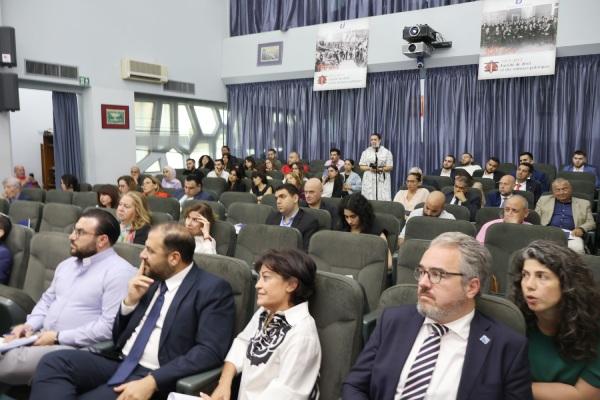




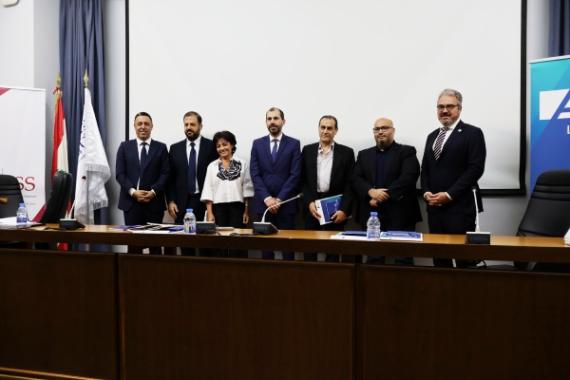
On June 3, 2025, the Middle East Institute for Research and Strategic Studies (MEIRSS), in collaboration with Konrad-Adenauer-Stiftung (KAS) – Lebanon Office, and under the patronage of the Business School at Saint Joseph University (USJ), organized a conference titled “Economic Recovery and Institutional Reform in Lebanon.” The event was held at the Gulbenkian Hall on USJ’s Huvelin Campus and brought together leading academics, policymakers, experts, and civil society actors to address Lebanon’s deepening crises and propose realistic paths to reform.
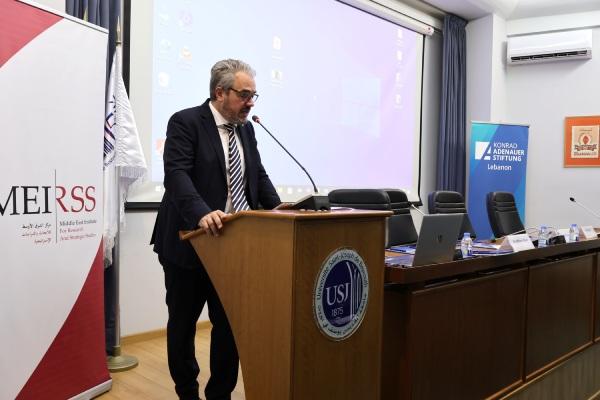
The conference opened with welcoming remarks from Prof. Fouad Zmokhol, Dean of the Faculty of Business Administration at USJ, who emphasized the role of academia in rebuilding trust, fostering public awareness, and empowering youth at this critical moment in Lebanon’s history. Mr. Michael Bauer, Director of KAS Lebanon, highlighted the university's role as a driver of change and called for practical political engagement that transforms challenges into actionable solutions. Dr. Elie Elias, Director of MEIRSS, underscored the importance of bridging academic research with policy implementation, especially in a context that demands rigorous, applied knowledge to navigate structural collapse.
The first session, moderated by journalist Antoine Saadé, focused on Lebanon’s economic recovery. Prof. Nicole Ballouz presented a research paper outlining the main economic challenges in the post-crisis period. She delivered a comprehensive analysis of the current economic situation, critiquing the absence of a coherent national recovery plan and proposing a practical roadmap for institutional and financial reform. The session addressed key issues such as monetary instability, rising unemployment, inefficiencies in the public sector, and the failure to safeguard depositors’ rights. Participants—including MP Ghassan Hasbani, Prof. Fouad Zmokhol, and Dr. Mohammad Abou Haidar—offered insightful interventions emphasizing the need for a transparent monetary policy, banking sector reform, tax restructuring, and carefully planned privatization.
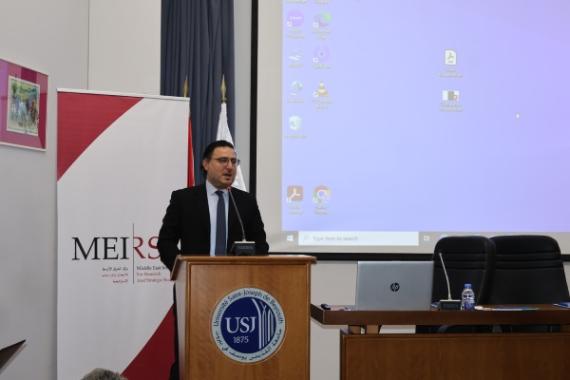
The second session, titled “Institutional Reform: A Political Approach,” featured a presentation by Dr. Elie Elias, who outlined the core themes of the research paper and its significance in offering a comprehensive reform framework to help Lebanon emerge from its compounded crises. The session included insights from journalist Nabil Bou Monsef, Dr. Khalil Jabara, and MP Ahmad Kheir. Discussions centered on rebuilding the Lebanese state on the foundations of sovereignty, justice, and effective governance. The session addressed critical topics such as the role of Hezbollah in undermining state institutions, the burden of the Syrian refugee crisis, and the urgent need for electoral, judicial, and administrative reform. Speakers called for expanded decentralization, the implementation of anti-corruption measures, and equipping the Lebanese Army to serve as the sole legitimate defender of national sovereignty.
This conference served as a valuable platform for open dialogue and critical thinking, offering clear, evidence-based proposals that align with Lebanon’s constitutional framework. It showcased the power of collaboration between academic institutions and policy actors and reinforced the role of think tanks like MEIRSS in shaping public discourse and national strategy. The event concluded with a call to publish the presented research in peer-reviewed journals and to organize similar academic-policy dialogues more regularly to engage youth and enrich the public policy landscape in Lebanon.