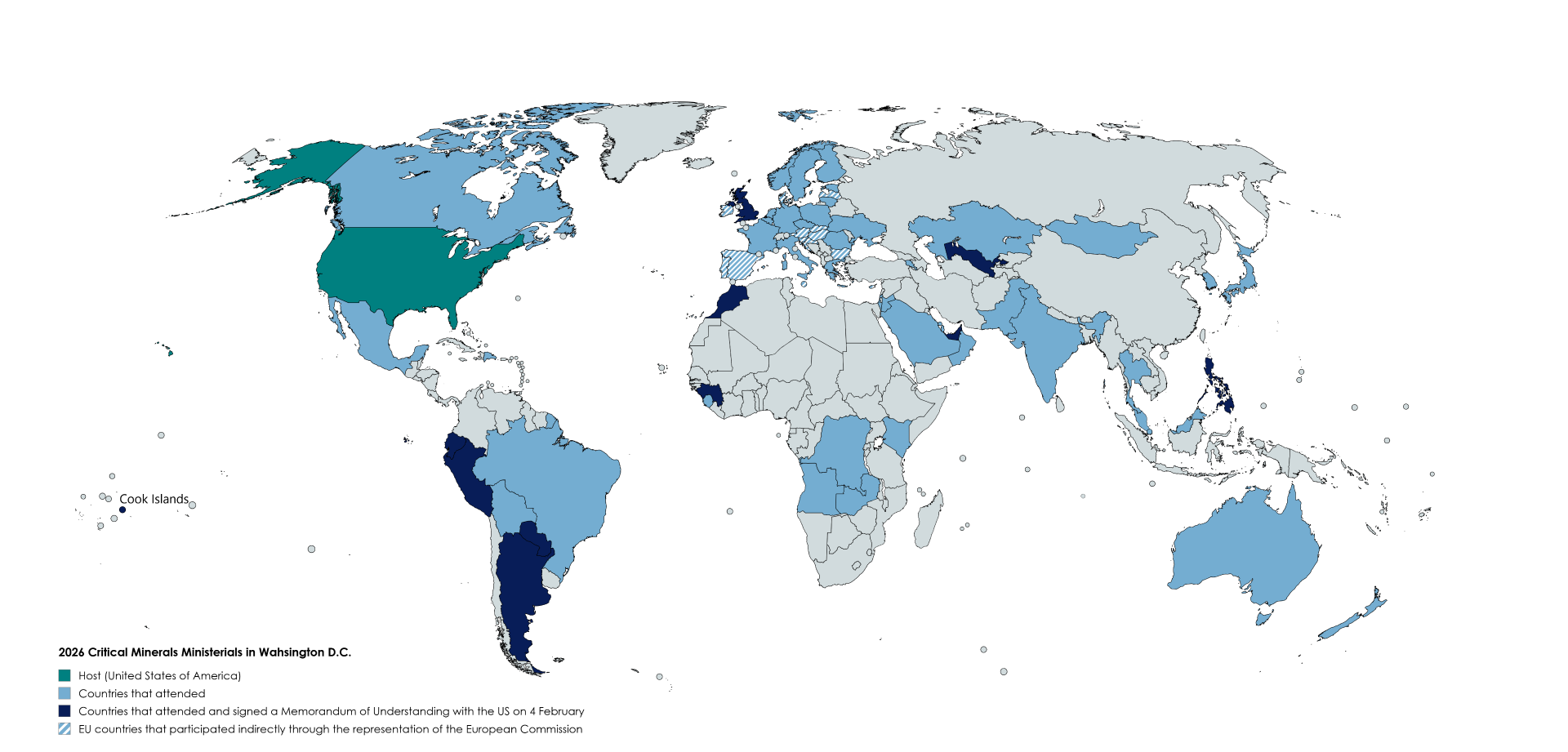
- On 4 February, the United States hosted the Critical Minerals Ministerial, bringing together representatives from 54 countries as well as the European Commission. The meeting aimed to explore ways for the United States to minimise disruptions in their supply chain of critical raw materials, notably by identifying alternative supply sources, strengthening secure and reliable transport and logistics networks, and promoting the development of a global critical minerals market that are secure, diversified, and resilient across the entire value chain.
- During the Ministerial, the United States signed several bilateral frameworks and Memoranda of Understanding (MoUs) with partner countries, announced new U.S. government financing opportunities to support strategic minerals projects, and marked the launch of the Forum on Resource Geostrategic Engagement (FORGE).
This map illustrates both the countries that participated in the Critical Minerals Ministerial and those that signed MoUs with the United States. As the European Commission participated in the meeting, all EU Member States were represented, either directly or through EU-level representation.
Source: https://www.state.gov/releases/office-of-the-spokesperson/2026/02/2026-critical-minerals-ministerial
About this series
“Global Europe Illustrated” is a section with a series of published maps designed to provide an insight into the EU's foreign policy ambitions in various regions. Each thematic map in the series focuses on the EU's global engagement in the context of EU election observation missions, global gateway projects and bilateral and multilateral EU summits and ministerial meetings with participating partner countries. In addition, each map is accompanied by a brief political analysis that provides nuanced views on what the map says about the EU's foreign policy objectives in the respective region and how these efforts are perceived. This combination of visual representation and analytical commentary provides a comprehensive understanding of the EU's engagement strategies and their impact on regional political realities.


Nicole Linsenbold