This week’s vote in the European Parliament (EP) on Mercosur illustrates how national positioning can, at times, outweigh political affiliation in trade policy decisions.
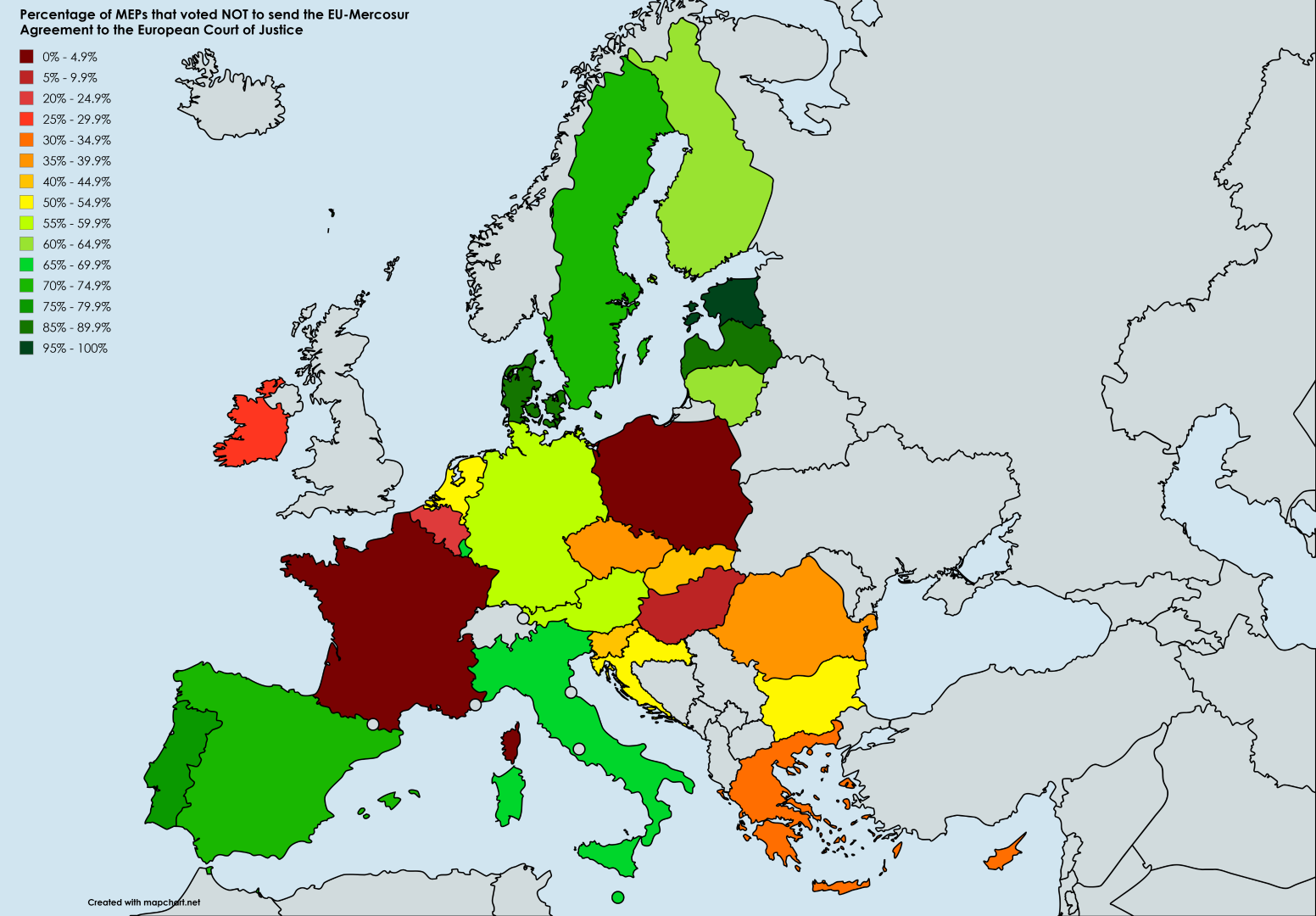
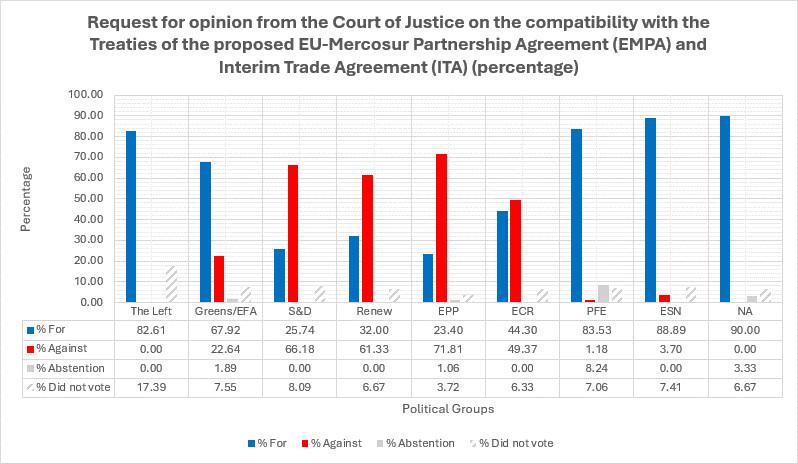
Beyond political affiliation, nationality played an unusually strong role in the EP vote. France and Poland stood out with unanimous cross-party support for a referral to the European Court of Justice (ECJ), while Hungary showed a similar tendency. By contrast, countries such as Denmark and Estonia displayed near cross-party alignment in the opposite direction. As the graphs and maps below show, these national patterns help explain the relatively low group discipline in otherwise pro-Mercosur groups and the internal split within the ECR.
At group level, the EPP recorded the lowest share of Mercosur-critical votes (23.4%) and the highest support (71.8%), followed by S&D and Renew. Opposition was concentrated on the left, among most Greens, the hard right, non-attached members, and around half of the ECR.

About this series
“Global Europe Illustrated” is a section with a series of published maps designed to provide an insight into the EU's foreign policy ambitions in various regions. Each thematic map in the series focuses on the EU's global engagement in the context of EU election observation missions, global gateway projects and bilateral and multilateral EU summits and ministerial meetings with participating partner countries. In addition, each map is accompanied by a brief political analysis that provides nuanced views on what the map says about the EU's foreign policy objectives in the respective region and how these efforts are perceived. This combination of visual representation and analytical commentary provides a comprehensive understanding of the EU's engagement strategies and their impact on regional political realities.


Nicole Linsenbold