












Bridging the Digital Divide: ITU - UNICEF - UNCTAD at the UN at 80
Eighty years ago, the United Nations was founded to foster peace, cooperation and development. Today, as the world enters a digital era, the UN family continues to play a decisive role in ensuring that no one is left behind in the race for connectivity.
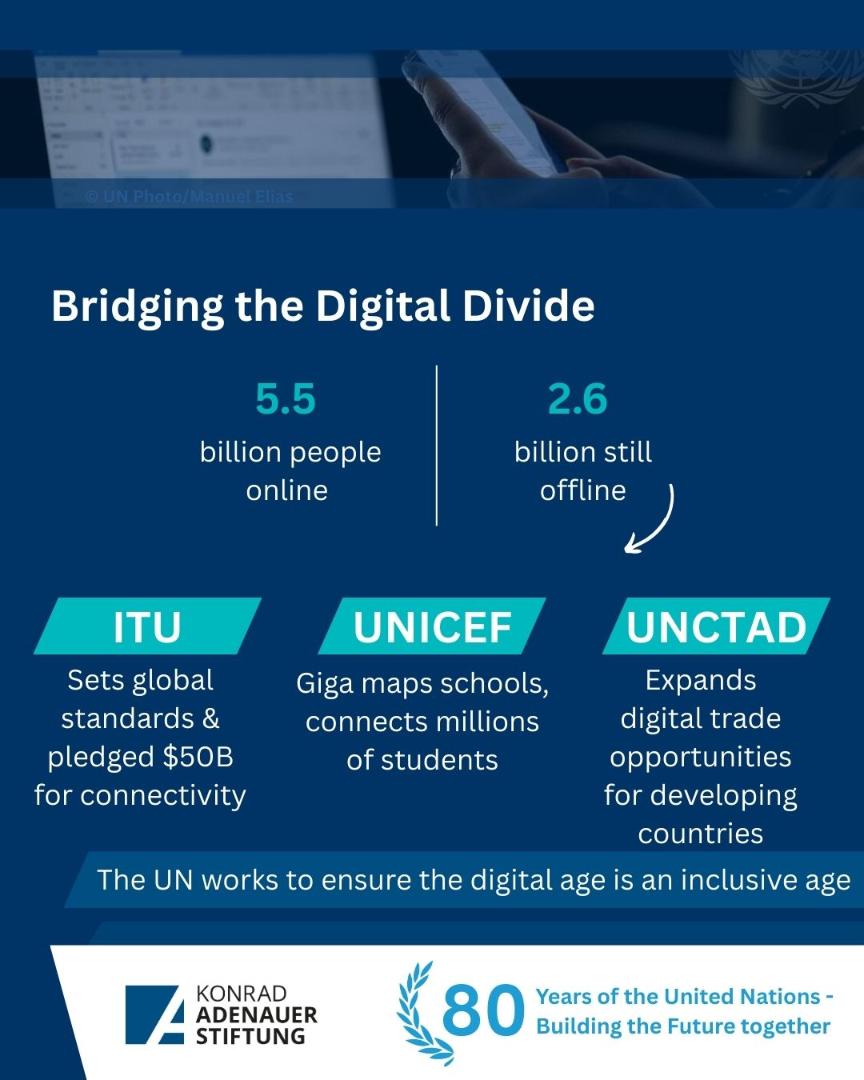
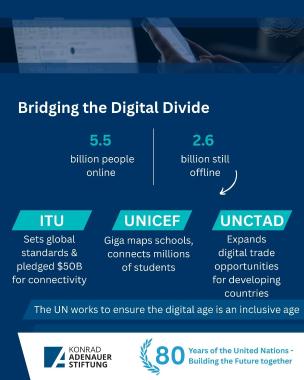
The internet has grown from one billion users in 2005 to more than 5.5 billion today—an extraordinary leap that has reshaped economies, education, health and societies. Yet, 2.6 billion people remain disconnected, unable to access the opportunities and benefits of the digital age. Closing this gap is not just a matter of technology and physical infrastructure, it is about inclusion and human rights.
The International Telecommunication Union (ITU) has been leading global action to connect the unconnected. Beyond driving connectivity through its Partner2Connect Digital Coalition, which has mobilized more than 50 billion dollars in pledges, ITU plays a unique role as one of the world’s standard-setting body for digital technologies. Its global technical standards ensure that networks and devices can seamlessly connect across borders, laying the foundation for an open and interoperable internet. ITU also manages the allocation of global radio-frequency spectrum and satellite orbits—essential resources that make mobile communications, broadcasting, navigation and emergency services possible. By setting the rules of the road for digital infrastructure, ITU enables billions of people to connect safely, affordably and reliably.
UNICEF has taken its mission of bridging the digital directly to children and schools. Together with ITU, its flagship initiative Giga has mapped more than 2.1 million schools and connected over 5,800 of them, bringing digital opportunities to 2.4 million students. UNICEF also supports digital skills development through programmes such as Skills4Girls and provides inclusive tools like the Internet of Good Things, which delivers life-changing information to millions worldwide.
UNCTAD is ensuring that developing economies can seize the benefits of digital trade. With their exports of digitally deliverable services surpassing one trillion dollars, UNCTAD’s eTrade for All initiative helps governments design the policies, regulations and infrastructure needed to expand e-commerce and digital opportunities.
The Commission on Science and Technology for Development (CSTD) adds a vital policy dimension, reviewing progress on the World Summit on the Information Society and advising governments on inclusive digital strategies. As the world prepares for this year’s WSIS+20 review, CSTD is shaping how digital transformation can drive sustainable and inclusive development for decades to come.
Together, these agencies—and the broader UN system—are working tirelessly to bridge the digital divide. Their efforts combine infrastructure, skills, policy and partnerships to ensure that digital opportunities reach every community, everywhere. As we celebrate 80 years of the United Nations, their message is clear: the digital age must be an inclusive age.
UNAIDS as a successful example of achievements in global health
Up to 2024, HIV/AIDS infections as well as related mortalities were on a downward trajectory. From the epidemic’s peak in 1995-1997 with annual new infections of approximately 3.3 million, only 1.3 million newly infected cases were reported by 2024. Mortality even had been brought down from 2.2 million in 2004-2005 to 630.000 in 2024. Awareness-raising programs and community outreach, anti-stigmatisation programs, and most of all the development of live-saving therapies and preventive drugs are at the core of this success.
When UNAIDS started to develop its 2026-2031 Global Aids Strategy it still formulated the aim to end AIDS as a public health threat by 2030 and sustain the HIV response after 2030.
UNAIDS predominantly depended on US funding. With USD 111.8 Mio. in 2024, the US funded almost 50% of the UNAIDS budget of USD 222.4 Mio. With the defunding of development assistance by the US, UNAIDS lost almost 80% of its funding for project related expenses going into community outreach, monitoring of infectious rates and the Stigmaindex. For UNAIDS it is not only the loss of its own operational funding, but also the uncertainties around bilateral funding to developing countries which jeopardize the achievements in the fight against HIV/AIDS over the last decades.
[1] PCB56_Financial_Report_2024.pdf
Bridging Innovation and Tradition: The WIPO IP and Traditional Knowledge Treaty
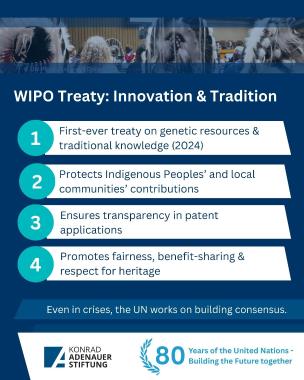
In a significant step in global cooperation, Member States of the World Intellectual Property Organization (WIPO) – a specialized agency of the United Nations - adopted the Treaty on Intellectual Property, Genetic Resources, and Associated Traditional Knowledge by consensus. This achievement came after more than two decades of negotiations aimed at ensuring that the use of genetic resources and associated traditional knowledge in patents is transparent and that the contributions of Indigenous Peoples and local communities are recognized.
The journey to adoption began in the early 2000s, driven by concerns over the misappropriation of genetic resources and traditional knowledge that had long informed scientific and technological innovations without proper acknowledgment or benefit-sharing. WIPO facilitated dialogue among countries with differing interests, Indigenous representatives, and other stakeholders. Through years of negotiation and compromise, the treaty emerged as a binding framework that balances innovation with fairness and respect for cultural heritage.
The treaty requires patent applicants to disclose the origin of any genetic resources and associated traditional knowledge used in their inventions. It formally acknowledges the contributions of Indigenous Peoples and local communities and applies to patent applications filed after the treaty enters into force in a given country. While its main focus is transparency, it lays the groundwork for future measures, including broader benefit-sharing mechanisms and additional intellectual property reforms.
As of July 2025, 44 countries have signed the treaty, and 2 have ratified it. The treaty requires 15 ratifications to enter into force, meaning it is still in the process of becoming legally binding. Its adoption demonstrates that even in a time of geopolitical tension, the international community can come together to address complex ethical and technological challenges. As the United Nations celebrates its 80th anniversary, the treaty stands as a reminder of the enduring power of multilateral diplomacy and the shared commitment to ethical innovation and fairness.
From SOS to Satellites: ITU’s Role in a Connected World
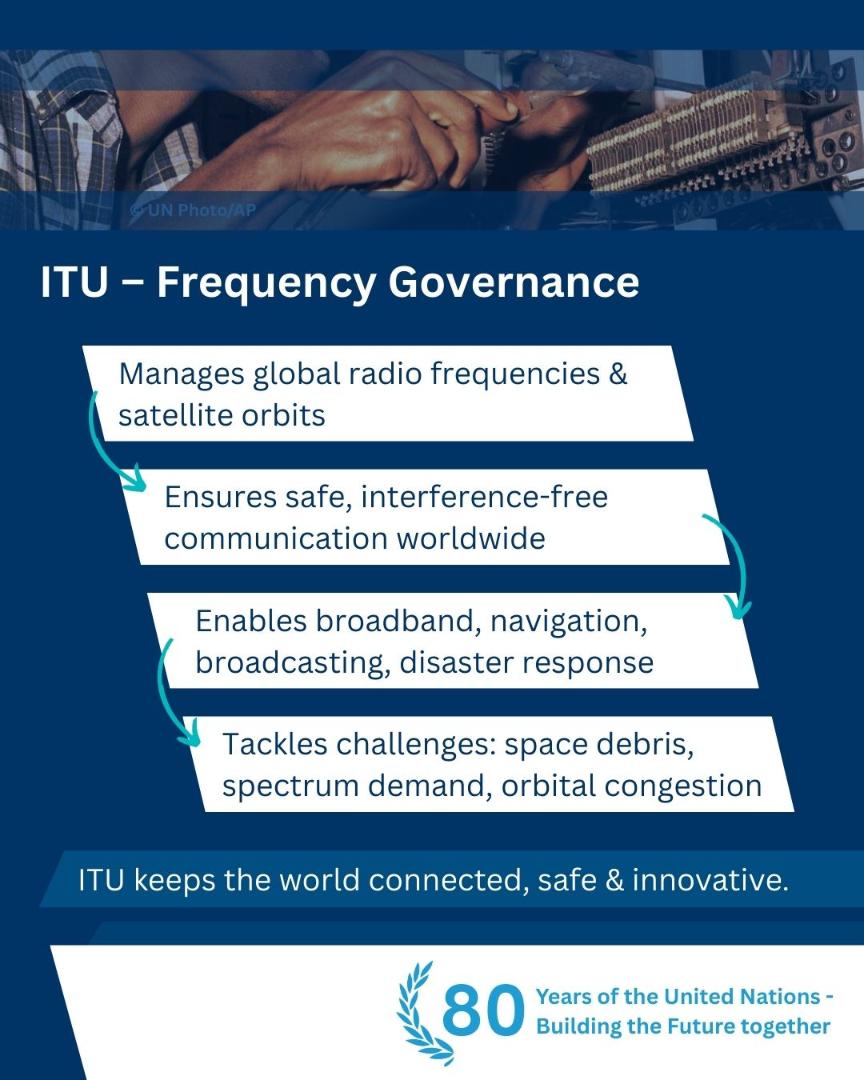
Since the adoption of the first internationally recognized distress signal, “SOS,” in 1906, the Radiocommunication Sector of the International Telecommunication Union (ITU-R) continues to shape global communications. By managing the international use of radio-frequency spectrum and satellite orbits, ITU-R ensures that radio services—from mobile and fixed broadband to broadcasting, satellite systems, and scientific applications—operate reliably and without interference. Its Radio Regulations provide a binding framework that harmonizes spectrum use worldwide, enabling innovation, safety, and connectivity across every continent and ocean.
ITU-R’s work touches the lives of people everywhere. It standardizes emergency communications, enhancing safety at sea, in the air, and on land. It coordinates satellite orbits to prevent interference while promoting equitable access to space-based resources, helping connect remote communities and bridge digital divides. It supports the global rollout of new technologies such as 5G, the Internet of Things, and advanced satellite systems, while enabling scientific research, weather monitoring, climate observation, and space exploration. Even amateur and experimental radio benefit from its protection, fostering education, curiosity, and innovation.
At the same time, ITU-R addresses pressing challenges. Rapidly growing demand for spectrum, the proliferation of satellite mega-constellations, and accelerating technological convergence put pressure on finite resources. Orbital congestion and space debris pose risks to communications and equitable access. Ensuring global connectivity for all nations and protecting spectrum-dependent systems from interference or misuse remain ongoing priorities.
Through its work, ITU-R creates a coordinated, safe, and innovative global radio ecosystem that sustains daily communication, scientific discovery, and public safety. Its efforts connect people, empower communities, and advance humanity’s capacity to communicate, explore, and respond to the challenges of an increasingly interconnected world.


Topics
Kenya’s Global Player Ambitions
The Pact for the Mediterranean as a Building Block for Diversifying European Partnerships
The EU’s Partnership Policy in Transition
Controversial First Steps of the Radev Cabinet
Czechia's defense and Ukraine policy under the new Babiš government – a first impression