








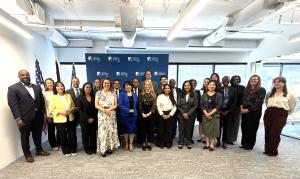
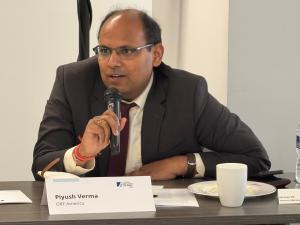
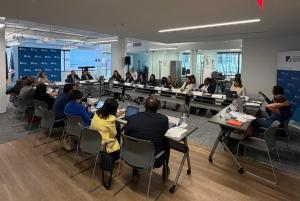
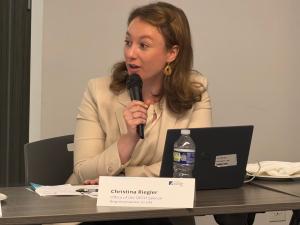
On June 16, the Konrad-Adenauer-Stiftung USA and the KAS New York Office convened a workshop in Washington, D.C. on “Financing Resilient SIDS Economies: UN–WBG Coordination on Debt Sustainability and Investment.” The workshop brought together representatives from Member States, the United Nations, the World Bank Group,m, and think tanks to examine how the international system can better support SIDS in navigating debt sustainability, fiscal space, climate finance, and investment for resilience.
Session I, “Debt Sustainability and Fiscal Space for SIDS Resilience,” featured Ms. Ianthe B. Douglas, First Secretary of the Permanent Mission of the Republic of Palau to the United Nations, and Mr. Juan José Martinez Badillo, Chief of the UNCTAD New York Office. The session explored SIDS’ structural vulnerabilities, the need for more affordable and accessible finance, the role of the Antigua and Barbuda Agenda for SIDS, the Multidimensional Vulnerability Index, and the potential of the Borrowers’ Platform to strengthen knowledge-sharing and borrower coordination.
Session II, “Financing for Development and Investment Pathways in SIDS,” featured Ms. Sona Varma, Manager of Operations Policy and Corporate Services at the World Bank Group, and Ms. Michelle Lee, Senior Analyst at Climate Policy Initiative. The session focused on the World Bank’s refreshed Small States Strategy, climate finance gaps, project preparation, investment pipelines, and the need to reduce fragmentation and transaction costs for SIDS.
Key takeaways included:
📍Debt sustainability for SIDS must be understood through the lens of structural vulnerability. Geography, climate exposure, distance to major markets, and repeated shocks create permanent constraints that traditional metrics do not fully capture.
📍Fiscal space is central to resilience. Without affordable finance and stronger buffers, SIDS are forced to respond to crises after they occur rather than invest in preparedness, adaptation, and long-term development.
📍Existing tools and platforms can be better connected. ABAS, the MVI, the Borrowers’ Platform, and the World Bank’s Small States Strategy offer important entry points for more coherent UN–IFI coordination.
📍Climate and development finance must become more accessible and less fragmented. Participants emphasized the need for stronger project preparation, technical assistance, and investment pipelines that respond to SIDS’ specific contexts.
Session I, “Debt Sustainability and Fiscal Space for SIDS Resilience,” featured Ms. Ianthe B. Douglas, First Secretary of the Permanent Mission of the Republic of Palau to the United Nations, and Mr. Juan José Martinez Badillo, Chief of the UNCTAD New York Office. The session explored SIDS’ structural vulnerabilities, the need for more affordable and accessible finance, the role of the Antigua and Barbuda Agenda for SIDS, the Multidimensional Vulnerability Index, and the potential of the Borrowers’ Platform to strengthen knowledge-sharing and borrower coordination.
Session II, “Financing for Development and Investment Pathways in SIDS,” featured Ms. Sona Varma, Manager of Operations Policy and Corporate Services at the World Bank Group, and Ms. Michelle Lee, Senior Analyst at Climate Policy Initiative. The session focused on the World Bank’s refreshed Small States Strategy, climate finance gaps, project preparation, investment pipelines, and the need to reduce fragmentation and transaction costs for SIDS.
Key takeaways included:
📍Debt sustainability for SIDS must be understood through the lens of structural vulnerability. Geography, climate exposure, distance to major markets, and repeated shocks create permanent constraints that traditional metrics do not fully capture.
📍Fiscal space is central to resilience. Without affordable finance and stronger buffers, SIDS are forced to respond to crises after they occur rather than invest in preparedness, adaptation, and long-term development.
📍Existing tools and platforms can be better connected. ABAS, the MVI, the Borrowers’ Platform, and the World Bank’s Small States Strategy offer important entry points for more coherent UN–IFI coordination.
📍Climate and development finance must become more accessible and less fragmented. Participants emphasized the need for stronger project preparation, technical assistance, and investment pipelines that respond to SIDS’ specific contexts.
Topics
Kenya’s Global Player Ambitions
The Pact for the Mediterranean as a Building Block for Diversifying European Partnerships
Why Australia’s New Foreign Policy Role Creates Opportunities for Germany
The EU’s Partnership Policy in Transition
Economic expert Christoph M. Schmidt accompanied the KAS for a year