








Executive Summary
- In October, the situation in the air war worsened significantly for Ukraine. Russia is now employing a modified attack concept and is directing its strikes more specifically at the energy sector. With fewer drones but more missiles, this resulted in the most extensive destruction so far this year.
- In October, Russia deployed 5,298 drones (-6%), 162 cruise missiles (+4%) and 108 ballistic missiles (+240%) against Ukrainian cities and civilian targets. Russia has not further increased the number of drones deployed in the past three months.
- The interception rate for drones fell to 80% (September: 87%), the worst figure since the beginning of 2024. The interception rate for ballistic missiles remains at only about 15% (in the summer it was still at 40–50%). The interception rate for cruise missiles is about 75%.
- In October, 1,213 drones and missiles could not be intercepted – a dramatic increase over the course of the year (in February, the figure was 145). The amount of explosive payload that was not intercepted has doubled within a month and is increasingly overwhelming Ukraine's air defense capabilities. This is a clear warning signal that support for Ukraine’s air defense needs to be stepped up under these worsening conditions.
- Attacks on energy supplies have reached a new level. 60% of Ukraine's natural gas production has been destroyed. Following targeted attacks on the power grid, equipment is urgently needed for repairs, especially for distribution and transmission networks.
- Russia continues to deliberately target civilians and critical civilian infrastructure, including maternity hospitals and kindergartens in frontline regions. The emergency power supply for nuclear facilities has also been affected.
- Moscow is experimenting with modified thermobaric and napalm-like warheads for Shahed drones. This could lead to significantly greater damage and higher civilian casualties.
- Leaked Russian procurement data shows an increase in orders for cruise missiles and ballistic missiles compared to last year. This also poses a threat to other European countries. The expansion of the Engels-2 military airfield suggests a further escalation of the air war against Ukraine.
- There is an urgent need for action to provide greater support for Ukraine's air defense, particularly in the area of drone defense. In the short and medium term, Ukraine's partners should invest significantly more in research and development in Ukraine.
- Germany also needs a comprehensive overall economic, technological, and industrial policy strategy that addresses the threat scenarios as well as deterrence vis-à-vis Russia.
Situation in October. Analysis and Trends
In October, the situation in Ukraine deteriorated significantly. Russia is increasingly succeeding in circumventing Ukrainian air defenses and damaging critical infrastructure.
The Russian army attacked Ukrainian cities and civilian targets with 5,298 drones in October – an average of 170 drones per night. (This is 6% less than in the previous month: 5,635. The highest number was in July: almost 6,300.) Since August, the number of drones deployed has been declining slightly, presumably because Russia is unable to meet its production targets for long-range drones (see ↗ Monitor Vol VIII). About 40% of the drones deployed in October were decoy drones (mainly of the Gerbera type).
Combined attacks with high intensity
In contrast, Russia is attempting to overwhelm Ukraine's air defenses with combined drone and missile attacks of great intensity and is increasingly targeting smaller, regional energy facilities ahead of the approaching winter. On the night of October 30, 705 missiles (including 653 drones) were launched in the third-strongest attack in a single night since the start of the war (the highest number was on September 7, 2025, with 823 missiles, including 810 drones).
In such attacks, missiles and drones are directed at a few targets from several directions at once, while “decoy drones” distract the air defense. The missiles are often deliberately directed over densely populated areas, making it much more difficult to intercept them safely. In addition, the Russian army has optimized the timing of its attacks by continuously gathering information on the locations of Ukrainian air defense systems and their reloading and preparation times (↗ RBC, 7.10.2025).
Interception rates are falling
As a result, the number of unintercepted attacks has risen sharply over the course of the year. In October, 1,077 drones could not be intercepted. In February, this figure was just under 100. In October, the interception rate for drones fell to 80% (September: 87%) – the worst figure since early 2024, when Ukrainian air defense forces were struggling with massive supply problems.
In addition, missiles with significantly more destructive power than drones are increasingly being used. In addition to 162 cruise missiles (+4%), 108 ballistic missiles were counted in October – more than three times as many as in the previous month (+240%).
The average interception rate for ballistic missiles (Iskander-M and Kinzhal types) has fallen since September from a very good rate in the summer (40 to 50%) to less than 20%. This figure remained at around 15% in October, which means that these types of missiles are causing increasingly severe damage. A total of 1,213 missiles and drones were not intercepted in October. In February 2025, the figure was only 145.
Interception Rates of Russian Missiles and Drones, by month
Destructive power doubles
The amount of explosive payload that was not intercepted doubled in October. Approximately 34,500 kg of
explosives failed to be intercepted by Iskander-M/KN23 ballistic missiles alone. With declining interception rates, drones also have a significantly greater destructive potential than in the previous month (+50%), even though fewer were deployed. In total, 41,200 kg of unintercepted explosive payload was attributed to ballistic missiles in October, 20,500 kg to cruise missiles, and 32,000 kg to drones.
Payload of unintercepted missiles and drones, in kg of explosives, by month
Attacks on civilians
On October 6, a maternity hospital in the Sumy region was attacked with drones (↗ RFERL, 6.10.2025), and on October 22, a kindergarten in Kharkiv with 30 children inside was attacked (↗ Suspilne, 22.10.2025).
Near the front lines, Russian troops often indiscriminately attack both civilian and military vehicles, making it difficult to provide medical care and evacuate endangered areas. In some cases, enemy drones continue to circle over attacked cities for hours after airstrikes to deter rescue workers. In Kherson, firefighters were attacked with a targeted double-tap strike on October 17 as they were extinguishing a fire following a drone attack (↗ Suspilne, 17.10.2025).
Northeast in the crosshairs
In October, the city of Kharkiv and the surrounding region were subjected to air strikes on an almost daily basis. Attacks on the Chernihiv region increased significantly. At the beginning of the month, there was an increase in Russian reconnaissance flights in the ar
ea, even though no fighting was taking place there. (↗ Suspilne, 9.10.2025) Later, the energy infrastructure there was heavily attacked. As in September, the area around Dnipropetrovsk was also severely affected, followed by the regions of Kyiv, Sumy, and Zaporizhzhia.
Days with Damage Reports by region, October 2025
A new dimension of attacks on energy infrastructure
In October, the Russian leadership focused even more specifically on destroying gas storage facilities, power plants, and energy infrastructure. Regional power companies, which are less well protected than the large state-owned power grid operators, are now increasingly being targeted.
On October 3, attacks on the Kharkiv and Poltava regions destroyed about 60% of Ukraine's natural gas production. Serhiy Koretsky, CEO of the state-owned energy company Naftogaz, described this as “the most massive and aggressive attack since the start of the large-scale invasion.” Additional material for repairs, especially to distribution and transmission networks, is urgently needed. The government's goal is to create “a strategic reserve of this equipment” (↗ FT, 9.10.2025).
Unlike in previous years, Ukraine imported massive amounts of gas in 2025. In the first half of the year, it purchased 2.3 billion cubic meters of gas worth 1 billion Euros – almost 20 times as much as in the same period in 2024 (0.12 billion cubic meters) (↗ energy-map, 29.10.2025).
The Bloomberg news agency estimates that Ukraine will have to spend around 1.9 billion Euros on additional gas imports in the winter of 2025/2026, or purchase an additional 4.4 billion cubic meters of gas. This corresponds to approximately 20% of its annual consumption. Much depends on how quickly damaged infrastructure can be repaired, with necessary repairs costing around 750 million Euros (↗ Bloomberg 9.10.2025).
On October 10, the Russian Air Force launched one of the largest attacks of the year against Ukrainian power generation facilities. In addition to thermal power plants, hydroelectric power plants and substations were hit, causing prolonged power outages in eight regions (↗ OSW, 14.10.2025).
Since February 2022, the thermal power plants of the private power generator DTEK alone have been attacked more than 200 times. The Russian army also targeted wind turbines, transformers, and network nodes more specifically this fall than in previous years.
Threat to nuclear safety
Power outages also pose a threat to nuclear safety. The Zaporizhzhia nuclear power plant continues to be completely dependent on emergency power supplies. Both the plant's management and the state grid operator Ukrenergo are prepared to repair the necessary power lines. However, the ongoing fighting does not always allow this to happen. At the former Chernobyl nuclear power plant, power failed in early October in the new protective shell surrounding the power plant block that was damaged in 1986. This was caused by damage to the Slavutych substation following Russian attacks (↗ Dixi Group, 6.10.2025).
Technical developments increase the dangers
Rapid technological developments are enormously changing the nature of warfare, especially with drones. The tactical use of drones close to the front lines and attacks on strategic targets such as infrastructure and cities are increasingly overlapping. This significantly increases the dangers for the civilian population.
One example is the integration of fiber optic technology into low-cost models such as the Russian Molnija drone or the control of flying relay stations (so-called mothership UAVs). Fiber optic drones with repeater functions quadruple the range of tactical weapons for Russia and also threaten targets far beyond the front lines (↗ ISW, 9.10.2025).
Meanwhile, both Russia and Ukraine are using long-range drones to lay mines in areas close to the front line, and since the summer, the Russian army has been increasingly using Shahed drones to systematically attack logistics chains, Ukrainian drone pilots, and even entire rows of houses in the hinterland (↗ Kyiv Independent, 8.10.2025).
The Russian armed forces are continuing to upgrade Geran-2 drones. With the help of night vision cameras and radio control, they were able to attack Ukrainian railway infrastructure more effectively than before in October.
The recent “arming” of drones with high-explosive fragmentation warheads is critical. Others are equipped with particularly dangerous thermobaric warheads and special sensors that trigger explosions even more precisely over a specific location
(↗ Militarnyi, 7.10.2025). In addition, Shahed drones have been identified containing napalm-like incendiary fuels and explosive mixtures that cause temperatures
of up to 3,500 degrees Celsius. This suggests that Moscow is experimenting with new warheads (↗ Kyivpost, 9.10.2025).
Modernized glide bombs with longer range
In October, several attacks with glide bombs went far beyond the 90-kilometer radius that had previously been considered their maximum range. According to Ukrainian sources, modified glide bombs were used in attacks on the Poltava, Kharkiv, and Mykolaiv regions. Some new models reportedly have a range of 100 to 180 kilometers, while their explosive payload has been reduced to 100 kilograms (↗ ISW, 24.10.2025). A new type of glide bomb, which behaves more like a cruise missile, has even been observed to have a range of 193 km. Although these modified bombs are easier to launch, they can reach cities far from the front line that have previously been spared such attacks (↗ Don's Weekly, 27.10.2025).
Spotlight. The prospects of air warfare
Costs of weapons production rise for Russia
In October, the Ukrainian online portal Militarnyi published data from secret procurement documents from the Ministry of Defense in Moscow. These documents allow for the first time a more accurate assessment of the scope and cost of Russia's missile procurement.
According to the data, the Russian military has ordered more cruise missiles and ballistic missiles (range over 350 km) in 2025 than in the previous year. The order figures add up to a total of 170 of these weapons per month for the current year. This figure is below Russia's previously assumed production capacity of 200 to 250 units per month (see ↗ Monitor VIII).
Missile production has become significantly more expensive for Russia. The Kh-101 cruise missile, for example, now costs almost 2.1 million euros instead of the previous 1 million euros. According to the leaked documents, Russia has ordered ballistic missiles worth around 450 billion rubles (4.8 billion euros) and cruise missiles worth around 380 billion rubles (4 billion euros) over the past two years.
In 2025, Russia ordered significantly more of the types of missiles that play a decisive role in air warfare: Iskander-M (9% more than in 2024), Kh-101 (+39%) and Kinzhal (+225%) (↗ Militarnyi, 23.10.2025). According to the published documents, the Kremlin has invested around 800 billion rubles (8.7 billion euros) in the procurement of these offensive weapons over the past two years.
Threat to NATO countries
The figures show that the threat posed by ballistic missiles in particular is also increasing for the countries on NATO's eastern flank. Regardless of its remaining strategic stockpiles, Russia will receive more than 880 ballistic missiles (Kinzhal, Zircon, and Iskander-M) in 2025 alone, which it can use either in the war against Ukraine or in other future conflicts.
In addition, the Russian military has apparently ordered a modernized version of the Iskander-K cruise missile with a range of more than 2,000 kilometers. A new type of Iskander-M missile (9M723-2) has also been ordered as part of the “Iskander-1000 long-range missile project,” which can reach targets beyond Ukraine. For European NATO countries that do not have sufficient suitable interceptor missiles to counter these systems (see ↗ Monitor VIII), the risk of being blackmailed by Russia is increasing.
Russia expands important military airport
The Ukrainian military intelligence service HUR points out that Russia is currently expanding the Engels-2 military airport in the Saratov region. Satellite images show that new parking spaces for Tu-95MS, Tu-160, Su-34, and Su-25 fighter jets and bombers are being built there. This raises fears of a further expansion of the air war, as Engels-2 is the launch site for strategic bombers that transport cruise missiles to their targets
(↗ Aratta, 17.10.2025).
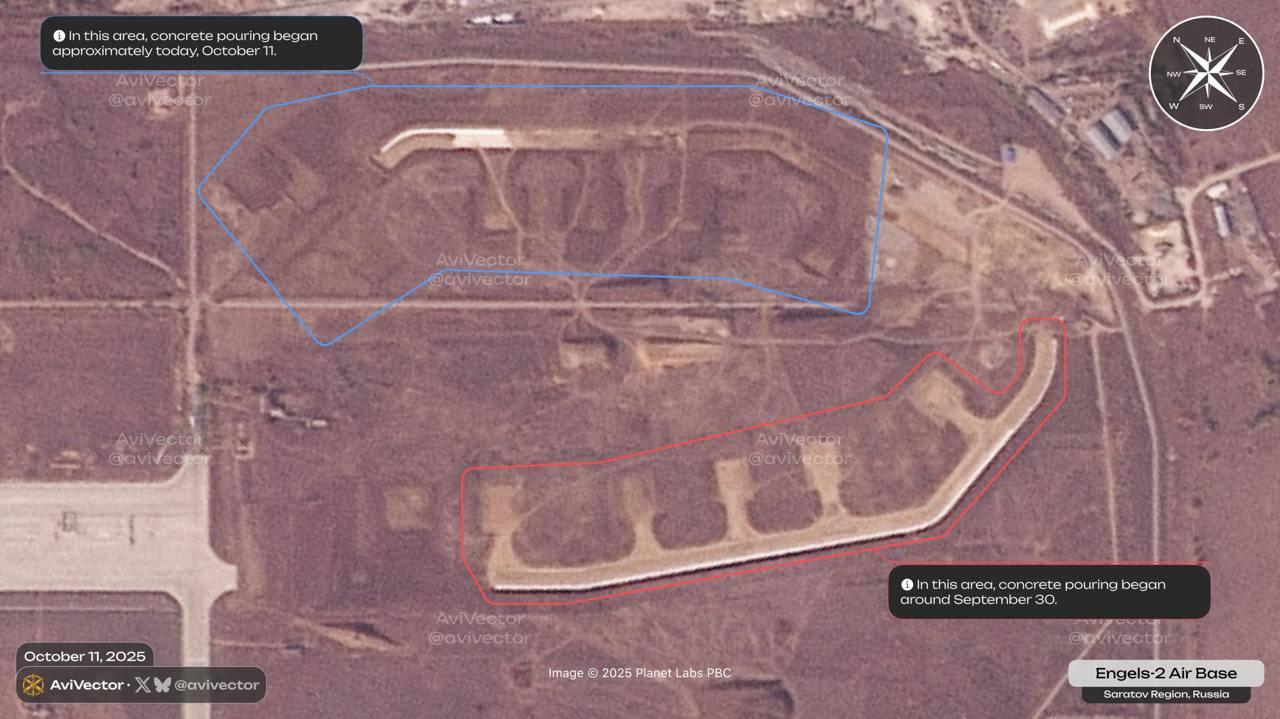 Telegram-Kanal ↗ Aratta, 17.10. 2025
Deep strike capability with Tomahawks
To effectively counter this increased threat to Ukrainian cities and infrastructure, it is not enough
to simply defend against incoming cruise missiles. Targeted attacks on Russian military airfields, weapons factories, and suppliers would significantly weaken Russia's offensive capabilities and better protect Ukraine. The Institute for the Study of War (ISW) believes that the Ukrainian army could use US Tomahawk missiles to cause significant damage to military facilities deep inside the Russian Federation, such as the drone factory in the Alabuga Special Economic Zone (see ↗ Monitor VIII) or the Engels-2 air base (↗ ISW, 17.10.2025), to prevent further Russian attacks.
 ↗ ISW, 17.10.2025.
However, it remains unclear whether the US administration will actually supply Tomahawk missiles to Ukraine and whether sufficient land-based launch systems are available, as air warfare expert Tom Cooper explains. He also points out that currently only a few Ukrainian missiles are capable of penetrating Russia's air defense missile belt at the frontline and that Ukraine would need its own air-based missiles or ballistic missiles to achieve greater success. However, these will not be available in the foreseeable future (↗ Tom Cooper, 14.10.2025).
The Ukrainian-made Flamingo cruise missiles are said to have a range of up to 3,000 kilometers and a speed of up to 900 kph. However, initial deployments indicate difficulties with targeting accuracy and penetrating Russian air defenses. if production scales to the planned 2,555 units per year, the Flamingo could significantly degrade Russian arms production facilities and military infrastructure (↗ Don's Weekly, 27.10.2025).
In the short term, the Ukrainian army would need more modern offensive weapons from Western stocks to take out radar and defense systems, so that Ukraine can attack Russian weapons factories and military airports more successfully (see ↗ Monitor VIII). Ukraine urgently needs systems that the German government is also considering purchasing for the Bundeswehr, such as the Tomahawk Typhon launch system, or the Taurus without US engines, as well as other types of cruise missiles (↗ Missile Matters, 2.11.2025).
Urgent need for action
Support for air defense
In order to effectively improve Ukraine's protection against Russian air strikes, support in all areas must be raised to a much higher level. There is an urgent need to increase procurement of American Patriot systems and PAC-3 missiles (see ↗ Monitor VIII) to defend against ballistic missiles. Without these, Russia can continue to systematically attack and shut down Ukraine's energy supply. Additional interceptors and air defense systems improve defense against cruise missiles, as evidenced by improved interception rates through the middle of this year.
The biggest challenge remains adapting to the new type of Russian drone attacks. In the short term, the high-energy defense weapons (directed-energy weapons, DEW) currently being tested, small air defense systems (surface-to-air missiles, SAMs) such as those currently being developed in Latvia, or existing 70 mm air-to-surface guided missile systems must be made available to Ukraine even more quickly (↗ ESD, 22.9.2025). In the medium term, economically viable systems must be developed and integrated with competitive production costs in the long term measured against comparatively inexpensive Russian drones .
According to President Zelensky, Ukraine is currently ramping up production of its own interceptor missiles, including homing models, so that 500 to 800 could be available per day in November (↗ Suspilne, 28.10.2025). However, even these quantities would not be sufficient. Ukraine also needs what has already proven itself in the defensive battle against Russian long-range drones: mobile defense systems such as Skyranger or Gepard with the appropriate ammunition supply, additional F-16 fighter jets, as well as other interceptors. Even simple aircraft and helicopters equipped with onboard cannons are already being used successfully in air defense. In addition, the development and production of Ukrainian interceptor drones must be significantly increased and accelerated with Western capital and know-how.
However, the Ukrainians do not see the main problem as being production, but rather the training of personnel that must master systems that are constantly adapting to new Russian attack patterns. This is a challenge that NATO has so far underestimated. Even in peacetime, three to four-digit numbers of drone pilots must be trained in order to increase personnel in the event of defense so that they can cope with the dimensions of Russian drone warfare.
It can be assumed that Russia will continue to expand its air war. Western allies must therefore develop military strategies to relieve Ukraine; sanctions alone are not enough. We presented proposals such as a no-fly zone (NFZ) and European cooperation in air defense in the previous issue (see ↗ Monitor IX).
Economic deterrence and innovation
A collapse of Ukraine's defenses or even a Russian victory in Ukraine would not only pose security policy problems for Europe. Back in 2024, the Kiel Institute for the World Economy (IfW) warned of the economic consequences and large-scale refugee movements that Germany in particular would be exposed to (see ↗ Monitor III).
In a recent guest article in the german newspaper FAZ, IfW director Moritz Schularick and Niall Ferguson (Stanford University) criticize “German-style armament”: although German systems such as IRIS-T play a decisive role in air defense, Germany still does not plan and produce on an industrial scale. In some weapon categories, Russian production exceeds the Bundeswehr's stocks in just one quarter.
If US deliveries to Ukraine fail to materialize toward the end of the year, Europe must be in a position to fill this gap. Germany is the only country in Europe with “fiscal leeway and the industrial base” (↗ FAZ, 4.11.2025), to maintain sufficient production capacity for defense purposes, but it lacks an economic and industrial strategy.
Ferguson and Schularick call for industrial scaling of armament through investments in production capacities, production clusters with the automotive industry, special contracts for defense purposes, and a “high-tech strategy” for investments in research and development in the defense sector, which would also generate spillover effects for the civilian economy, as well as politically controlled coordination of military planning and industrial policy through a “Defense Industrial Board.”
The success of this strategy would not only ensure Europe's “economic deterrence capability” but also create potential in other economic fields and consolidate Europe's technological and industrial base (↗ FAZ, 4.11.2025).
Learning from Ukraine
Ukraine has expanded its defense industrial base with remarkable speed, particularly in state-of-the-art technologies, as highlighted in a recent study by the Jamestown Foundation. Yet progress is not only technological; it is driven by new organizational frameworks. Platforms such as Brave1, which brings together innovators, military units, investors, and government actors, or Defense City, which accelerates the development, production, and export of defense products, are reshaping how the sector operates (↗ Jameston Foundation, 5.10.2025). Software innovations from Ukraine also benefit the German Bundeswehr and NATO, and data from Ukraine has become indispensable for US defense companies. Ukraine is not only becoming the “drone capital” of the world, but also a place of learning and an irreplaceable interface in the development of AI.
Analyst Benjamin Cook emphasizes that Ukraine's recipe for success does not lie in the construction of drones or their rapid development: “It’s the feedback. It’s the fast-fail iteration that the West must learn (...) in order not to fall behind.”
Ukraine's speed of innovation, particularly in drone development and electronic warfare (EW), will outpace the Russian defense system in the long-term, where many platforms require years to develop and field. Added to this is the political capital that Ukraine is building as an innovation leader in the defense sector. NATO is also aware of this, writes Cook: “They must learn from Ukraine if they want to avoid wasting lives while learning on the job in the next conflict.“ (↗ Cook, 31.10.2025)
Ukraine benefits from an active civil society that supports reforms and innovations in the defence sector. NGOs work closely with authorities, ministries and international institutions. In doing so, they support good governance through civilian oversight and promote alignment with Western and NATO standards. They ensure greater transparency and accountability, especially in procurement and contracting, thereby combating corruption. NGOs also address issues that are often overlooked, such as women and children in conflicts and Ukraine's implementation of international humanitarian law. These structures, which are successful in Ukraine, are not established in Western countries, particularly in Germany. Even in research, strategic security policy has long been marginalised (↗ FAZ, 14.9.2023). Apart from the United Kingdom, few Western countries actively support organizations that are integral to Ukraine’s defense policy ecosystem.
The decisive factor remains whether Ukraine receives sufficient financial resources to withstand the intensified situation in the air war and on the front lines. Above all, there is a lack of investment in research and development. Germany and Europe must now demonstrate that they are willing to invest significantly more in peace and security on our continent.
 Kyiv Dialogue
Method
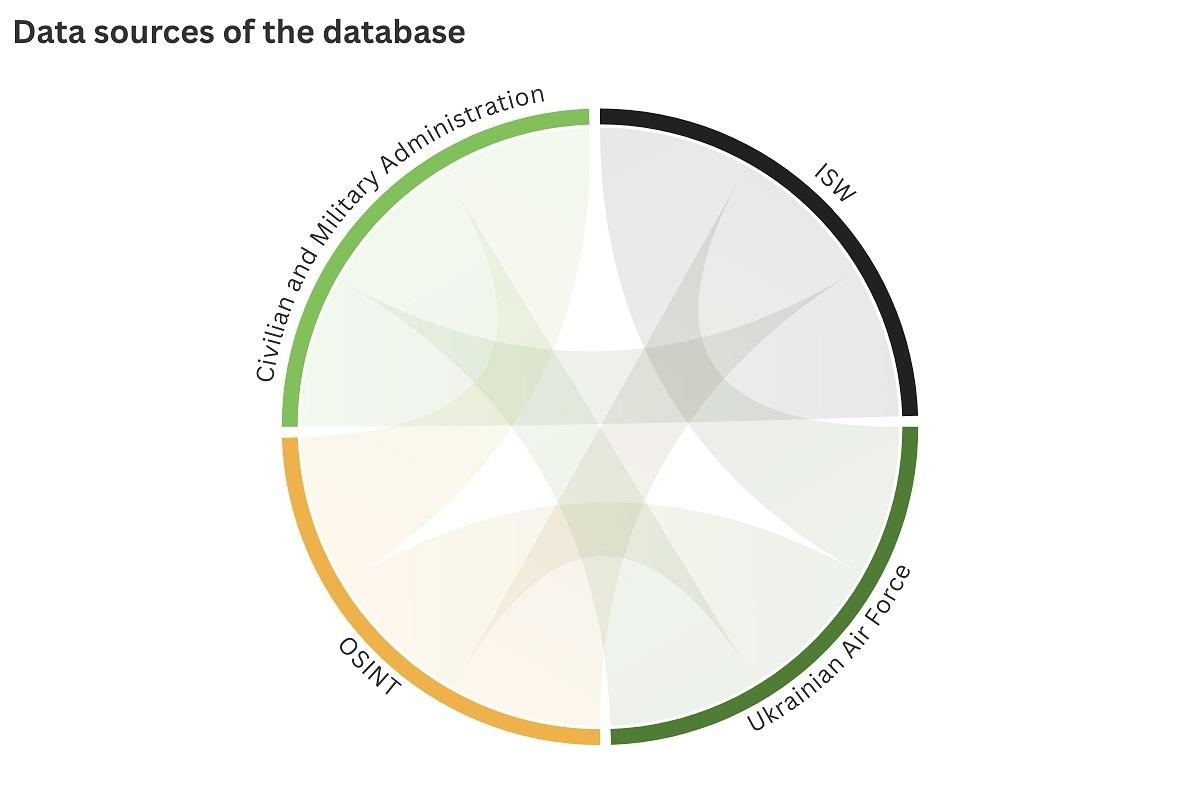
The air strike database is regularly cross-referenced with daily reports from the Institute for the Study of War (ISW) in Washington (↗ ISW).
The launch records originate from the Ukrainian Air Force reports (↗ KPSZSU), and data on regional targets and damage—if available—is supplemented with civilian and military administration sources.
These figures are further verified using additional OSINT sources and are considered highly reliable.
Accurately quantifying air strike damage during an active war is inherently challenging. Providing overly precise information could aid Russian military planning, which is why certain reporting restrictions apply (↗ Expro, 2.1.2025).
Consequently, this analysis focuses on attack patterns and dynamics rather than detailed damage assessments.
With over 38 months of data and around 64,300 documented attacks, robust trends have emerged. Monthly missile counts are approximate values, as irregularities have been noted in Ukraine’s reporting system. Discrepancies with other OSINT sources remain within a 10 % margin, often below 3 %.
A comparison with the missile and drones assessment by the Center for Strategic and International Studies (CSIS) in Washington over a period of more than two years shows a deviation of only 1.6 % (↗ CSIS).
For attacks lacking definitive quantification, the lowest plausible estimates have been used. Due to possible underreporting in high-intensity phases, actual interception rates may be slightly higher, with an estimated deviation of less than 5 %.
About the Author
Marcus Welsch is a freelance analyst, documentary filmmaker, and publicist.
Since 2014, he has specialized in OSINT journalism and data analysis, focusing on the Russian war against Ukraine, military and foreign policy issues, and the German public discourse.
In cooperation with Kyiv Dialogue, he has conducted research and panel discussions on Western sanctions policy since 2023.
Since 2015, he has been running the data and analysis platform ↗ Perspectus Analytics.
About Kyiv Dialogue
Kyiv Dialogue is an independent civil society platform dedicated to fostering dialogue between Ukraine and Germany.
Founded in 2005 as an international conference format addressing social and political issues, it has moved to support civil society initiatives aimed at strengthening local democracy in Ukraine since 2014.
Since Russia’s full-scale invasion in 2022, the focus has shifted to social resilience, cohesion, and security policy—including military support for Ukraine and Western sanctions policy.
Kyiv Dialogue is a program of the European Exchange gGmbH.
CONTACT
Kyiv Dialogue
c/o Europäischer Austausch gGmbH Erkelenzdamm 59, D-10999 Berlin +49 30 616 71 464-0 info@kyiv-dialogue.org www.kyiv-dialogue.org
Konrad Adenauer Foundation Ukraine
Bogomoltsja St. 5, Wh. 1, 01024 Kyiv / Ukraine
+38 044 4927443 office.kyiv@kas.de
www.kas.de/de/web/ukraine


You need to sign in in order to comment.