








Details
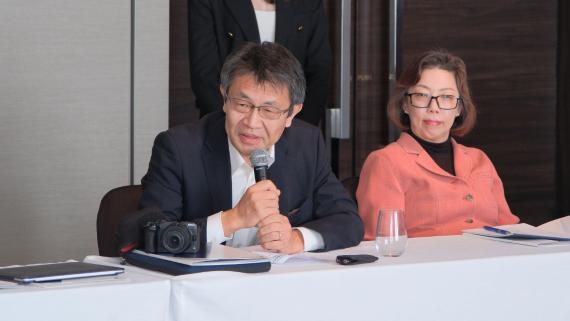
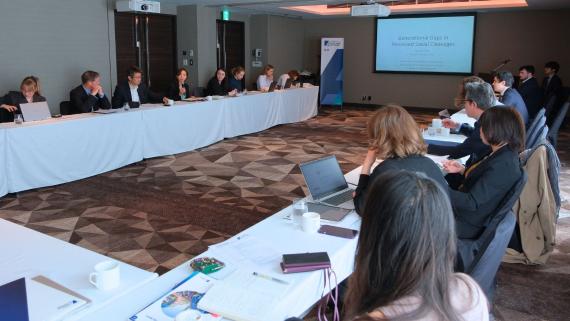
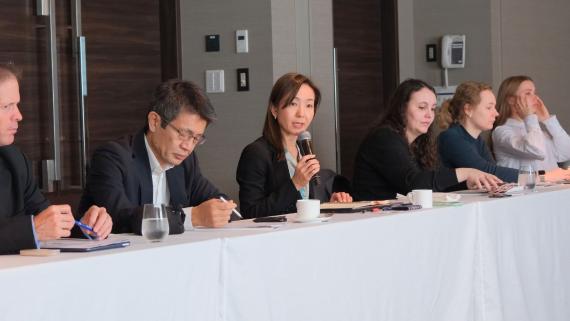
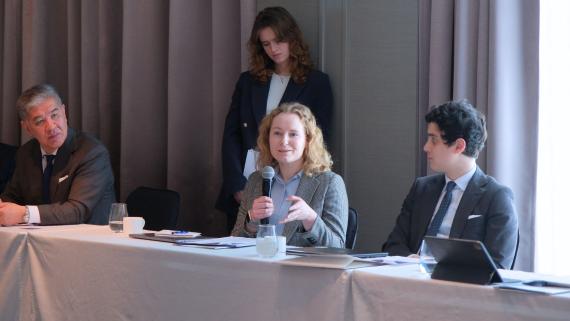
Tuesday, March 10 2026
Welcome Remarks
- Mr. Paul Linnarz, Country Representative Japan, Director Regional Economic Programme Asia (SOPAS, KAS)
Introduction: Diplomacy and foreign relations in an increasingly polarised landscape: Implications and challenges, followed by Q&A
- Ms. Melanie Saxinger, Consul General, Consulate General of the Federal Republic of Germany Osaka-Kobe
Session 1: Shifting constituencies: How Japanese parties have responded to social trends among the electorate, followed by Q&A
- Prof. Garren Mulloy, Professor, Faculty of International Relations, Daito Bunka University
- Prof. Hiromi Murakami, Adjunct Professor, Department of Political Science, Temple University Japan
- Prof. Michito Tsuruoka, Professor, Faculty of Policy Management, Keio University
- Discussion and Q&A moderated by
Mr. Tom Sutton, Project Manager, Country Programme Japan, Konrad-Adenauer-Stiftung
Session 2: Immigration as a driver of political polarisation in the EU and Japan, followed by Q&A
Lead Remarks:
- Prof. Patrick Strefford, Professor, Department of International Relations, Kyoto Sangyo University
- Prof. Masahide Kobayashi, Professor, Faculty of Policy Studies, Shobi University
- Discussion and Q&A moderated by
Prof. Nobumasa Akiyama, Graduate School of Law, Hitotsubashi University
Session 3: The uses and misuses of social media among voters and parties, and the impact of the economy on elections, followed by Q&A
Lead Remarks:
- Ms. Diletta Fabiani, Research Fellow, Strategy and Deterrence Program, Sasakawa Peace Foundation
- Prof. Naoyuki Yoshino, Professor Emeritus of Economics, Keio University
- Discussion and Q&A moderated by
Mr. Paul Linnarz – Country Representative Japan & Director, Regional Economic Programme Asia (SOPAS), Konrad-Adenauer-Stiftung
Wednesday, March 11 2026
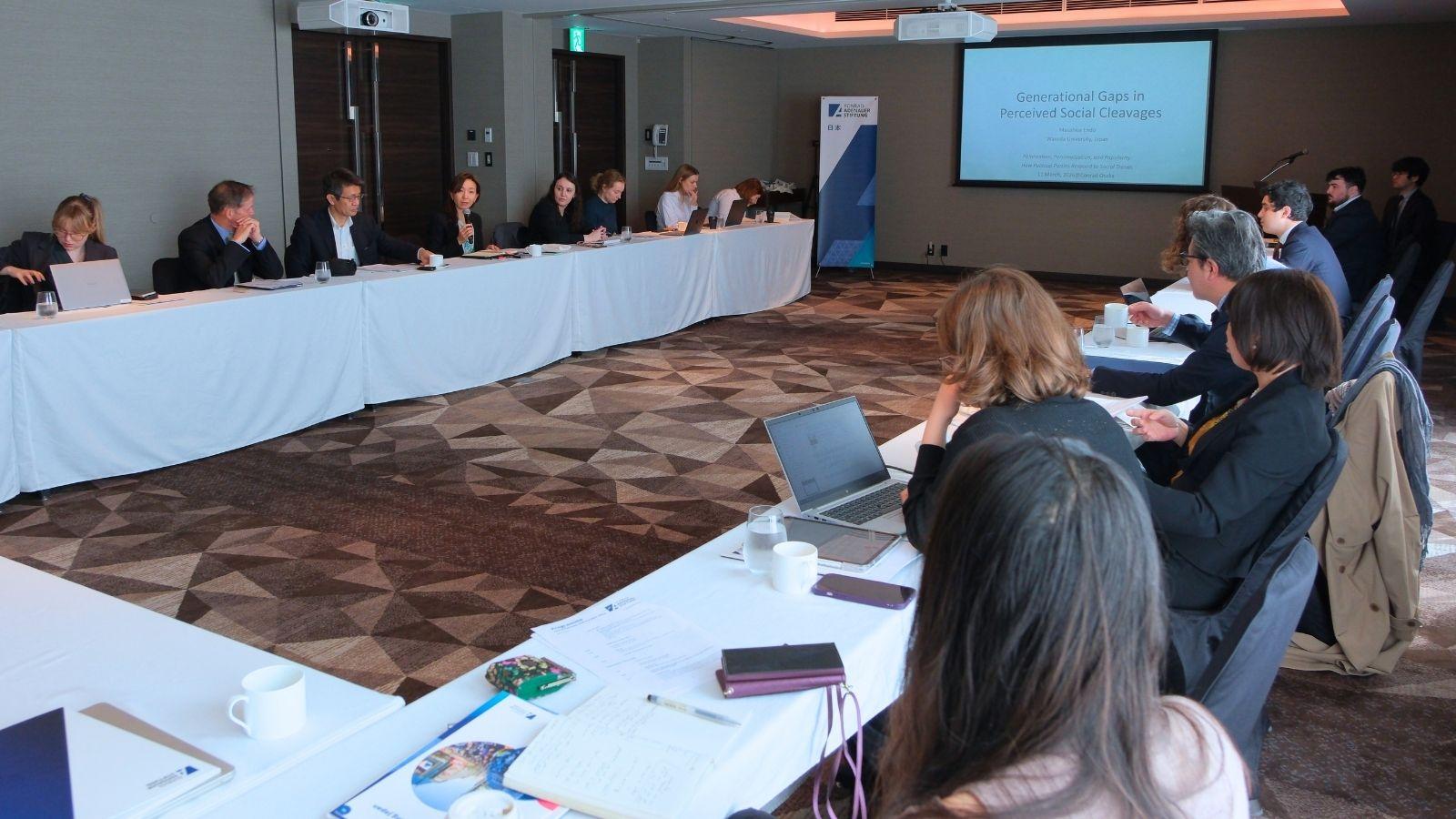
Session 4: Generational gaps in perceptions of and participation in politics, followed by Q&A
Lead Remarks:
- Prof. Masahisa Endo, Professor, Faculty of Social Sciences, Waseda University
- Prof. Xavier Mellet, Associate Professor, Center for the Global Liberal Arts Program, Rikkyo University
- Prof. Toru Yoshida, Professor, Faculty of Policy Studies, Doshisha University
- Discussion and Q&A moderated by
Prof. Maiko Ichihara, Professor, School of International and Public Policy, Hitotsubashi University
Session 5: Changing political narratives in times of economic anxieties, followed by Q&A
Lead Remarks:
- Mr. Gabriele Maletta, Research Assistant, Institute of Geoeconomics
- Prof. Tomoko Matsumoto, Associate Professor, Institute of Arts and Sciences, Tokyo University of Science
- Discussion and Q&A moderated by
Mr. Tom Sutton, Project Manager, Country Programme Japan, Konrad-Adenauer-Stiftung