








Asset-Herausgeber

Publikationen

Asset-Herausgeber

Creative Commons

Jordan’s Gas Discoveries and Its Changing Energy Landscape

Domestic and Regional Economic Implications

This paper explores how Jordan’s natural gas developments could reduce energy import dependence and strengthen economic resilience. While GDP growth remains modest and energy imports still dominate, the reassessed Risha Gas Field offers significant long-term supply potential. The key challenge is infrastructure and utilisation—particularly the need for a major pipeline to enable distribution and exports. The paper highlights opportunities across power generation, industry, and transport, positioning natural gas as a central driver of diversification, competitiveness, and energy security.

Creative Commons

Toward Strengthening the Role of Parliament in Supporting the Rights of Persons with Disabilities in Jordan

Policy Paper

International experiences and recommendations for strengthening the role of parliament in advancing the rights of persons with disabilities.

WANA-KAS Think Tank School

Call for Applications

West Asia-North Africa (WANA) Institute, in partnership with Konrad Adenauer Stiftung (KAS) Office Jordan, are launching the joint project “WANA-KAS Think Tank School”. This project seeks to engage early-career Jordanians launching their careers as policy analysts in think tanks or civil society organisations. The WANA-KAS Think Tank School will provide participants with the space, skills, and expertise to co-create their learning trajectory as policy analysts.

Smarterpix/ Ale_Mi

Wahrnehmungen jordanischer Außenpolitik: Wandel und Kontinuität

Umfragen zeigen Verschiebungen in außenpolitischen Prioritäten und Partnerschaften bei gleichbleibender Grundausrichtung jordanischer Außenpolitik

Im Kontext regionaler Instabilität bleibt die jordanische Außenpolitik geprägt von einer pragmatischen Herangehensweise und dem Fokus auf die Erhaltung von Sicherheit und Stabilität. Aufgrund wirtschaftlicher Herausforderungen steigt gleichzeitig die Erwartungshaltung der Bevölkerung, dass die Außenpolitik konkrete Ergebnisse für Jordaniens Wirtschaft liefert. Während die USA und Saudi-Arabien weiterhin das Feld der Partnerländer Jordaniens anführen, nimmt das Vertrauen in die stabilisierende Rolle der USA in der Region ab. Das Deutschlandbild erholt sich trotz Kritik im Kontext des Gaza-Kriegs im Ver-gleich zum Vorjahr.

Addressing Socio-Economic Challenges in Jordan

Reflections on the Economic Modernisation Vision (EMV)

Jordan continues to face a complex socio-economic landscape marked by structural unemployment, pressure on public services, regional disparities, and increasing strain on natural resources — challenges further intensified by a volatile regional environment and shifting global economic dynamics. In response, the Kingdom launched the Economic Modernisation Vision (2022–2033), a comprehensive national roadmap aimed at accelerating inclusive and sustainable economic growth while enhancing overall wellbeing. The vision sets an ambitious reform agenda, yet its success depends on effective implementation, evidence-based policymaking, and sustained dialogue among stakeholders.

IMAGO / Xinhua

EU-Jordanien-Gipfeltreffen

Symbolischer Schritt für eine strategische Partnerschaft

Mit dem ersten bilateralen Gipfeltreffen zwischen der Europäischen Union (EU) und Jordanien setzten beide Akteure ein Signal für die Vertiefung ihrer Partnerschaft in Zeiten regionaler Instabilität im Nahen Osten. Mit ihrer Unterstützung für Jordanien möchte die EU das Partnerland in seiner wichtigen stabilisierenden Rolle in der Region stärken und entsprechend zur internen Stabilität des Landes beitragen, insbesondere durch die Ankurbelung der Wirtschaft. Für die EU bietet die vertiefte Partnerschaft außerdem eine Gelegenheit, sich im Kontext der zunehmend unberechenbaren US-Außenpolitik als verlässlicher Partner und Akteur im Nahen Osten zu profilieren. 

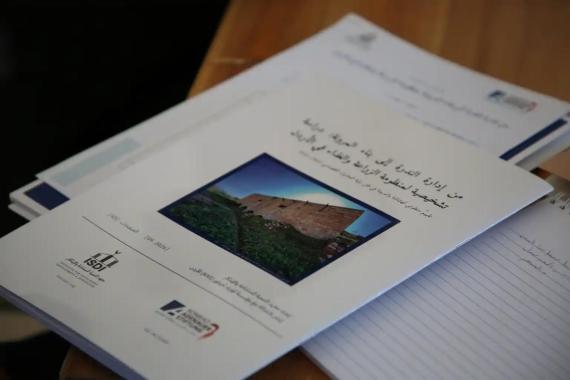
Policy Paper: The System of Agricultural Holdings in Jordan

Institutional Challenges and Recommendations for Legislative Reform

This paper analyzes the agricultural holdings (AHs) registration system in Jordan, revealing gaps between the legal framework and actual practices, which have turned the system from a planning tool into a bureaucratic burden. Issues include inconsistencies in definitions, annual rather than five-year certificate renewals, and inefficient procedures. Through legal analysis and interviews, the paper identifies problems like redundant hard-copy submissions and weak field inspections. It offers policy and procedural recommendations to align laws, digitize processes, standardize inspections, and streamline timelines, aiming to restore the system's original purpose while reducing the administrative load on farmers and the Ministry of Agriculture.

Iraq ’s Foreign Policy – Between Domestic Fragmentation and the Search for National Sovereignty

An Analytical Review of Non-State Actors and Implications of Current Conflicts in the Middle East

Addressing Socio-Economic Challenges in Jordan

Call for Papers

KAS Jordan and their partner, West Asia North Africa (WANA) Institute, are launching a paper-series that focuses on addressing socio-economic challenges in Jordan. We invite researchers and professionals, especially emerging scholars, with demonstrated experience in socio-economic development, public policy, or related fields to apply.

Foreign Relations Survey - Wave V

Call for Applications

KAS Jordan is commissioning the fifth wave of its Foreign Relations Survey to assess public opinion on Jordan’s foreign policy, international partnerships, and regional dynamics. We are inviting experienced research firms to apply by 10 July 2025. The selected firm will be responsible for questionnaire design, nationwide data collection, analysis, and presenting findings at a launch event.