





From the Editor ’s Desk
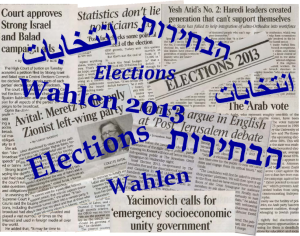
We are pleased to publish the first issue of the Elections 2013 Update, which focuses on Arab politics in Israel in anticipation of the 19th Knesset elections. This issue contains current information on the activities of the Arab political system in preparation for the upcoming elections.
The 19th Knesset elections will take place on January 22, 2013. According to the Central Elections Committee, there are 5,656,705 eligible voters registered in the Voters Registry. According to a recent Israel's Central Bureau of Statistics press release, it is estimated that eligible voters in Arab and Druze towns account for 15% of all eligible voters in Israel. Thus it can be estimated that some 848,500 Arab and Druze citizens have the right to vote in the current elections.
Five Arab and Arab-Jewish lists will compete in the upcoming elections:
- Ra’am-Ta’al-Mada, a coalition of the parliamentary faction of the Islamic Movement, the Arab Movement for Change (Ta’al) and the Arab Democratic Party (Mada);
- Hadash – the Democratic Front for Peace and Equality;
- Balad – the National Democratic Alliance;
- Da’am – the Organization of Democratic Action; and
- Hope for Change, a new Arab party.
This issue of "Elections 2013 Update" attempts to answer these and other questions. It offers editorials, information pertaining to the parties’ preparations, and a review of the main campaign issues, with emphasis on items and excerpts from Arab-language media newspapers and websites). The final section of the issue includes background statistics on several topics. Information is based on the computerized data archive of the Konrad Adenauer Program for Jewish-Arab Cooperation.
Our readers are invited to contact us through:
Konrad Adenauer Program for Jewish-Arab Cooperation
Arik Rudnitzky, Project Manager (arabpol@post.tau.ac.il)
© All rights reserved to the Konrad Adenauer Program of Jewish-Arab Cooperation, Tel Aviv University, 2012. The editorials reflect the opinions of their authors only.
This is a translated version of an issue originally published in Hebrew on December 20, 2012. We would like to extend our thanks to Ms. Renee Hochman, who translated and edited the material from Hebrew into English. We also thank Ms. Teresa Harings of Tel Aviv University's Moshe Dayan Center for her most valuable assistance in editing the material in English.
Arik Rudnitzky
The Editor