





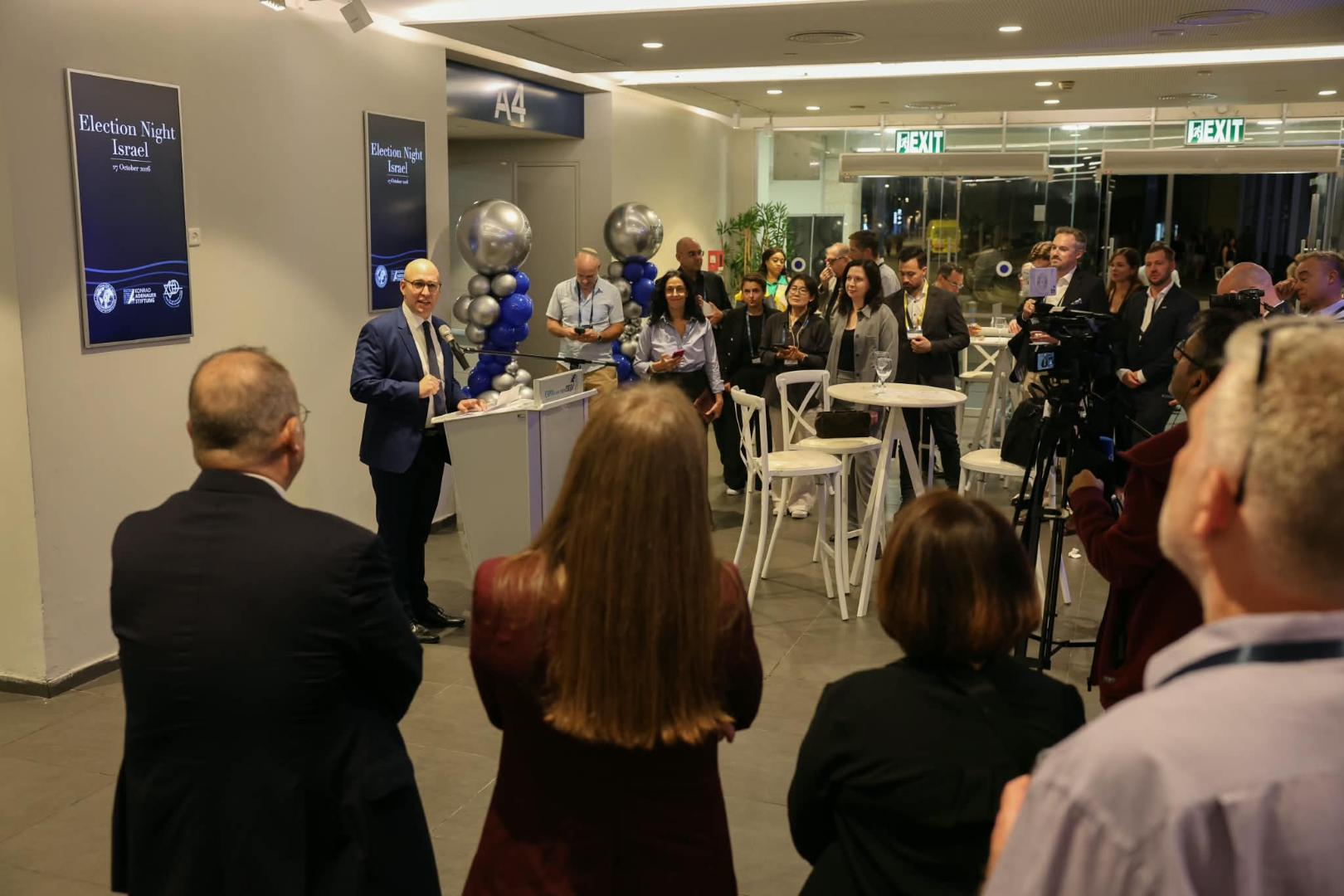
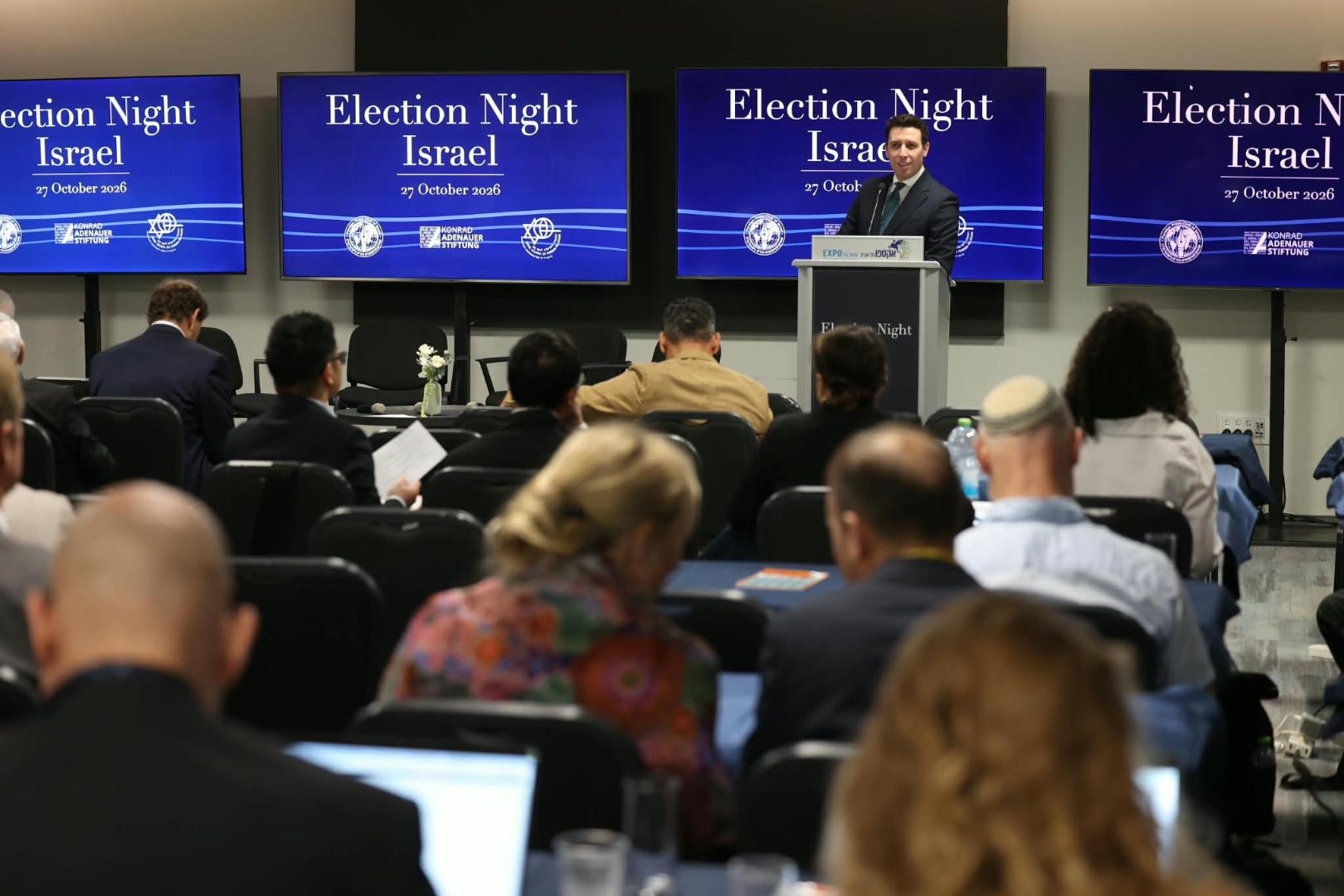
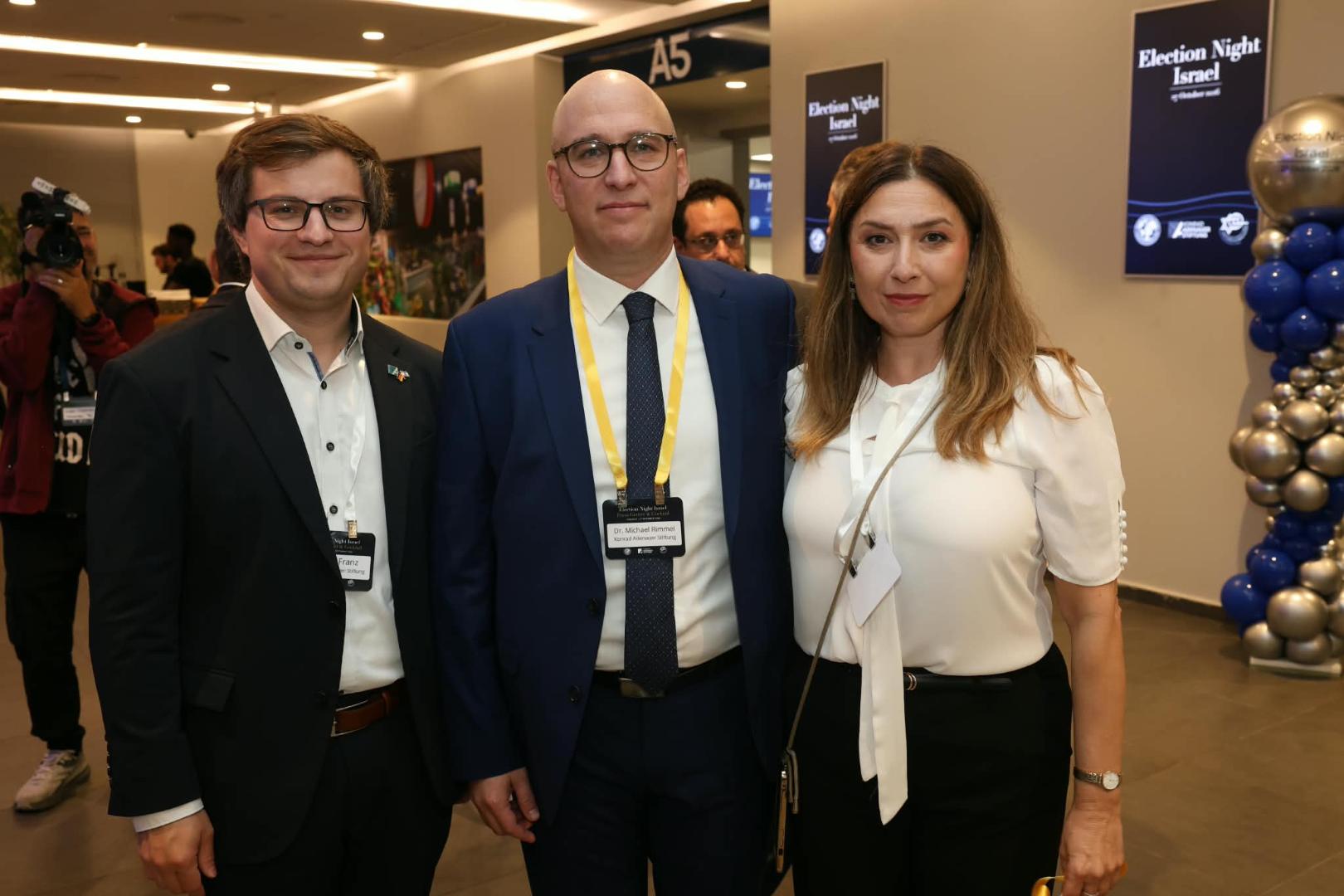
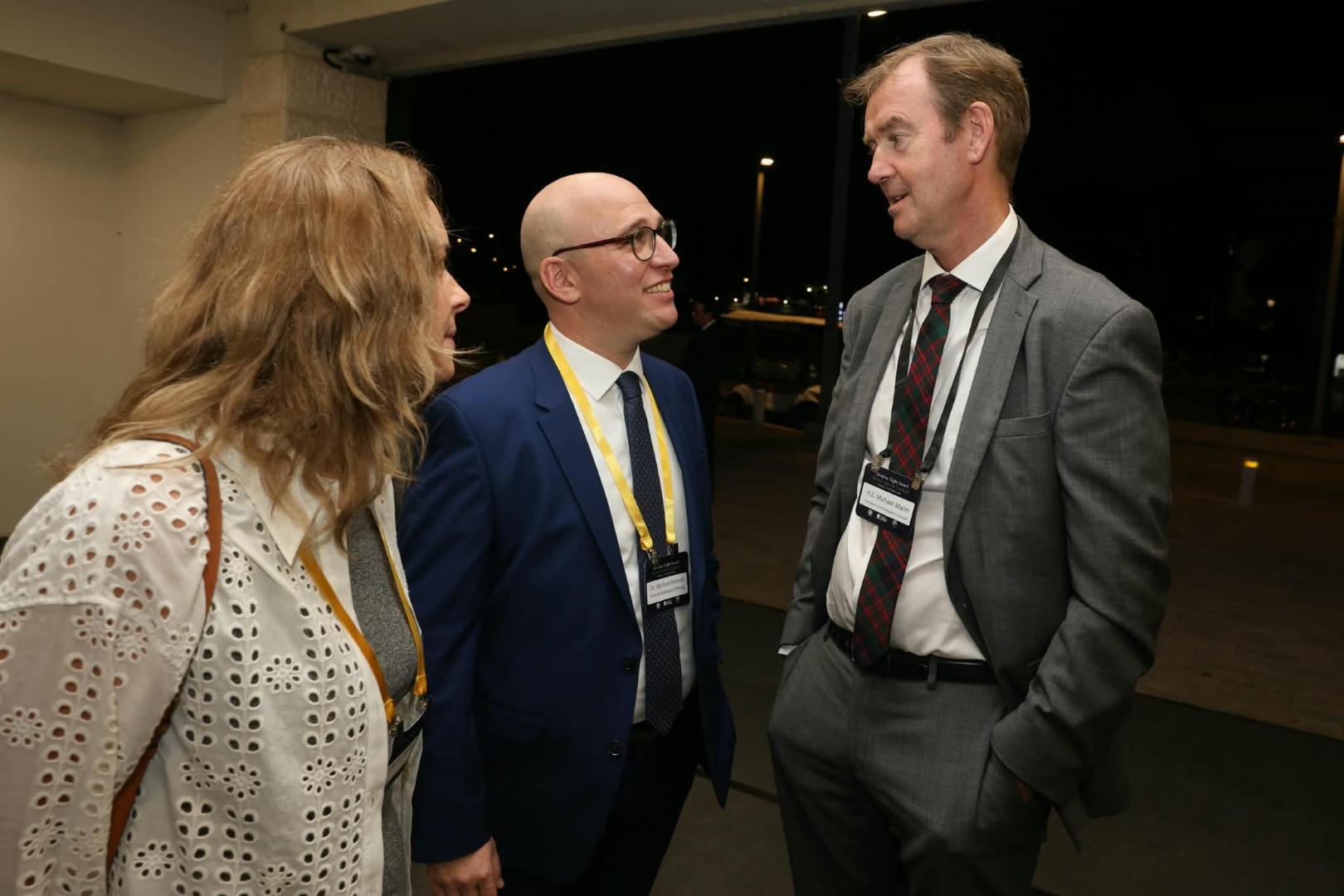
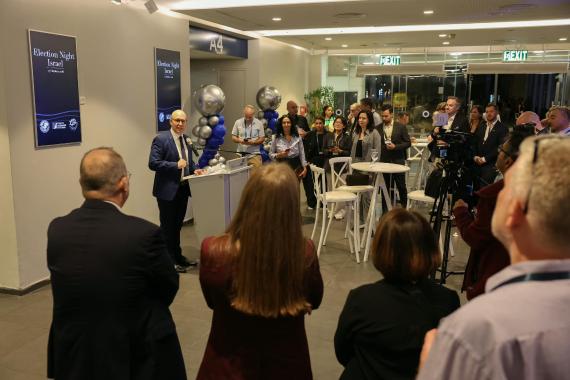
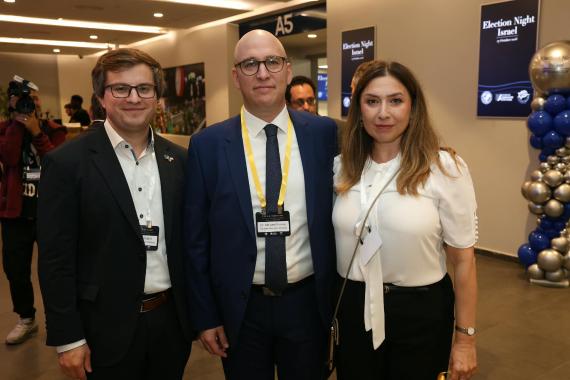
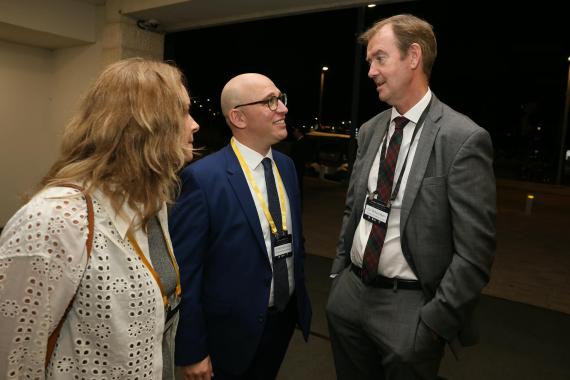
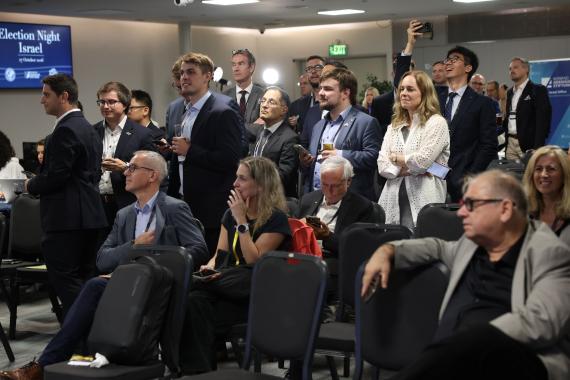
On the day of the elections in Israel, at 6.30 pm the KAS Election Night opened its door. Guests could register, grab a drink and get to know each other at Hall 10 of the Tel Aviv Expo. Remarkable people, among them the German Ambassador, Alexander Graf Lambsdorff, the EU Ambassador, Michael Mann, diplomats from over a dozen countries and international journalists assembled together to debate the election outcomes, possible scenarios and consequences for Israel and the international community.
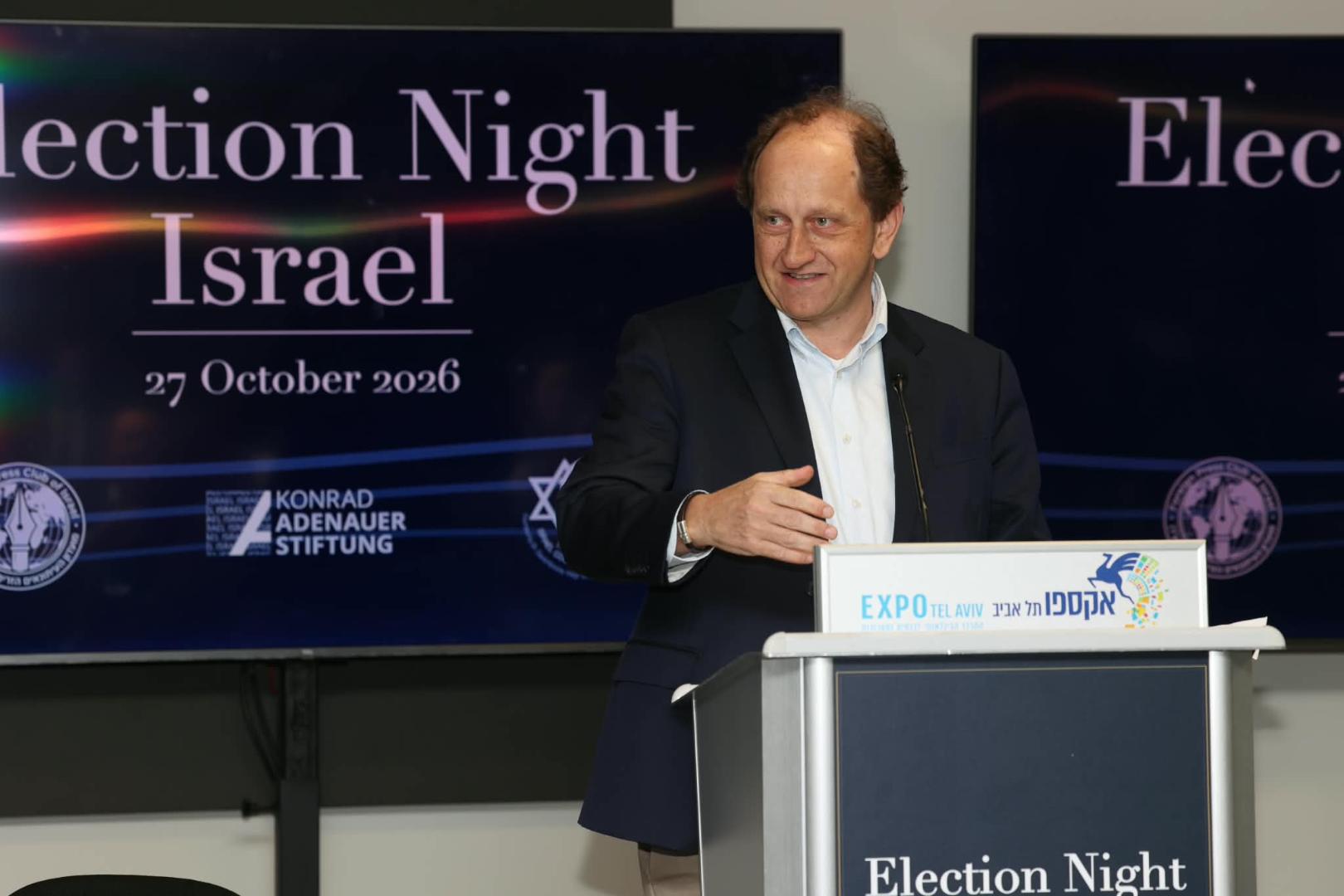
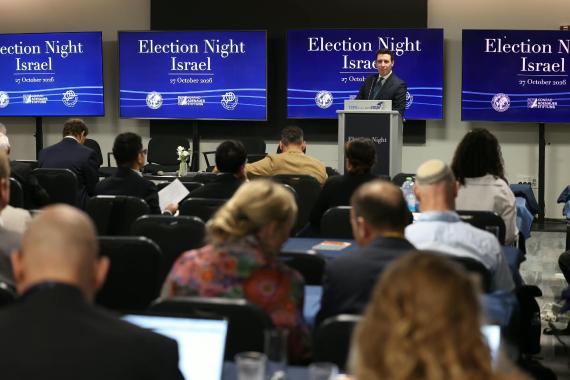
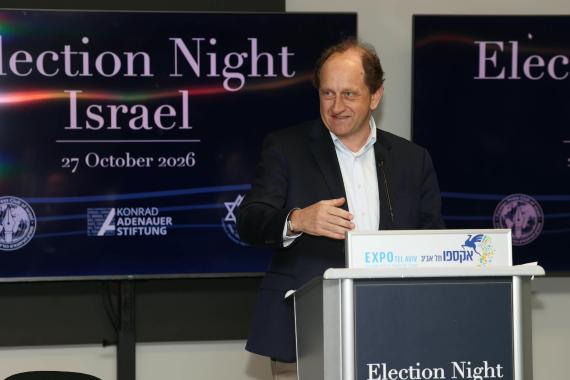
The event started with opening remarks by the heads of the three organizations inviting to the event: Dr. Michael Rimmel for the Israel Office of the Konrad-Adenauer-Foundation, Dr. Laurence Weinbaum for ICFR, and Talia Dekel from the Israel Press Club. They were followed by opening remarks of distinguished guests. The German ambassador Alexander Graf Lambsdorff quoted his counterpart in Berlin and called the election a “celebration of democracy”, while acknowledging that the difficulties start the day after, when the politicians need to build coalitions and majorities from what the people voted for. He also stressed Germany’s position as strong ally of Israel:
“Whatever the next government is, we [Germany] are ready to engage and continue to stand a friend to Israel.”
He was followed by the former Israeli Ambassador to the UK, Mark Regev. Regev highlighted the fact that Israel is having “free, open and democratic” elections, celebrating European values. He also stressed the puzzle that, although Israel celebrates European values, Europeans seems to ignore it, and, furthermore, cooperate closer with states in the region that ignore these values. Regev then set the stage by describing the situation for the coalition and the opposition camp, pointing to the fact that in Israel every result is thinkable.
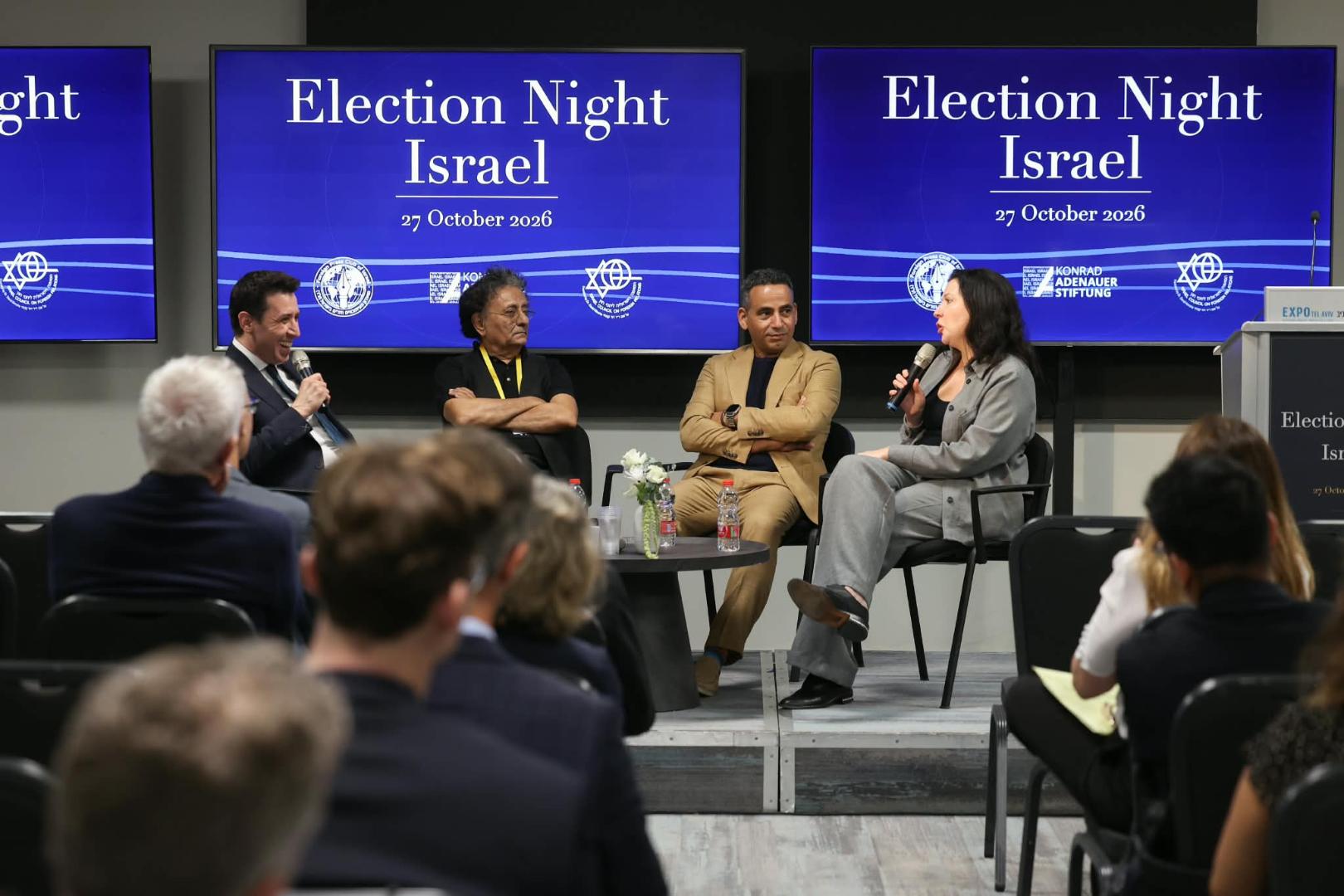
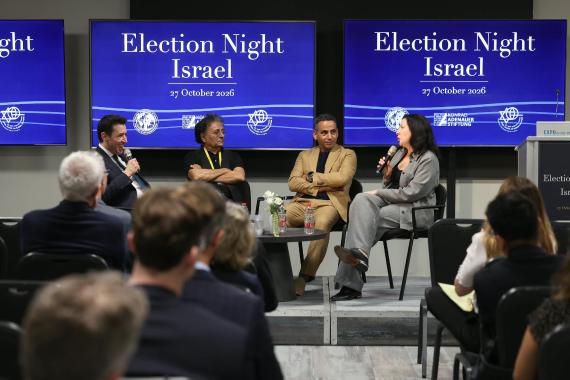
His remarks were followed by a panel, moderated by Attila Somfalvi. Irina Nevzlin, director of the ANU Museum in Tel Aviv, argued that the campaign missed conversations about the future of Israel and the different visions the parties have for the country. She argued that only very few issues like Iran really unite Israel, and that “vision” cannot emerge out a “state of survival” in which Israel is at the moment. Former MK Yoel Hasson stressed that the “7th of October continues to exist in every Israeli” and that is a great liability that “no one took responsibility”. He argued that the next government has to work on the internal issues before developing policies for the international world. He also made clear that not everyone in Israel is right, but all in the center fear to say that they are in the center as they are accused of being anti Israeli. From his perspective, a majority is disappointed of the results of the war against Iran. Former journalist Ben Dror Yemini stated that the underlying problem is the Palestinian issue. As long as there is no successful path, Israel will not be able to move on. To make steps, he demanded leadership:
“We don’t need polls, we need leadership.”
If it is not solved, Israel will suffer. In the US, he argued, the debate is shifting towards sanctions for Israel, which will pressure the next government as well.
After a short break, Nimrod Nir, academic from the Hebrew University, provided the audience with the necessary tools to interpret the exit polls. He provided the audience with four reasons why the early polls with differ from the final results. First, the 3,25 hurdle makes polling difficult as few thousand voters can make a difference. Second, the turnout issue, a relevant topic this years election, is difficult to grasp but can be very effective. Third,
“… five to ten percent of the voters decide who to vote on the day of election.”
Four, sampling certain societal groups, like Ethiopian Jews or ultraorthodox, is very difficult as they are not reachable through traditional tools of sampling. Add to that 650.000 double ballots from soldiers and diplomats, and the prediction of results becomes very difficult.
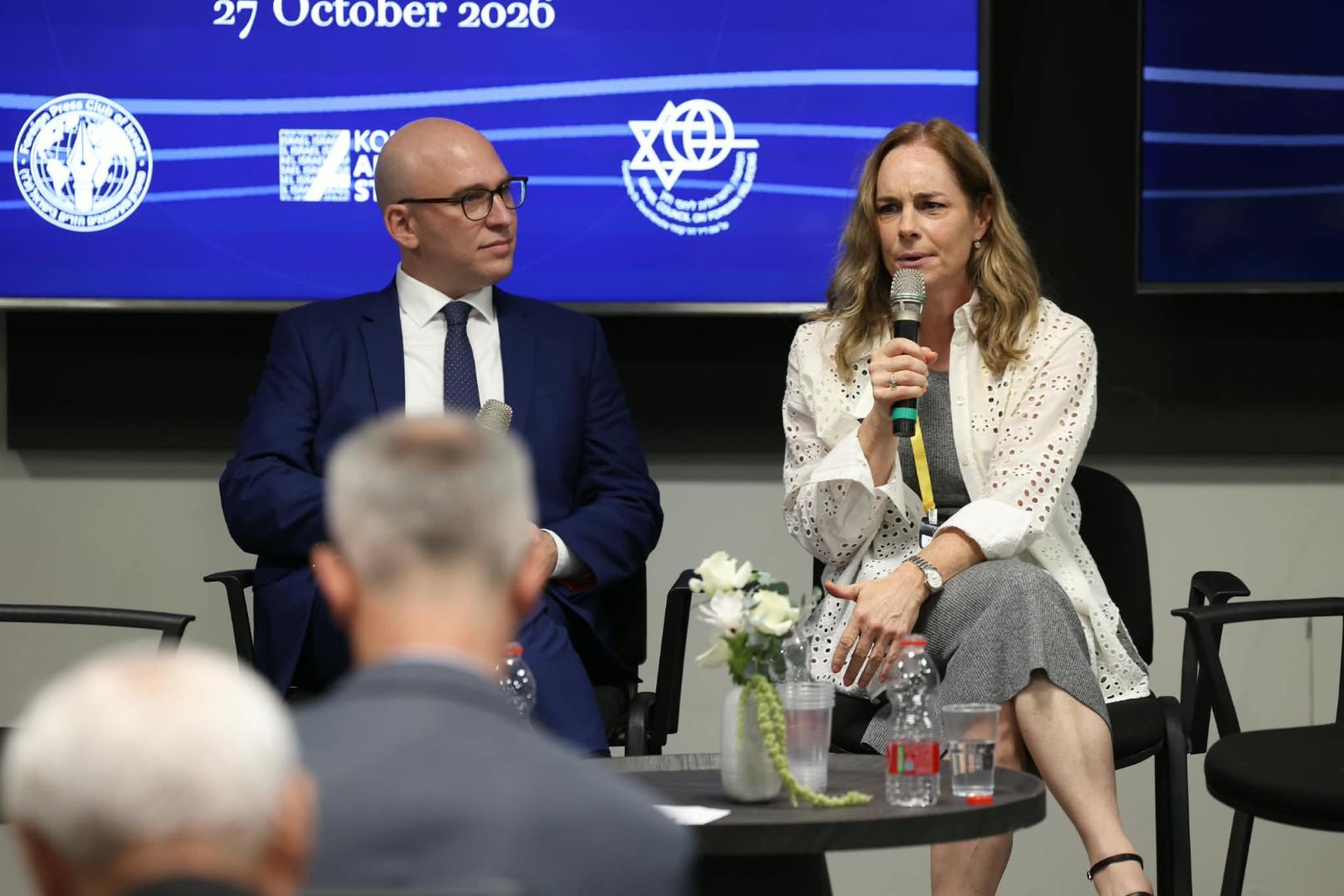
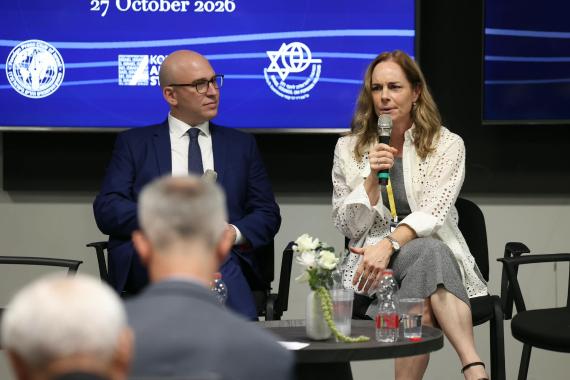
The explanation on the polls followed a conversation about the European perspective on this election. For this, Dr. Rimmel spoke with Hildegard Bentele from the European Parliament. Bentele argued that, as it is the only election in the region, EU is looking closely on the election result. A possible new government might turn Israels attention more outward again, while continued elections and a renewed war with Iran would create problems for EU decision makers. For Bentele,
“Germany is a true friend of Israel but more and more ignored by Israel.”
For Europe, Israel is an important partner, one from which one can learn and develop the own capabilities. On the other hand, the situation in the West Bank and in Gaza creates a lot of problems. The situation in both areas need to improve to have a positive outlook in the EU-Israel relations.
The final remarks before the exit polls were revealed at 10 pm came from Michal Hatuel from MIND, explaining the American perspective on the election and on Israel. First, she argued that the upcoming US election in the following weeks matters as much as Israels elections for the bilateral relations. If the Democrats gain a majority in one of the chambers of Congress, they will have hearings and committee meetings dealing with US help for the war in Gaza and on the war against Iran, criticising Israel and its military operations. Second, she feared that the current MoU between the two countries, which ends in 2029, will not be prolonged but heavily reduced, resulting in less US support for Israel. Third, from her observation, the US and the Israeli society started to move towards different directions, already before October 7, 2023, which makes dialogue more difficult.
At the same time, she argued that Israels strategic value for the US did not decrease but increase in the last years. Israels defence technology, its intelligence for the region, but also its political support in the international realm is of growing value for the US. This led her to argue that the future of the two states has opportunities and challenges. Yet,
“… the new government will meet extreme expectations, and I wonder if they can really fulfil these?”
The constraints by coalition partners, public opinion as well as the different national and international expectations need to be managed.
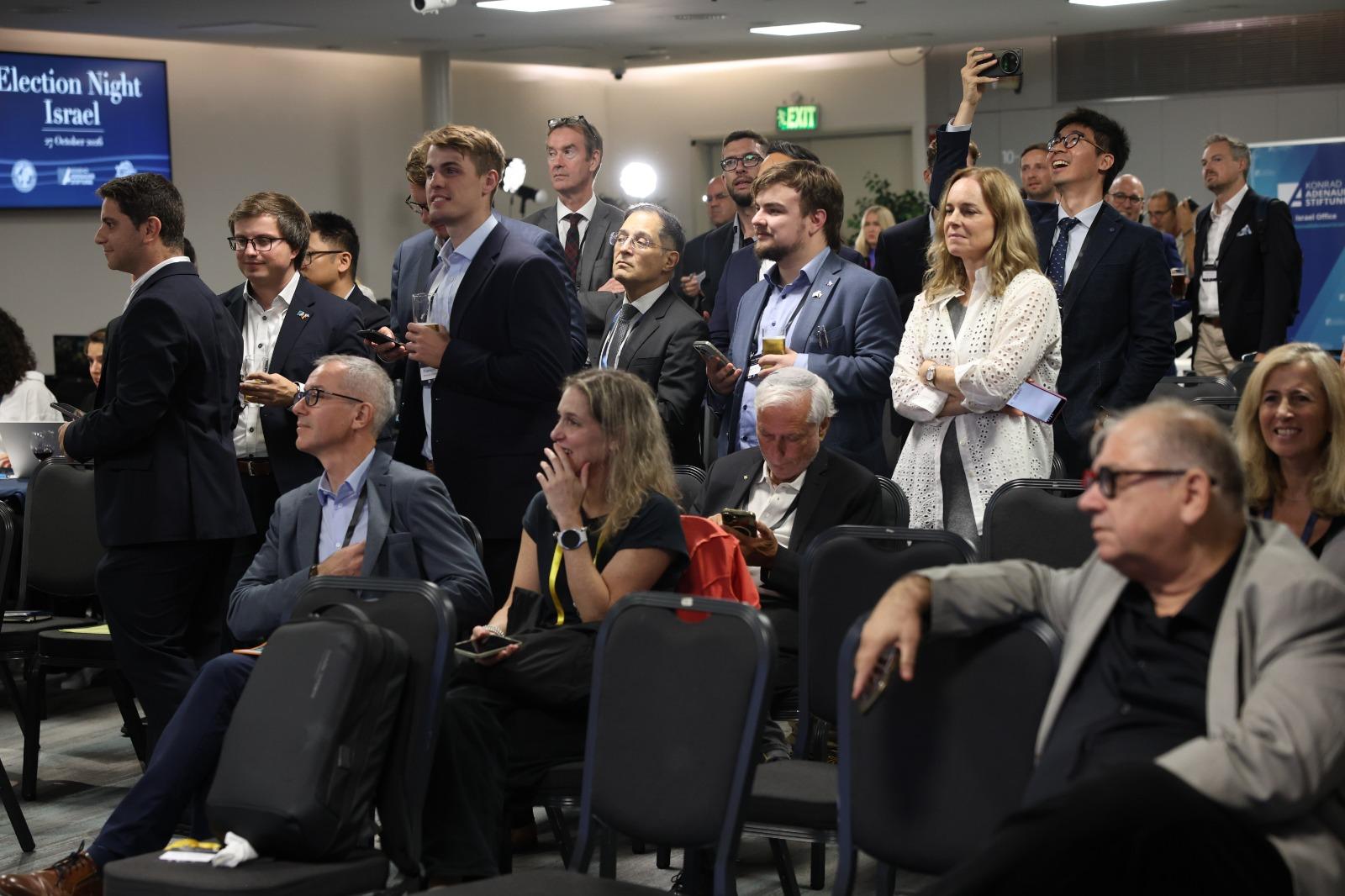
After a short break, the crowd assembled in front of the screens showing KAN, Channel 12, Channel 13 and Channel 14. At 10 pm, all could see the different exit polls and discuss that they meant. International correspondents started to interview diplomats and experts, had live coverages from the event to their broadcasting channels.
Following the release of the exit polls, guests remained engaged in lively discussions as diplomats, journalists, experts, and political observers analysed the results together and assessed their implications for Israel’s political future. Throughout the evening, the KAS Election Night provided a unique platform for informed debate, bringing together diverse international and Israeli perspectives at a decisive moment for the country. As the first projections emerged and scenarios for coalition-building began to take shape, participants exchanged views on the challenges and opportunities ahead, making the event a vivid demonstration of dialogue, democratic engagement, and shared analysis of Israel’s future.