





Djibouti: State and Society
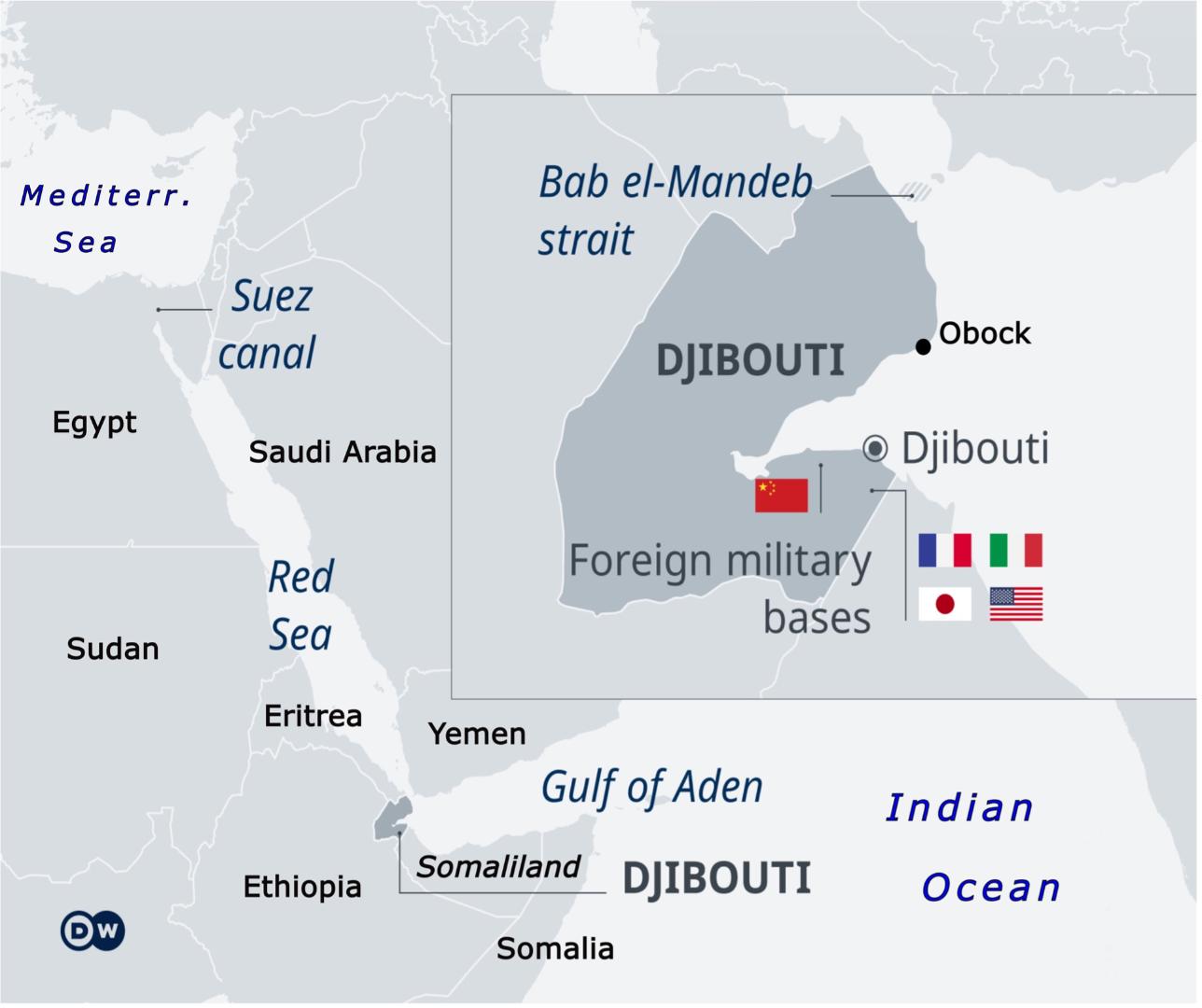
The Republic of Djibouti (French: République de Djibouti) is a small coastal state in the Horn of Africa (HoA) that limits in the north with Eritrea, in the west and the south with Ethiopia and in the south-east with the de facto state of Somaliland.[1] Djibouti is located on the southern shore of the Bab al-Mandab Strait (from Arabic “Gate of Tears”), a 27 kilometres wide maritime chokepoint that separates the Red Sea from the Gulf of Aden (see map on page 4). On the northern shore of the chokepoint lies Yemen, which is part of the Arabian Peninsula. With a total surface of around 23.669 square kilometres, Djibouti is significantly smaller than neighbouring countries.
Around 1.1 million people live in Djibouti, although more than half the population lives in the capital city Djibouti (also called Djibouti-Ville). The population is growing at an annual rate of 1.5 per cent and is composed of 60 per cent ethnic Somalis (primarily from the Issa clan), 35 per cent members of the nomadic Cushitic Afar people, and five per cent ethnic Arabs, Ethiopians and other ethnic groups. The country lies at the centre of the so-called East African migration route (Eastern Route), which runs from the Horn of Africa to the Arabian Peninsula via the Red Sea and is predominantly used by Ethiopian migrants. Furthermore, 96 per cent of the population are Sunni Muslims. The official languages are French and Arabic, although most Djiboutians communicate with one another in either Afar or Somali in everyday life. In general, the higher a Djiboutian’s level of education, the better their command of French. English is spoken mainly in the tourism sector and among the educated classes.
Political System
From 1862 to 1977, Djibouti was a French colony. In 1977, the country obtained its independence, and in 1981 it became a one-party state under the leadership of the Somalis-Issas. From 1991 to 1994, the country was entangled in a civil war between Afar rebels, who demanded a greater inclusion in Djibouti’s political system, and governmental forces. Given the rebels’ political demands and their relative success on the battleground, the Issa-led government was forced to reintroduce a multi-party system in 1992. Yet, the Djiboutian political system remained dominated by the ethnic group of Somalis-Issas. In 1999, the Issa Omar Guelleh was elected President and remains since then in power.
De jure, Djibouti is a democratic and presidential republic with multiple political parties. De facto, the country’s political system is dominated by the power of the President and its political party, the People’s Rally for Progress (French: Rassemblement populaire pour le progrès; RPP). The RPP is by far the largest party represented in the Djiboutian Parliament, as it occupies 45 of a total of 65 seats. Over the last years, the political system of Djibouti has become more autocratic, given President Guelleh’s determination to remain in power. Last April, Guelleh was re-elected President for the sixth time in a row. Thanks to a modification of the Constitution in October 2025 that suppressed the age limit of 75 years for competing for presidential elections, the 78-years-old President could be elected again. During the same process, the implementation of a referendum as prerequisite for the adoption of a new Constitution was removed, giving the President the power to adopt a new Constitution regaring the dominance of his party in Parliament. Prior to this strengthening of Presidential power, the Constitution had been changed in April 2010 to remove the limit of presidential terms.
Foreign Policy / International Relations
As a small country with limited economic and military capabilities, Djibouti relies on particularly stable relations with other countries, since it can’t always assert its interests towards them. Therefore, Djibouti seeks to avoid geopolitical dependencies. The quest for neutrality and balancing between external actors form two central pillars of the country’s foreign policy. Djibouti maintains good relations with most countries of the region, in the Horn of Africa as well as in the Middle East. Only the relationship with Eritrea remains difficult because of a longstanding border conflict.[2]
To strike a balance between cooperation with external actors and a degree of strategic autonomy, Djibouti employs a two-pronged strategy. At the regional level, it often acts as a mediator to resolve regional inter-state conflicts and to counter security threats in collaboration with partner states. For example, Djiboutian soldiers are participating in the African Union Support and Stabilisation Mission in Somalia (AUSSOM) to assist the Somali armed forces in their fight against the Islamist terrorist organisation al-Shabaab. At the international level, Djibouti strengthens its strategic autonomy by allowing a whole range of states to maintain military bases on its territory and to carry out military operations and exercises on an ad hoc basis (see the following chapter). As a result, foreign states with permanent military bases in Djibouti are dependent on the country for their security and are therefore, to a certain extent, willing to take Djibouti’s national interests into account.
Djibouti’s closest bilateral partners include not only its neighbours Ethiopia and Somalia, but also its former colonial power, France, as well as China and the United States. At a regional level, Djibouti is the actual founding member of the most important regional organisation in the Horn of Africa, the Intergovernmental Authority on Development (IGAD), which encompasses all eight countries of the Horn of Africa in the broader sense, with the exception of Eritrea.[3] Djibouti is also a member of the African Union, the Arab League, the Organisation of Islamic Cooperation (OIC) and the Common Market for Eastern and Southern Africa (COMESA).
Economy
With a Human Development Index (HDI) of 0.513, Djibouti belongs to the countries with low human development. The country has a gross domestic product (GDP) of 4.7 billion U.S.-dollars and a GPD per capita of 4,420 U.S.-dollars, meaning that Djibouti is the East African country with the third highest GDP per capita. At the same time, 42 per cent of the Djiboutian population live in extreme poverty, while the unemployment rate reaches almost 26 per cent — even around 70 per cent for the younger population. Furthermore, Djibouti’s GDP is growing at an annual rate of six per cent, whereas its inflation rate is comparatively low at 1.5 per cent. Djibouti’s economy is dominated by the services sector, which accounts for around 85 per cent of GDP. The industrial sector accounts for around 14 per cent of GDP, whilst the agricultural sector, due to Djibouti’s arid climate, accounts for just one per cent of GDP. Djibouti’s services sector consists largely of port logistics, which alone accounts for around 70 per cent of GDP and consequently establishes Djibouti as a logistics hub for maritime trade between Asia and Europe. From a foreign trade perspective, Djibouti’s main export destination is Ethiopia, which accounts for 83.5 per cent of the country’s total export volume. Furthermore, China, India and the United Arab Emirates are among Djibouti’s three largest import partners.
Djibouti’s Geostrategic Importance for External Powers
Given its geostrategic location between the Red Sea and the Indian Ocean, Djibouti has become a desired location for international armed forces. The possession of a permanent military base in Djibouti offers foreign states three geostrategic advantages. 1) Firstly, international air and naval forces can quickly reach the trouble spots of Yemen, Sudan and Somalia from Djibouti in order to intervene there if necessary — for example, to carry out drone strikes against terrorist groups or to evacuate their own citizens. 2) Secondly, a naval base in Djibouti enables the protection of maritime traffic through the Bab al-Mandab Strait, through which ten per cent of global maritime trade and 22 per cent of the world’s container trade by sea passes. 3) Thirdly, European states with a permanent military presence in Djibouti have access to the Indo-Pacific region (often referred to in U.S. security policy jargon as the ‘Indo-Pacific Theatre’), where they can project their military power. For Indo-Pacific states such as China or the U.S., on the other hand, Djibouti offers geostrategic access to the East African ‘opposite coast’. After all, the Indo-Pacific region is of increasing geostrategic importance given that it is the central arena for the intensifying systemic rivalry between the ‘political West’ and China.
For the geostrategic reasons outlined above, four countries have now established permanent military bases in Djibouti: China, Italy, Japan and the United States (see map below). France also maintains a permanent military presence in the country. However, French forces have been stationed in Djibouti — a former French colony — since the 19th century. In addition, Spanish soldiers are stationed at the French naval base in Djibouti as part of the EUNAVFOR (European Union Naval Force) Operation Atalanta contingent. Furthermore, the South Korean Navy uses Djibouti’s commercial port for naval operations, whereas the Indian Navy is permitted, under bilateral agreements, to use the French, Japanese and American military bases in Djibouti for logistical purposes.
 Deutsche Welle
In addition, Russia and Saudi Arabia aimed at establishing military bases in Djibouti in the past. In 2014, however, the Djiboutian Government interrupted the bilateral negotiations with the Russian side, after the U.S. pressured Djibouti to stop the project of a Russian air base.[1] Ten years later, in 2024, Saudi Arabia signed a bilateral agreement with Djibouti to open a logistics zone in the port of Djibouti. From the perspective of the Djiboutian partners of KAS, this commercial project could, in the long term, pave the way for the establishment of a Saudi naval base.
The French Military Bases in Djibouti
France has maintained a continuous military presence in Djibouti since the 19th century. In Djibouti City, the French armed forces operate an air base (Base aérienne 188 Djibouti ‘Colonel Massart’), a naval base (Base navale du Héron) and an army base. France also operates a training centre for desert combat (Centre d’entraînement au combat et d’aguerrissement au désert de Djibouti — CECAD). All three bases form the ‘French Forces Stationed in Djibouti’ (Forces françaises stationnées à Djibouti — FFDj), the largest contingent of the French armed forces outside France and its overseas territories.
The FFDj comprise over 1,000 soldiers, although their troop numbers have been gradually reduced since Djibouti’s independence. As France has been forced to abandon its military bases in the Sahel and West Africa over the past four years for political reasons, it can be assumed that it will have an interest in at least maintaining its current troop strength in Djibouti. The lease of the air base and the rights of use at the port form part of the Djiboutian-French defence agreement, which has been in place since 1977 and was extended by ten years in 2014 and subsequently by a further 20 years in September 2025.
The United States Naval Expeditionary Base ‘Camp Lemonnier’
Since late 2002, ‘Camp Lemonnier’ — a naval expeditionary base named after a French general — has been home to the Combined Joint Task Force – Horn of Africa (CJTF – HOA), which operates under the U.S. Africa Command (USAFRICOM). The barracks were originally operated by the French Foreign Legion and subsequently, for a short period, by the Djiboutian armed forces. Following substantial investment, several thousand U.S. soldiers are now stationed at what is the only permanent U.S. military base on the African continent. The base also temporarily hosts smaller British units.
Since 2013, the U.S. armed forces have also stationed a drone unit at Chabelley Airfield in Chabelley — a military airfield previously little used and reserved for the French armed forces — some nine kilometres south-west of Djibouti City. To this day, the Predator and Reaper systems are primarily deployed from here for counter-terrorism operations in Yemen and Somalia. The role of the U.S. armed forces in Djibouti, or rather that of CJTF-HOA, is based on four key areas of operation: 1) strengthening cooperation with East African partners, 2) strengthening the partnership between the U.S. and its allies in Djibouti, 3) supporting operations and plans in East Africa, and 4) crisis management.
The Japanese Air Base
Since 2011, Japan operates a permanent air base in Djibouti, directly adjacent to Djibouti-Ambouli International Airport. To this day, the base remains the only overseas military base of the Japanese Self Defense Forces (SDF). Its establishment was a direct consequence of the Japanese Navy’s participation in international efforts to combat Somali piracy, with the aim of providing escort protection for Japanese merchant ships. Given the ongoing threat posed by Somali pirates, Japanese naval vessels keep regularly calling at the port of Djibouti, where they use a dedicated area. However, compared with the French and Chinese naval bases, the SDF port area is small and can only accommodate a few ships at once.
The Italian Support Base ‘Amedeo Guillet’
In 2013, Italy inaugurated its ‘Italian Support Base’ (Base Militare Italiana di Supporto — BMIS) ‘Amedeo Guillet’ in Djibouti. The military base, which is located in proximity of the border with Somaliland, was established based on a bilateral defence cooperation agreement between both countries. With a permanent military asset in Djibouti, Italy is able to participate in regional maritime security operations, such as the EUNAVFOR operations Atalanta and Aspides.
China’s Naval Base ‘Doraleh Support Base’
The Chinese naval base ‘Doraleh Support Base’ was established in 2017 in Djibouti. The naval base is the latest foreign military base in the country, as well as the first and up to date only official military base of China’s People’s Liberation Army (PLA) outside Chinese territory. The Chinese leadership justified the opening of the naval base in Djibouti by citing the protection of Chinese maritime trade and Chinese citizens in the region, as well as the execution of peacekeeping missions in Africa and the Middle East. The establishment of the naval base took place against the backdrop of a ‘Strategic Partnership’ agreed between China and Djibouti in 2017, which has significantly deepened bilateral security and economic relations between the two countries. China’s rights of use for the base are valid for ten years, until 2027. Given the close relationship between China and Djibouti, it is likely that these rights will be extended.
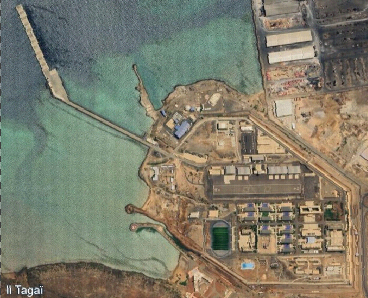
With a force of 2,500 naval and army personnel, the Chinese naval base is one of the largest foreign military bases in Djibouti. It is significantly larger than all other foreign naval bases in Djibouti and, according to various reports, could even accommodate considerably more troops. China’s naval base is situated in the north-western part of Djibouti City, in the immediate vicinity of the Doraleh Multipurpose Port. The base includes a 341-metre-long quay, completed in 2022, at which not only destroyers and submarines but even one of China’s aircraft carriers could dock (see satellite image below). The naval base also features a helipad. However, for aircraft of any kind, the PLA has to use the Djibouti-Ambouli International Airport
 Google Earth
China’s Increasing Economic Influence in Djibouti
The opening of China’s naval base in Djibouti symbolises the growing influence of the Middle Kingdom in the Horn of Africa. For years, China has been expanding its influence in Djibouti in the fields of security policy, economy and science. The People’s Republic of China has been a close trading partner of Djibouti for 20 years. Since the start of Guelleh’s presidency in 1999, China has invested an estimated 14.4 billion U.S.-dollars in the country, particularly in infrastructure. Chinese state-owned companies hold stakes in key infrastructure projects in Djibouti — such as the railway line between Addis Ababa and Djibouti, which opened in 2017, and the Doraleh container port, which opened in the same year. Other key infrastructure projects financed by China include, amongst others, a 3.5 billion U.S.-dollars free trade zone opened in 2018 — one of the largest free trade zones on the African continent — as well as Djibouti’s integration into the Pakistan & East Africa Connecting Europe (PEACE) submarine cable, which facilitates internet connections between Europe, Asia and Africa.
At present, a planned spaceport is the most economically and geopolitically significant Chinese infrastructure project in Djibouti. In January 2023, the Djiboutian government, together with the Chinese companies Hong Kong Aerospace Technology Group and Touchroad International Holding Group, signed a Memorandum of Understanding (MoU) on the construction of a commercial spaceport. Plans include investment of one billion U.S.-dollars in seven satellite launch facilities and three rocket test launch pads, which are due to be completed within five years. The two Chinese companies involved are to be granted the unrestricted right to launch satellites and rockets into space for a period of 30 years. The Chinese spaceport will be located near the town of Obock, on the northern shore of Tadjoura Bay, meaning that China’s naval base and the new spaceport would lie opposite each other at the two entry and exit points of the Gulf of Tadjoura (see map on p. 4). Analysts view the project as a continuation of China’s economic and maritime expansion in the Indo-Pacific region and, in particular, in East Africa.
For the Djiboutian leadership, economic relations with China are proving to be a double-edged sword. On the one hand, Djibouti’s economy is benefiting from Chinese investment, which is making a decisive contribution to the growth of Djibouti’s GDP. On the other hand, the Djiboutian government has accumulated significant debts to China in recent years. As a result, 70 per cent of the country’s outstanding debts is owed to China, which in turn accounts for around 25 per cent of Djibouti’s import and export trade. How can Djibouti’s economic dependence on China be explained? Western states and the International Monetary Fund (IMF) refuse to finance projects in Djibouti outside the humanitarian sector, citing Djiboutian President Guelleh’s involvement in corruption. Djibouti therefore has very few options for raising capital, which in turn has led to China’s current strong influence. Furthermore, by forging closer ties with China, the country can avoid becoming dependent on Western nations (such as France or the U.S.).
The German Footprint in Djibouti: The Role of the Bundeswehr and Germany’s Security Interests
Latest Developments
At present, only the German Navy is stationed in Djibouti, albeit on a very limited scale. It is taking part in the EUNAVFOR Operation Aspides to protect Western merchant ships against drone and missile attacks carried out by the Yemeni Houthi militia. Last October, the Bundestag approved the extension of the Bundeswehr’s mandate until 31st October 2026. Given the ongoing threat to international shipping posed by the Houthis and the political significance of the EU mission in the Red Sea, a further extension of the Bundeswehr’s mandate for Aspides appears possible. In addition to the German Navy’s participation in EUNAVFOR Aspides, Germany’s security policy engagement in Djibouti also comprises bilateral security and defence cooperation between the two states. For example, the two countries are working together on the maintenance of hospitals and training centres.
Past Deployments of the Bundeswehr in the Horn of Africa
The Federal Republic of Germany’s current security policy engagement in Djibouti dates back to the presence of the German armed forces in the Horn of Africa, which has spanned more than 20 years. Of the Bundeswehr’s armed services, the German Navy in particular has been assigned the leading role in safeguarding German security and economic interests in this geostrategically significant region. Germany’s security interests in the ‘Red Sea Security Arena’ have always been, and continue to be, focused on combating current security threats in the maritime domain: 1) From 2002 to 2008, the focus lied on maritime terrorism; 2) from 2008 to 2016, on Somali piracy; and 3) since February 2024, against the backdrop of the Houthi threat, greater attention has once again been devoted to terrorism at sea.
During the first ‘deployment phase’ from 2002 to 2008, Germany regularly sent naval vessels to the Horn of Africa to take part in Operation Enduring Freedom (OEF), an U.S.-led counter-terrorism operation. Since then, the German Navy’s involvement has been embedded within the EU’s Common Security and Defence Policy (CSDP). During the second phase of operations, from 2008 to 2016, the German Navy contributed its own ships to EUNAVFOR Atalanta to work alongside European partners in combating Somali piracy and smuggling networks at sea.[1] In 2018, the Bundeswehr ended its participation in the EUTM (EU Training Mission) Somalia training mission and, in April 2022, its participation in EUNAVFOR Atalanta. It was not until the launch of Operation EUNAVFOR Aspides in February 2024 that the German Navy returned to Djibouti. From February to April 2024, the air defence frigate ‘Hessen’ took part in the European operation.
Since then, the German government has made no further attempt to deploy a naval vessel to the Red Sea for an extended period.[2] Consequently, the main burden of EUNAVFOR Aspides is currently borne by the French and Italian navies. Since the start of the operation,a ship from the Italian Navy has served as the operational flagship, while the French Navy maintains a robust and permanent presence through its naval base in Djibouti.
Outlook
Given its strategic location along one of the world’s most important maritime trade routes, Djibouti should form the focal point of German security and defence policy in East Africa and — considering the current shift within Germany’s Africa policy from a priority on West Africa to East Africa — possibly across the whole of sub-Saharan Africa. In view of Germany’s economic dependence on open sea lanes, a return of the German Navy to the Horn of Africa could make a significant contribution to safeguarding German foreign trade. Such a move would also strengthen the security engagement of the EU in the region and provide military relief to European partners that are currently being active there.
[1] As de facto state, Somaliland has the structures and institutions that are necessary for a state to function. It is, however, only recognised by Israel as a sovereign state so far.
[2] In 2008, the border conflict between Eritrea and Djibouti escalated to a military confrontation that provoked the death of dozens of soldiers on both sides.
[3] In the stricter sense, only Ethiopia, Djibouti, Eritrea and Somalia (including Somaliland) are considered as being part of the Horn of Africa. In the broader sense, the above-mentioned states as well as Kenya, Sudan, South Sudan and Uganda are included in the ‘Greater Horn of Africa’. The EU, for instance, defines the Horn of Africa based on the broader definition with eight states.
[4] Since then, Russia seeks to establish a naval base in Port Sudan, on the Sudanese coastline of the Red Sea. However, the bilateral negotiations with the Sudanese government have not yet yielded any significant results. As an alternative, Russia might consider the Eritrean ports of Assab and/or Massawa.
[5] The EUNAVFOR Atalanta is still being carried out, especially through the active engagement of the Spanish and French naval forces. The operational headquarters of the operation are located in Spain (Rota), whereas its centre for maritime surveillance, the ‘Maritime Security Centre Indian Ocean’, is situated in France (Brest).
[6] As part of the Indo-Pacific Deployment (IPD) 2024, a task force of the German Navy was supposed to pass through the Red Sea in autumn 2024 on its return journey from the Far East to Germany. However, in view of the threat posed by the Houthis, Federal Minister of Defence Pistorius decided to reroute the task force around the Cape of Good Hope instead. In October 2025, the Federal Government stated in a response to a parliamentary question from the political party AfD that there were no plans to deploy a German frigate to the Indo-Pacific in 2026. Furthermore, no decision has yet been taken regarding the deployment of a frigate in the region in 2027.