Maritime security has increasingly gained attention and prominence as a shared concern, yet there still lacks a systematic and holistic approach to addressing its many related challenges—from piracy to illicit fishing, cyber attacks on digital infrastructure to environmental destruction. In the absence of one United Nations (UN) coordinating body and integrated strategy, several UN agencies, programmes, and funds are tackling maritime security affairs under different mandates, resulting in a fragmented approach.
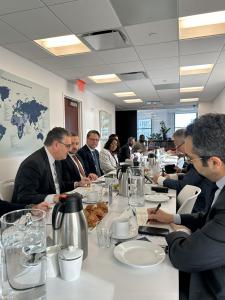
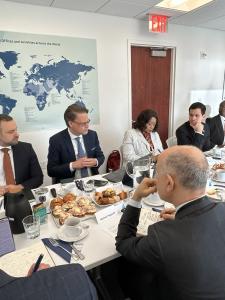
In view of the above, the Konrad Adenauer Foundation (KAS) New York Office and Permanent Mission of Greece to the United Nations convened a workshop on December 5 on “Enhanced and Systematic Coordination for Stronger Maritime Security.” Together with representatives from across the UN system, as well as Member States, they shared best practices/lessons learned from their respective maritime security initiatives and explored recommendations for a more coherent, comprehensive approach among UN entities to address maritime security concerns. The workshop featured opening remarks by Mr. Ioannis Stamatekos, Deputy Permanent Representative of Greece to the United Nations, and an expert assessment by Dr. Christian Bueger, International Relations Professor at the University of Copenhagen and Research Fellow at the United Nations Institute for Disarmament Research (UNIDIR).
Key takeaways from the discussion included:
- Maritime security requires sustained political and financial support from Member States, but both tend to dwindle once threats recede. Within the Security Council specifically, meetings and resulting resolutions and statements on the issue have been largely reactive and ad hoc.
- That said, the majority of Member States support a strengthened role for the UN on maritime security. Importantly, current elected Member States on the Council (E10) have helped to keep the issue on the agenda, as illustrated by the open debates by Greece in May 2025 and Panama in July 2025 and an Arria-formula meeting on the protection of seafarers, organized by Greece, India and the Philippines and co-sponsored by Denmark, Japan, Panama, and Romania in November 2025. Going forward, the E10 can play a critical role in maintaining this momentum.
- In the context of UN80 reform, the establishment of a new UN entity to oversee maritime security would be unlikely, but the establishment of a coordinating mechanism—providing a platform for relevant stakeholders to meet and jointly work on shared priorities—would be a valuable asset. With funding also under stress, public-private partnerships were cited as a potential avenue for enhanced maritime security.