Details
About the Panel Discussion
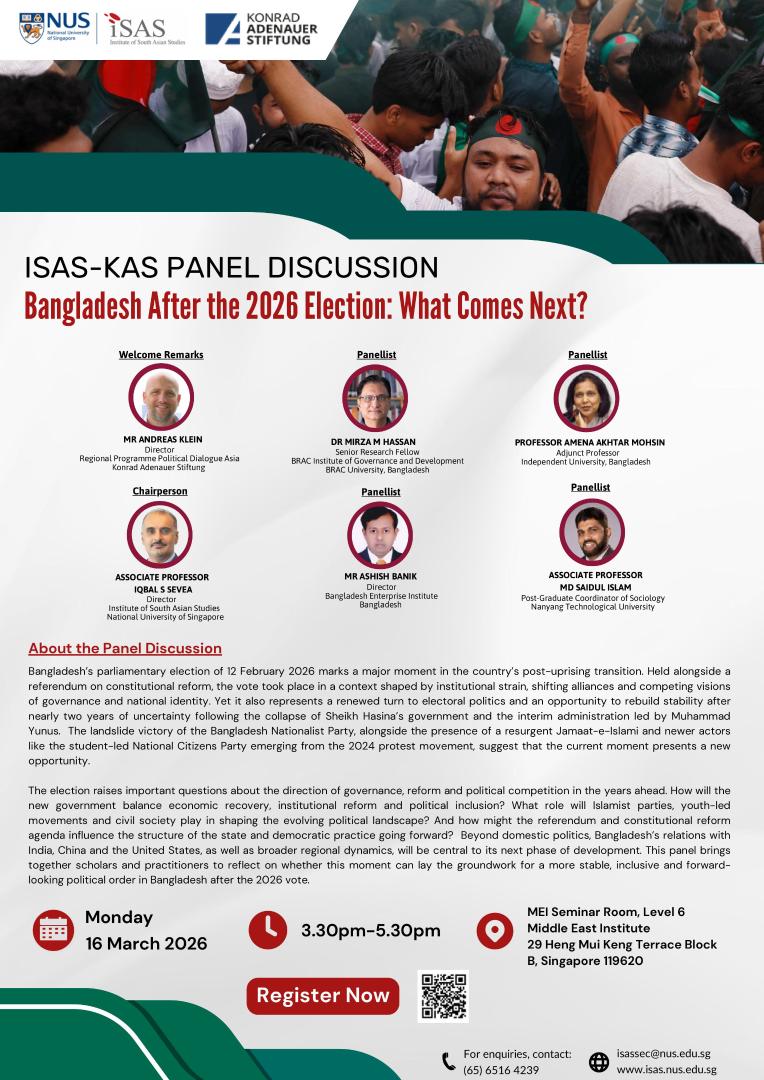
Bangladesh’s parliamentary election of 12 February 2026 marks a major moment in the country’s post-uprising transition. Held alongside a referendum on constitutional reform, the vote took place in a context shaped by institutional strain, shifting alliances and competing visions of governance and national identity. Yet it also represents a renewed turn to electoral politics and an opportunity to rebuild stability after nearly two years of uncertainty following the collapse of Sheikh Hasina’s government and the interim administration led by Muhammad Yunus.
The landslide victory of the Bangladesh Nationalist Party, alongside the presence of a resurgent Jamaat-e-Islami and newer actors like the student-led National Citizens Party emerging from the 2024 protest movement, suggest that the current moment presents a new opportunity.
The election raises important questions about the direction of governance, reform and political competition in the years ahead. How will the new government balance economic recovery, institutional reform and political inclusion? What role will Islamist parties, youth-led movements and civil society play in shaping the evolving political landscape? And how might the referendum and constitutional reform agenda influence the structure of the state and democratic practice going forward?
Beyond domestic politics, Bangladesh’s relations with India, China and the United States, as well as broader regional dynamics, will be central to its next phase of development. This panel brings together scholars and practitioners to reflect on whether this moment can lay the groundwork for a more stable, inclusive and forward-looking political order in Bangladesh after the 2026 vote.
Date: Monday, 16 March 2026
Time: 3.30pm – 5.30pm
Venue: Middle East Institute (MEI) Seminar Room, Level 6, Middle East Institute, NUS
National University of Singapore
29 Heng Mui Keng Terrace
#06-06 (Block B),
Singapore 119620
Chair: Associate Professor Iqbal S Sevea (Director, ISAS)
Panellists:
Dr. Mirza M Hassan (BRAC University)
Professor Amena Akhtar Mohsin (Independent University, Bangladesh)
Mr Ashish Banik (Bangladesh Enterprise Institute)
Associate Professor Md Saidul Islam (NTU)
Download the agenda: Bangladesh After the 2026 Election What Comes Next ISAS-KAS Panel Discussion - 16 March 2026 - Programme (3).pdf