The Pacific Alliance, ASEAN and the Evolving Landscape of Cross-Pacific Economic Relations
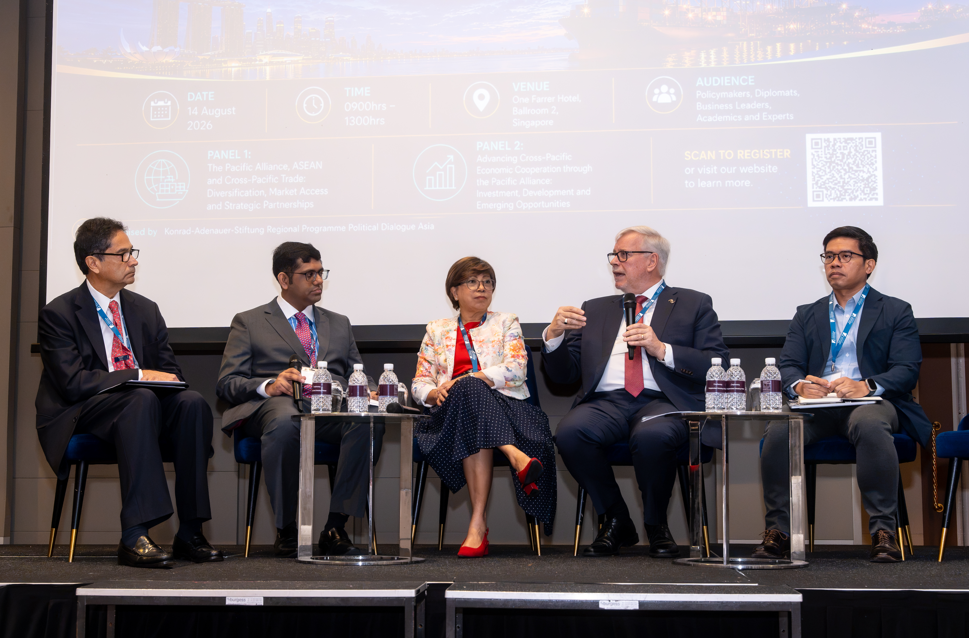
On 14 August 2026, the Konrad-Adenauer-Stiftung Regional Programme Political Dialogue Asia convened the seminar “The Pacific Alliance, ASEAN and the Evolving Landscape of Cross-Pacific Economic Relations” at One Farrer Hotel in Singapore. Three keynote addresses and two expert panels brought together diplomatic, academic, policy and business perspectives from Southeast Asia, Latin America, Europe and the wider Asia-Pacific.
The seminar took place at a time of growing geopolitical uncertainty, protectionism and concern over the resilience of global supply chains. Against this backdrop, participants considered how ASEAN and the Pacific Alliance—comprising Chile, Colombia, Mexico and Peru—could translate their shared interest in open markets and international cooperation into stronger trade, investment and institutional ties.
The programme opened with keynote addresses by H.E. Ambassador Ong Keng Yong, H.E. Ambassador Agustín García-López Loaeza, Ambassador of Mexico to Singapore, and Mr David Gregosz, MdB, Member of the German Parliament. Their contributions situated cross-Pacific cooperation within Singapore’s efforts to diversify its economic partnerships, Mexico’s Pro Tempore Presidency of the Pacific Alliance, and the wider German and European interest in stronger relations with Southeast Asia and Latin America.
Both panel discussions were chaired by Mr Anish Mishra, Project Manager / Research Fellow for Foreign Affairs and Security Policy at the KAS Regional Programme Political Dialogue Asia, who guided the exchanges on the opportunities, constraints, and practical pathways for stronger ASEAN–Pacific Alliance cooperation.
The first panel, “The Pacific Alliance, ASEAN and Cross-Pacific Trade: Diversification, Market Access and Strategic Partnerships,” examined how existing regional frameworks could be used more effectively. Speakers repeatedly emphasised that the challenge was not necessarily the absence of agreements, but the need to connect those agreements to businesses, investors and institutions.
Tan Sri Datuk Dr Rebecca Fatima Sta Maria highlighted the convergence between ASEAN, APEC and the Pacific Alliance in areas such as trade liberalisation, the digital economy, sustainable development, support for small and medium-sized enterprises and regional connectivity. She identified the Free Trade Area of the Asia-Pacific as a continuing collective aspiration and proposed three practical areas for deeper engagement: collaboration on World Trade Organization reform, digital economic integration and more regular institutional dialogue.
Professor Jaime García presented Peru as an increasingly important platform for connecting Latin America with Asia. He pointed to Peru’s extensive trade architecture, openness to investment and strengths in mining, agribusiness, infrastructure and renewable energy. New logistics infrastructure, particularly the ports of Chancay and Callao, could reduce transport times and support more integrated production and investment networks across the Pacific. He argued that the relationship should develop gradually: first through deeper trade, market access and business links, and later through innovation, higher education, digital transformation and the green transition.
From a New Zealand business perspective, Mr Stephen Jacobi argued that the Comprehensive and Progressive Agreement for Trans-Pacific Partnership could serve as a bridge between the Asian and Latin American sides of the Pacific. However, trade agreements alone are insufficient. Effective connectivity must also include transport links, digital networks, compatible regulations, efficient customs procedures and strong commercial relationships. Smaller economies such as New Zealand, Singapore and Chile may not determine the size of regional markets, he noted, but they can help protect the quality and credibility of regional rules.
Professor Aries A. Arugay described the Philippines not simply as a market, but as a potential connector between the Pacific Alliance and maritime Southeast Asia. Drawing on the long history of trans-Pacific contact, he called for the conversion of episodic diplomacy into repeatable mechanisms for cooperation. His proposals included a Philippines–Pacific Alliance business mechanism, standards cooperation with Chile, work with Colombia on peacebuilding and rural development, and a structured agenda with Peru on minerals, fisheries, ports and disaster-risk reduction.
Political ambition and economic constraints
The second panel, “Advancing Cross-Pacific Economic Cooperation through the Pacific Alliance: Investment, Development and Emerging Opportunities,” considered both the potential and the limitations of closer relations.
Professor Diego Sánchez-Ancochea offered a deliberately cautious assessment. Although the Pacific Alliance represents a sizeable market and has attracted considerable diplomatic interest, intra-Alliance trade remains below four per cent of members’ total commerce. Distance, high logistics costs, weak firm-to-firm networks, limited institutional capacity and political discontinuity continue to constrain cooperation with ASEAN. He argued that progress would depend on selective, high-value links in areas such as critical minerals, renewable energy, agri-food security, services and talent, with Singapore acting as a financing and regional headquarters platform.
Mr Mohamad Al-Arief focused on Indonesia and the opportunities for South–South cooperation. His presentation highlighted complementarities in the energy transition—including Latin American lithium and Indonesian nickel—as well as digital services, fintech, e-commerce, climate resilience and SME development. His central message was that geographic distance could be reduced through stronger digital and institutional connectivity.
Professor Carlos Aquino Rodríguez noted that Peru is among Latin America’s most Asia-oriented economies: approximately half of its goods trade was conducted with Asia in 2025. Yet trade with ASEAN represented only 2.1 per cent of Peru’s total trade. He therefore called for more value-added exports, industrial parks and special economic zones, stronger business networks, a Peru–ASEAN chamber of commerce and expanded people-to-people exchanges.
Professor Paz Milet García reflected on the Pacific Alliance’s fifteenth anniversary and its importance as a long-term instrument of Chilean foreign policy. She emphasised the value of political leadership, a strong technical framework and private-sector participation, noting that SMEs account for more than half of intra-Alliance trade. Deeper relations with ASEAN could offer Latin American states more diversified and reciprocal partnerships, but the Alliance must strengthen political coordination and its capacity to manage internal tensions.
The seminar demonstrated that stronger ASEAN–Pacific Alliance relations will not emerge through agreements alone. Progress will depend on targeted cooperation, commercially viable projects, institutional continuity and sustained networks among governments, businesses, universities and policy institutions. By convening this dialogue, KAS reaffirmed its commitment to international political dialogue, regional integration and international cooperation across regions.