





Asset-Herausgeber

Publikationen

Asset-Herausgeber

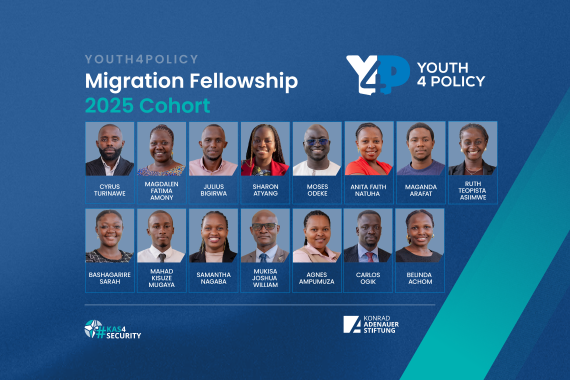
Meet the 2025 Youth4Policy Migration Fellows

Fifteen emerging policy thinkers join the final Migration Cohort of the Youth4Policy Fellowship to explore Uganda’s emigration, labour, climate, and governance dynamics.

The 2025 Youth4Policy Migration Fellowship marks the final migration-themed cohort under our Youth4Policy Programme. This diverse group of 15 young professionals; drawn from law, economics, technology, diplomacy, peacebuilding, and social work, represents a new wave of thinkers tackling Uganda’s migration story. Their research explores labour externalisation, brain drain, diaspora participation, climate-driven migration, and the intersection of rights, governance, and development. Together, they bring fresh perspectives, lived experience, and data-driven approaches to influence Uganda’s migration policy landscape and reimagine how the country engages its citizens, both at home and abroad.

Public Interest Litigation in Uganda: A Comprehensive Case Compendium

Uganda launched its first-ever Compendium of Public Interest Litigation (PIL) Case Decisions, a groundbreaking publication that brings together 24 landmark rulings delivered by the Constitutional and Supreme Courts between 1996 and present. Compiled by the Fidelis Leadership Institute (FLI) in partnership with Konrad-Adenauer-Stiftung Uganda and South Sudan (KAS), the compendium serves as a vital resource for legal practitioners, civil society, policymakers, scholars, and the general public. This carefully curated volume not only documents significant constitutional decisions but also offers thematic analyses and expert commentary, making complex legal judgments accessible and relevant to a wider audience. The cases selected address key issues such as human rights, good governance, rule of law, and the protection of vulnerable and marginalized communities.

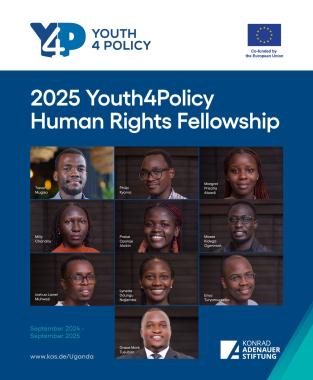
Alternative Policy Options for Uganda's Approach to Human Rights

Youth4Policy in Human Rights

Alternative Policy Options for Uganda's Approach to Human Rights is a collection of policy alternatives by fellows from the concluded Youth4Policy in Human Rights Fellowship. These young professionals have delved into several areas of human rights and political representation, offering fresh perspectives. Their contributions are a response to the pressing human rights issues of our time, from the representation of the most vulnerable communities to the digital sphere. The Youth4Policy Fellowship is a vital component of the concluding Human Rights Our Concern! Project, a laudable initiative co-funded by the European Union and the German Federal Ministry for Economic Cooperation and Development (BMZ). The project aims at strengthening evidence-based advocacy for the protection and promotion of Human rights and freedoms in Uganda.

Youth4Ppolicy-Migration Final Call for Applications

The Youth4Policy (Y4P) Fellowship is an initiative of the Konrad-Adenauer-Stiftung (KAS) Uganda and South Sudan aimed at empowering a new generation of Ugandan policy thinkers and researchers. It provides a unique opportunity for young professionals to engage in migration-related policy research, informed dialogue, and evidence-based advocacy. Since 2022, the Y4P Migration Fellowship has specifically focused on Uganda’s migration dynamics, enabling fellows to explore critical issues such as forced displacement, emigration, and refugee protection. This 2025 fellowship marks the final migration-themed intake under this programme. Y4P equips fellows with rigorous policy analysis tools and exposes them to real-world policy processes through interaction with migrants, fieldwork, stakeholder engagement, and academic training. Previous fellows have successfully transitioned into careers in public service, academia, international organizations, and civil society.

Examining Uganda's Migration Policy _ 2024

Youth-Led Policy Solutions for Uganda’s Migration Challenges and Opportunities

This publication presents a collection of 16 policy papers authored by the 2024 cohort of Youth4Policy Migration Fellows, with guidance from experienced mentors and researchers. It offers a timely and in-depth examination of Uganda’s evolving migration landscape, addressing both internal and cross-border migration issues. The papers explore diverse themes including the medical brain drain, protection of migrant workers, diaspora engagement, border management, human trafficking via social media, youth emigration, and the impact of regional migration policies. Each paper provides context-specific insights, identifies critical policy gaps, and proposes actionable policy recommendations aimed at strengthening migration governance in Uganda. The publication amplifies the voices of young policy thinkers and aims to inform decision-makers, civil society actors, and development partners seeking to create more inclusive, rights-based, and development-oriented migration frameworks in Uganda and beyond.

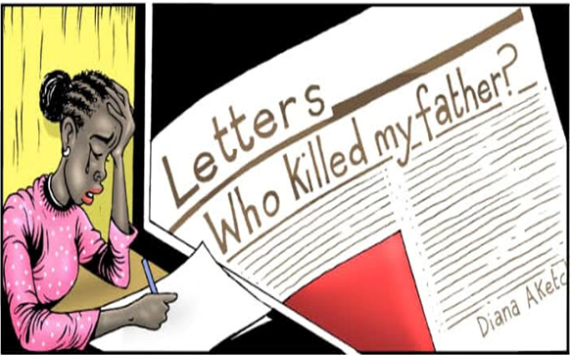
Odyssey of Courage

Nyakueth's Migration Story

Dear Reader, The Republic of South Sudan and a significant part of Northern Uganda share a long and tumultuous history of violence. The two regions have borne the brunt of decades-long armed conflicts that have left thousands of the inhabitants displaced. Although the neighbouring governments have brokered peace deals with dissidents, they have also at times supported guerrilla movements fighting against each other. During Sudan’s first civil war, approximately 74,000 Southern Sudanese are reported to have sought refuge in Uganda. Due to the presence of shared communities across the border, some refugees moved in with their families across the border in Uganda. More moved further south into Buganda where they took up jobs as casual labourers. The wealthy few were integrated into the suburbs where they enjoyed similar privileges and success in Uganda’s economy as the elite in their newfound home. Those who didn’t have any family members or relatives in Uganda were subjected to exploitation and discrimination. They were also drawn into the ethnic conflicts that have been ongoing in their home nations. Even when the UNHCR has made numerous efforts to repatriate willing Southern Sudanese refugees over the years, some have chosen to remain in Uganda. In 1975, refugees from Northern Uganda sought refuge in Southern Sudan. Whereas some Ugandans joined their relatives and friends across the border in Sudan, the rest took up official refuge in the UNHCR resettlement camps. Due to ongoing armed conflicts in South Sudan, Uganda has maintained an open-door policy. Although there are some limitations to this policy, it offers significant opportunities such as free education up to the university level for some individuals, the ability to work, engage in subsistence farming, and voluntary repatriation. This fictional comic book narrates the story of Diana Nakyueth, a South Sudanese refugee who fled to Uganda with her two sons during the violence that took place in 2016. When she arrived in Kiryandongo with her two sons, Nakyueth worked as a nurse in the settlement’s health centre. Uganda hosts an estimated 1,578,669 refugees, more than half of whom (56.5%) are South Sudanese. Nakyueth’s story highlights the potential of Uganda’s open-door refugee policy to facilitate a dignified migration for people facing one of the most dehumanizing realities of life.

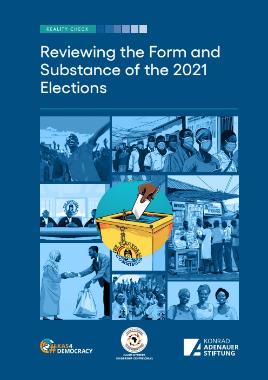
Reviewing the Form and Substance of the 2021 Elections

Foreword Reviewing the Form and Substance of the 2021 Elections is a compilation of articles that examine the legal, social, political, cultural and historical setting of the Ugandan General Elections that were held in January 2021. The idea to this book was born in February of the same year. The country had just come out of the elections that were defined by a strong military presence in the streets, violence, repressive measures on the civil society, an internet blackout and a worldwide pandemic. Anxiety was still felt in the air. The work on the book should provide the first opportunity for an in-depth analysis of the elections, while most just wanted to move on with their normal life offside the political fighting. Ultimately, life was continuing – with old powers in charge and new emerged forces that have set out to challenge the status quo. Continuation and change, traditional actors and newcomers, old playbook strategies and new tactics have awakened hope and equally caused disillusion among one of the youngest and fastest growing populations in the world. The book takes the reader back to the events of that period and provides essential context for the Ugandan and international public to understand the nature and the evolvement of Ugandan elections. With eight contributions by different authors, the publishers of this book have tried to offer a comprehensive depiction of key areas defining that election – among them the COVID-19 pandemic, the monetization of the elections as well as the role of social media in the electoral campaigns and reporting. It investigates the role of institutional stakeholders, legally responsible for the organization and implementation of the elections such as the Electoral Commission, and those that have emerged as key stakeholders in its conduct such as the military. It touches upon the democratic expectations towards the elections and depicts its realities. Lastly, it pays attention to various social groups – their own interests and actions as well as their conceptualization and instrumentalization by competing political forces. With this book, we are contributing to a body of knowledge on Ugandan elections – discussing their uniqueness but also allowing for comparative analysis with other elections worldwide. Some of the authors critically question to which extent the mere holding of regular elections, despite failures in form and substance, is sufficient to legitimize the winners and the political system as democratic. As such, the book also serves as a summary of experiences and lessons learned for the future. As the Konrad-Adenauer-Stiftung, we are committed to our mission “Shaping. Democracy. Together”. We thank the Julius Nyerere Leadership Centre (JNLC) for the cooperation on this book. We are grateful for the restless personal commitment of Dr. Nansozi K. Muwanga to the success of this project. We hope this will be an interesting, insightful and valuable resource for any interested citizen – be it in their professional and/or individual capacity. We thank all authors for their interest and willingness to bring our idea to life. Anna Reismann Country Representative Konrad-Adenauer-Stiftung Uganda and South Sudan

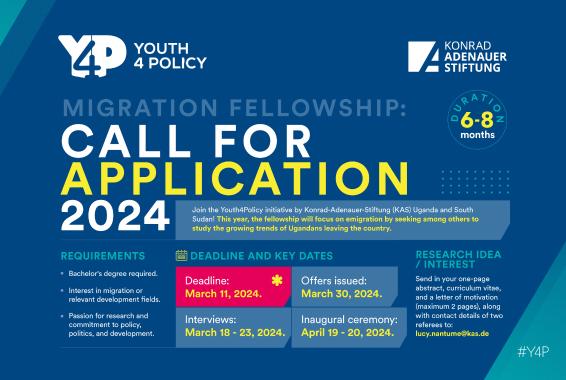
Call for Applications 2024

Youth4Policy Migration Fellowship - Second Cohort!

The Y4P Migration Fellows will have an unparalleled opportunity to spend six to eight months gaining both academic and field experience working in the niche area of migration and being part of a community to build an inclusive and responsive pro-youth policy landscape. Besides interacting with migrants and learning from their experiences, the fellows will have the chance to access key stakeholders and experts in the field of migration. Throughout the Programme, the fellows will be trained in key public policy topics as well. Ultimately, the fellows shall be equipped with relevant tools to enable them undertake research, write policy papers, and contribute to ongoing advocacy and policy-making efforts. Fellows will also have exposure to the workings of KAS’ key partners and collaborators, which includes international agencies, state agencies and Civil Society Organizations. Moreover, the Y4P Migration Fellowship can be used as a springboard towards a wide range of academic and professional opportunities in the future. Y4P and KAS alumni have gone on to pursue careers in the development sector, academia, public service as well as private sectors.

Migration Project Newsletter - Issue 02

In our second edition of the KAS Migration Project Newsletter, we reflect on the strides made since February 2022 in addressing migration and forced displacement in Uganda and South Sudan. This initiative aims to understand and mitigate the various factors driving cross-border and internal movements.

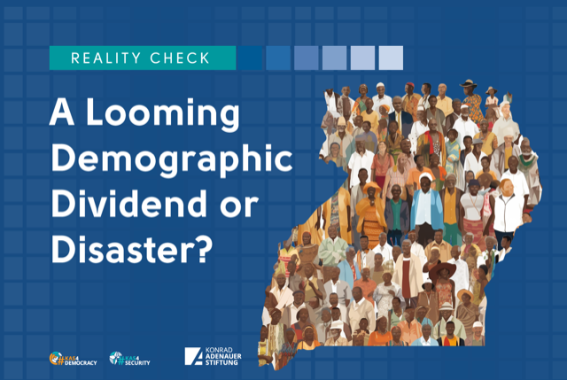
Reality Check Series on Demography - 'A Looming Demographic Dividend or Disaster?'

We are delighted to present our latest thought-provoking analysis, delving into the rapidly changing population and age structure of Uganda, titled 'A Looming Demographic Dividend or Disaster?', this series engages in critical dialogues surrounding the profound implications of Uganda's evolving demographic landscape with propositions of a possible demographic dividend that have featured prominently, especially in the public sector circles.

Asset-Herausgeber

Länderberichte

Politische Kurzberichte der KAS-Auslandsbüros

Die Konrad-Adenauer-Stiftung ist in rund 110 Ländern auf fünf Kontinenten mit einem eigenen Büro vertreten. Die Auslandsmitarbeiter vor Ort können aus erster Hand über aktuelle Ereignisse und langfristige Entwicklungen in ihrem Einsatzland berichten. In den "Länderberichten" bieten sie den Nutzern der Webseite der Konrad-Adenauer-Stiftung exklusiv Analysen, Hintergrundinformationen und Einschätzungen.

Veranstaltungsberichte

Die Konrad-Adenauer-Stiftung, ihre Bildungsforen und Auslandsbüros bieten jährlich mehrere tausend Veranstaltungen zu wechselnden Themen an. Über ausgewählte Konferenzen, Events, Symposien etc. berichten wir aktuell und exklusiv für Sie unter www.kas.de. Hier finden Sie neben einer inhaltlichen Zusammenfassung auch Zusatzmaterialien wie Bilder, Redemanuskripte, Videos oder Audiomitschnitte.

ARISE

A Women’s Development Magazine

ARISE magazine features varying issues around women and development in Uganda. Whether women wearing uniform, working as farmers, or holding political offices: We review the trends and challenges women face in Uganda. The magazine has been published in cooperation with Action for Development since 1990.

Reality Check

Die Serie analysiert politische, soziale und wirtschaftliche Themen der politischen Tagesordnung Ugandas und unterzieht sie einer kritischen Untersuchung. Reality Check wird in Kooperation mit dem Centre for Development Alternatives veröffentlicht.

Economic Policy Paper Series

Wir stellen die Wirtschaftspolitik Ugandas auf den Prüfstand: Wie gestaltet sich wirtschaftlicher Fortschritt im Land? Welche Hindernisse stehen ihm im Weg? Welche Wirtschaftszweige haben das Potential, zum notwendigen wirtschaftlichen Strukturwandel im Land beizutragen und Arbeitsplätze zu schaffen? Und welche Aufgabe kommen dabei dem Privatsektor und dem Staat zu? Die Economic Policy Paper Series wird in Kooperation mit dem Centre for Development Alternatives veröffentlicht.

Asset-Herausgeber