




Details
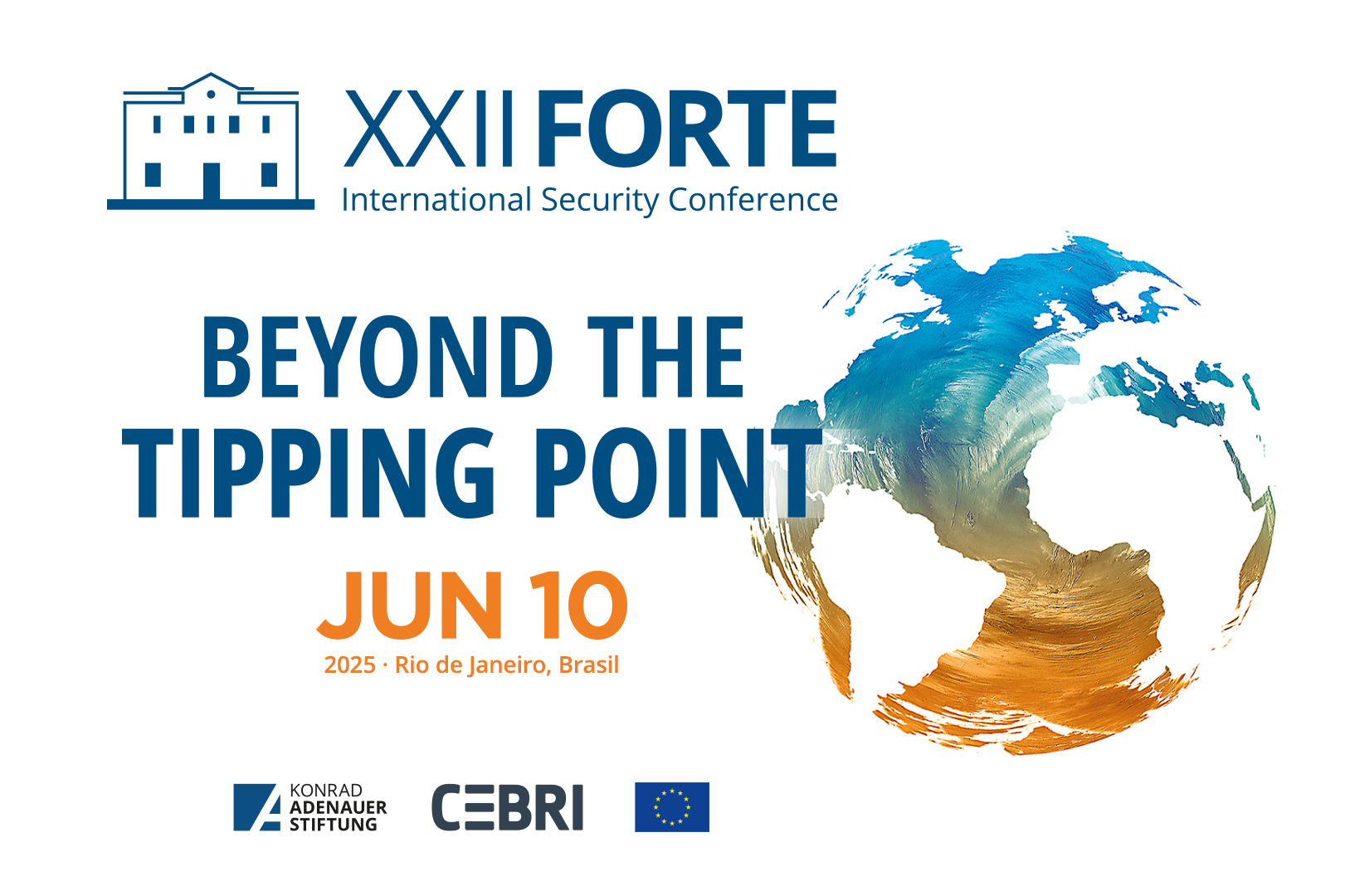
In 2024, the world reached a critical milestone: for the first time, the global average temperature surpassed 1.5°C above pre-industrial levels, exceeding the threshold set by the Paris Agreement. This turning point not only underscores the urgency of the climate crisis but also signals deeper geopolitical and security ramifications. As climate-related disruptions intensify, the international system faces multiple tipping points—not only in the environmental sphere but also in the stability of multilateral institutions, global governance, and security frameworks.
The XXII Forte International Security Conference has a distinct mission: to illuminate the pressing security challenges of a rapidly changing world. Anchored in the broader shifts reshaping the international order, the conference emphasizes Europe and Latin America as pivotal regions in this discourse. In alignment with COP30, the event will highlight the intersection of climate action, multilateral cooperation, and security, reinforcing the role of these platforms in fostering resilience and stability amid global uncertainties.
The nexus between climate change and international security is now at the forefront of strategic discussions. Climate change is not merely an environmental issue but a threat multiplier, aggravating conflicts, straining resources and testing the resilience of institutions designed to foster stability. Simultaneously, the world is witnessing an inflection point in multilateralism for security and defence, as rising nationalism, economic uncertainties, and shifting power dynamics challenge the effectiveness of collective responses to global threats. In this complex landscape, an integrated approach to security, climate action, and governance is imperative.
This evolving climate-security nexus calls for critical thinking and collaborative action to mitigate its impacts on populations, governments, and institutions worldwide. In an era of shifting strategic alliances and rising uncertainty, what role should Latin America and the European Union play in addressing these challenges? The resurgence of nationalism – driven by economic recession, protectionism, and the erosion of democratic values – poses a fundamental question: Can global cooperation be strengthened to ensure stability and mitigate emerging threats?
As Latin America’s largest international security forum, the Forte International Security Conference has, for over two decades, facilitated critical discussions on shared security concerns in partnership with Europe. This year, it expands its scope, fostering a dialogue that transcends regional boundaries and seeks common solutions to navigate the evolving international security landscape.
Agenda
08:00 | Registration
09:00 – 09:30 | Opening remarks
09:35 – 10:50 | Keynote speeches panel:
Climate meets security: threat multiplier and global issue?
- Given the intensifying impacts of climate change, how can governments and international institutions integrate security and climate action to prevent conflicts and ensure global stability?
- In a context of rising geopolitical tensions and economic challenges, is it possible to strengthen multilateralism to collectively address climate threats and their repercussions on global security?
- What are the main political and institutional barriers to turning climate commitments into concrete and effective action, and how can the international community overcome them?
Antonio Patriota, Brazil’s Former Minister of Foreign Affairs, Ambassador of Brazil to the United Kingdom and Member of CEBRI’s International Advisory Board, Brazil
Brian Glynn, Managing Director for the Americas in the European External Action Service, Belgium
Roland Theis, Member of the German Bundestag, Germany
Moderation: Danielle Ayres, Director of Information Security at Institutional Security Office of the Presidency of the Republic, Brazil
10:55 – 11:15 | Flash Talk 1 (20 min full speech)
Quando a multipolaridade pode ser estável?
When might multipolarity be stable?
Speaker: Matias Spektor, Full Professor at the School of International Relations at Getulio Vargas Foundation and Senior Fellow at CEBRI, Brazil
11:20 – 12:25 | Panel 1
Multilateral aspects of climate change: challenges to COP30
- How can major multilateral agreements, such as the Paris Agreement, strengthen international cooperation to mitigate the impacts of climate change on global security?
- What are the challenges to effectively implementing climate commitments made by countries and regional blocs, and how can political and economic barriers be overcome?
- How do the rise of new global powers and the reshaping of the international order influence the future of multilateralism in climate governance?
María Isabel Ortiz Mantilla, State Representative and Chair of the Environmental Commission of the Congress of the Mexican State of Guanajuato, Mexico
Emmanuella Doussis, Professor of international institutions at the National and Kapodistrian University of Athens, UNESCO Chairholder on Climate Diplomacy, Greece
Izabella Teixeira, Former Brazilian Minister of Environment and Member of CEBRI’s International Advisory Board, Brazil
Moderation: Marianna Albuquerque, Professor at the Institute of International Relations and Defense, Federal University of Rio de Janeiro (IRID-UFRJ) and Senior Fellow at CEBRI, Brazil
12:30 – 14:15 | Lunch break
14:20 – 14:40 | Flash Talk 2 (20 min full speech)
Climate change as global threat in local conflicts
Speaker: Nisreen Elsaim, Fellow at Robert Bosch Academy, Germany/Sudan
14:45 – 15:50 | Panel 2
Crime transnacional, segurança e impactos ambientais: uma interseção complexa
Transnational crime, security and environmental impacts: a complex interplay
- How can international cooperation actions track and combat the financing of transnational crimes that have environmental impacts?
- How do transnational criminal activities, such as human trafficking, arms smuggling, and the illicit trade of natural resources undermine the national efforts against climate change?
- How can the interplay between security, the environment, and organized crime be integrated into public policies to mitigate risks and enhance global governance?
Nancy Patrícia Gutíerrez, Former Minister of Interior of Colombia
Maria Rosa Sabbatelli, Head of Unit for Global and Transregional Threats and Challenges at the Service for Foreign Policy Instruments (FPI) within the European Commission, Belgium
Robert Muggah, Specialist in security, cities, climate action, and digital transformation, and co-founder of the Igarapé Institute, Brazil
Moderation: Marcelo Della Nina, Head of the General Coordination for Combating Transnational Illicit Activities at the Brazilian Ministry of Foreign Affairs, Brazil
15:50 – 16:20 | Coffee break
16:25 – 17:30 | Panel 3
The new geopolitics of energy: resources, security and power
- How do the energy transition and competition for natural resources impact international relations and global security in the 21st century?
- What role do new technologies and renewable energy sources play in redefining geopolitics and reducing international tensions?
- How can cooperation between Europe and Latin America in the exploration of critical minerals advance the development of the defense industry, with mutual benefits in technological development?
Horacio Werner, Executive Director at Agenda Antartica, Argentina
Elena Lazarou, Fellow at Chatham House and Senior Fellow at ELIAMEP, Belgium
Rafaela Guedes, Member of a panel of experts on Energy Transition at the Institute for Climate and Society (iCS) and Senior Fellow at CEBRI, Brazil
Moderation: Hussein Kalout, Former Special Secretary for Strategic Affairs of Brazil, Member of CEBRI’s International Advisory Board, Brazil
17:35 – 17:40 | Closing remarks


Topics
Partners