








Summary
-
Russland intensiviert derzeit seine Angriffe auf die Ukraine weiter. Die Zahl der eingesetzten Marschflugkörper und ballistischen Raketen hat sich im Februar mehr als verdoppelt auf 290 (Januar: 137). Neben dem Energiesektor zielen die Angriffe zunehmend auf die Eisenbahn-Infrastruktur und die Wasserversorgung.
-
Russia is further intensifying its attacks on Ukraine. The number of cruise missiles and ballistic missiles used more than doubled in February to 290 (January: 137). In addition to the energy sector, the attacks are increasingly targeting railway infrastructure and water supply systems.
- Since 2022, the Russian army has carried out 5,796 attacks on the Ukrainian power grid, killing 247 energy engineers and deliberately targeting infrastructure more than 900 times. The cost of reconstruction by 2035 is estimated at 588 billion US dollars, including 90.6 billion US dollars for the energy sector, with an immediate need of 4.9 billion US dollars in 2026.
- In February, the Russian Air Force attacked civilian targets with 5,059 long-range drones, equivalent to 181 drones per night – an increase of 27% compared with the previous month. In addition, there were 118 attacks with ballistic missiles and 172 with cruise missiles. The hypersonic Zircon missile (SS-N-33) was used regularly for the first time in February.
- The interception rate for drones improved to 87% (previous month: 83%). The rate for cruise missiles remained almost unchanged (64%), while it declined significantly for ballistic missiles (from 40% to 30%). In total, 780 aerial weapons (including 658 drones) were not intercepted (previous month: 820, including 750 drones).
- Russia will produce around 960 ballistic missiles and similar types in 2026 (Kinzhal, Zircon and Iskander-M). Additional interceptor missiles for Patriot systems are therefore needed more urgently than ever. Demand for these in other wars such as the Iran war further restricts deliveries to Ukraine. Destroying Russian production facilities with Deep Precision Strikes will be decisive for the course of the air war.
- In a cyber operation, Ukraine hacked the accounts of Russian military personnel and monitored drone control systems for six months. The resulting data on attack planning and flight routes improved Ukrainian air defence and enabled attacks on Russian drone command sites as well as the elite Rubikon unit.
- Satellite communication is gaining increasing strategic importance. Ukraine has entered into new European cooperation arrangements for reconnaissance in this area. The Starlink blockade against the Russian army significantly restricts its offensive capabilities. The effectiveness of Russian drone attacks near the front has declined by 20–40% as a result. Russia will not find an adequate replacement for access to Starlink in the next three to five years.
Situation in February 2026.
Russia further expanded its air war against Ukraine in February, deploying not only more long-range drones but above all significantly more cruise missiles and ballistic missiles. The energy system remains the primary focus of attacks; however, the Russian army is increasingly also targeting transport routes such as railway lines to disrupt the supply of Ukrainian forces at the front.
During the four years since the start of the full-scale invasion, Russia has killed at least 247 people working at power plants during 5,796 attacks on Ukraine’s electricity grid. Substations operated by the state grid operator Ukrenerho have been attacked more than 900 times (⬈ Dixigroup, 3.3.2026).
Reconstruction will cost hundreds of billions of US dollars
According to an assessment of losses in Ukraine between 24 February 2022 and 31 December 2025 prepared jointly by the Ukrainian Ministry of Development and the World Bank, total reconstruction needs over the next ten years amount to 588 billion US dollars.
The need for the restoration and modernization of the energy sector is estimated at 90.6 billion US dollars (+34% compared with the previous report from February 2025), including 71 billion US dollars for the electricity sector, 6.4 billion US dollars for the heating sector, 5.2 billion US dollars for gas infrastructure, and 4.6 billion US dollars for the oil sector. According to the report, the immediate need for 2026 amounts to 4.9 billion US dollars
Drone attacks rise again
A total of 5,059 long-range drones were counted in February (January: 4,442). As before, around 63% are of the Shahed type; the rest are largely Gerbera-type decoy drones. On average, this corresponds to 181 drones per night – an increase of 27% compared with the previous month (143 drones).
However, the Russian army still appears unable to carry out long-range drone attacks with the same intensity as in summer 2025, when more than 6,000 drones were used in July, for example – presumably because Ukrainian air strikes on supplier companies in Russia continue to disrupt production (⬈ Monitor Vol. XII).
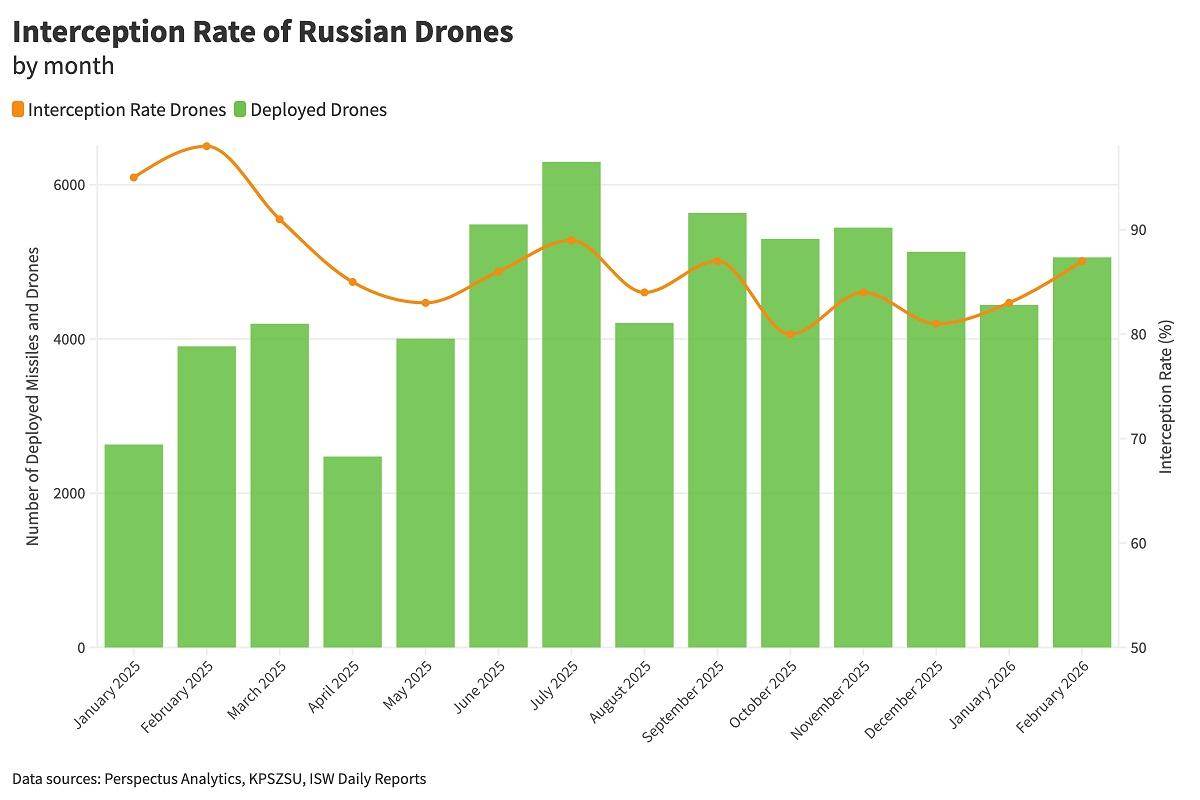 Perspectus Analytics, Повітряні Сили Збройних Сил України, ISW
The pattern of drone attacks has hardly changed since September 2025. On around 20 nights per month, Russia attacks Ukraine with more than 100 drones, and on about five nights with more than 200. This year, there have so far been fewer highly intensive attack waves with more than 400 drones per night than in autumn 2025 – presumably because the high number of deployed drones did not lead to greater success in overcoming Ukrainian air defence (see interception rate below).
The deployment pattern for missile attacks has also remained unchanged since autumn 2025, with four to six medium-sized and large attack waves involving more than 25 missiles per night – although the number of missiles used increased significantly in February.
Improved interception rates in drone attacks
Although significantly more long-range drones were deployed in February than in the previous month, fewer reached their targets: in February, 658 drones were not intercepted (January: 751). This is due to the improved interception rate, which averaged 87% in February (previous month: 83%), but still varies widely depending on the operational profile and regional focus of the attacks (between 72% and 94%). In the four attack nights in February when around 400 drones were used, the interception rate never fell below 89%. This shows that Ukraine is able to maintain effective air defence even under high operational pressure.
Ukrainian interceptor drones account for a significant share of this success and are now responsible for around one third of intercepted drones (⬈ Business Insider, 24.2.2026). These defence systems have been increasingly deployed since the end of 2025 and have contributed significantly to stabilizing drone air defence (⬈ Monitor Vol. XI).
At the same time, Russia continues to expand its drone attack capabilities. Satellite imagery shows the opening of new launch sites for Shahed drones, for example at the Shatalovo air base in Smolensk region and in Millerovo in Rostov region (⬈ Militarnyi, 4.2.2026). Recently, Russia has equipped Shahed drones with mines and cluster munitions, which have caused significant destruction of civilian and energy infrastructure.
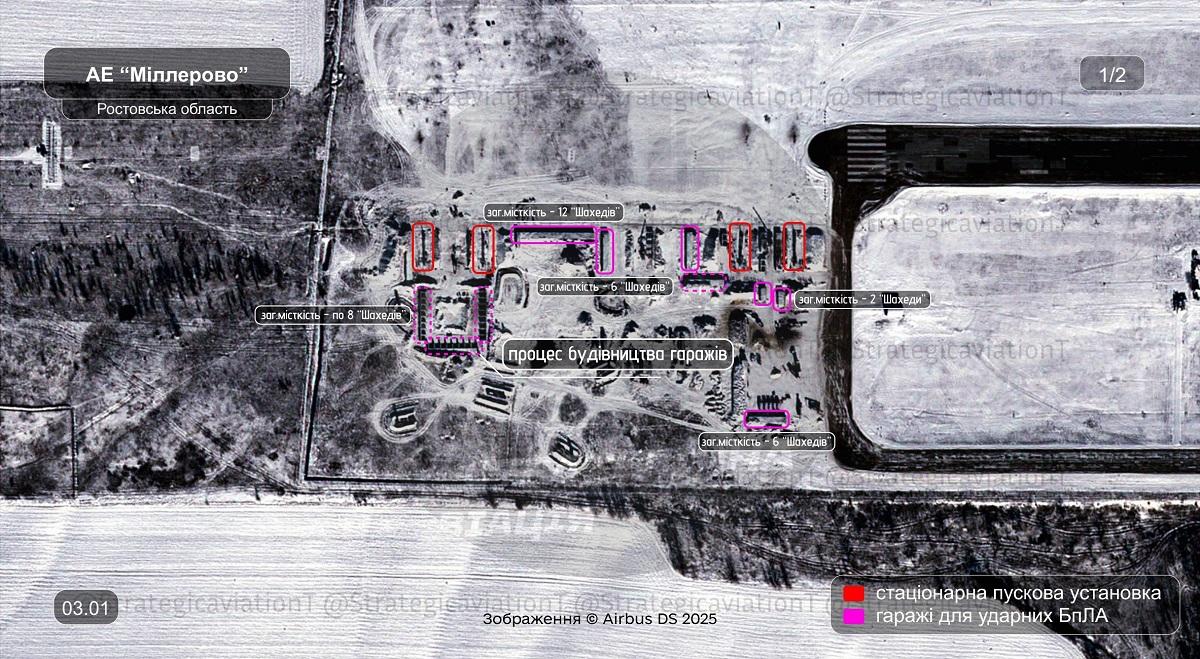 StrategicaviationT, 4.2.2026
Ukrainian President Volodymyr Zelenskyy warned that Russia will shift its attacks more strongly toward logistics and water infrastructure in spring 2026, after primarily targeting the Ukrainian power grid during the winter (⬈ Ukrinform, 2.3.2026). Attacks on railway lines had already increased in 2025 (⬈ Monitor Vol. VIII, Monitor Vol. XII). Ukraine continues to rely on extensive international support for its air defence (⬈ Monitor Vol. XII).
Sharp increase in missile attacks
It is notable that the number of ballistic and cruise missiles used more than doubled: from 137 in January to 290 in February. Only in 2024 were similar numbers of attacks with these weapons recorded per month, which have significantly greater destructive power than drones.
The interception rate for missiles varies greatly depending on type and deployment location – with weather also playing a role. It can restrict the deployment of F-16 and Mirage fighter aircraft used to intercept cruise missiles (⬈ RBC, 8.2.2026).
The interception rate for cruise missiles increased slightly from 62% in January to 64% in February. In total, 780 attacks were not intercepted in February, including 658 drones (January: 820 attacks not intercepted, including 750 drones).
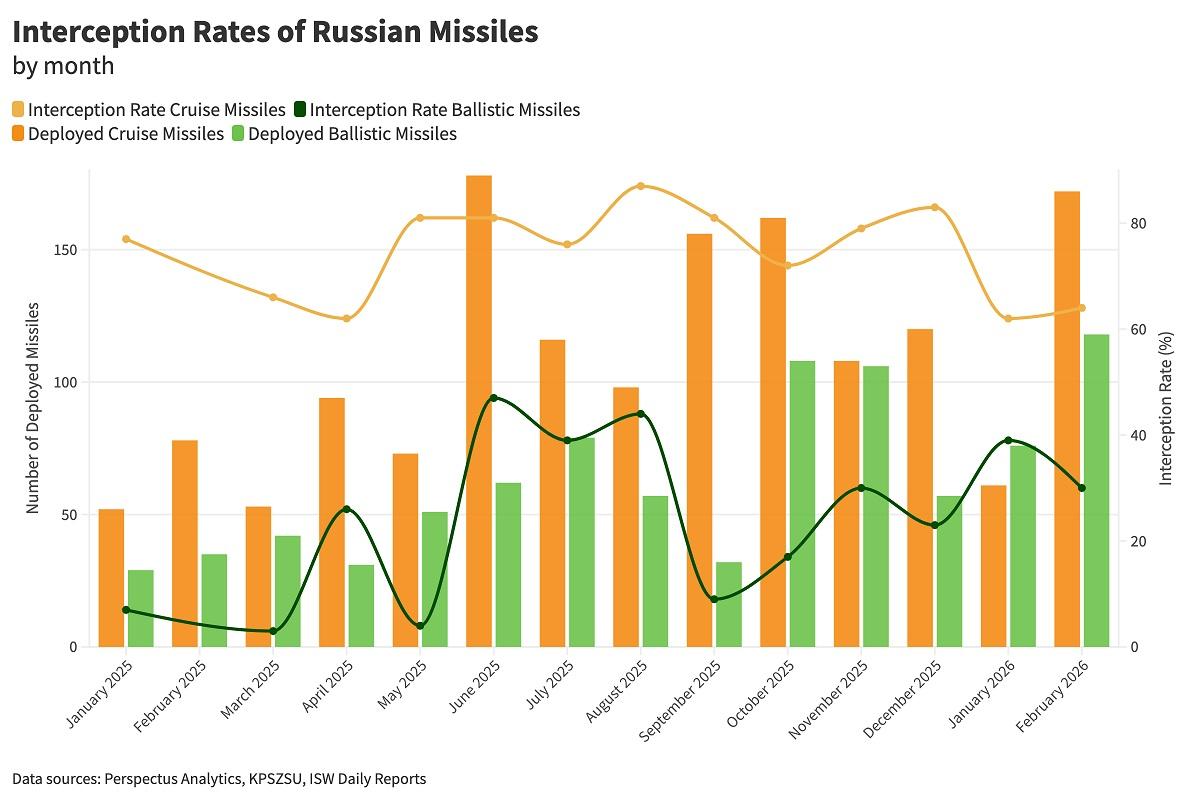 Perspectus Analytics, Повітряні Сили Збройних Сил України, ISW
The number of cruise missiles used increased from 61 in January to 172 in February. Since the monthly average in 2025 was 110, it can be assumed that the Russian army held back cruise missiles in January and used them in February in addition to newly produced ones.
The number of ballistic missiles used increased from 76 in January to 118 in February (monthly average in 2025: 58). It is assumed that Russia still maintains a large stockpile of various aerial weapons – particularly ballistic missiles (⬈ Monitor Vol. VIII).
Since January 2026, Russia has been regularly using the Zircon hypersonic missile (NATO code: SS-N-33). In February, the number of deployments doubled. Russia had repeatedly announced the missile type in recent years but had hardly used it until the end of 2025. Zircon, like some other cruise missiles used in Ukraine, was designed as an anti-ship weapon against large targets such as aircraft carriers and destroyers. The missile accelerates like a ballistic missile and then approaches the target like a cruise missile at hypersonic speed.
Almost 1,000 ballistic missiles per year
Procurement data from the Russian Ministry of Defence over the past two years aimed at annual production of around 880 ballistic missiles or similar systems (Kinzhal, Zircon and Iskander-M) (⬈ Monitor Vol. X).
Russia’s current production rate is estimated at 60 Iskander-M missiles and ten Kinzhal and Zircon missiles each per month. Extrapolated, this would amount to around 960 produced missiles per year (⬈ ISW, 24.2.2026), which either follow a ballistic trajectory or travel at hypersonic speed (over Mach 5) and have a range of more than 350 km.
Together with cruise missile stocks, this would amount to more than 2,000 attack weapons of various types – with a range of more than 300 km and a destructive power ten times greater than that of Shahed drones.
Expansion of the air war
Since January, Russia has again increasingly used S-300 and S-400 missiles with quasi-ballistic trajectories for attacks on ground targets (⬈ Monitor Vol. XIII). Military expert Gustav Gressel warns that Moscow may temporarily suspend larger ground offensives to conserve personnel reserves and instead expand air strikes (⬈ Ukraine-Analysen, 24.2.2026).
Russia is searching for weaknesses in air defence and puts Ukraine under massive pressure through concentrated attack waves against individual points. In doing so, Ukrainian air defence positions themselves are often at risk of being destroyed and must be protected. This leads to additional shortages in other locations (⬈ RBC, 2.2.2026).
Ukrainian air defence effective
Nevertheless, Ukrainian air defence is more successful than images of destroyed houses might suggest. Since 2022, air defence has been deployed around 26,800 times. It has intercepted around 45,000 Shahed-type drones as well as 92,000 other drones, and slightly fewer than 4,000 missiles and cruise missiles, including 274 Iskander-M missiles and 86 Kinzhal missiles. Even new Zircon missiles have been shot down (⬈ KpsZSU, 24.2.2026).
At the end of February, the new Ukrainian Minister of Defence Mykhailo Fedorov announced plans to particularly work on improving air defence. A new electronic evaluation system (After Action Review, AAR) will analyse night attacks more effectively. It systematically evaluates not only flight paths, launch locations, and the positions of interceptor systems. This AAR is intended to evaluate the effectiveness and success of various defence components and decision-making processes and to accelerate technical adaptation processes (⬈ Suspilne, 27.2.2026).
Iran war increases shortages of air defence ammunition
However, even the best analysis is of little use if air defence does not have enough interceptor missiles. A chronic ammunition shortage for Patriot air defence systems, whose production is severely limited worldwide, significantly restricts operational capability. The consequences are measurable: in February, the interception rate for ballistic missiles fell in some cases to below 30% (January: 40%).
The war between the United States and Iran further aggravates this bottleneck and demonstrates how heavily modern conflicts strain air defence stockpiles. The Center for Strategic and International Studies (CSIS) warns in a recent study that the United States had already expended significant quantities of missile defense interceptors in 2025, including during the Israel–Iran conflict and during operations against Houthi attacks in the Red Sea.
Although the U.S. Army has increased its long-term procurement objectives for Patriot PAC-3 interceptors, inventory planning and industrial incentives must be better aligned to enable new production lines, more stable budgets, and larger stockpiles (⬈ CSIS, 5.12.2025). If these shortages are not resolved in the medium term, a strategic dilemma could emerge that may limit US engagement in some regions of the world.
Comparative calculations in the Monitor repeatedly show that current Western production capacities are insufficient to provide enough defensive systems to counter Russia’s annual production of ballistic missiles alone. According to an analysis by missile expert Fabian Hoffmann, European NATO states would at best have 400–500 Patriot interceptor missiles and a maximum of 100 Aster-30 interceptor missiles (SAMP/T system) available annually. Considering that two interceptor missiles are generally required for each ballistic missile attack, this would allow only up to 300 ballistic missiles to be intercepted per year (⬈ Monitor Vol. VIII).
Deliveries to Ukraine are insufficient
The scope for further deliveries of key air defence ammunition to Ukraine is therefore becoming increasingly limited. The latest announcement of a delivery from Germany included only five Patriot interceptor missiles and was linked to the condition that other countries provide an additional 30 missiles of this type from their own stocks (⬈ Table.Briefings, 12.2.2026). This amount of ammunition is only sufficient to repel a single medium-sized nightly Russian air attack with ballistic missiles.
The initiative by the Ukrainian president to offer expertise in air defence to Gulf states threatened by Iran in exchange for interceptor missiles illustrates how scarce defence resources have become.
The United States and Israel are attacking Iranian drone and missile facilities to reduce the pressure on their own interceptor systems. Ukraine, however, is being denied similar means – such as Tomahawk missiles.
Deep Precision Strikes even more important in 2026
In 2026, the capabilities for Deep Precision Strikes (DPS) – precise attacks on targets deep within enemy territory – will become even more decisive for relieving pressure on Ukraine’s air defence. With even small deliveries of Tomahawk missiles from the United States, the Ukrainian army could attack missile and drone facilities in Russia much more effectively and disrupt important supply chains. The Institute for the Study of War (ISW) names the Shahed drone production facility in the Alabuga Special Economic Zone (Republic of Tatarstan) and the machine-building plant in Votkinsk (Republic of Udmurtia) as key targets (⬈ ISW, 3.3.2026). Deliveries of European cruise missiles such as Taurus or Storm Shadow would also provide additional capability gains (⬈ Monitor Vol. XI).
On the night of 20-21 February 2026, Ukraine reportedly attacked Russian targets with domestically produced FP-5 (“Flamingo”) cruise missiles; at least one appears to have struck the Votkinsk Machine Building Plant. Missile expert Fabian Hoffmann notes that even successful strikes on large industrial facilities are unlikely to cause lasting disruption without repeated attacks and therefore stresses the importance of strengthening Ukraine’s deep-strike capabilities. He also argues that insufficient Western support in this area constitutes a major policy failure. According to Hoffmann, it remains unclear whether recent modifications to the FP-5 have improved its accuracy enough to reliably hit intended targets deep inside Russia. (⬈ Missile Matters, 25.2.2026).
Improved air defence intelligence through cyber operation
In February, Ukraine imposed sanctions on Belarusian ruler Alexander Lukashenko for supporting Russian attacks. In 2025, Russia stationed a system for remote control of combat drones on the territory of Belarus, facilitating attacks on northeastern Ukraine, particularly against energy and railway infrastructure (⬈ Monitor Vol. XII).
The sanctions were based on findings from a cyber operation conducted by the Ukrainian cyber analysis center Fenix in cooperation with the hacker group InformNapalm. Accounts of Russian military personnel and drone pilots were hacked, and their drone control systems were monitored for six months. The resulting data significantly improved intelligence on drone routes and thus Ukrainian air defence (⬈ InformNapalm, 20.2.2026).
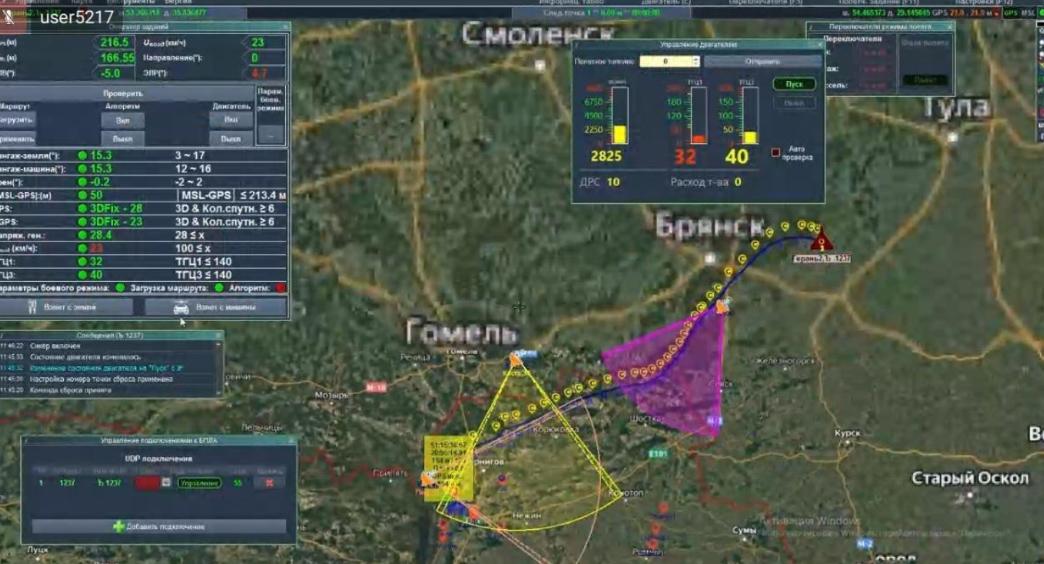 ⬈ InformNapalm, 23.2.2026
As a result, the Ukrainian army was able to conduct targeted attacks on command posts and drone launch ramps in Russia, as well as against the Russian elite unit Rubikon, which develops combat, reconnaissance, and interceptor drones, and coordinates their deployment (⬈ Kyiv Post, 25.2.2026).
As early as autumn 2025, Ukraine had shared information from this operation with NATO partners. According to these findings, Russian drones that entered Polish airspace in September (⬈ Monitor Vol. IX) were used to test whether civilian mobile communications infrastructure in Belarus could be used to attack transport routes in Ukraine and Poland to cut Ukraine off from Western weapons deliveries (⬈ Polskie Radio, 23.2.2026).
Spotlight. Satellites as key infrastructure
The effects of restricted satellite communication
Efforts by Ukraine and the US space company SpaceX to deny Russian forces access to Starlink terminals continue to affect drone operations and the coordination of the Russian army. Russia used Starlink both for communication at the front and to extend the range of drones to strike targets deep in the Ukrainian hinterland or conduct Battlefield Air Interdiction (BAI) operations (⬈ Monitor Vol. XIII).
Russian Starlink terminals shut down
At the beginning of February, Starlink terminals operated by Russia were blocked, and Ukrainian users were comprehensively re-verified using a whitelist (⬈ Mychajlo Fedorow, 5.2.2026). It was discovered that Russian military personnel had repeatedly impersonated Ukrainian units or asked people with Ukrainian passports to register Starlink terminals.
Ukrainian hackers and the domestic intelligence service SBU subsequently collected information via Telegram channels and bots on 2,420 Russian Starlink users and blocked their access. Russian authorities reportedly then attempted to blackmail Ukrainian prisoners and pressure their relatives into registering terminals. Through this operation, the SBU also obtained detailed location data for numerous Russian units (⬈ Armyinform, 16.2.2026).
At the end of January, SpaceX had already integrated so-called Kill Switches into Starlink terminals to prevent them from being used for drone attacks. The system interrupts the connection as soon as it detects movement exceeding 75–90 km/h (⬈ DroneXL, 31.1.2026).
Blockade weakens Russian air attacks
Whether these adjustments will have a lasting effect will become clear in the coming months. Russian drone engineers have already attempted to adapt their drones to the speed limitation and expand the operational range of short-range drones even without Starlink. In February, Geran drones were converted into “motherships” to transport FPV drones deeper into the Ukrainian hinterland and extend their control signal. Without Starlink, however, these systems – mostly originating from China – are easier to jam (⬈ Monitor Vol. XIII).
The ISW observed that the Starlink blockade is preventing Russia from continuing tactical strikes and ground operations with the same intensity as before. Coordination among Russian troops was also immediately disrupted, as confirmed by Russian military bloggers (⬈ Serhii „Flash“ Beskrestnov, 5.2.2026). Ukrainian troops exploited this for counterattacks and territorial gains in the south (⬈ ISW, 23.2.2026).
According to a Ukrainian commander, the effectiveness of Russian drone attacks declined by 20–40% in February as a result of the Starlink outages. The Russian army may be able to establish replacement solutions within one to two months, but the same level of efficiency cannot be expected for three to five years (⬈ The Independent, 25.2.2026).
Moscow tests alternative satellite communication
Russia is attempting to expand its satellite communication capabilities and in mid-February demonstratively tested the stratospheric communication system Barrage-1 for the first time as a possible alternative to Starlink. However, the platform consisting of several balloons cannot replace a satellite-based network. The Ukrainian side suggested attacking the object, which floats at an altitude of between 20 and 30 km, with S-300 interceptor missiles (⬈ Dagens, 16.2.2026).
Another project to expand Russian satellite communication called Rassvet (English: Dawn) is experiencing delays. Originally, 16 high-speed internet satellites were to be launched into low Earth orbit by the end of 2025; this has now been postponed to 2026. Production delays are hindering the programme. So far, only six satellites are in orbit for testing laser links and 5G compatibility. Rassvet is unlikely to achieve the capabilities of Starlink. The Yamal satellite fleet operated by Gazprom Space Systems is also unable to assume military functions (⬈ TWZ, 18.2.2026).
Russia spies on satellite communications
According to the Financial Times, Russia is expanding its capabilities to spy on and potentially disrupt satellite communications, apparently in preparation for a possible confrontation with NATO. Russian satellites Luch-1 and Luch-2 are said to have intercepted communications from government and military satellites over Europe to prepare for future interference (⬈ FT, 4.2.2026).
Europe assumes responsibility
Ukraine is meanwhile intensifying its cooperation with European partners: France is now providing a significant share of intelligence that previously came predominantly from the United States (⬈ Reuters, 15.1.2026).
In addition, Ukraine is now working more closely with the Finnish satellite operator ICEYE, which provides continuous access to high-resolution SAR satellite imagery, combined with AI-supported geospatial analysis by the French space company Safran.AI. SAR images (Synthetic Aperture Radar) deliver image resolutions as fine as 16 cm and function independently of weather and time of day – an advantage over optical sensors, which are often limited in Ukraine by clouds or smoke (⬈ Aerotime, 19.1.2026, Militarnyi, 21.1.2026).
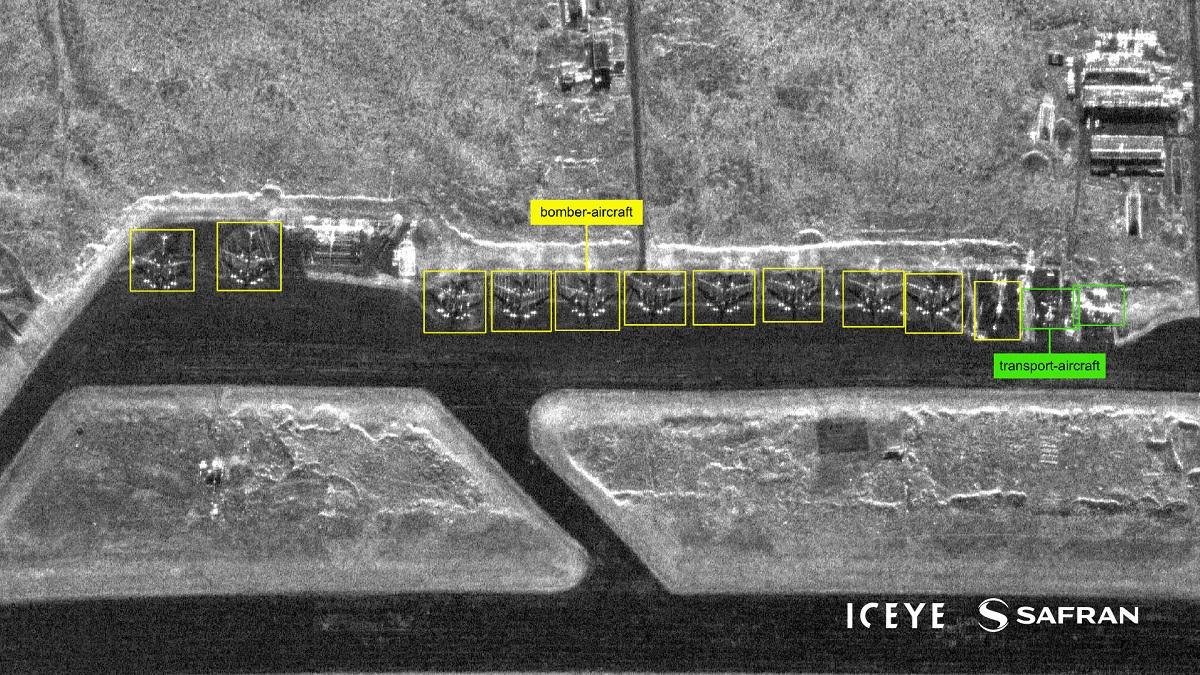 ICEYE/Safran.AI, 19.5.2025
The growing European involvement in satellite and intelligence reconnaissance illustrates a necessary shift: Europe is assuming an increasing share of responsibility for the defence of Ukraine and must become capable of defending itself – even without deterrence guarantees from the United States. The pressure to fill this gap has intensified further due to the war in Iran: American warfare is drawing away precisely those resources which Ukrainian air defence needs the most.
A study by the Insikt Group assumes that Putin will use the next two years – until the US presidential elections – to expand hybrid warfare (New Generation Warfare) against Europe to weaken political trust, undermine transatlantic unity, and shape the physical and psychological environment in Europe to his advantage, possibly in preparation for a later military escalation (⬈ Insikt Group, 24.2.2026).
The speed at which European countries expand their support for Ukraine and their own defence capabilities will be decisive in determining whether Russia can be effectively deterred in Europe and future wars prevented. As John Karlsrud, research professor in the Research Group for Peace, Conflict and Development at the Norwegian Institute of International Affairs (NUPI), emphasized at a Cafe Kyiv panel, consistent support for Ukraine is not only strategically necessary. It is also far less costly financially than the consequences of a partial Russian victory in Ukraine (⬈ Kyiv Dialogue, 26.2.2026).
Method
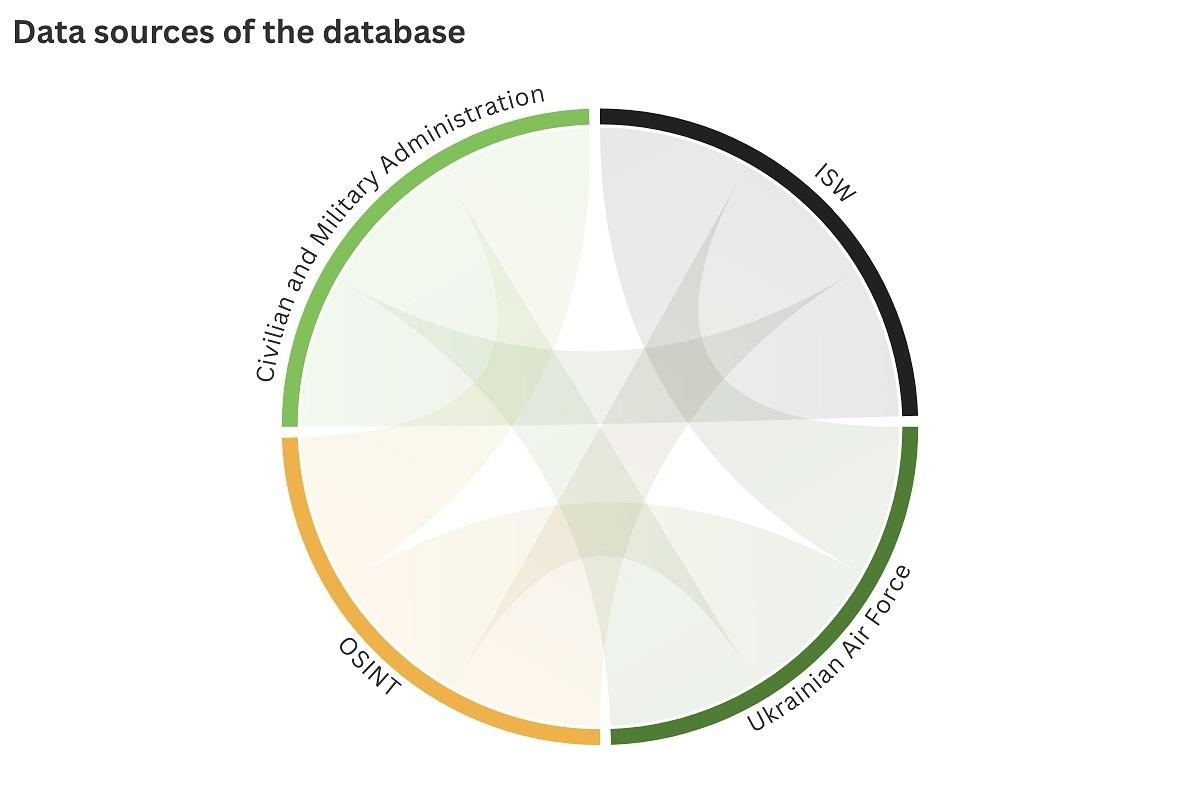
The air strike database is regularly cross-referenced with daily reports from the Institute for the Study of War (ISW) in Washington (↗ ISW).
The launch records originate from the Ukrainian Air Force reports (↗ KPSZSU), and data on regional targets and damage—if available—is supplemented with civilian and military administration sources.
These figures are further verified using additional OSINT sources and are considered highly reliable.
Accurately quantifying air strike damage during an active war is inherently challenging. Providing overly precise information could aid Russian military planning, which is why certain reporting restrictions apply (↗ Expro, 2.1.2025).
Consequently, this analysis focuses on attack patterns and dynamics rather than detailed damage assessments.
With over 42 months of data and around 85.332 documented attacks, robust trends have emerged. Monthly missile counts are approximate values, as irregularities have been noted in Ukraine’s reporting system. Discrepancies with other OSINT sources remain within a 10% margin, often below 3%.
A comparison with the missile and drone assessment by the Center for Strategic and International Studies (CSIS) in Washington over a period of more than two years shows a deviation of only 1.6% (↗ CSIS).
For attacks lacking definitive quantification, the lowest plausible estimates have been used. Due to possible underreporting in high-intensity phases, actual interception rates may be slightly higher, with an estimated deviation of less than 5%.
ABOUT THE AUTHOR
Marcus Welsch is a freelance analyst, documentary filmmaker, and publicist.
Since 2014, he has specialized in OSINT journalism and data analysis, focusing on the Russian war against Ukraine, military and foreign policy issues, and the German public discourse.
In cooperation with Kyiv Dialogue, he has conducted research and panel discussions on Western sanctions policy since 2023.
Since 2015, he has been running the data and analysis platform ↗ Perspectus Analytics.
ABOUT KYIV DIALOGUE
Kyiv Dialogue is an independent civil society platform dedicated to fostering dialogue between Ukraine and Germany.
Founded in 2005 as an international conference format addressing social and political issues, it has moved to support civil society initiatives aimed at strengthening local democracy in Ukraine since 2014.
Since Russia’s full-scale invasion in 2022, the focus has shifted to social resilience, cohesion, and security policy—including military support for Ukraine and Western sanctions policy.
Kyiv Dialogue is a program of the ↗ European Exchange gGmbH.
 Kyiv Dialogue


You need to sign in in order to comment.