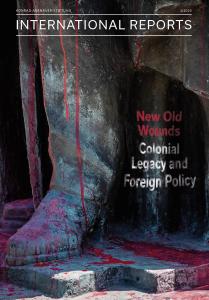


Issue: 2/2025




In a Nutshell
- The outrageous statements coming from “progressive” circles after 7 October 2023 triggered a long-overdue debate on postcolonial theory, though this debate has often lacked clarity and objectivity.
- Postcolonial approaches have undoubtedly contributed to the understanding of the legacies of imperialism, but the field is now increasingly dominated by unscientific and politically activist writing.
- Recent currents display a pronounced hostility towards the West by narrowing their focus to European colonialism of past centuries. Western “coloniality” has overtaken “capitalism” as the supposed root cause of all global ills.
- In these narratives, Israel is vilified as a Western state founded by “settler colonialists” that must be abolished.
- The practical value of postcolonial theory in terms of improving living conditions in the “Global South” is close to zero. Instead, this theory has become a useful tool – in both the “Global South” and the West – for a wide range of actors who reject the liberal-democratic order.
- The uncritical adoption – and to some extent funding – of such discourse by the German state needs to be reassessed.
The field known collectively as “postcolonialism” – which encompasses various research approaches and discursive arenas – is currently under sustained attack. This is no accident. Many observers were appalled by the reactions within “progressive” circles to the Hamas massacre of 7 October 2023. These reactions prompted a closer look: What kind of thinking labels Israelis “white settler colonialists”, seeks to liberate the world from imperialism and oppression and simultaneously aims to “provincialize” Europe and the West? Ever since these questions were raised publicly, debate around postcolonialism has intensified, though without being always accurate, and often with more noise than precision. At times enlightening yet usually predictable, this debate is often ineffective.
Dismissing the theoretical structure of postcolonialism as just another woke trend or as a politically correct aberration may be partly accurate, but it often fails to do justice to the phenomenon and leaves critics vulnerable. This is too serious an issue for polemics. What the postcolonial paradigm shift calls for is not culture-war posing, but a thorough and well-grounded examination: The reinterpretations of history and contemporary reality that are taking place here are no longer fringe academic projects; rather, they now dominate entire disciplines, shape public discourse and are both politically championed and institutionally supported. But how are we to face up to the force of this intellectual programme?
First, it is essential to distinguish between postcolonial scholarship that genuinely contributes to the study of colonial history on the one hand and scholarship that is aimed squarely at attacking Western thought and universal values on the other hand. In the former category, postcolonial perspectives have indeed made valuable contributions. They have helped reframe the importance of colonialism, its lasting effects in the present and the power asymmetries that continue to underlie relationships between former colonies and colonial powers. Postcolonial approaches have played a major role in changing how we view the brutality of European imperialism – a perspective that only a few decades ago was far less critical. Nostalgic glorifications are now largely out of bounds, and the lingering effects of colonial crimes – from arbitrary borders and dependencies to psychological legacies – are broadly acknowledged. However, these elements are becoming less and less central to postcolonial research. Indeed, the focus has shifted from the analytical project of studying colonialism to the operational project of changing the world and its structures. A systematic critique must therefore take into account at least five key elements.
1. Lack of Scholarly Rigour
The first line of critique concerns the claim that postcolonial theories and concepts are by nature scholarly approaches. In reality, methodologically and empirically robust work is the exception rather than the rule in this field, which tends to be dominated by texts that belong more to the realm of practical philosophy, political theory or outright activism. “Scholarly” work often consists mainly of coining and promoting terminology or sociological concepts such as “hybridity”, “subalternity” and “epistemic violence”. While this may be legitimate and occasionally illuminating, it is also an old strategy for boosting the legitimacy of ideologies and even religious belief systems. For similar reasons, Marxism–Leninism once called itself “scientific socialism”.
Despite this, the notion that postcolonial theory is inherently scientific has largely taken hold – just as critics of postcolonialism are increasingly often accused of lacking scholarly credibility themselves. Postcolonial apologists often respond to criticism by claiming that their opponents have not read the key texts, lack expertise or dismiss serious concepts based on a gut feeling, prejudice or vague insinuations. Unfortunately, there is some truth in this. Criticism of postcolonialism is also something of a trend – one that fits comfortably within the current conservative zeitgeist. Many critiques lean more on opinion than on substance, with few people outside expert circles taking the time to grapple with the dense writings of Edward Said, Dipesh Chakrabarty or Gayatri Spivak.
However, it is also true that criticism is growing louder because these foundational texts are now being read more closely – and are increasingly often being called into question. In the German-speaking world, we now also find well-informed critical engagement with specific aspects of postcolonial theory. Scholars such as Ingo Elbe – who has written on postcolonial antisemitism – and Monika Albrecht – who analyses the reception of postcolonial approaches – have laid a solid foundation for challenging the claim that these theories are genuinely scientific. Dismissing such criticism as “unscientific” because it does not argue from within the system does not hold up, especially not for a theoretical framework that sets out to question established knowledge systems and perceptions of reality.
Postcolonial theorists also frequently argue that there is no such thing as “postcolonialism” in the singular – that is, that there is no unified theory or research programme. While this is technically true, it is also a distraction. It is correct that the family of postcolonial approaches addresses a wide range of different phenomena, structures and processes. However, it is equally true that these approaches share a set of core assumptions and convictions: Reality is said to reflect power structures, perceptions are said to be susceptible to deconstruction, changing language is said to change reality and everything is claimed to be “structural” in nature – and therefore scientific by default. Inherited from French deconstructionism, these assumptions tie the various strands together – even those that do not deal directly with colonialism. Thus, the claim that “there is no such thing as postcolonialism” is a fairly transparent attempt to deflect criticism.
Ottoman conquests, Arab slave trading and Soviet imperialism are largely ignored.
Finally, postcolonial theorists also regularly accuse their critics of engaging in revanchist identity politics and of attempting to engineer a shift to the right or an illiberal backlash. There is some truth to this, as well. Indeed, recent moves by the Trump administration targeting US universities and postcolonial theorists have undermined the credibility of serious critique, thereby turning some of these theorists into perceived martyrs for academic and intellectual freedom. Left-wing identity politics is being fought with right-wing identity politics.
2. Hostility to the West
As a leftist project of world transformation, postcolonialism must also be understood as an intellectual revolt against everything associated with the West (or against that which is perceived as such). Newer strands of the discipline in particular show little interest in analysing colonialism as a global, trans-historical phenomenon and instead focus almost exclusively on European colonialism over the past few centuries. Ottoman conquests, Arab slave trading, Soviet imperialism and other non-Western forms of domination are largely ignored or downplayed. A central reference point remains Edward Said’s 1978 postcolonial classic “Orientalism”, which argued that the West needed the Orient as a negative mirror to define itself. While Said rightly exposed racist and exoticizing portrayals of the “Orient”, his thesis that non-Western people are fundamentally “different” also arrived at a time when the failure of real-world socialism was becoming increasingly awkward for the Left – and when the revolution in Iran briefly fuelled misplaced hopes. Since then, the notion of Western “coloniality” – and the idea that Western societies are intrinsically and incurably racist – has often replaced capitalism as the go-to explanation for the world’s problems.
The end of the Cold War and the 9/11 terrorist attacks accelerated this shift. The open or covert approval of the attacks by certain Western intellectuals helped crystallise what critics of postcolonialism such as Ian Buruma and Avishai Margalit call “anti-Westernism”. This hostility to the West found further traction after 2000. For example, the failure of Western-led democratisation efforts and the rise of global crises lent support to postcolonial scepticism towards the West. Sociologist Vivek Chibber views this fixation on “Western guilt” as a reduction of postcolonialism to a cliché-ridden anti-Enlightenment programme.
The reference to “Jewish voices” within the postcolonial camp does not absolve it of the charge of antisemitism.
3. Antisemitism
Third, postcolonial approaches must be criticised for providing an academic framework for antisemitic ideas and activism. Literary critic Adam Kirsch has shown in his book on settler colonialism how concepts that were originally developed to analyse colonialism in the US and Australia are now being mechanically applied to Israel. Since the centuries-old colonisation of North America and Australia cannot realistically be reversed, Kirsch argues, the abolition of Israel becomes the only remaining case in which postcolonial theory can be enacted in practice.
Those who advocate this programme reject the accusation that it has anything to do with antisemitism. Further, they claim that criticism of Israel’s existence is legitimate, that Israel plays only a minor role in postcolonial theory and that many Jewish scholars also support postcolonial approaches. Here again, there is some truth to these statements – but much is misleading or simply false. It certainly remains a matter of debate whether antisemitism is a structural feature of postcolonial theory or merely a symptom of this theory’s anti-Western worldview. For writer Yascha Mounk, the two are increasingly indistinguishable. In intersectional postcolonial discourse, Israel – and therefore Jews – are lumped in with the West and therefore must be opposed. In Germany, at least, there is still broad consensus that denying Israel’s right to exist is antisemitic.
The reference to “Jewish voices” within the postcolonial camp also does not absolve it of the charge of antisemitism; rather, this reference is more a sign of postcolonialism’s dominance in both Western academia and cultural institutions than of genuine Jewish support. Where “Indigenous perspectives” are otherwise central to postcolonial thought, Jews appear to be the exception. Instead, this role is more often claimed by Israel’s self-declared “Indigenous” enemies. For Islamists such as Hamas – and many other opponents of the Jewish state – postcolonial language and its vocabulary of defamation (“genocide”, “apartheid”, “colonial state”) offer both political ammunition and an ideological blueprint. On the very day of the massacre of 7 October 2023, the BDS boycott movement celebrated the attack as a response by “Indigenous Palestinians” to the ethnic cleansing by “apartheid Israel and the colonialist West”.
4. Exploitation by Autocrats and Radicals
This brings us to the fourth point: Postcolonial thinkers often unwittingly serve as useful idiots for those who oppose human rights, democracy, freedom – and Israel and the West in general. The West’s own self-critical intellectuals have become increasingly important allies to its geopolitical opponents. As early as in February 2017, Russian foreign minister Sergey Lavrov called for a “post-Western world order” at the Munich Security Conference and has since pursued alliances with like-minded actors. Russian ultranationalist philosopher Aleksandr Dugin draws on decolonial rhetoric, as do Hindu nationalists, Chinese power strategists and Iran’s mullahs. Across the globe, postcolonial arguments are used to justify authoritarian, reactionary and ethnonationalist policies.
In what were once called “developing countries”, postcolonial terminology is seen as intellectual navel-gazing.
Islamists were among the first to recognise this potential. For over a century, they have promoted Islam (as opposed to the West) as the solution to the world’s problems. Their fight against democracy, human rights and secularism – as well as against women, ethnic minorities, queer people and religious dissenters – is often framed as an “Indigenous Muslim perspective”. The reach and resonance of this narrative can now be observed not only on social media, but increasingly often also on the streets of German cities. In 2024, the macho Islamists of the Caliphate Movement marched through Essen and Hamburg, brandishing slogans about “Western and colonial oppression” echoing fragments of postcolonial rhetoric and promoting antidemocratic, antisemitic and anti-Western ideology. This and similar examples clearly show how authoritarian and radical actors are becoming increasingly fluent in the vocabulary of postcolonialism. This shift should have prompted a wave of critical self-reflection among scholars in the field. Thus far, however, there has been little sign of that happening. Postcolonial thought continues to operate on the basic premise that the “Global South” must be liberated from the West as the sole source of oppression.
5. No Help for the South
This is one reason why postcolonial perspectives offer little benefit to the South. While the postcolonial deconstruction of “development” as a Eurocentric concept may have been intellectually stimulating, it has done nothing to improve the lot of those living in what were once called “developing countries”. Postcolonial terminology remains largely unknown in these regions – or is seen as an exercise in intellectual navel-gazing by Western or Westernised elites. Postcolonial activism becomes completely meaningless for the people concerned when it descends into symbolic gestures. In the US and Australia, for instance, cultural institutions and universities have adopted the practice of issuing ritualised statements that recognise Indigenous land rights. It goes without saying that this has no practical impact whatsoever on the communities in question.
Countries such as India, Malaysia and Indonesia emerged from poverty not as a result of postcolonial theory, but through hard work, structured trade relations and the benefits of globalisation. If you ask people on the streets of Cairo, Kinshasa or Karachi, the response is clear: They want more trade and investment, not more lecturing and interference. The fact that postcolonial ideas have nevertheless become mainstream in many parts of the world has more to do with their usefulness to local elites than with their relevance to people’s day-to-day lives. The postcolonial obsession with all things “Indigenous” and the rejection of Western involvement have become convenient tools for non-Western elites to distract from their own failings. In some African countries, postcolonial rhetoric is also being used to justify the growing influence of neocolonial powers, such as Russia and China.
Postcolonial thinkers are sawing off the very branch they are sitting on.
What Comes after Postcolonialism?
If all claims about the world are viewed purely as power-based speaker positions, then the idea of objective truth disappears. Global governance systems, international institutions and even international law are then dismissed as constructs of a colonial, Western system of oppression. The human rights and international law principles underpinning these systems are no longer seen as universally valid, but rather only as “Eurocentric” perspectives that are specific to a certain time and context. The real-world consequences of this shift in thinking are already visible: Human rights standards are being eroded, global institutions and legal frameworks are being undermined and democratic principles are being called into question. If this trend continues, the postcolonial world will be a world driven by hard interests and power politics – a world very different from the one its advocates imagine. Postcolonial thinkers are – perhaps unknowingly – sawing off the very branch they are sitting on, the platform from which they promote their ideas.
All the more reason why critical and clear-headed engagement with postcolonialism is so important. There is nothing wrong with thinking about power and guilt. Indeed, it is vital to reflect on the consequences of declining Western influence and the erosion of Western institutions. However, it is counterproductive to lump everything together. At a time when some governments and political actors in the West are lashing out against postcolonialism and are discrediting legitimate justice debates, constructive alternatives must be offered – from both left and right – to protect a rules-based order. This is a challenge facing academia, civil society and politics alike.
In academia, the bridges between postcolonial theorists and their critics have largely collapsed. However, a growing body of serious literature now offers a constructive critique of the blind spots and weaknesses in postcolonial knowledge production. This work deserves support and further development, especially when it comes to antisemitism, the legitimisation of authoritarian mindsets and the rejection of universal human rights. To ignore this criticism is unacceptable. But critics of postcolonialism must also become more capable of engaging in discourse. It is not possible to fight leftist activism, political agendas and outright nonsense by replicating these issues from the right.
Public understanding of the scale and significance of the postcolonial shift remains limited. Much as in many areas of academia, the spheres of the art world, media and public debate too often fall for postcolonialism’s simulation of scholarly rigour and pseudo-complexity. There is still little critical awareness that this way of thinking now pervades universities, cultural institutions, political parties and NGOs, not to mention the UN General Assembly, Islamist rallies and May Day demonstrations. Some of what is currently labelled “postcolonial” may one day be seen as part of a broader social transformation. However, the scandal surrounding Documenta Fifteen has shown just how vigilant societies must be when hatred and contempt are disguised as progressive indigeneity.
The most important answers to postcolonial challenges will likely have to come from the political sphere. Domestically, the issues at stake are funding and cultural policy as well as appointments to advisory boards and professorships in addition to political rhetoric and party platforms. In terms of foreign policy, the growing criticism of the West calls for a renewed commitment to Western alliances and institutional cooperation – despite the difficulties in dealing with the Trump administration, or precisely because of them. At the same time, there is a need to revitalise and strengthen global and regional cooperation mechanisms. Postcolonial thinking will not solve the conflicts in the Middle East or in Ukraine, nor will it deliver global prosperity, gender equality or climate solutions. What is needed are global alliances, reliable rules-based systems and smart diplomacy.
The change of government in Germany offers an opportunity for a reset. The previous government too often adopted postcolonial redefinitions and assumptions without reflection, thereby alienating international partners with ideologically driven lectures. There is now a chance to leave behind this mix of ideology, activism and semantic confusion – and to help shape a post-postcolonial world order.
– translated from German –
Dr Andreas Jacobs is Head of the Social Cohesion Department in the Analysis and Consulting Division of the Konrad-Adenauer-Stiftung.
Choose PDF format for the full version of this article including references.