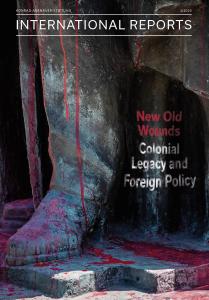
Issue: 2/2025




Dear Readers,
When the UN was founded in 1945, it had 51 member states. Today, that number stands at 193. There were two periods during which the increase in this figure was particularly striking: around 1990, following the collapse of the Soviet Union; and earlier, between the mid-1950s and early 1960s, when the remaining European colonial empires largely dissolved and their former territories were “granted” both statehood and independence.
That happened more than half a century ago, but it certainly did not involve drawing a line under the subject of colonialism. And that is a good thing. Addressing and reappraising the crimes committed by the predominantly Western European colonial powers in the regions they controlled remains a legitimate and important concern. Equally legitimate is the question as to whether – and to what extent – economic exploitation and colonial-era structures have continued to weigh on the development of former colonies since they achieved independence. This is by no means a new issue. Some readers may recall Marxist-influenced dependency theory, which emerged in the 1960s and 1970s in response to modernisation theory. It dealt with underdevelopment as a consequence of what was understood to be a structural dependence on global capitalist systems dominated by the West.
In recent decades, a broader discourse has emerged in academic and activist circles under the label of postcolonialism – one that goes far beyond these earlier questions and concerns. In Germany, this discourse long went unnoticed by the broader public. Then came 7 October 2023, when an Islamist terrorist organisation launched an attack on Israel – the only liberal democracy in the Middle East – indiscriminately murdering civilians and taking others hostage. The cynical response from some self-proclaimed “progressives” was that this was a legitimate act of resistance by Indigenous Palestinians against a state of white settler-colonialists.
This gross political and moral misjudgement is the clearest example to date of the shortcomings inherent in these postcolonial theories. In the present issue of International Reports, Andreas Jacobs highlights these flaws in no uncertain terms – flaws that range from a lack of academic rigour, anti-Western bias and antisemitism to a vulnerability to misuse by autocrats and to near-total irrelevance to the real lives of people in former colonies, whose cause postcolonial theorists claim to defend. As Jacobs puts it, “In reality, methodologically and empirically robust work is the exception rather than the rule in this field”. In this current issue, we aim to provide – primarily through the perspectives of our International Offices – a well-informed – though by no means exhaustive – contribution to the discussion on what role colonial legacies and the discourse around them actually play in various countries and world regions.
In her article on the trade relations of African states, Anja Berretta explores the question as to whether the often-poor economic development of these countries can be attributed to the legacy of European colonialism and to ongoing unfair trade relations between the West and Africa. Drawing on a wide range of data and numerous examples of countries, she demonstrates that the trade and economic policies chosen by African governments themselves often provide a far more convincing explanation of each country’s performance.
Colonialism is also relevant in a very different way in the case of certain authoritarian states. David Merkle analyses how China and Russia use selective historical narratives both to reinforce the power of their ruling elites at home and to discredit Western states on the international stage. Postcolonial discourse has become a favourite tool in these efforts – deployed via artificial intelligence and social media not only in Africa, Asia and Latin America, but also among sympathetic audiences in Western societies.
Moscow in particular has often succeeded in portraying Europe and the United States as colonialists while presenting itself as an anti-imperialist actor with no colonial past, which is especially striking given Russia’s own long history of imperial ambition in its immediate neighbourhood. Stephan Malerius and Florian Binder trace this history drawing on the example of the South Caucasus, and reveal that in this region, and especially in Georgia, Russia is increasingly seen as a colonial power by some parts of society.
Meanwhile, Sebastian Grundberger examines how the authoritarian Left in Latin America uses postcolonial rhetoric not only to legitimise dictatorships stretching from Havana to Managua and Caracas, but also to lend intellectual support to its alliances with the regimes in Beijing, Moscow and Tehran – “united against the West”, as he puts it in the title of his article.
By contrast, Philipp Gerhard locates Brazil’s foreign policy “between West and South”. He argues that after decades of Western alignment, Latin America’s largest country has increasingly diversified its relations towards other global partners in recent years – a shift driven by a number of key factors, with the influence of postcolonial narratives being one of them. Initially an elite academic phenomenon imported from North American and European universities, these narratives later gained traction within Brazil’s left-wing parties. While they do not shape the country’s overall foreign policy, they do help explain certain tendencies, such as President “Lula” da Silva’s anti-Israeli rhetoric.
Finally, two articles in the present issue also examine how Western European states are addressing their colonial legacies. Just a few months ago, the United Kingdom agreed to hand over the Chagos Islands – located in the middle of the Indian Ocean and of considerable strategic importance – to Mauritius. As Canan Atilgan and Lukas Wick write in their article, countries that were once part of the British Empire and that are now members of the Commonwealth are increasingly calling on London to confront the darker chapters of its imperial past with honesty. The British government is willing to engage in such a reappraisal in principle, but it continues to reject formal apologies or reparations.
A similar debate has emerged in recent years between Germany and Tanzania, which had been part of the former colony of German East Africa up until the First World War. The impetus for this debate, however, came not from Dar es Salaam, but from Berlin. As Tilmann Feltes and Sebastian Laschet observe in their article, “it seems unlikely that a misguided debate on colonialism would have taken root in Tanzania without German involvement”. The debate was misguided in the sense that the previous German government – particularly the leadership of the Foreign Office – conducted it on a one-sided basis, often ignoring the issues that Tanzania’s government itself wished to address and lacking sufficient awareness of Tanzanian remembrance culture. As a result, the initiative did more harm than good to German–Tanzanian relations.
What does all this mean in terms of German and European foreign policy? The lesson to draw from misguided attempts at reappraising the past – and from legitimate criticisms of postcolonial discourse – must not be to avoid dealing with the dark and, to a certain extent, criminal aspects of Europe’s colonial history. Where our international partners wish to have that conversation, we should engage in it – based on historical facts. Not only is this a matter of moral responsibility, but it is also in our own interest. Many of the 193 UN member states referred to above are former colonies. Their positioning is crucial in light of our ongoing confrontation with revisionist autocracies such as China and Russia.
What we must avoid, however, is a form of ideology-driven remembrance policy that caters more to the emotional needs of domestic politicians, their electorates and certain activist groups than to the actual priorities of our international partners. And under no circumstances should we uncritically adopt a postcolonial narrative that absolves these partners of their own agency, that portrays Western colonialism as the root of all global problems and that in so doing not only misrepresents historical and present realities, but also seriously harms our interests.
I hope you find this report a stimulating read.
Yours,

Dr Gerhard Wahlers is Editor of International Reports, Deputy Secretary General and Head of the Department European and International Cooperation of the Konrad-Adenauer-Stiftung (gerhard.wahlers@kas.de).