
Issue: 1/2026




In a Nutshell
- Long regarded by many Japanese as the country’s “natural party of government”, the Liberal Democratic Party (LDP) suffered significant losses in the 2024/2025 elections, primarily losing ground to parties on the right of the political spectrum.
- In the snap lower house election of February 2026, however, the LDP achieved the best result in its 70-year history: With a two-thirds majority, it will now fill over half of the seats on all parliamentary committees.
- The election of right-conservative Sanae Takaichi as LDP leader and prime minister in autumn 2025 was controversial and not without risk, as was the formation of a centre-right coalition with the Japan Innovation Party. However, the election victory vindicated both the party and Takaichi.
- The state of the economy was the central issue in the most recent elections. With reform pledges and a massive stimulus package, Takaichi appealed to the preferences of a majority of voters, as did her restrictive positions on immigration.
If Japan’s best-known parties were arranged from far left to far right and a line were drawn through the middle of the party landscape, the Japanese Communist Party (JCP), Reiwa Shinsengumi (“Beautiful Harmony”), the Social Democratic Party (SDP), and the Constitutional Democratic Party (CDP) would fall to the left of this line, while Kōmeitō (“Justice Party”) would mark the centre-left and the Democratic Party for the People (DPP) the centre-right. Further to the right would follow the Japan Innovation Party (Nippon Ishin no Kai; JIP), the Liberal Democratic Party (LDP), and Sanseitō (“Party of Political Participation”). On the far right of this scale would be the Conservative Party of Japan (CPJ). However, the CDP and Kōmeitō are now only represented as independent parties in the upper house (Sangiin, or House of Councillors); in the lower house (Shūgiin, or House of Representatives), they merged in January to form the Centrist Reform Alliance (CRA).
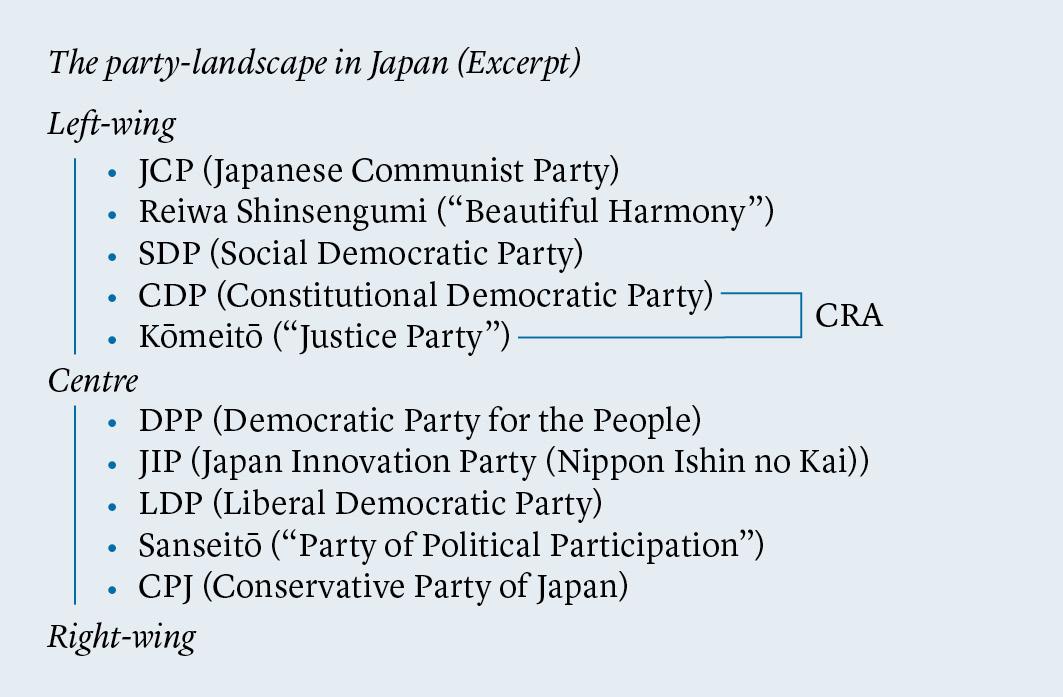
While Edo Naito argues in the Japan Times that terms such as “liberal”, “conservative”, and “populist” have a “completely different meaning” in Japan than elsewhere,1 the left–right spectrum proposed by Edelman will suffice for the purposes of the present analysis.2 Moreover, this article does not examine all the parties mentioned above, instead focusing on selected parties to the right of centre, in particular the LDP.
On 8 February 2026, the LDP achieved what hardly anyone had expected. In the snap lower house election, it secured the best result in its 70-year history: The governing party won 316 of the 465 seats, increasing its representation in the powerful parliamentary chamber by 125 seats. Even without its coalition partner, the JIP, it thus commands a two-thirds majority and fills over half the seats on all 17 standing committees in the lower house. How was this possible given that the LDP had been mired in a deep crisis for two years?
A major party-funding scandal shook the Liberal Democrats at the end of 2023, and in summer 2024, highly unpopular Prime Minister Fumio Kishida announced that he would not seek re-election. Under his successor, Shigeru Ishiba, the LDP and its then–coalition partner Kōmeitō lost their majority in the subsequent lower house election in October. By the middle of last year, the ruling coalition had also failed to secure a majority in the upper house election. Meanwhile, to both the left and right of the LDP, the DPP and Sanseitō recorded significant gains, with Ishiba subsequently being forced to step down. Kōmeitō then ended its alliance with the LDP, which had been in place since 1999 – a worst-case scenario for the party. The new LDP leader, Sanae Takaichi, had to find a new coalition partner at speed. After intensive negotiations, the JIP stepped in. However, even together with the JIP, the Liberal Democrats still lacked a majority in both chambers of parliament. For her election as prime minister, Takaichi therefore additionally relied in the lower house on the votes of several independents. Since late October last year, she has been the first woman at the head of Japan’s government.
A battle on several fronts
After three independent MPs had switched to the LDP in November, the governing coalition regained a razor-thin majority, at least in the lower house. However, public approval ratings for the LDP remained well below 30 per cent after Takaichi had taken office. Her decision to dissolve the lower house as early as in January and to call a snap election after just three months in office – in the middle of a snowy winter – was therefore highly risky. To offset its losses, the LDP had to win back both moderate conservatives and voters on the far right in an election campaign shortened to just twelve days. The party additionally needed to regain appeal among independents and younger voters. But how could such a balancing act succeed? As in many countries, fewer and fewer people in Japan feel bound to established parties. Since the early 1990s, the Liberal Democrats have lost four-fifths of their members, with around 60,000 people leaving the party in 2024 alone.3
Voters are primarily concerned about their economic well-being.
In October, the party selected Sanae Takaichi as its new leader from among five candidates. Takaichi was not only the sole woman, but also the “most conservative and furthest to the right”.4 Citing its inability to support a partner that was abandoning moderate conservative principles, Kōmeitō ended its long-standing cooperation with the LDP – and Takaichi was by no means the uncontested favourite among LDP MPs in the race for party leadership.5 The alliance with the JIP also ruled out a possible coalition with the centre-left CDP, even though this would have produced comfortable parliamentary majorities. Together with the largest opposition party, the LDP could theoretically have dispensed with snap lower house elections altogether.
Atmospherics, negotiation dynamics, political timing, and unexpected offers likely played just as great a role in these decisions as did strategic considerations, of course. With the benefit of some hindsight, the present analysis seeks to examine how polarisation within Japanese society has shaped voter preferences, how forces on the political right have influenced the LDP, and how the party – under Takaichi and in coalition with the JIP – ultimately succeeded in asserting itself. The discussion focuses on four elements: willingness to reform, conservatism, governing capacity, and participation.
Willingness to reform: “It’s the economy, stupid”
Japanese parties hold divergent positions on issues such as how Japan should position itself vis-à-vis China and the United States; how gender equality should be advanced; whether nuclear power is too risky; which taxes should be raised or lowered; and whether the country should revise its pacifist constitution, recognise the Self-Defence Forces as a full military, and increase defence spending. However, in Japan’s rapidly ageing and shrinking society, voters are primarily concerned with their economic well-being.
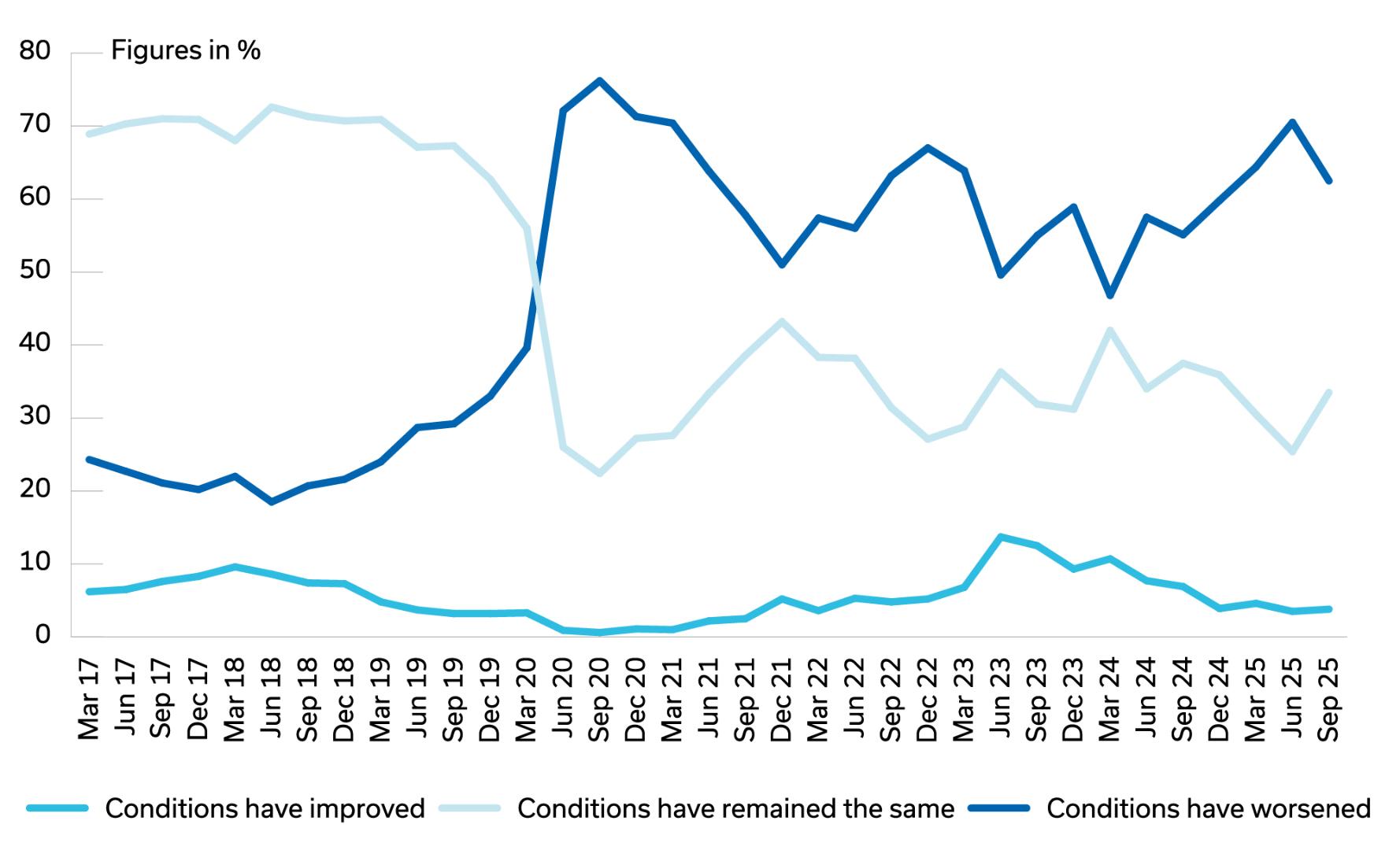
According to regular surveys conducted by the Bank of Japan (BoJ), more than half of all Japanese have consistently believed since the outbreak of the COVID-19 pandemic that the economic situation has worsened compared with in the previous year (Fig. 1). By mid-2025, the share of dissatisfied respondents – at around 70 per cent – was as high as in March 2021, when the state of emergency had to be extended in several prefectures due to rising infection rates.6
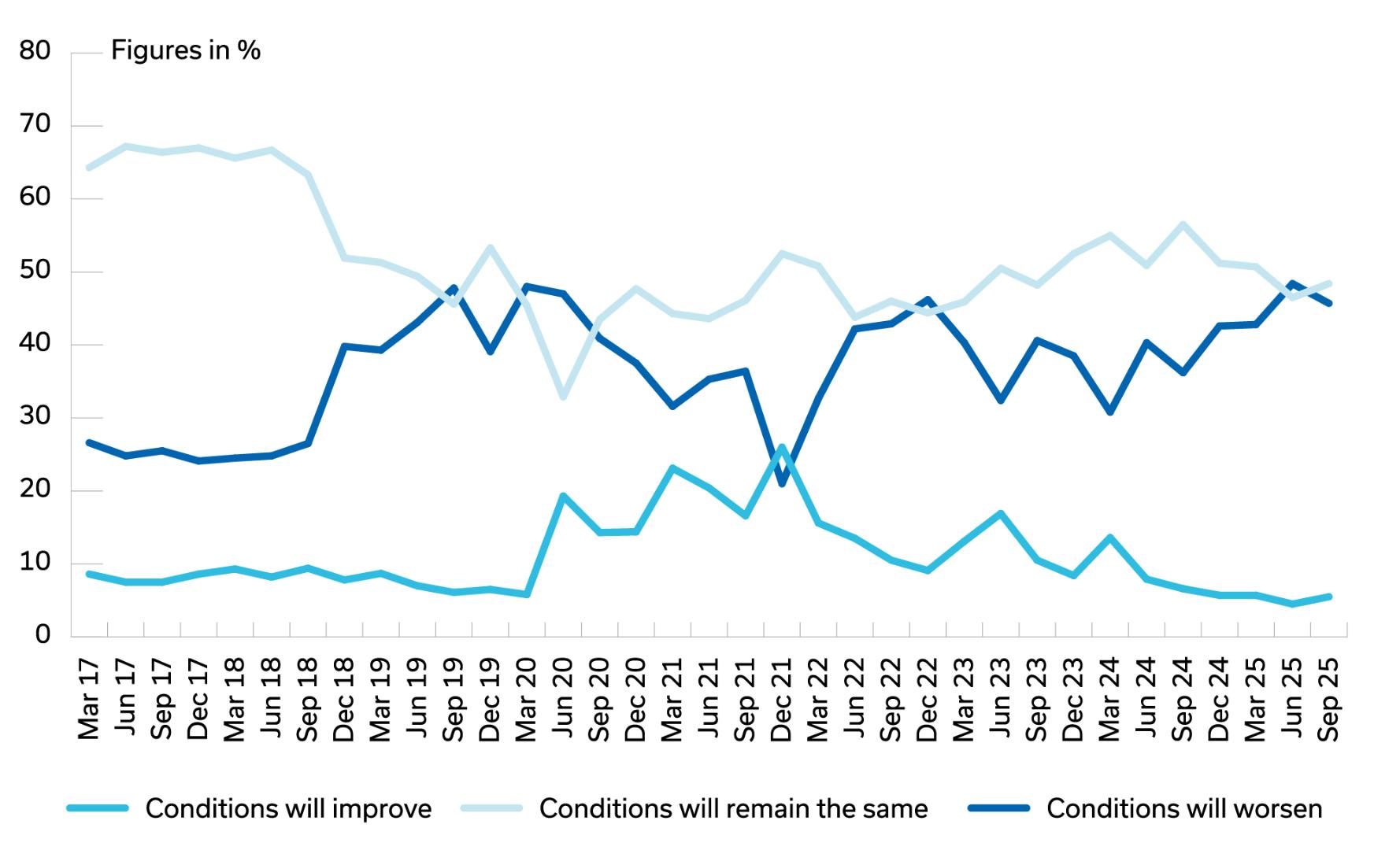
According to BoJ surveys (Fig. 2), during the COVID-19 pandemic, many Japanese still expected the economic situation to improve within the following twelve months. By autumn of last year, however, almost half of respondents expressed pessimism about future economic developments.
Fig. 1: Subjective assessment of overall economic conditions compared to the previous year
Source: own illustration based on Bank of Japan 2026: Opinion Survey, in: https://ogy.de/zf9c [16 Nov 2025].
Fig. 2: Expectations for economic conditions for the following year
Source: own illustration based on Bank of Japan 2026: Opinion Survey, in: https://ogy.de/zf9c [16 Nov 2025].
According to post-election surveys conducted by the world’s highest-circulation newspaper, Japan’s Yomiuri Shimbun, the most important political issues in the February lower house election were inflation and economic policy (81 per cent), followed by foreign policy and security (65 per cent). Tax reform – including the at-least-temporary abolition of the consumption tax on food – and social security – including pensions – followed close behind, at 64 per cent each.7 But how does this explain the gains made by the populist Sanseitō in both the 2025 upper house election and again in the recent lower house election? With its conspiracy theories, nationalist slogans, and criticism of tourists and foreign workers, the far-right party is hardly associated with economic competence. Part of the answer has its roots in the early 1990s.
At the time, Germany, Japan, and the United States were all facing major socio-economic challenges, albeit for different reasons. With the slogan “It’s the economy, stupid”, Bill Clinton’s campaign strategist James Carville urged Democrats in 1992 to centre their presidential campaign entirely on the economy amid recession.8 Germany was grappling with the consequences of reunification, with many people in eastern Germany having lost their jobs. In Japan, the property bubble had burst, and the long-booming “Japan Inc.” had collapsed. What followed was the “Japan crisis” and three lost decades. Those entering the labour market in the 1990s often struggled to secure permanent full-time employment with adequate pay. Japan’s so-called “ice-age generation” continues to suffer in the labour market to this day.9 A post-election survey by Asahi Shimbun found that Sanseitō performed significantly better among men (60 per cent) than among women in the upper house election. Among voters aged 40 to 59, 42 per cent of those who cast their second vote for the far-right party in July 2025 belonged to this “ice-age generation”.10
Just as the Republicans in crisis-stricken early-1990s America were replaced by the Democrats, Japan’s Liberal Democrats were voted out of government in 1993 for the first time in 38 years. Although the new seven-party coalition quickly fell apart and the LDP returned to power in 1994, political scientist Toru Yoshida regards the change in government as an often-overlooked turning point: He states that it led to the setting up of “opposing camps of ‘modernizers’ and ‘conservatives’, […] [thereby] replacing the old left-right cleavage. On an electoral level, it was clearly from this time onwards that constituencies began to exercise choice between reformist and anti-reformist preferences.”11 One outcome of this development was the premiership of Jun’ichirō Koizumi (2001 to 2006). The LDP prime minister pushed through sweeping reforms in Japan despite strong resistance, including from within his own party. Koizumi enjoyed a high level of approval among the public at large. His successor, Shinzō Abe – prime minister from 2006 to 2007 and again from 2012 to 2020 – was also among the reformers of recent decades. This explains why Prime Minister Takaichi now views herself as standing in Abe’s political tradition.
Less than one month after taking office, Takaichi’s government launched a comprehensive stimulus package that – according to a Yomiuri Shimbun survey – was rated positively by 63 per cent of respondents, with approval rising to 72 per cent among supporters of the LDP and JIP. The package also received majority backing among independents (59 per cent) and even among opposition supporters (56 per cent).12 Takaichi’s mantra of “work, work, work, work, work” was named buzzword of the year in early December.13
Conservatism: “Imperial family, cultural heritage, memory of the nation”
The 64-year-old is guided more than only by her mentor’s reformist zeal in efforts to revitalise the economy and domestic consumption. Abe – who was assassinated in 2022 – was – like Koizumi – a member of the strongly conservative Seiwakai faction within the LDP, which was dissolved in 2024 after a major party-funding scandal. This was also the faction in which Takaichi had found her political home. By contrast, her predecessors Fumio Kishida and Shigeru Ishiba were associated with – or at least supported by – the far more moderate Kōchikai faction.14 Abe had been able to hold together the nationalist wing of his party. Until the end of his tenure, the LDP was not a “centrist party” in the German sense, but rather a broad conservative catch-all party positioned at the centre of the conservative spectrum that aimed to appeal from the centre-right to the far right. Sanseitō was founded in 2020 to the right of the LDP, followed in 2023 by the CPJ. Both have sparked debate in the media over what the Liberal Democrats stand for today.15
With her more conservative agenda, the new prime minister has been well received, particularly on the right of centre.
From the perspective of Tomohiko Taniguchi, chairman of the influential lobby organisation Nippon Kaigi, Japanese conservatism revolves around three elements: “We are here to preserve what has been handed down through generations – the imperial family, cultural heritage, the memory of the nation”. Taniguchi believes that “borderless liberalism” threatens Japanese identity: “Think of Mount Fuji. A mountain, yes – but above all a sacred presence. Now, people climb it waving flags for social media ‘likes’. That symbolic desecration causes pain.” Taniguchi advocates quota limits for workers from China. Nippon Kaigi also supports enshrining male-only succession to the imperial throne and adding a third clause to Article 9 of the constitution that explicitly recognises the Self-Defence Forces.
According to Taniguchi, the LDP followed this line during Abe’s tenure. “With Abe gone and Fumio Kishida dismantling what held it up, we no longer blindly support the LDP”.16 In this respect, too, Takaichi faced considerable pressure to reposition the party. She needed to close ranks. With her more conservative agenda, the new prime minister was well received in the first weeks after taking office, particularly – though not exclusively – on the right of centre.
According to a mid-November Asahi Shimbun poll, the LDP–JIP governing coalition was backed by nearly 70 per cent of respondents, with only 17 per cent opposed. 66 per cent considered Takaichi’s proposed tougher immigration policy “promising”, while 56 per cent – including many younger Japanese – believed the island nation needed fewer visitors and immigrants.17 Any new scandal, internal disputes, or “missteps” by the prime minister might well have eroded this political momentum, particularly among younger voters; instead, approval ratings held steady into January. This paved the way for the snap lower house election.
Governing capacity: “LDP-style politics, competently delivered”
In 2009, the Liberal Democrats were voted out of office for the second time in their 70-year history. On that occasion, the now-defunct Democratic Party of Japan (DPJ) prevailed largely because it did not promise clientelist benefits for support groups and instead underscored its governing credibility with pledges of fundamental reforms to approval procedures and decision-making processes between executive and legislature.18 Then, the Fukushima disaster struck in 2011. In the eyes of many voters, the DPJ mishandled the crisis. A year later, Shinzō Abe returned to power with the LDP and its junior coalition partner, Kōmeitō. For many Japanese, a left-led cabinet had failed for the second time. Political disillusionment grew, and turnout declined in subsequent years.
From 2012 onwards, the LDP effectively faced only one serious challenger: its current coalition partner, the JIP. In terms of their political programme, the two parties were closely aligned. The Innovation Party had split from the LDP in 2010 as a local movement, seeking to continue the reform agenda of former Prime Minister Koizumi. It had succeeded in breaking the LDP’s dominance in the Osaka region.19 The party had received good ratings at the local and regional level for its handling of the COVID-19 pandemic.20 Given its regional roots, the JIP is to the LDP roughly what the CSU is to the CDU in Germany, although candidates of both parties compete in constituencies within and outside the Osaka region. The JIP did not claim ministerial posts in the new government, however, leaving day-to-day governance to the Liberal Democrats – a pattern that might change in the next cabinet reshuffle planned for autumn.
For decades, the LDP has been regarded by many Japanese as the country’s “natural party of government”. It has enjoyed the backing of powerful business associations as well as of agricultural and fisheries lobbies. Local support groups (kōenkai) have organised campaigns for “their” LDP candidates.21 Religious organisations have also been part of this system of “organised votes” (soshikihyō). Before electoral reform in the mid-1990s, only the personalised first vote counted; thus, multiple LDP candidates often competed against one another in the same constituency. They were unable to differentiate themselves in terms of their policy platform, being forced to do so only through their respective support networks. Among LDP candidates without local political backgrounds, many are graduates of Japan’s top universities. Before entering politics, they typically gain professional and leadership experience in ministerial bureaucracies, public agencies, corporations, and associations.22 Traditionally, this group has supplied many of the leading figures in the party and in government.
With a planned record budget of 122.3 trillion yen, the aim is to bring about a sustained economic recovery in 2026.
The LDP benefited for decades from a strong reservoir of public trust in its governing competence. For example, surveys conducted around the 2012, 2017, and 2024 elections revealed that 22 per cent of respondents who actually favoured the JCP’s policies still intended to vote for the Liberal Democrats. Only seven per cent preferred the LDP’s policy platform outright, yet 38 per cent planned to vote for it.23 This credibility suffered significantly after the party-funding scandal had come to light at the end of 2023, however, thereby contributing to the losses in the 2024 lower house election. In his commentary for the Japan Times, Michael MacArthur Bosack also argues that the 2025 upper house election did not signal a “rise of conservative populism in Japan, and with it, xenophobic and regressive policies”. Rather, he says, the dominant issue was the financial strain on households, with voters punishing the LDP for its “continued inability” to address this core concern. The desire for “LDP-like politics” persists, he suggests – but only if it is delivered competently.24 Since the lower house election, the Japanese government has therefore been working intensively to pass the budget for fiscal year 2026. With a planned record volume of 122.3 trillion yen (currently around 670 billion euros), the aim is to lay the groundwork for a sustained economic recovery from April onwards.
Participation: “Offering a clear vision of the future”
For decades, the soshikihyō system of votes – mobilised via support networks and associations – functioned reliably. Since the electoral reform in the mid-1990s, however, its importance has gradually declined, with traditional media coverage increasingly coming to replace it as a driver of voter preferences, while online campaigns have since emerged alongside it.
After its founding in 2020, Sanseitō largely bypassed traditional media, focusing heavily on YouTube.25 The party produces a daily online news podcast for its roughly 70,000 members (as of July 2025). It has set up local and regional chat groups and invites supporters to training courses run by its in-house DIY School.26 Sanseitō charges relatively high monthly membership fees that are tiered. Those who pay more enjoy greater influence.27
Most supporters of the far-right party belong to the urban and suburban middle class. The party has established local chapters in almost all of the 289 single-member constituencies in the lower house – even where victory on the first vote was unrealistic. Because voters can also enter a candidate’s name on the second ballot, however, proportional representation still offered a path to parliament. Even in constituencies where candidates had virtually no chance under the majority system, local branches acted as grassroots “ground troops” campaigning energetically for the party and its leader, Sohei Kamiya.28 As a result, Sanseitō was able to increase its number of lower house seats from three to 15.
As recently as during the upper house election in the middle of last year, supporters of Sanseitō, Reiwa Shinsengumi, and the DPP identified much more strongly both with their respective parties and with their leaders than did LDP supporters.29 In the lower house election, the Liberal Democrats seized the opportunity to field Sanae Takaichi as a highly popular figurehead. With nearly 2.4 million followers on X, the prime minister was able to mobilise younger and undecided voters.30 The strategy worked: Around 35,000 new followers joined her account during the 12-day campaign alone. From the second half of January up until election day, LDP videos and campaign ads on YouTube were viewed more than 200 million times.31 Despite wintry temperatures and heavy snowfall, turnout reached just over 56 per cent – higher than in the 2024 lower house election.
With Sanae Takaichi as party leader and prime minister, the Liberal Democrats staged a remarkable comeback after the funding scandal and electoral setbacks of the past two years. Upon taking office in October, Takaichi was well advised to appoint her four rivals in the leadership contest to ministerial posts in the new government, thereby placating internal critics. Having now secured a two-thirds majority in the lower house, she is unlikely to face major internal power struggles in the near future. Takaichi was not elected solely because of her popularity, however, but also because she promised far-reaching reforms and effective crisis management. Under her leadership, the Liberal Democrats still have to prove they can deliver. Seventy years after its founding, Yomiuri Shimbun wrote in a leading editorial last year that the party must “offer a clear vision for the future”.32 Ultimately, it may not be the left or right fringes of the political spectrum – or the polarisation of Japanese society – but rather the cohesion of the Liberal Democrats in tackling the Herculean tasks ahead that will determine whether Sanae Takaichi will one day be compared with Shinzō Abe.
– translated from German –
Paul Linnarz is the Konrad-Adenauer-Stiftung’s Country Representative Japan and Director Regional Programme Economic Governance in Asia (SOPAS), based in Tokyo.
- Naito, Edo 2025: What is a ‘Japanese conservative’ in this day and age?, The Japan Times, 31 Aug 2025, in: https://ogy.de/wcar [24 Nov 2025].↩︎
- Edelman 2025: Japan’s 2025 Upper House Election Results, 24 Jul 2025, in: https://ogy.de/abyu [22 Nov 2025].↩︎
- Johnston, Eric 2025: As it turns 70, LDP struggles to find its fountain of youth, The Japan Times, 16 Mar 2025, in: http://ogy.de/1fnh [7 Dec 2025].↩︎
- Johnston, Eric 2025: Who’s who in the LDP presidential race?, The Japan Times, 22 Sep 2025, in: https://ogy.de/s2iy [6 Dec 2025].↩︎
- Linnarz, Paul 2025: Double Turning Point. Japan’s Lower House Elects Sanae Takaichi as Prime Minister, Country Reports, Konrad-Adenauer-Stiftung, 21 Oct 2025, in: https://ogy.de/vizk [6 Dec 2025].↩︎
- Richter, Carolin 2021: Das ostasiatische Krisenmanagement in der Corona-Pandemie am Beispiel von Japan und ob es als Vorbild für Deutschland dienen kann., 31 May 2021, p. 16, in: https://ogy.de/1dfr [21 Nov 2025].↩︎
- The Yomiuri Shimbun 2026: Poll Shows 55 % Feel Good about Election Result; High Expectations for Takaichi’s Political Positions Seen as Largest Driver of Support, The Japan News, 11 Feb 2026, in: https://ogy.de/gr6n [22 Feb 2026].↩︎
- Goddard, Taegan 2024: It’s the Economy Stupid, Goddard Media, in: https://ogy.de/loab [7 Dec 2025].↩︎
- NHK 2025: Japan’s lost generation missing out on wage hikes, 21 Feb 2025, in: https://ogy.de/x2hy [22 Nov 2025].↩︎
- The Asahi Shimbun 2025: Sanseito, DPP sharply increase their presence in Upper House, 21 Jul 2025, in: https://ogy.de/zte7 [7 Dec 2025].↩︎
- Yoshida, Toru 2012: The change of government in Japan: temporality and institutional constraints on alternation, University of Tokyo Journal of Law and Politics Vol 9, pp. 49 f., in: https://ogy.de/nwgf [7 Dec 2025].↩︎
- The Yomiuri Shimbun 2025: Japan PM Takaichi’s Economic Policies Rated Well, Yomiuri Poll Finds, The Japan News, 24 Nov 2025, in: https://ogy.de/m6cx [7 Dec 2025].↩︎
- The Sankei Shimbun 2025: Takaichi’s ‘Work, Work, and Work’ Soundbite Wins Buzzword of the Year, JAPAN Forward, 1 Dec 2025, in: https://ogy.de/0k47 [7 Dec 2025].↩︎
- Yōichi, Serikawa 2025: Takaichi Sanae: The LDP’s Last Hope to Avoid Further Decline?, Nippon, 7 Oct 2025, in: https://ogy.de/713j [30 Nov 2025].↩︎
- Naito 2025, n. 1.↩︎
- Manning, Daniel 2025: What Is Nippon Kaigi? Its New Chair Explains, JAPAN Forward, 1 Aug 2025, in: https://ogy.de/9bz6 [24 Nov 2025].↩︎
- Kimijima, Hiroshi 2025: Survey: 66% back Takaichi’s tougher policies on immigration, The Asahi Shimbun, 17 Nov 2025, in: https://ogy.de/s9qg [24 Nov 2025].↩︎
- Yoshida 2012, n. 11, pp. 54 f.↩︎
- Fahey, Robert Andrew / Marcantuoni, Romeo 2025: From conspiracy theory movement to challenger party: The case of Japan’s Sanseitō, WIAS Discussion Paper No. 2024-001, 23 Jan 2025, pp. 15 f., in: https://ogy.de/cuql [30 Nov 2025].↩︎
- Kuriwaki, Shiro / Horiuchi, Yusaku / Smith, Daniel M. 2025: Winning Elections with Unpopular Policies: Valence Advantage and Single-Party Dominance in Japan, in: Quarterly Journal of Political Science 20: 4, pp. 439–476, here: pp. 468 f., in: https://ogy.de/4zao [2 Mar 2026].↩︎
- Yoshida 2012, n. 11, p. 48.↩︎
- Sugimori, Kōji 1968: The Social Background of Political Leadership in Japan, in: The Developing Economies 6: 4, December 1968, pp. 487–509, here: pp. 492 ff., in: https://ogy.de/mbot [30 Nov 2025].↩︎
- Itō, Daiichi 1968: The Bureaucracy: Its Attitudes and Behavior, in: The Developing Economies 6: 4, December 1968, pp. 446–467, here: p. 459, in: https://ogy.de/mbot [30 Nov 2025].↩︎
- Bosack, Michael MacArthur 2025: Conservatives win big in Japan — just not the Liberal Democratic Party, The Japan Times, 21 Jul 2025, in: https://ogy.de/bbis [8 Dec 2025].↩︎
- Sanseito-Official: 参政党【公式】(Coalition Party Official), YouTube, in: https://ogy.de/mg2a [8 Dec 2025].↩︎
- DIY School 6th: グローバリズムと日本人ファースト (Globalism and Japan First), in: https://ogy.de/3yex [8 Dec 2025].↩︎
- Ninivaggi, Gabriele 2025: Doctrine forms the core of Sanseito’s strategy, with some caveats, The Japan Times, 16 Oct 2025, in: https://ogy.de/f5ua [8 Dec 2025].↩︎
- Tsunehira, Furuya 2025: Behind Sanseitō’s Electoral Explosion: Bottom-Up Strategy Propels “Japanese First” Party, Nippon, 19 Sep 2025, in: https://ogy.de/x81j [30 Nov 2025].↩︎
- Masaki, Hata 2025: The Passion Behind the Politics: Survey Sheds Light on Support for Japan’s Parties, Candidates, Nippon, 5 Sep 2025, in: https://ogy.de/hdt4 [30 Nov 2025].↩︎
- Takata, Akira 2025: PM Takaichi’s Use of Social Media Draws Public Interest, Carries Risks, The Japan News, 30 Nov 2025, in: https://ogy.de/9nsk [8 Dec 2025].↩︎
- Yasuda, Tatsuro / Fuji, Ryohei 2026: PM Takaichi’s Online Popularity Also Drives LDP to Landslide Victory in Japan’s Election, Followers on X Increased Rapidly During Campaign, The Japan News, 10 Feb 2026, in: https://ogy.de/5clm [20 Feb 2026].↩︎
- The Yomiuri Shimbun 2025: 70th Anniversary of LDP’s Founding: Fulfill Responsibilities As Central Player in Politics / Must Change Its Nature in Multiparty Era, The Japan News, 15 Nov 2025, in: https://ogy.de/351l [9 Dec 2025].↩︎